CPT code 85651: Erythrocyte sedimentation rate, non-automated
CPT code 85651: Definition, descriptor, and code summary CPT code 85651 is the p...

Last Updated: Nov 24, 2026
33217 is the CPT code for insertion of 2 transvenous electrodes, permanent pacemaker or implantable defibrillator. It reports the placement of two new leads, not the pulse generator.
Use it when two leads go into an existing device, or alongside a generator replacement code at the same session. Coders can confuse it with its single-lead sibling 33216 and with complete-system codes such as 33208, which already include the leads. That mix-up can drive denials on cardiac device claims.
Let Pabau's smart automation suggest the right codes, reduce claim denials, and keep your practice compliant—effortlessly.
Automate repetitive tasks and focus on what matters most—your patients.
Reduce coding errors and ensure compliance with the latest regulations.
Clean claims, fewer denials, and faster reimbursements.
Powerful insights and reporting to help your practice thrive.
HIPAA compliant SOC 2 certified GDPR-compliant Trusted by 4,000+ clinics worldwide

CPT code 33217 reports insertion of two new transvenous leads for a permanent pacemaker or implantable defibrillator, without the pulse generator.
Report 33217 when two leads go into an existing device, or alongside a generator replacement code from 33227-33229.
Never pair 33217 with 33206-33208 or 33249, because those complete-system codes already include the leads.
In 2026, 33217 carries 9.89 total RVUs, pays about $330 nationally in a facility setting, and has a 90-day global period.
The operative note must name both lead positions and record sensing and pacing thresholds for each lead.
CPT code 33217 describes the insertion of two transvenous electrodes for a permanent pacemaker or implantable defibrillator. CMS lists it in the 2026 physician fee schedule RVU file as a surgical procedure with a 90-day global period. It reports the two leads only, not the pulse generator. The AMA places it in the Surgery section, Cardiovascular system, in the Pacemaker or Implantable Defibrillator subsection (33202-33275).
CPT code 33217 covers advancing two separate transvenous leads through a central vein, typically the subclavian or cephalic. The physician then positions them in the heart under fluoroscopic guidance. One lead usually goes in the right atrium and one in the right ventricle. The code bundles the following into one reportable service:
Repositioning of an existing lead is reported separately with 33215, so it is not part of 33217.
The code applies whether the leads serve a dual-chamber pacemaker or a dual-chamber ICD. The defining criterion is two new leads placed transvenously in one operative session for a permanent cardiac implantable electronic device (CIED). In practice that usually means leads added to an existing device, or new leads placed during a generator replacement.
CPT code 33217 covers lead insertion only. Each of the following is reported with its own code and does not belong under 33217:
CMS National Correct Coding Initiative (NCCI) edits govern which codes may be billed alongside 33217. Reporting 33217 and 33216 for the same patient on the same date breaks an NCCI edit. One code means one lead, and the other means two. Pairing either code with a complete-system code such as 33208 or 33249 also triggers edits and audit exposure.
CPT code 33216 covers insertion of a single transvenous electrode, and CPT code 33217 covers insertion of two. The operative note must state clearly how many new leads went in. Payers decide between the two codes from that note.
A practical test is to search the operative note for the phrase “atrial lead.” If it is absent, the coder cannot support 33217, whatever the implant log says. Payers audit the note, not the device manufacturer’s report.
CPT code 33217 sits in a code family that separates lead procedures from generator procedures and from complete systems. The deciding question is what was implanted at the session, as the decision table below shows.
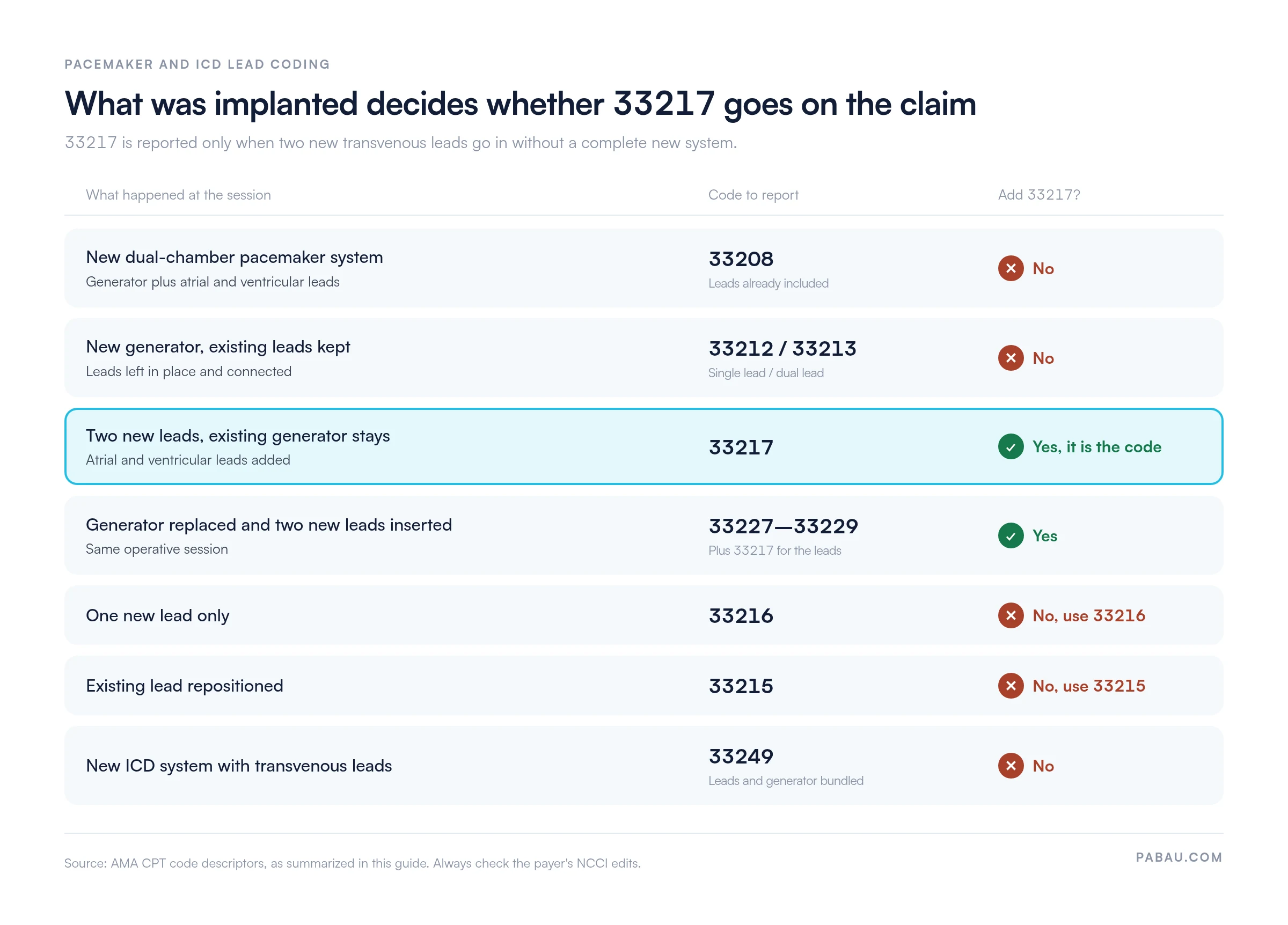
A frequent billing question is whether 33217 can be billed with 33208. It cannot, because 33208 already includes the atrial and ventricular leads. 33217 is reported when two leads are added to an existing or separately billed generator, for example with a replacement code from 33227-33229.
The same logic rules out pairing 33217 with 33249. That code already includes ICD lead placement in its descriptor.
Before billing 33217 with a generator replacement code, confirm the operative note shows two new leads rather than repositioned ones. Repositioning goes to 33215. A complete new system goes to 33208 or 33249 on its own, with no separate lead code.
Modifier selection on 33217 claims depends on the payer, the operative setting, and whether a second procedure was performed at the same session. The CMS fee schedule indicators settle the Medicare answer for co-surgery and assistants.
Modifier 59 is frequently misused on cardiac device claims. Applying it to override an NCCI edit without supporting documentation is an audit flag. Reserve it for procedures that are genuinely distinct services on the same date, with separate indications documented in the note.
Medicare pays CPT code 33217 under the CMS Physician Fee Schedule (PFS), adjusted by locality. The figures below come from the CY2026 national RVU file. Use the CMS PFS Look-Up Tool for the rate in your Medicare Administrative Contractor (MAC) locality.
The national amount is the total RVU multiplied by the conversion factor. Your MAC applies geographic practice cost indices (GPCIs) on top, so the paid rate will differ. The work RVU of 5.45 sits just below the 5.48 assigned to 33216, the single-lead code.
Payer medical necessity review for CPT code 33217 starts with the operative note. The note must show that two new leads were placed, and the record must support each of the following elements:
Missing threshold measurements and an absent atrial lead position are documentation elements auditors look for on 33217 claims. When either is absent, query the physician before billing rather than reporting 33217. The fundamentals of submitting a clean claim apply equally to cardiac procedure codes.
Medicare does not require prior authorization for CPT code 33217 itself. It does require the clinical indication to meet National Coverage Determination (NCD) 20.8 for pacemakers or NCD 20.4 for ICDs. Each MAC’s Local Coverage Determinations (LCDs) can specify qualifying diagnoses further, so check the LCD for the practice’s jurisdiction before submitting.
Commercial payers handle prior authorization variably. Most major commercial plans require pre-authorization for CIED implant procedures, including lead placement. The pre-auth request typically requires:
Prior authorization status does not guarantee payment. Payers may still deny a claim if the submitted codes or documentation differ from what was authorized. Record the authorization number in the billing record and keep a copy of the authorization letter for each case. The medical billing fundamentals guide shows how authorization status is tracked through the claim lifecycle.
Medical necessity for lead placement depends on the ICD-10-CM diagnosis codes submitted with the claim. The diagnosis must match NCD 20.8 for pacemakers or NCD 20.4 for ICDs, or the applicable MAC LCD. The table below lists ICD-10-CM codes often paired with CPT code 33217 on pacemaker or ICD claims.
Use the most specific ICD-10-CM code available. Bradycardia, unspecified (R00.1) is a last resort, because most payers prefer a coded etiology such as sick sinus syndrome or AV block. Submitting a non-specific code when a more specific one is documented in the chart invites a medical necessity denial.
Claims for CPT code 33217 draw close payer review because the procedure is high-value. These are five common denial categories and their corrective actions.
The guide to medical billing denial codes covers the CARC and RARC combinations that appear on cardiac device remittances. The AAPC Codify CPT lookup also helps coders catch unbundling and NCCI conflicts before a claim reaches a payer.
Run a quarterly audit of the 33217 and 33216 claims submitted in the previous 90 days. Compare each operative note against the billed code. Flag any note that lacks the atrial lead position or both threshold measurements for physician review before the timely-filing deadline closes.
A 33217 claim depends on three records lining up: the operative note, the prior authorization and the remittance that comes back. Billing teams often track each one in a different place, so a missing authorization or a short payment surfaces weeks late.
Pabau, a practice management platform with built-in claims management software, keeps them on one patient case. The authorization code, dates and sessions are tracked on the case, with a warning when one is missing. Claims go out as CMS-1500 or 837P files with an eligibility check first.
Submission runs through the Claim.MD clearinghouse, which routes claims to the payers on Claim.MD’s list. Pabau’s claims management tracks claim status through Claim.MD and imports ERA remittances, which carry the denial reason codes. Your biller sees a denied 33217 line next to the note and authorization behind it, so the correction starts the same day.
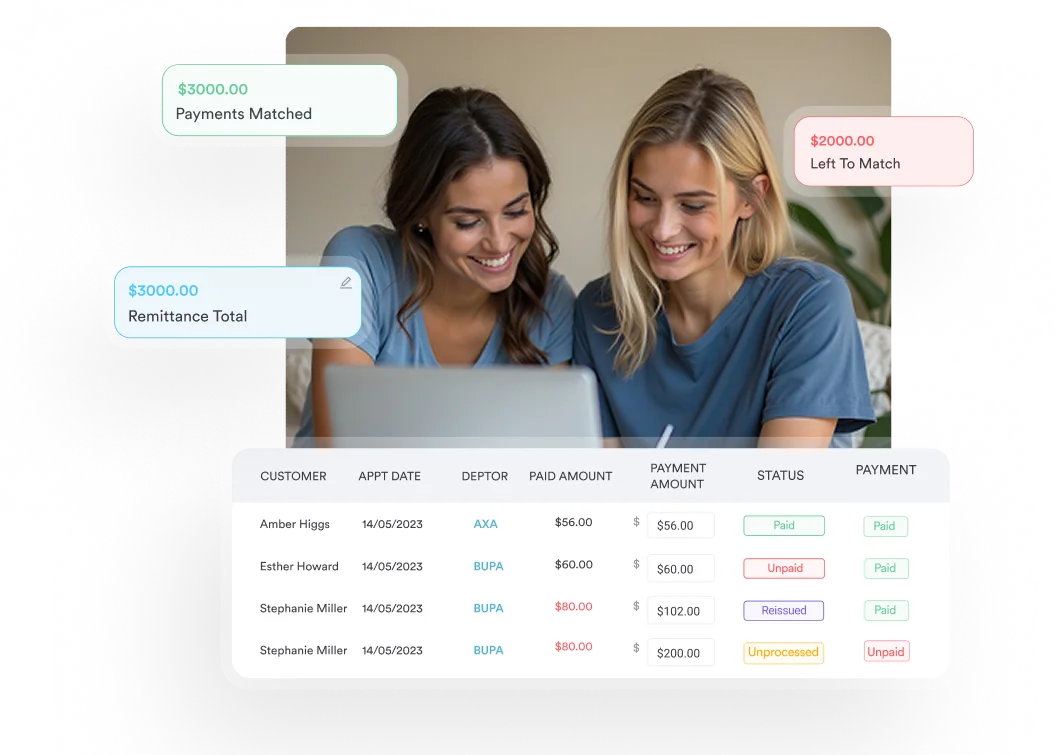

Pabau’s claims management sends claims through Claim.MD, checks eligibility and imports ERA remittances with their denial reason codes. Prior authorizations sit on the case, with a warning when one is missing.

CPT code 33217 is a lead code, so the claim stands or falls on what the operative note says went in. Two new leads into an existing device, or alongside a generator replacement, is 33217. A complete new system is 33208 or 33249 on its own.
Check every note for both lead positions and both thresholds before the claim leaves the practice. A physician query before submission is faster than an appeal after a wrong-code denial.
Book a demo to see how Pabau keeps authorizations, claims and remittances for cardiac device procedures on one patient case.

Only one lead went in? CPT code 33216 covers single transvenous electrode insertion and the documentation that separates it from 33217.
Implanting a complete dual-chamber system? CPT code 33208 explains the system code that already includes both leads.
Confused about denial reason codes on cardiac claims? Common denial codes in medical billing explains the CARC and RARC combinations most often seen on high-value procedure claims.
Want to understand how claims move from submission to payment? How 837 electronic claim files work covers the EDI format used to submit CPT 33217 and other cardiac device codes.
CPT code 33217 reports the insertion of two transvenous electrodes, usually an atrial and a ventricular lead, for a permanent pacemaker or implantable defibrillator. It covers the leads only. CPT 33208 is a complete pacemaker system with leads, so it is not billed with 33217. Generator replacement codes 33227-33229 can accompany it when two new leads go in at the same session.
CPT 33216 covers insertion of a single transvenous electrode, and CPT 33217 covers insertion of two. The operative note must document both lead positions to support 33217. If only one lead position is recorded, only 33216 can be reported.
Modifier 51 applies when 33217 is reported with another procedure at the same session, such as a generator replacement. Modifier 59 may separate a distinct service when documentation supports it, but never as a routine NCCI bypass. Per the CMS fee schedule indicators, Medicare does not permit co-surgeons on 33217 and does not pay an assistant at surgery.
No. CPT 33208 is a complete dual-chamber pacemaker system, and it already includes the atrial and ventricular leads. Report 33217 when two new leads go into an existing device, or with a generator replacement code from 33227-33229 at the same session.
A common reason is an operative note that documents only one lead, which supports 33216 rather than 33217. Others are missing prior authorization and a diagnosis that does not meet NCD 20.8 for pacemakers or NCD 20.4 for ICDs. Pairing 33217 with 33208 or 33249, or missing threshold documentation, also triggers denials.