CCSD code XR940: Foreign body retrieval billing guide
CCSD code XR940 is the UK private healthcare code for retrieval of a foreign bod...

Last Updated: Nov 26, 2026
33234 is the CPT code for removal of transvenous pacemaker electrode(s); single lead system, atrial or ventricular. It covers taking out one pacemaker lead through the venous route it was implanted in.
Removing two leads is 33235, and removing the pulse generator alone is 33233. Defibrillator electrodes are coded 33244 or 33243 instead. Confirm the lead count from the operative report before you assign the code.
Let Pabau's smart automation suggest the right codes, reduce claim denials, and keep your practice compliant—effortlessly.
Automate repetitive tasks and focus on what matters most—your patients.
Reduce coding errors and ensure compliance with the latest regulations.
Clean claims, fewer denials, and faster reimbursements.
Powerful insights and reporting to help your practice thrive.
HIPAA compliant SOC 2 certified GDPR-compliant Trusted by 4,000+ clinics worldwide

CPT 33234 covers removal of one transvenous pacemaker lead, atrial or ventricular. Dual lead systems use CPT 33235 instead.
The operative report must confirm the number of leads removed before the code is finalized.
For a full system removal, 33233 for the generator is reported with 33234. Check current NCCI edits and modifier rules first.
Defibrillator electrodes are never coded 33234. They use 33244 for transvenous extraction or 33243 for removal by thoracotomy.
Medicare reimbursement rates change annually, so verify the current MPFS figures before you submit a claim.
CPT code 33234 is the code for removing one transvenous pacemaker lead, either atrial or ventricular. Its full descriptor reads “Removal of transvenous pacemaker electrode(s); single lead system, atrial or ventricular,” as listed in Abbott’s Medicare pacemaker reimbursement guide. The code sits in the Pacemaker or Implantable Defibrillator subsection of the AMA CPT code set. Its neighbors are 33235 for a dual lead system and 33233 for generator-only removal.
The “(s)” in the descriptor allows for more than one electrode within the single lead system. It does not mean several independent leads came out. Coders sometimes misread it and report 33234 for two separate ventricular leads, which is incorrect.
CPT 33234 is appropriate when a physician removes a single transvenous pacemaker lead for a documented medical reason. The operative report must state the clinical indication clearly. The coder cannot assume medical necessity from the procedure description alone.
Accepted indications most payers recognize include:
33234 does not cover removal of an implantable cardioverter-defibrillator (ICD) lead. ICD electrode removal sits in the same Pacemaker or Implantable Defibrillator subsection. It is coded 33244 for transvenous extraction and 33243 for removal by thoracotomy. If the operative report references a defibrillation coil, shock lead, or high-voltage lead, 33234 is likely incorrect.
Transvenous electrode removal involves accessing the lead through the same venous route used for implantation, typically the subclavian or cephalic vein. The physician applies traction, uses a locking stylet, or deploys a powered sheath to free the lead from fibrous tissue before withdrawing it.
The operative report must document all of the following for a 33234 claim to hold up at audit:
A short, undifferentiated operative note stating “lead removed without complication” is the fastest route to a medical necessity denial. The note needs enough clinical specificity that a reviewer can confirm the single-lead scope without calling the facility.
The difference between 33234 and 33235 is the number of leads removed, not the complexity of the extraction technique. Coders must count leads from the operative report, not from the device type listed in the admission record.
LV lead ambiguity: When only the left ventricular lead comes out of a biventricular pacemaker, published guidance points to 33234. One lead is extracted. When the LV lead and a second lead come out in the same session, 33235 applies. Confirm the count from the operative report. Where the payer’s LCD is silent, get written confirmation before billing.
Three codes cover pacemaker system removal, and they are frequently confused. Knowing what each one covers prevents both underbilling and duplicate reporting.
Full system removal: When the pulse generator and its lead come out together, AAPC and CPT guidance report 33233 with the matching lead code. That is 33234 for a single lead or 33235 for a dual lead system. Check the current NCCI edits and modifier rules for the pair before filing, through a lookup such as AAPC Codify. The map below adds the defibrillator codes, so each removal lands on one code.
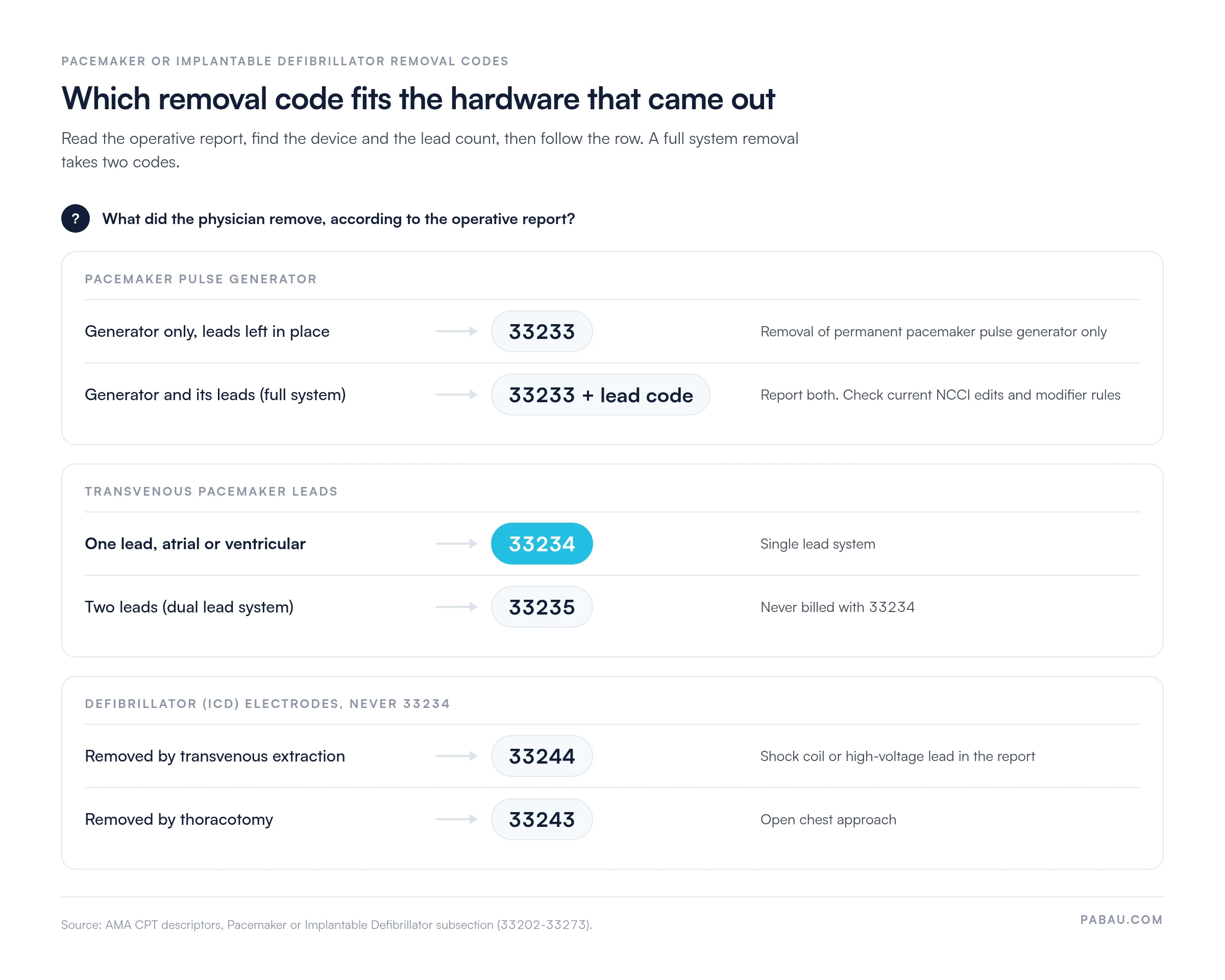
Read the operative report against the map before you choose between adjacent codes. The lead count and the device type settle most coding questions on this family.
Payers require a diagnosis code that substantiates medical necessity for CPT code 33234. The treating physician’s documentation must support the ICD-10 code selected. The coder cannot add a diagnosis that is not in the clinical record.
Use CrossCoder to verify the procedure-to-diagnosis crosswalk and confirm the ICD-10 code supports the specific indication in the operative record before submission.
Medicare reimbursement for CPT code 33234 is calculated from the Medicare Physician Fee Schedule (MPFS). It uses relative value units (RVUs) for physician work, practice expense, and malpractice risk. The table below shows where each component comes from. Verify the current-year national rate and locality-adjusted amount with the CMS Physician Fee Schedule lookup tool before submitting a claim.
Run the RVU lookup on the CMS MPFS tool at the start of each calendar year. Medicare reimbursement for surgical codes like 33234 can shift when the annual conversion factor changes. A fee schedule left on last year’s rate drifts out of step with what Medicare pays.
Prior authorization requirements for CPT code 33234 vary considerably by payer. Original Medicare (Parts A and B) generally does not require prior authorization for medically necessary cardiac device procedures. Medicare Advantage plans and commercial payers often do. Failing to confirm before scheduling is one of the fastest ways to generate a preventable denial.
The documentation submitted with a prior authorization request should mirror what will support the claim. That means lead count, clinical indication, physician’s plan of care, and supporting imaging or device interrogation results. If authorization is obtained and the operative findings change the lead count (single becomes dual), the authorization must be updated before billing.
Most denials on CPT code 33234 fall into one of four categories, and each has a clear corrective action. A denial management workflow that sorts them by category gets each claim to the right fix first time.
When a denial comes back with a CARC code, cross-reference the reason against standard medical billing denial codes. That tells you whether the fix is documentation, a code correction, or an authorization, before you choose the appeal pathway.
Track your 33234 denial rate separately from your overall cardiology claim rejection rate. If 33234 denials cluster around a single payer, that payer’s LCD likely has a documentation requirement your operative template isn’t capturing. Pull their Local Coverage Determination and update the template before the next case.
Run this checklist at the pre-submission stage to catch errors before they surface as denials. For the documentation principles behind a clean submission, see submitting a clean claim and the superbill documentation guide.
A 33234 claim depends on three records that often live in different places: the authorization, the eligibility check, and the claim itself. Pabau, a practice management platform with built-in insurance billing, keeps all three on the patient’s case.
Pabau’s cardiology claims management software tracks authorization codes, dates and sessions on the case and warns when one is missing. Eligibility checks run before the date of service, so a lapsed plan surfaces before the procedure instead of after the denial.
Practices submit electronic claims via Claim.MD to thousands of US payers. ERA remittances return to the same record, so a short payment on a lead removal shows up against its invoice.


Pabau connects your claims data to your clearinghouse for electronic submission and eligibility checks. Authorization codes sit on the case, with a warning when one is missing.

Treat the operative report as the deciding document for 33234. Count the leads there, confirm the device is a pacemaker rather than a defibrillator, and add 33233 only when the generator came out too.
When the same denial keeps returning, fix the operative note template before the next claim. A template that captures lead count, lead position and indication prevents that denial on every future case.
Book a demo to see how Pabau keeps authorizations, eligibility checks and claim submission for cardiac device procedures on one record.

Need a refresher on what happens after the claim leaves the practice? Electronic remittance advice explains how ERA files decode payer payment decisions and denial reason codes.
Trying to reduce clearinghouse friction on cardiac claims? Claim.MD clearinghouse overview covers how the integration connects Pabau to thousands of US payers for 837P submission.
Building a cardiology billing compliance program? Medical billing compliance outlines the documentation and audit-readiness standards that apply to high-value surgical codes like 33234.
CPT code 33234 covers removal of a single transvenous pacemaker electrode, atrial or ventricular, from a permanent pacing system. Use it when one lead is extracted and the operative report confirms the single-lead scope. If two leads are removed, 33235 applies instead.
The distinction is the number of leads removed. 33234 is for a single lead, and 33235 is for a dual lead system. The extraction technique, device manufacturer, and procedure complexity do not determine code selection. Confirm the lead count from the operative report, not from the admission record or device type.
Yes. For a full system removal, AAPC and CPT guidance report 33233 for the pulse generator with the matching lead code. That is 33234 for a single lead or 33235 for a dual lead system. Check the current NCCI edits and modifier rules for the pair before you submit.
Original Medicare (Parts A and B) generally does not require prior authorization for CPT 33234, but Medicare Advantage plans almost always do. Confirm with the specific plan before scheduling. Commercial payers nearly universally require pre-authorization for this procedure.