HCPCS Code V5095: Semi-implantable middle ear hearing prosthesis
HCPCS Code V5095: Definition and clinical descriptor HCPCS Code V5095 is the Lev...

Last Updated: Nov 25, 2026
K5710 is the CCSD code for ablation of the atrio-ventricular junction, including mapping. It covers catheter ablation of the AV node and His bundle to create complete heart block. That block controls the ventricular rate in drug-refractory atrial fibrillation.
Mapping is bundled into the code, so it is never billed separately. A permanent pacemaker implanted at the same sitting is a separate procedure with its own CCSD code.
Let Pabau's smart automation suggest the right codes, reduce claim denials, and keep your practice compliant—effortlessly.
Automate repetitive tasks and focus on what matters most—your patients.
Reduce coding errors and ensure compliance with the latest regulations.
Clean claims, fewer denials, and faster reimbursements.
Powerful insights and reporting to help your practice thrive.
HIPAA compliant SOC 2 certified GDPR-compliant Trusted by 4,000+ clinics worldwide

CCSD Code K5710 covers ablation of the AV junction, including mapping, as a single billable procedure.
Cardiac mapping is bundled within K5710 and must not be coded separately.
AV junction ablation intentionally creates complete heart block, so a same-day pacemaker implant is billed under its own code.
K5710 differs from K5760 in target and goal, because K5760 covers pulmonary vein isolation to restore sinus rhythm in AF.
CCSD Code K5710 is the CCSD code for ablation of the atrio-ventricular junction, including mapping, billed as one catheter procedure. The descriptor in the CCSD Group’s schedule reads “Ablation of atrio-ventricular junction (including mapping).” That parenthetical has a direct billing effect. Electrophysiological mapping of the AV junction is part of the procedure, so it is never claimed as an add-on.
The procedure class is interventional electrophysiology, performed in a catheterization laboratory under fluoroscopic guidance. CCSD Code K5710 sits in the heart and cardiology chapter (chapter 8) of the schedule, within the K57 electrophysiology group. Its neighbors in that group share the same code structure but cover different anatomical targets and clinical indications.
Ablation of the atrioventricular junction is a catheter-based electrophysiology procedure that interrupts conduction between the atria and ventricles. The lesion sits at the level of the AV node and His bundle. The intended result is iatrogenic complete heart block. The ventricles can no longer follow a rapid or irregular atrial rate, so ventricular rate control is achieved definitively.
The procedural sequence follows these steps:
Radiofrequency catheter ablation is the standard energy modality, and some centers use cryoablation. The energy source does not change the CCSD Code K5710 assignment.
AV junction ablation using CCSD Code K5710 is indicated when medical management has failed to control the ventricular rate in persistent or permanent atrial fibrillation. It is a rate-control strategy of last resort. The atria keep fibrillating after ablation, but the ventricles are protected from rapid irregular conduction.
NICE guidance on rate control in AF and British Heart Rhythm Society recommendations identify AV junction ablation as appropriate when:
K5710 also applies in other supraventricular tachyarrhythmias where the AV node is ablated as the rate-control mechanism. Permanent AF with drug-refractory rapid ventricular response is still by far the most common indication.
This indication is clinically distinct from pulmonary vein isolation, where the goal is to restore sinus rhythm. That procedure uses a different target anatomy, a different approach, and a different CCSD code, K5760.
The included and excluded components of CCSD Code K5710 decide which other codes can legitimately join it on a claim for the same episode. Overclaiming a bundled component triggers rejection. Underclaiming a separately billable procedure forfeits income the practice has earned.
The K57 group contains several ablation codes that look alike but map to different anatomical targets and clinical purposes. Submitting CCSD Code K5710 when K5760 is clinically appropriate, or the reverse, is a common coding error in private cardiac electrophysiology billing. Pabau’s reference library of CCSD codes covers the wider schedule beyond this group.
The distinction between K5710 and K5760 matters most because both involve ablation in an AF context. K5710 is a rate-control procedure that blocks AV conduction. K5760 is a rhythm-control procedure that isolates the pulmonary veins, so the two codes are not interchangeable.
Nearby K5750 covers internal cardioversion and is not an ablation code at all. Ablation of a ventricular arrhythmia has its own code too, K5740. The chart below matches each atrial and AV ablation target to its code.
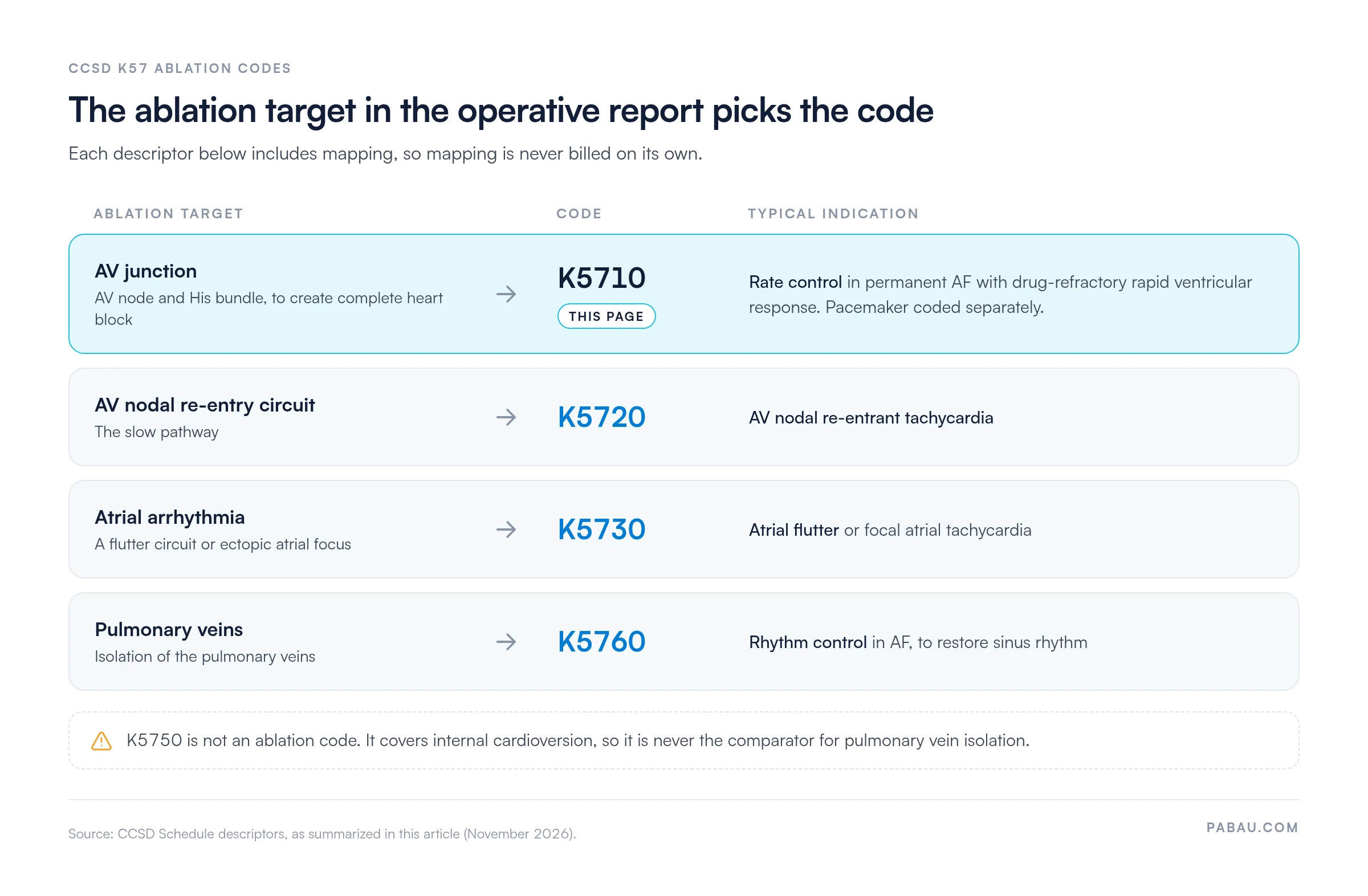
Before submitting a claim for any K57 ablation code, confirm the target anatomy from the operative report. AV junction ablation (K5710) and pulmonary vein isolation (K5760) are the pair most easily confused in private electrophysiology billing, and their pre-authorization criteria differ.
The catheterization laboratory report and procedure note must support CCSD Code K5710 specifically, not simply confirm that an ablation took place. Payers reviewing an electrophysiology claim look for procedure-specific findings, and a generic ablation note will not satisfy them. Billing records that capture the elements below protect against post-payment audit as well as upfront rejection.
The operative report for a K5710 claim must include:
CCSD Code K5710 is a complex interventional cardiac procedure. All major UK private medical insurers require pre-authorization before it is performed, and proceeding without it typically means non-payment or reduced reimbursement. Pabau’s guide to Bupa CCSD codes explains the code structure Bupa uses across recognized cardiology procedures.
Submit pre-authorization requests well before the procedure date, never on the day. Most insurers run a clinical review for complex cardiac interventions, and it can take several working days. Emergency procedures go through each insurer’s urgent authorization pathway, with the clinical urgency documented in the request.
Payer policies on evidence requirements change periodically. Always verify the current requirements through the insurer’s provider portal rather than relying on previously approved claims as a guide.
CCSD Code K5710 claims are denied for predictable reasons. Most denials are avoidable with correct pre-authorization, accurate code selection, and complete operative documentation. Claims management software such as Pabau keeps the codes, authorization details and documents for each claim on one record before it reaches the payer.
AV junction ablation using CCSD Code K5710 intentionally creates complete heart block, and that block is the intended endpoint of the procedure. Once the ablation succeeds, the patient has no intrinsic AV conduction. Same-day permanent pacemaker implantation is therefore clinically necessary.
The CCSD principle for same-session procedures is that distinct procedures with separate clinical resources and separate operative steps are separately billable. Pacemaker implantation after AV junction ablation meets this test. It is a different operative procedure, uses different hardware, and carries its own technical complexity.
When coding both procedures for the same episode:
The pacemaker code depends on what was actually implanted, never on a default assumption. Check the exact code for that device type in the current edition of the CCSD schedule. For a single-chamber system, Pabau’s guide to K6000 walks through the coding.
Always include both K5710 and the pacemaker code in the pre-authorization request before the procedure date. Adding the pacemaker code later to an already authorized K5710 claim is a common reason for delayed payment in complex cardiac episodes.
No separate His bundle code is listed in the public CCSD descriptors, so confirm the code with the CCSD Group before you submit. His bundle ablation targets the bundle of His, the conduction structure just distal to the AV node. It sits at the AV junction and is anatomically continuous with the AV node.
The K5710 descriptor names the atrio-ventricular junction. That makes it the natural candidate when the intent is to ablate this conduction system and create complete heart block. The result is the same as AV node ablation, which is pacemaker dependence.
Check the current CCSD schedule edition before you assign the code. Describe the target site clearly in the operative report, so the payer’s clinical reviewer can match the code to the documentation.
Each denial reason above starts with paperwork. A missing pre-authorization reference stops payment. So does a pacemaker code left off the claim, or a cath lab note with no endpoint. Many practices still gather those pieces from email, spreadsheets and the hospital’s system before they invoice.
In Pabau, the authorization details, both procedure codes and the operative documents sit on the same patient record as the invoice. UK claims go to insurers electronically through Healthcode and Bupa. The K5710 line and the pacemaker line leave the practice on the same claim, with the evidence the insurer asked for at pre-authorization.
The result is fewer queried claims and less time spent rebuilding an episode weeks after the procedure.

Pabau supports UK private practice billing workflows, including CCSD procedure codes, invoicing, and payer claim management. See how it handles cardiac and electrophysiology billing.

K5710 is a narrow code, and that narrowness makes it safe to bill when the paperwork lines up. Confirm the AV junction as the target before you code, so the claim never drifts toward K5760. Then put the pacemaker code and both procedures into one pre-authorization request before the procedure date.
The trade-off is a little more effort before the cath lab day. A few checks up front cost far less than a queried claim afterward. Book a demo to see how Pabau keeps CCSD-coded cardiology claims complete from pre-authorization to payment.

Need a broader CCSD billing reference? Bupa CCSD procedure codes covers the full Bupa fee schedule and how CCSD codes map to Bupa’s billing system.
Looking for practice billing tools? Pabau’s claims management software helps private practices submit, track, and manage CCSD-coded invoices across UK insurers.
Coding a ventricular ablation instead? CCSD Code K5740 covers ablation of a ventricular arrhythmia and how it is billed.
CCSD Code K5710 covers ablation of the atrioventricular junction including electrophysiological mapping, performed as a single procedure in a cardiac catheterization laboratory. The code applies when the AV junction is the target and complete heart block is the intended endpoint.
Cardiac mapping is included within K5710. The official CCSD descriptor reads “ablation of atrio-ventricular junction (including mapping)”, and that parenthetical is an explicit bundling instruction. Submitting mapping as a separate code alongside K5710 will result in rejection.
K5710 targets the AV junction to create complete heart block as a rate-control strategy. K5760 isolates the pulmonary veins to restore sinus rhythm as a rhythm-control strategy. The target, indication and goal all differ, so the codes are not interchangeable.
No separate His bundle code is listed in the public CCSD descriptors. K5710, which names the atrio-ventricular junction, is the natural candidate when the aim is complete heart block. Confirm the code with the CCSD Group before you submit.
Yes. Permanent pacemaker implantation is separately billable alongside CCSD Code K5710 because it is a distinct operative procedure with its own resources and clinical rationale. Use the appropriate CCSD pacemaker code for the device type implanted and include both codes in the pre-authorization request.
Bupa typically requires documentation of failed drug therapy (agent, dose, duration), an echocardiography report, and Holter monitor or ambulatory ECG data. AXA Health requires a clinical referral letter confirming the AF diagnosis and evidence of rate-control drug failure. Both must be in place before the procedure date, because retrospective requests are rarely approved for elective cases.
The most common reasons are missing pre-authorization, the wrong code (K5760 instead of K5710), and mapping claimed as a separate code. Incomplete operative documentation and no evidence of prior conservative treatment follow close behind. Each is avoidable with correct pre-authorization and thorough cath lab documentation.