

HCPCS Code L0472: Hyperextension TLSO billing guide
HCPCS code L0472: Official descriptor and device definition HCPCS code L0472 des...

Last Updated: Nov 5, 2026
Billable Code
93279 is the CPT code for an in-person programming device evaluation of a single lead pacemaker, or a leadless pacemaker in one cardiac chamber. The clinician tests the device, adjusts its settings step by step to select the best permanent values, and signs an analysis, review and report.
The lead count decides the code. A dual lead pacemaker goes to 93280, a multiple lead pacemaker to 93281, and an ICD to 93282-93284. A remote check of the same pacemaker is 93294, not 93279.
Let Pabau's smart automation suggest the right codes, reduce claim denials, and keep your practice compliant—effortlessly.
Automate repetitive tasks and focus on what matters most—your patients.
Reduce coding errors and ensure compliance with the latest regulations.
Clean claims, fewer denials, and faster reimbursements.
Powerful insights and reporting to help your practice thrive.
HIPAA compliant SOC 2 certified GDPR-compliant Trusted by 4,000+ clinics worldwide

CPT code 93279 covers in-person programming of a single lead pacemaker, or a leadless pacemaker in one cardiac chamber.
Dual and multiple lead pacemakers take 93280 and 93281. In-person ICD programming has its own codes, 93282 to 93284.
The record must show the device, the lead count, the parameters tested, the final programmed values and a signed report.
93279 has no global period of its own. A pacemaker implant’s 90-day global bundles related follow-up visits, so check the implant date before adding an E/M.
Pabau’s claims management software lets cardiology practices attach device programming codes at the point of care and route claims straight from the clinical note.
CPT code 93279 is the code for an in-person programming device evaluation of a single lead pacemaker, or a leadless pacemaker in one cardiac chamber. The American Medical Association maintains it in the 93279-93298 family of implantable, insertable and wearable cardiac device evaluations. Its descriptor has four parts, and each one shapes what the note must show.
Programming includes the in-person interrogation, so 93288 is not reported for the same encounter. The final values do not have to differ from the starting values. Testing the device and confirming its existing settings still supports 93279, as long as the testing is documented. A visit that only downloads data, with no iterative testing, is an interrogation instead.
The 93279-93281 family covers in-person programming of pacemakers. Lead configuration is the only difference between the three codes, so the lead count has to come from the device record. In-person ICD programming sits in a parallel family, 93282 to 93284.
The implant report is the authoritative source for lead count. A pacemaker with one lead in the right ventricle or the right atrium is a single lead system (93279). An atrial lead plus a ventricular lead is a dual lead system, billed as 93280.
A biventricular pacemaker with three leads is a multiple lead system (93281). If the device is an ICD, none of the three pacemaker codes apply.
Lead count is the last of three questions. Where the patient was and whether settings were tested come first, and each one rules out a neighboring code.
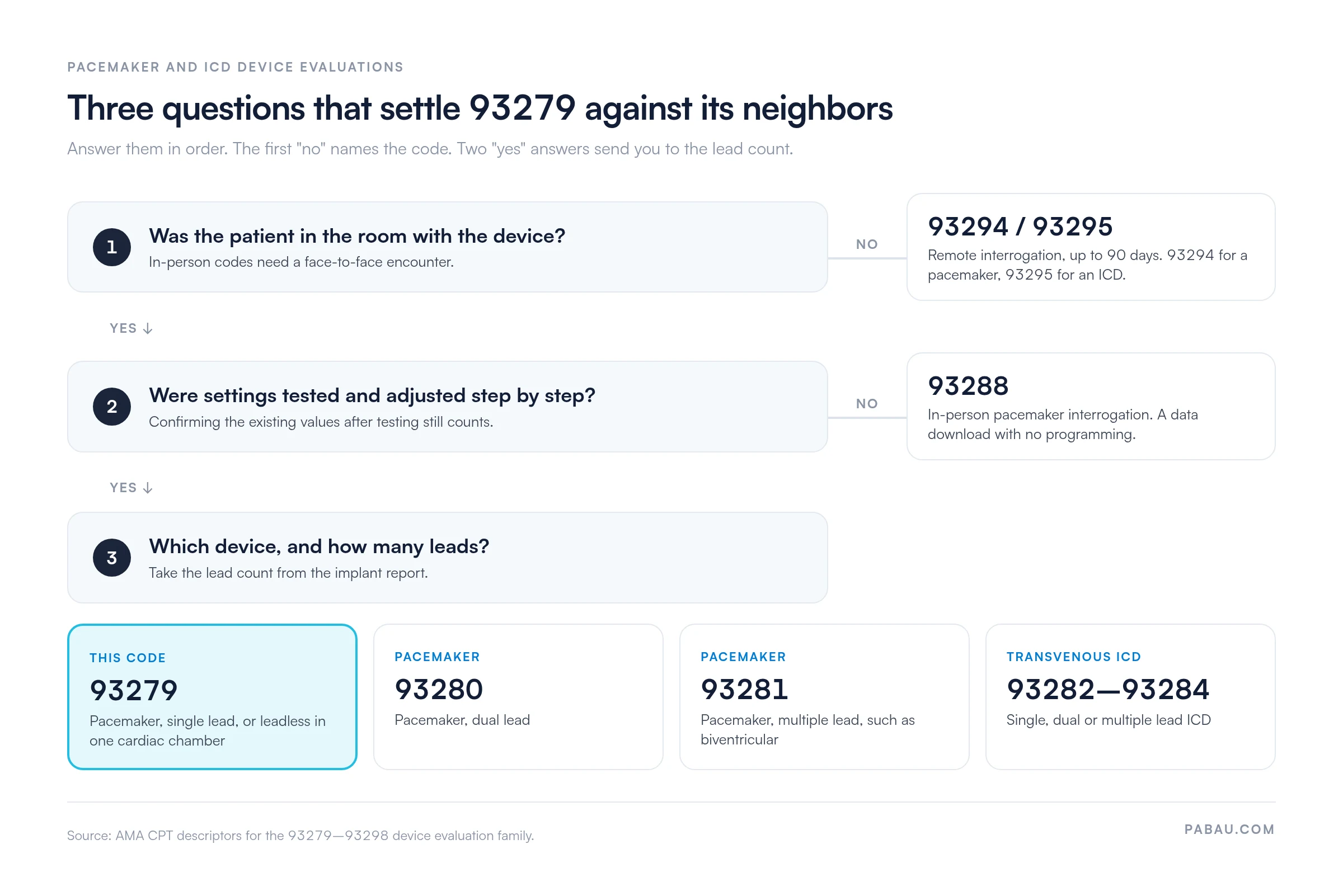
Pull the original implant report the first time you code a programming visit for a new patient. The manufacturer’s interrogation printout also lists the device and its leads in the header, which settles 93279 versus 93280 before the claim goes out.
CPT 93294 covers remote interrogation device evaluations of a pacemaker for up to 90 days. It pays for the interim analysis and reports by a physician or other qualified health care professional. It applies to single, dual and multiple lead pacemakers, and to leadless ones.
The remote ICD equivalent is 93295. The technical side of remote monitoring, from data acquisition to technician review, is billed separately as 93296.
When the patient is in the office and the clinician adjusts the device, 93279 applies. When the patient transmits from home and the clinician reviews the data, the remote codes apply.
Billing 93279 for a remote review is one of the errors payer audits flag. The place of service (POS) code is a second check. POS 11 (office) alongside 93279 is consistent, while POS 12 (home) is not.
A 93279 claim needs a record that shows five elements. A payer can deny or downcode the service when one of them is missing.
In Pabau, the practice management software we build, cardiology practices set up note templates that capture each of these elements during the visit. Billers then get what they need without chasing the clinician. See how claims management software connects device programming documentation to claim submission.
Medicare reimburses CPT code 93279 under the Medicare Physician Fee Schedule (MPFS). The code has a professional and a technical component. In a hospital outpatient setting, the physician bills the professional component with modifier 26. Rates change every year with the conversion factor and the locality, so check the current figure in the CMS lookup tool.
Commercial payers mostly follow Medicare policy for cardiac device evaluations, but contractor and payer rules vary. Check your Medicare Administrative Contractor’s guidance and each payer’s policy before assuming national rules apply.
The global period is the rule most often misread for this code. 93279 carries the indicator XXX, so it has no global period of its own. Pacemaker implant codes, such as 33206, 33207 and 33208, carry a 90-day global period. That package covers related follow-up visits, while Medicare lists diagnostic tests outside it.
A medically necessary programming check after an implant is therefore generally reportable, but some payers still bundle early device checks. Record the implant date and code in the billing system. Good revenue cycle management then lets your team spot and appeal a wrongful global-period denial.
CPT code 93279 has no fixed annual frequency limit under Medicare national policy. Each visit must be medically necessary, and some payers set their own caps or prior authorization rules. Check the payer contract or LCD before billing repeat visits.
Most 93279 denials can be prevented with the right checks before submission. The table below maps the most frequent triggers to a specific fix.
Catching these patterns early depends on a billing system that shows the device type, lead count and place of service before a claim goes out. Pabau’s denial management in healthcare guide covers the broader workflow. Electronic claims sent through Claim.MD also pass real-time edits before they reach the payer.
Store the device type and lead count on the patient record the day the pacemaker is implanted. Every later programming visit then codes from that one field, not from memory.
Medical necessity for a pacemaker programming visit is established through the diagnosis codes on the claim. The table below lists ICD-10-CM codes commonly reported with 93279, based on coding guidance from the AAPC and device management references.
Payer LCDs vary on which ICD-10 codes establish medical necessity for 93279. Confirm your contractor’s covered diagnoses before assuming Z45.010 suffices for every visit. Some contractors want the arrhythmia or conduction diagnosis first when the visit changed therapy rather than confirmed settings.
The clean claim baseline still holds for every 93279 submission. That means the correct CPT code, a matching diagnosis and a consistent place of service.
Many cardiology practices code device checks from the interrogation printout after the visit. A biller then rebuilds the lead count and the diagnosis from the chart, and errors creep in at each hand-off.
Pabau keeps the device note and the claim in one record. The clinician documents the tested and final values in a template, then selects 93279 and its ICD-10 pairing. The claim routes from that note.
The outcome is fewer lead-count and place-of-service denials. The practice also keeps a record that holds up if a payer audits the visit.

Pabau connects device programming documentation to claim submission, so the device note, the lead count and the CPT code selection happen in one workflow.

CPT code 93279 is a narrow code. It fits one device family, one lead configuration and one setting, so coding it correctly starts with the implant report rather than the visit note.
Confirm the device is a pacemaker, count its leads, and document the iterative testing and final values. Those three checks prevent most of the denials this code attracts, and they cost a few minutes per visit.
Pabau’s claims management software confirms the device code, the ICD-10 pairing and the place of service at the point of care. Book a demo to see how it handles device checks for cardiology practices.

Need a framework for handling claim denials systematically? Denial management in healthcare covers the workflow steps for reviewing, appealing, and preventing payer rejections across CPT code families.
Want to understand how electronic claims reach payers? The 837 file format explains how CPT codes, diagnosis codes, and place-of-service data are structured in the HIPAA-standard claim transaction.
Looking for the billing compliance framework behind these rules? Medical billing compliance outlines the documentation and coding standards that support audit-ready claims.
Billing the technical side of remote monitoring? CPT code 93296 explains how data acquisition and technician review are reported apart from the professional remote codes.
Checking an implant’s global period? CPT code 33208 covers dual-chamber pacemaker insertion and the 90-day global that follows it.
CPT code 93279 covers an in-person programming device evaluation of a single lead pacemaker, or a leadless pacemaker in one cardiac chamber. The clinician tests the device, adjusts settings iteratively to select permanent values, and signs an analysis, review and report.
The difference is lead count. 93279 covers a single lead or one-chamber leadless pacemaker, and 93280 covers a dual lead pacemaker. Both require an in-person encounter, and billing the wrong one invites a denial.
No. 93279 is a pacemaker code. In-person ICD programming uses 93282, 93283 or 93284, depending on whether the ICD has a single, dual or multiple lead system.
Yes. Medicare pays 93279 under the Physician Fee Schedule, and the rate changes each year with the conversion factor. In a hospital setting, the physician bills the professional component with modifier 26.
The record needs the device type and lead configuration, the interrogation report, and the parameters tested and adjusted. It also needs the final programmed values and a signed analysis by the professional who performed the in-person service.
93279 is an in-person programming visit for a single lead or one-chamber leadless pacemaker. 93294 covers remote interrogation of any pacemaker for up to 90 days, with no in-person contact. Billing 93279 for a remote review will not survive a place-of-service audit.
Yes, but only when a separately identifiable, medically necessary E/M service was provided. Document the E/M apart from the device programming note, and append modifier 25 to the E/M code, as most payers require.



