

CCSD code G5100: Bypass of duodenum billing guide
CCSD code G5100 bills a bypass that leaves the duodenum in place CCSD code G5100...

Last Updated: Oct 16, 2026
33208 is the CPT code for insertion of new or replacement of permanent pacemaker with transvenous electrode(s); atrial and ventricular.
Coders most often confuse it with 33228, which covers replacement of the pulse generator alone. That mix-up is the most common pacemaker billing error. The code sits in a three-code family alongside 33206 (atrial, single-chamber) and 33207 (ventricular, single-chamber). What separates them is the number of leads placed and which chambers they pace.
Let Pabau's smart automation suggest the right codes, reduce claim denials, and keep your practice compliant—effortlessly.
Automate repetitive tasks and focus on what matters most—your patients.
Reduce coding errors and ensure compliance with the latest regulations.
Clean claims, fewer denials, and faster reimbursements.
Powerful insights and reporting to help your practice thrive.
HIPAA compliant SOC 2 certified GDPR-compliant Trusted by 4,000+ clinics worldwide

CPT code 33208 covers insertion of a complete new dual-chamber pacemaker system: the pulse generator plus both the atrial and ventricular transvenous leads.
Use 33208 only for a new system. A battery swap that reuses the existing leads is 33228, and confusing the two is the most common denial trigger.
Medical necessity needs a covered ICD-10-CM diagnosis in the operative report, such as I44.2 complete AV block or I49.5 sick sinus syndrome.
The physician bills the professional work only. The facility bills the device itself under HCPCS C1785 or C1786, on a separate claim.
Practice management software like Pabau tracks procedure codes, monitors claim status, and surfaces denial patterns across cardiology and electrophysiology billing.
CPT code 33208 is defined by the American Medical Association as: Insertion of new or replacement of permanent pacemaker with transvenous electrode(s); atrial and ventricular.
In practice, the physician inserts a pulse generator and places two transvenous pacing leads at a single operative session. One lead sits in the right atrium, the other in the right ventricle.
Completeness is the operative concept. All three components must be placed at the same session: the pulse generator, the atrial lead, and the ventricular lead. If any component is pre-existing, or is not placed at this encounter, 33208 does not apply.
The device cost, meaning the physical pacemaker hardware, is excluded from the physician’s 33208 payment. The facility bills the pacemaker device separately using HCPCS codes C1785 (dual-chamber pacemaker, rate-responsive) or C1786 (non-rate-responsive). Newer billers often submit the device on the professional claim and have it rejected.
The 33206/33207/33208 family is separated by a single clinical variable: how many chambers are paced and which leads are placed. Getting this wrong leaves the operative note and the submitted code describing different procedures, which almost always ends in a denial.
The clinical decision between single-chamber and dual-chamber pacing belongs to the implanting electrophysiologist. The coder’s job is to match the code to what the operative report describes: how many leads were placed, and in which chambers. When the operative report instead describes a temporary single-chamber electrode wired to an external generator, the claim belongs under CPT code 33210.
CPT code 33208 covers new system insertion only. CPT 33228 covers replacement of a dual-chamber pulse generator when the existing leads are retained. These two codes are not interchangeable, and using 33208 where 33228 belongs is the single most common pacemaker billing error.
When leads are replaced at the same session as the generator, code each component separately: the generator replacement plus the applicable lead revision codes. Reverting to 33208 in that scenario is wrong. Check whether the operative note says the existing leads were reused or new ones were placed.
A defibrillator generator swap sits outside this pacemaker family altogether. When the device being replaced is a dual-lead implantable cardioverter-defibrillator, the replacement is coded 33263. If that defibrillator carries leads in three or more chambers, as a CRT-D does, the swap is coded 33264.
Read across all four codes at once and the pattern is simple, because one fact in the operative note decides each of them.
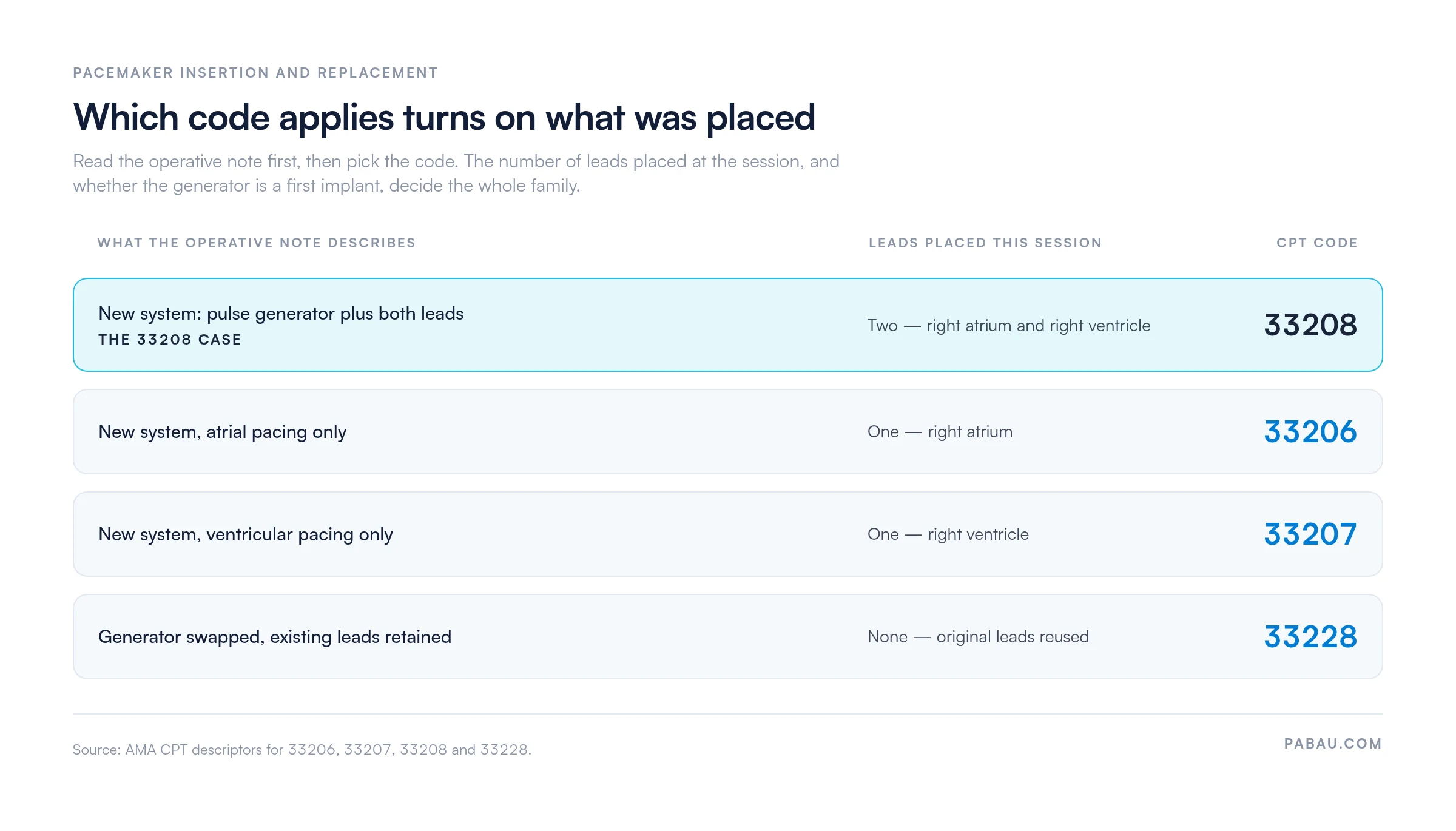
Medical necessity for CPT code 33208 must be supported by a covered ICD-10-CM diagnosis code documented in the patient record. Payers, Medicare Administrative Contractors included, judge necessity against the applicable Local Coverage Determination for cardiac pacing. An unsupported diagnosis code is a leading denial driver even when the procedure was clinically appropriate.
Common covered diagnoses are listed below. Verify each one against the active MAC LCD for your jurisdiction, because covered code lists are updated periodically.
The clinical rationale for choosing dual-chamber over single-chamber pacing has to appear in the physician’s documentation. Payers expect the operative report to say why AV synchrony was necessary, because the diagnosis code alone does not establish it.
Complete AV block sometimes follows a transcatheter aortic valve replacement, coded 33361 when the transfemoral approach is used. Where that is the sequence, say so in the operative note, because it explains why permanent pacing became necessary.
Insufficient documentation is the second most common cause of pacemaker claim denials, behind code selection errors. The operative report must confirm both the procedure performed and the medical necessity for the dual-chamber approach specifically, rather than for pacing generally.
Capturing these elements at the point of care heads off most post-submission documentation requests. The operative note must include:
Pre-submission validation at the clearinghouse catches documentation mismatches before a claim reaches the payer, which costs far less than appealing them afterwards.
Run a pre-submission checklist on every 33208 claim. Confirm the operative note documents both lead placements. Check that the device serial numbers match the facility claim. Check that the ICD-10 diagnosis is a covered indication under the applicable MAC LCD. A five-minute pre-bill review prevents a 60 to 90 day denial and resubmission cycle.
Modifiers attached to CPT code 33208 signal specific billing circumstances to payers. The wrong modifier, or a missing required one, generates an edit or a denial. The table below covers the modifiers that come up most on pacemaker implant claims.
The KX modifier requirement varies by MAC jurisdiction. Check whether your processing contractor requires KX on pacemaker procedure claims before you submit. Missing it in a jurisdiction that requires it is an automatic denial.
Medicare reimbursement for CPT code 33208 is calculated from the CMS Medicare Physician Fee Schedule using Relative Value Units (RVUs). The national payment amount changes annually with each fee schedule update. Pull current figures straight from the CMS lookup before you quote a reimbursement amount to your finance team.
Reconciling what Medicare actually paid against what the fee schedule predicted is worth doing on every 33208 claim. Remittance advice files carry line-level adjustments, so a systematic underpayment surfaces faster than it would in a manual review of paper EOBs.
The global period for CPT code 33208 is 90 days. Follow-up visits related to the implant during that window are bundled into the surgical fee and cannot be billed separately. Visits for unrelated conditions inside the global period are billable with modifier 24 appended to the E&M code.
Programming checks on the implanted system belong to a different code family, in the Medicine section rather than Surgery. An in-person programming evaluation of a dual lead pacemaker system is reported with 93280, with lead parameters documented for both channels.
Commercial payer rates for 33208 vary from Medicare allowables and follow contracted fee schedules. Reconciling the two by payer, rather than claim by claim, is what shows a practice which contract is underperforming.
CMS’s prior authorization program for hospital outpatient department services does not currently include 33208. The list of covered service categories at 42 CFR 419.83 runs to eight entries, and cardiac device implantation is not one of them:
That does not make a 33208 claim authorization-free. Commercial payers set their own rules, and most of them require authorization for an elective pacemaker implant. Confirm insurance eligibility verification and authorization status with the specific payer before the procedure is scheduled.
Checking authorization status before the procedure is scheduled removes the most preventable denial category on high-complexity cardiac claims.
Most 33208 denials fall into six categories. Tracking which category each rejection lands in lets you fix the root cause, rather than reworking claims one at a time. The denial codes a payer returns tell you which pattern you are looking at.
Denials rarely spread evenly across all six. Two or three causes usually account for the bulk of a practice’s 33208 rejections. Fixing those first clears more claims than a general tightening of process.
CPT 33225 covers addition of a left ventricular pacing electrode for cardiac resynchronization therapy. It can be reported alongside CPT code 33208 when CRT with pacemaker (CRT-P) is performed at the same session as new dual-chamber system insertion. That combination suits patients with symptomatic heart failure, reduced ejection fraction, and a wide QRS complex who meet CRT candidacy criteria.
Before appending 33225, check the current NCCI Procedure-to-Procedure (PTP) edit status between 33208 and 33225 using the CMS NCCI tool. NCCI edits are updated quarterly. Modifier 59 may be required to bypass an edit where the procedures are genuinely distinct and separately documented.
The place of service (POS) code on the physician claim directly affects the Medicare payment rate. Pacemaker implants typically happen in cardiac catheterization labs, EP labs, or operating rooms inside a hospital or ambulatory surgical center. The physician bills the professional component; the facility bills the device, the supplies, and its own overhead.
One point matters most for cardiology billing staff. The device HCPCS codes, C1785 and C1786, are submitted by the hospital or ASC on the facility claim. The physician’s CMS-1500 claim for 33208 covers professional work only, so device codes on the professional claim will be rejected. Mapping which charge belongs to which claim type, on every pacemaker encounter, keeps the two claims in step.
Flag every 33208 claim for dual-claim reconciliation at month end. Confirm that the professional claim (CMS-1500, 33208) and the facility claim (UB-04 with C1785/C1786) have both been submitted and adjudicated. An unpaid facility device claim is easy to miss when the professional claim pays cleanly.
In most cardiology and electrophysiology practices, the 33208 checks above live in someone’s head or on a printed sheet. The coder reads the operative note, remembers that a generator swap belongs to 33228, and cross-references the diagnosis against an LCD. Whether the KX modifier made it onto the claim tends to surface at denial.
Practice management software like Pabau moves those checks onto the claim itself. Our claims management software holds the procedure code, its supporting diagnosis, and any modifiers on one record. Claims go out electronically, and the remittance posts back against the charge it belongs to.
That pays off at month end. Denial patterns come back as a sortable list rather than a stack of paper. A practice can see that four of its last ten 33208 rejections share one missing documentation element, then fix that element once.

Pabau’s claims management software helps cardiology and electrophysiology practices track procedure codes, monitor claim status, and catch incomplete documentation before a claim reaches the payer.

Dual-chamber pacemaker billing rewards the coder who reads the operative note before reaching for a code. The note says how many leads were placed and whether the generator is a first implant. Those two facts settle the whole code family.
The trade-off worth remembering is time. A five-minute pre-bill review costs less than a 60 to 90 day denial and resubmission cycle, and it is the same short review every time. Build it into the billing template and it stops being a decision anyone has to remember.
Book a demo to see how Pabau handles cardiac procedure billing end to end, from the coded charge through to the posted remittance.

Need guidance on how clearinghouse submissions work? Medical claims clearinghouse overview explains how EDI transactions flow from practice to payer.
Want to understand the 837P file format for CPT claims? 837 EDI file guide covers the transaction set structure used to transmit professional claims electronically.
Not yet enrolled with the payers you bill? Insurance credentialing guide covers how payer enrollment affects your ability to bill procedures like 33208 without automatic rejections.
CPT code 33208 covers insertion of a new dual-chamber permanent pacemaker system. That means the pulse generator plus both the atrial and ventricular transvenous leads, placed at the same session. It does not cover generator-only replacement (33228), lead-only procedures, or single-chamber pacemaker insertions (33206/33207). The device cost is billed separately by the facility using HCPCS codes C1785 or C1786.
33206 covers atrial single-chamber pacemaker insertion, with one lead in the right atrium. 33207 covers ventricular single-chamber insertion, with one lead in the right ventricle. 33208 covers dual-chamber insertion with both atrial and ventricular leads. The number and chamber placement of the leads decides which code applies, and the operative report must specify both lead placements to support 33208.
The most commonly required modifier is KX. It attests that Medicare LCD criteria for pacemaker implantation are met, and some MAC jurisdictions require it on every claim. Modifier 62 applies when two surgeons each perform a distinct portion of the procedure. Modifier 80 is used for a surgical assistant. Laterality modifiers (LT/RT) do not apply to pacemaker implant procedures.
No. Generator replacement for a dual-chamber pacemaker is coded with CPT 33228, not 33208. Using 33208 for a battery replacement that retains the original leads is the most common pacemaker coding error. It is also a leading cause of claim denials. Only use 33208 when a complete new system, including both leads, is inserted at the same session.
Yes. Cardiac resynchronization therapy with pacemaker (CRT-P) can be added at the same session as the new dual-chamber insertion. CPT 33225 may then be reported alongside CPT code 33208. Verify the current NCCI PTP edit status before billing both codes, as modifier 59 may be required. The clinical indication for the LV lead must be separately documented in the operative note.
Six causes account for most of them. The biggest is using 33208 instead of 33228 for a generator-only replacement. The others are an unsupported diagnosis code, missing commercial prior authorization, unbundled fluoroscopic guidance or pocket creation, incomplete operative documentation, and an omitted KX modifier. Correcting code selection and documentation removes the majority of 33208 denials.



