Pabau Engage inbox

Pabau Engage is here: every patient conversation in one inbox.

Learn more
Billing Codes

CPT code 33235: Dual lead pacemaker electrode removal guide

CPT code 33235 reports the removal of transvenous pacemaker electrodes from a dual lead system, the atrial-plus-ventricular setup of a dual-chamber pacemaker. It covers leads taken out through the vein, not by opening the chest, and it never covers the generator.

Where coders slip is counting leads. The descriptor splits 33234 and 33235 by system type, and AAPC’s Cardiology Coding Alert reads it the same way. So a single lead pulled from a dual-chamber system still points to 33235. Get the system, the approach and the indication into the op note, and most denials on this code never start.

Key takeaways

Key takeaways

CPT code 33235 reports transvenous removal of pacemaker electrodes from a dual lead system, while 33234 covers a single lead system.

The descriptor separates the two codes by system type, so read the op note for the device as well as the lead count.

ICD electrodes go to 33244 or 33272, and pacemaker removal by thoracotomy uses 33236, 33237 or 33238.

Lead the claim with a complication diagnosis such as T82.110A or T82.7XXA, then add Z95.0 for device status.

Most 33235 denials trace back to an op note missing the system, approach or indication, or to a missing prior authorization.

Found our content helpful?

CPT code 33235 at a glance: One code for dual lead systems

33235 sits in the Pacemaker or Implantable Defibrillator subsection of the Surgery chapter, which the American Medical Association (AMA) maintains. Check these details before you build the claim.

FieldDetail
Code33235
Official descriptorRemoval of transvenous pacemaker electrode(s); dual lead system
Code family33200-33275 (Pacemaker or Implantable Defibrillator)
Procedure categorySurgical, cardiac implantable device
Global period90-day surgical global (verify in current MPFS indicator)
Single lead counterpart33234 (removal of transvenous pacemaker electrode(s); single lead system, atrial or ventricular)

Dual lead removal usually follows lead failure, infection or an upgrade

In a transvenous removal, the leads come out through the subclavian, cephalic or femoral vein rather than through the chest wall. An electrophysiologist or cardiothoracic surgeon usually performs it under fluoroscopy.

The dual lead system is the one a dual-chamber pacemaker (DDD/DDDR) uses, with one atrial and one ventricular lead. Typical reasons to take leads out include:

  • Lead failure. A fracture, insulation breach or threshold rise that reprogramming can’t fix.
  • Device infection. A pocket infection or lead-related endocarditis that calls for removing the whole system.
  • System upgrade. A move to a cardiac resynchronization therapy (CRT) device where the existing leads won’t work.
  • Venous occlusion. Removal to restore venous access for a new lead.
  • Recall or advisory. A manufacturer safety advisory that leads to planned extraction.

The approach matters as much as the device. When the surgeon removes leads through a thoracotomy, 33235 no longer fits, and the open-removal codes 33236, 33237 or 33238 take over.

The system type, not the lead count, separates 33234 from 33235

Both descriptors read “electrode(s)”, so either code can cover one lead or more. What differs is the system the leads belong to. That is why one atrial lead removed from a dual-chamber pacemaker still codes as 33235.

FeatureCPT 33234CPT 33235
System typeSingle lead system, atrial or ventricularDual lead system
Leads removedThe lead(s) of a single lead systemOne or both leads of a dual lead system
ApproachTransvenousTransvenous
Op note wording to look for“Single-chamber pacemaker”, “VVI system”, “RV lead extracted”“Dual-chamber pacemaker”, “DDD system”, “atrial and ventricular leads”
Relative work RVULowerHigher

Some coders still pick the code by counting leads removed. If a payer questions a one-lead claim from a dual system, send the op note showing the system type and ask which rule it applies.

Key rule: Code only the work the physician completed. If a planned removal stopped partway, the op note should say what was removed and why the rest stayed.

Open removal, ICD leads and generators each have their own code

Five neighboring codes catch most 33235 mix-ups, and the approach plus the device sorts them quickly. The panel below maps each scenario to its code.
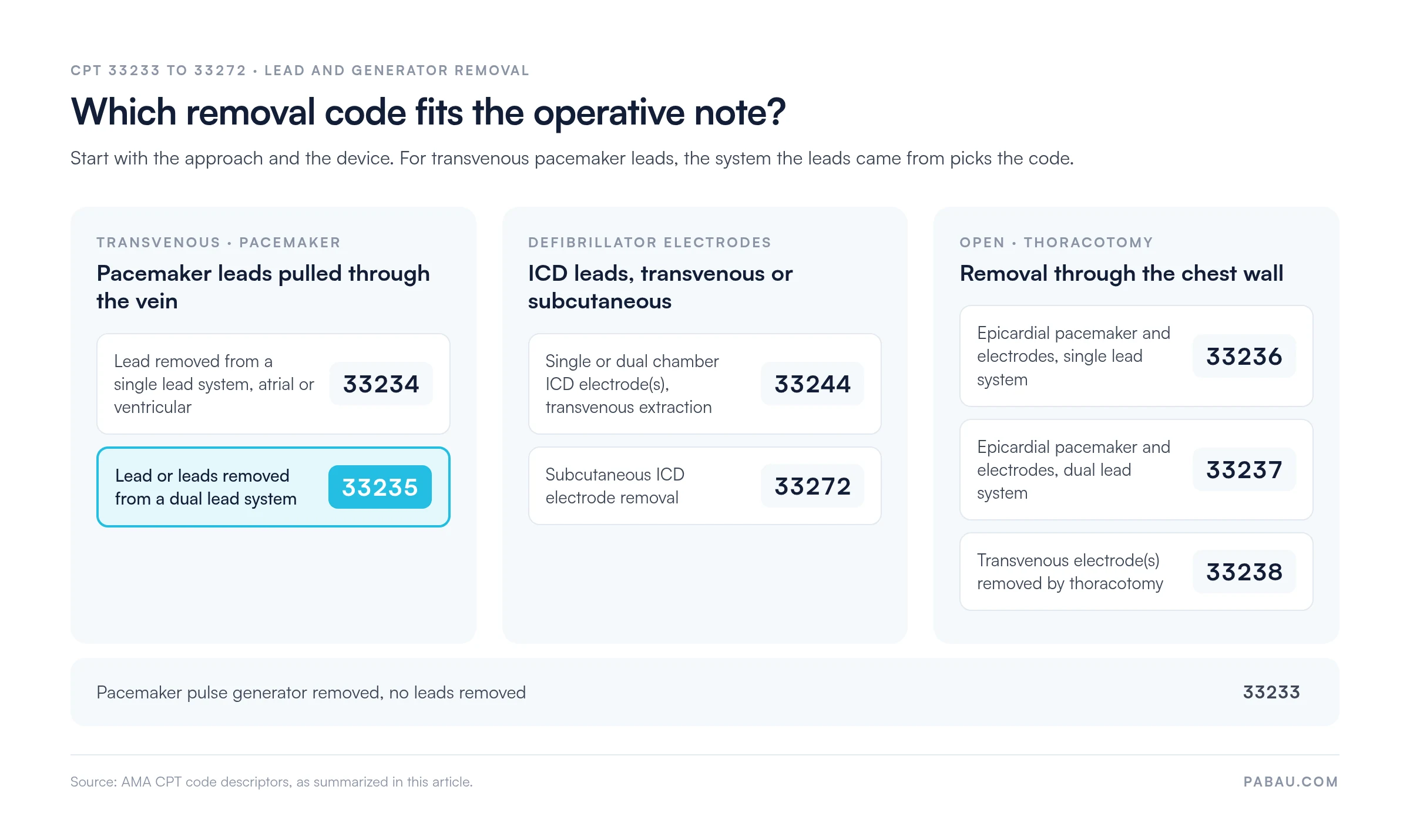
Decision panel of CPT lead removal codes
Only transvenous removal from a dual lead pacemaker system lands on 33235. Descriptors follow the AMA CPT code set.

In claim terms, 33235 does not cover:

  • A single lead system. Use 33234 when the leads come from a single lead pacemaker system.
  • Transvenous ICD lead extraction. Use 33244 for removal of single or dual chamber implantable defibrillator electrode(s) by transvenous extraction.
  • Subcutaneous ICD electrodes. Use 33272 to remove a subcutaneous ICD electrode, and 33273 to reposition one.
  • Removal by thoracotomy. Use 33236 or 33237 for an epicardial pacemaker and its electrodes, single or dual lead. Use 33238 for transvenous electrodes removed by thoracotomy.
  • Generator-only work. Use 33233 to remove a pacemaker pulse generator alone, or 33227-33229 to replace one. ICD generator replacement uses 33262-33264.

Laser sheaths and mechanical tools don’t change the code. CPT has no separate code for tool-assisted pacemaker lead extraction, so 33234 and 33235 cover transvenous removal however it is done.

CodeDescriptionRelationship to 33235
33234Removal of transvenous pacemaker electrode(s); single lead systemUse for a single lead system instead of 33235
33233Removal of permanent pacemaker pulse generator onlyReport alongside 33235 when the generator comes out too
33244Removal of single or dual chamber ICD electrode(s) by transvenous extractionICD leads; never substitute 33235
33272Removal of subcutaneous ICD electrodeS-ICD systems; different device and approach
33236-33238Removal of pacemaker electrodes by thoracotomyOpen approach; replaces 33235 when the chest is opened
33208Insertion of new or replacement of permanent pacemaker with transvenous electrode(s); atrial and ventricularReported with 33233 and 33235 when the whole system is replaced
33249Insertion or replacement of permanent ICD with transvenous lead(s), single or dual chamberAn upgrade from pacemaker to ICD; check NCCI edits for the pair

How a 33235 claim moves from op note to payer

Every 33235 claim passes through the same five hands. Each step below names what has to be right before the claim moves on.

  1. The physician dictates the op note. It names the system type, the approach, each lead removed and the indication.
  2. The coder abstracts the codes. 33235 goes on first, then any other procedure from that session, such as 33233 for the generator or a new device code.
  3. The diagnosis goes on. A complication code leads, with Z95.0 added for device status where it applies.
  4. Billing scrubs the charge. The team checks NCCI edits for every code pair, adds modifiers only where the note supports them and attaches the prior authorization number.
  5. The claim goes to the payer. It goes out as a CMS-1500 or 837P, the 90-day global starts, and the remittance is posted against the expected rate.

Worked example: A full system swap after a lead fracture. A patient’s dual-chamber pacemaker shows a fractured atrial lead. The physician removes the generator and both leads through the vein, then implants a new dual-chamber system. The coder reports 33233 for the old generator, 33235 for the leads and 33208 for the new system.

T82.110A leads the diagnosis, with Z95.0 added for device status. Before submission, billing confirms the NCCI status of each pair and attaches the payer’s authorization number. Miss either step, and a clean procedure still comes back denied.

Documentation that holds up to a 33235 medical review

Payers review 33235 because it pays more than 33234. The op note should cover these points:

  • The system type. Name the device as a dual-chamber pacemaker with atrial and ventricular leads.
  • The approach. State the venous access site (subclavian, cephalic or femoral) and that the leads came out through the vein.
  • Each lead removed. Name every lead removed in the session, and any lead left in place.
  • The medical necessity. State the indication with its findings, such as impedance trends, fluoroscopic findings or culture results.
  • Fluoroscopy. Document fluoroscopy use and time.
  • The physician. Confirm who performed the procedure, and the supervising role if residents took part.

Solid op notes are the base of medical billing compliance for high-value cardiac procedures. They also cut post-payment audit exposure.

ICD-10 codes that support 33235 start with a device complication

A diagnosis that doesn’t explain the removal is an automated denial trigger. Lead with the complication, then add device status.

ICD-10-CM codeDescriptionClinical scenario
T82.110ABreakdown (mechanical) of cardiac electrode, initial encounterLead fracture or insulation failure prompting removal
T82.120ADisplacement of cardiac electrode, initial encounterDislodged lead that can’t be repositioned
T82.190AOther mechanical complication of cardiac electrode, initial encounterLead problems such as rising thresholds or perforation
T82.7XXAInfection and inflammatory reaction due to other cardiac and vascular devices, implants and grafts, initial encounterPocket infection or lead infection; add a code for the organism
Z45.010Encounter for checking and testing of cardiac pacemaker pulse generator [battery]Device management only; rarely supports removal on its own
Z95.0Presence of cardiac pacemakerSecondary device-status code; never the reason for removal

Use the seventh character for the encounter. A is the initial encounter for active treatment, D a subsequent encounter, and S a sequela. Removal during active treatment takes A, and a wrong character trips an automatic edit.

Two pairing rules catch coders out. T82.7XXA needs an extra code for the organism, such as one for a staph infection. And Z95.0 carries an Excludes1 note against Z45.0-, so never report Z45.010 and Z95.0 together.

Modifiers for 33235 each carry their own audit risk

Most 33235 claims need no modifier. When one does apply, the table shows when it fits and what draws scrutiny.

ModifierWhen to useCaution
-22The procedure was substantially harder than usual, such as heavily adherent leadsNeeds a detailed op note explaining the extra work; triggers manual review
-51Multiple procedures on the same date, such as 33235 with a generator procedureMedicare applies its multiple procedure rules itself; not every payer recognizes -51
-59A distinct procedural service, where 33235 and another code were separate servicesUse only when documentation supports it; misuse triggers overpayment recovery
-80 / -82Assistant surgeon, or assistant surgeon when no qualified resident is availableMedicare doesn’t pay assistants on some cardiac codes; check your MAC’s policy

Laterality modifiers (-RT/-LT) aren’t standard for cardiac lead procedures. A few commercial payers ask for them, so confirm with the payer before you append one.

Medicare pays 33235 under the physician fee schedule

Medicare pays 33235 under the Medicare Physician Fee Schedule (MPFS), which the Centers for Medicare and Medicaid Services (CMS) updates each January. Rates vary by location through the Geographic Practice Cost Index (GPCI) applied to each RVU component.

ComponentNotes
Work RVUReflects physician time and intensity; higher than 33234
Facility vs. non-facility rateThe facility rate applies in a hospital or ASC, where this procedure is done
Global period90-day surgical global; routine post-op care is part of the procedure payment
Annual updateRates change each calendar year; use the MPFS file for the date of service

Use the CMS Physician Fee Schedule lookup tool to confirm this year’s payment for 33235 in your MAC region. The FastRVU lookup tool gives a quick RVU breakdown with geographic adjustment. Rates move every year, so check a live source for the date of service.

Prior authorization depends on the plan, not the code

Traditional Medicare (Parts A and B) doesn’t require prior authorization for 33235 as a standard rule. Many Medicare Advantage plans and commercial insurers do, though. A claim denied for a missing authorization is hard to overturn on appeal.

When a plan does require it, the request usually includes:

  • Device implant records confirming a dual lead system
  • Lead data, such as impedance trends and sensing and pacing thresholds
  • Echocardiogram or fluoroscopic images when infection or a structural problem is the indication
  • Culture results when infection is the indication
  • The ordering physician’s statement of medical necessity

Confirm the requirement with each payer before scheduling, as part of your prior authorization process. Record the authorization on the patient’s billing record, and put the number on the claim.

Five mistakes that get 33235 claims denied

Each mistake below has a fix you can build into the workflow. Sound denial management for this code starts before submission.

  • An op note that never names the system. “Leads removed” without “dual-chamber” leaves the reviewer guessing. Fix it with a dictation template that prompts for system type, approach and each lead.
  • The wrong code for the system. A single lead system billed as 33235, or an ICD lead billed as a pacemaker lead. Code from the op note, never from the scheduling plan. The denial codes in medical billing reference lists the CARC codes these errors bring back.
  • A same-day NCCI conflict. Billing 33235 with a generator code such as 33228 can hit an edit. Check the current NCCI table for the pair, and use -59 only when the note shows separate services.
  • A missing prior authorization. The plan required it and nobody asked. Build an authorization check into scheduling for every cardiac device procedure.
  • A diagnosis that doesn’t explain the removal. Z45.010 alone, when the note describes an infection, won’t carry the claim. Lead with the complication code, then add Z95.0.

Pro Tip

NCCI edits update every quarter, so a pair that passed last quarter can fail today. Before you bill 33235 with a generator or new device code, pull the current table and check the modifier indicator. It tells you whether -59 is allowed for that pair at all.

Before you submit: A 33235 claim checklist

  • The op note names a dual lead system, and the approach is transvenous.
  • Every lead removed, and any lead left in place, is listed.
  • The indication has findings behind it, such as impedance data, imaging or cultures.
  • A complication code leads the diagnosis, with the right seventh character.
  • Z95.0 and Z45.010 don’t appear on the same claim.
  • Each same-day code pair has been checked against the current NCCI table.
  • Any modifier matches something the op note says.
  • The prior authorization number is on the claim where the plan requires one.

A clean claim on the first pass is the fastest way to protect cash flow on a code this size. A clearinghouse that runs its edits before the payer sees the claim catches what the checklist misses.

How Pabau keeps 33235 claims moving from note to payment

Cardiac device claims stall when the authorization sits in one system, the claim in another and the remittance in a third. Billing staff end up chasing a 90-day global case across three screens.

Pabau, the practice management platform we build, keeps that trail on the patient record. Its medical billing software sends CMS-1500 and 837P claims to thousands of US payers through our Claim.MD integration. Eligibility checks, claim statuses and ERA remittances come back into Pabau, and denied claims are flagged for rework.
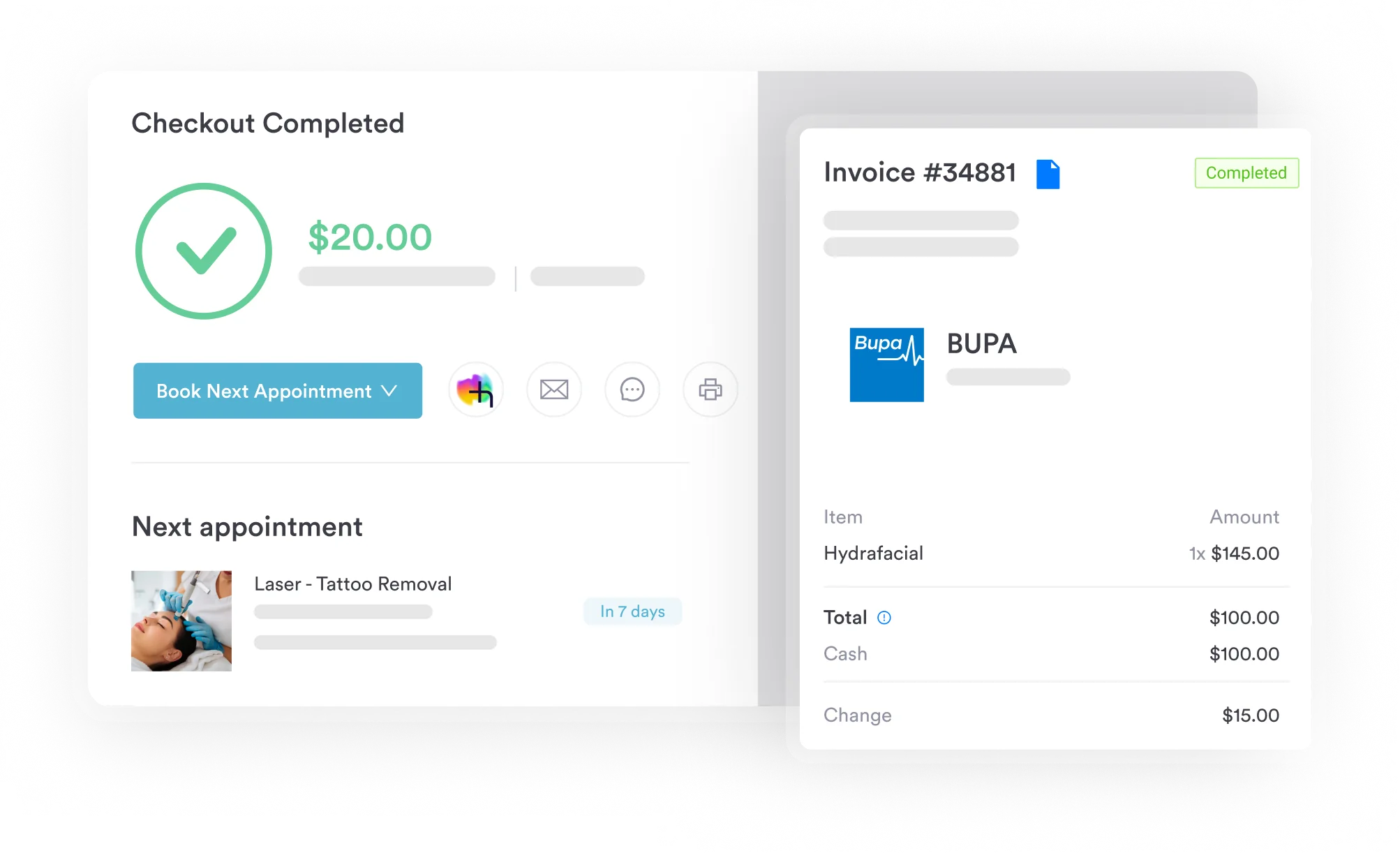
Pabau claims management screen
Pabau’s claims management tracks each claim from submission to remittance, so a 33235 denial is flagged for rework before the appeal window closes.

Prior authorization codes, dates and sessions sit on the patient’s case, and Pabau warns your team when one is missing. That puts the authorization check in the scheduling step, where the checklist above needs it.

Get cardiac device claims paid on the first pass

Pabau sends claims through Claim.MD, tracks authorizations on the patient case and brings ERA remittances back for reconciliation. Denied claims are flagged for rework.

Pabau claims management dashboard

Conclusion

If you change one habit on 33235, read the op note for the system before you count leads. That single check settles 33234 versus 33235 and keeps ICD and open removals out of the wrong code.

The rest is order. Lead with a complication diagnosis, check NCCI for every same-day pair, and confirm the authorization before the procedure is booked. Do that, and a 33235 claim stops needing an appeal to get paid.

Book a demo to see how Pabau tracks cardiac device claims from authorization to remittance.

Continue your research

Continue your research

Coding the new system after removal? CPT code 33206 covers permanent pacemaker insertion with an atrial lead.

Checking a device before deciding on removal? CPT code 93288 explains billing for in-person pacemaker interrogation.

Need a foundation in medical billing workflows? What is medical billing explains the process from charge capture through payment posting.

Looking for clearinghouse submission guidance? Claim.MD clearinghouse overview covers how electronic submission works for procedure claims.

Want to understand 837 file submission? 837 electronic claim file guide details the format used to send CPT claims to payers.

Frequently asked questions

Is left ventricular lead removal reported with 33235?

CPT has no separate code for removing a coronary venous (left ventricular) pacing lead. Coding guidance has long pointed to 33234 or 33235, chosen by the system, with modifier 22 for unusual difficulty. Check current CPT Assistant guidance before billing.

Can you bill 33235 for a lead that is capped and abandoned?

No. Capping a lead and leaving it in the body is not a removal, so 33235 doesn’t apply. Report the procedures performed, such as a new lead insertion, and record the abandoned lead in the op note.

How do you code lead removal plus a new pacemaker?

Report each part. A full dual-chamber system swap is typically 33233 for the old generator, 33235 for the leads and 33208 for the new system. Check NCCI edits for each pair before adding modifiers.

Who bills CPT 33235, the physician or the hospital?

Both, on separate claims. The physician who performs the removal bills the professional service on a CMS-1500 or 837P claim. The hospital or ASC bills its facility charge on its own claim.

Is CPT 33235 an add-on code?

No. 33235 is a standalone surgical code with a 90-day global period, so it can be reported on its own. Routine follow-up visits in those 90 days are part of its payment.
Found our content helpful?
Avatar photo
Monika Lazarevska
Content Writer

Monika Lazarevska writes content for owners and healthcare professionals who want clear, no-fluff content that actually helps them run their practice better. With a background in storytelling and SEO, she knows how to make even the driest topics worth reading. Off the clock, you'll find her in a café somewhere in Europe, probably with a good book and an even better coffee.
×