CPT code 51797: Intra-abdominal voiding pressure add-on
What CPT code 51797 covers CPT code 51797 is the add-on code for intra-abdominal...

Last Updated: Oct 19, 2026
28008 is the CPT code for fasciotomy, foot and/or toe. It covers a surgical incision into the fascia of the foot or toe, made to relieve compartment pressure or release a diseased band of fascia.
It is not a fasciectomy: 28008 describes an incision into the fascia (including an open plantar fascia release by incision) without excising tissue. Coders confuse it with 28060 and 28062, which remove plantar fascia. Endoscopic plantar fascia release has its own code, 29893.
Let Pabau's smart automation suggest the right codes, reduce claim denials, and keep your practice compliant—effortlessly.
Automate repetitive tasks and focus on what matters most—your patients.
Reduce coding errors and ensure compliance with the latest regulations.
Clean claims, fewer denials, and faster reimbursements.
Powerful insights and reporting to help your practice thrive.
HIPAA compliant SOC 2 certified GDPR-compliant Trusted by 4,000+ clinics worldwide

CPT code 28008 describes a fasciotomy (incision) of the foot and/or toe, with no fascial tissue excised.
Common ICD-10 pairings are T79.A21/T79.A22 for traumatic compartment syndrome of the lower extremity and M79.671/M79.672 for foot pain.
Medicare pays 150% when -50 is used on one line; some commercial payers prefer separate -LT and -RT lines.
The 90-day global period bundles routine post-op visits, and an unrelated procedure inside that window needs modifier -79.
Pabau’s claims management sends 837P claims through Claim.MD and matches ERA/835 remittances, so billing staff can track each 28008 claim to payment.
CPT code 28008 is the surgical code for a fasciotomy performed on the foot and/or toe. It sits in the Musculoskeletal System chapter of the AMA CPT codebook, under Incision Procedures on the Foot and Toes (28001-28035). The official AMA descriptor is: Fasciotomy, foot and/or toe.
A fasciotomy is an incision into the fascia to relieve pressure or treat a fascial condition. A fasciectomy is a different procedure, because it excises (removes) fascial tissue. CPT 28008 applies when the surgeon incises the fascial layers of the foot or toe without removing tissue. That distinction decides the code and drives the documentation requirements.
CPT 28008 is performed when fascial pressure or pathology in the foot or toe needs a surgical release that conservative treatment can’t provide. Acute compartment syndrome of the foot is the highest-acuity indication. It can follow crush injuries, calcaneal fractures, or prolonged external compression, and it needs emergency decompression to prevent ischemic necrosis.
Medical necessity documentation must confirm that surgery was indicated. It should show that conservative management was tried, or was inappropriate given the urgency. The operative record must also identify the site (foot or toe) and the laterality.
Every claim for CPT 28008 needs an ICD-10-CM diagnosis code that supports medical necessity. Medicare contractors’ LCDs and payer policies define covered diagnoses, so a missing or unsupported diagnosis commonly leads to denial.
Plantar fasciitis is coded M72.2. The M77.3- codes look similar but describe a calcaneal spur, so they don’t stand in for a plantar fasciitis diagnosis.
Laterality matters throughout. A claim for CPT 28008 without a laterality modifier is a common denial trigger. So is a non-lateralized ICD-10 code where a lateralized version exists. Check the code’s laterality options before you submit.
Billing a fasciectomy code when the operative report describes a fasciotomy, or the reverse, is a costly error on foot procedures. Payers audit the distinction. Fasciotomy (CPT 28008) is an incision, while fasciectomy (CPT 28060 or 28062) excises fascial tissue. The chart below maps each technique to its code, including the endoscopic route.
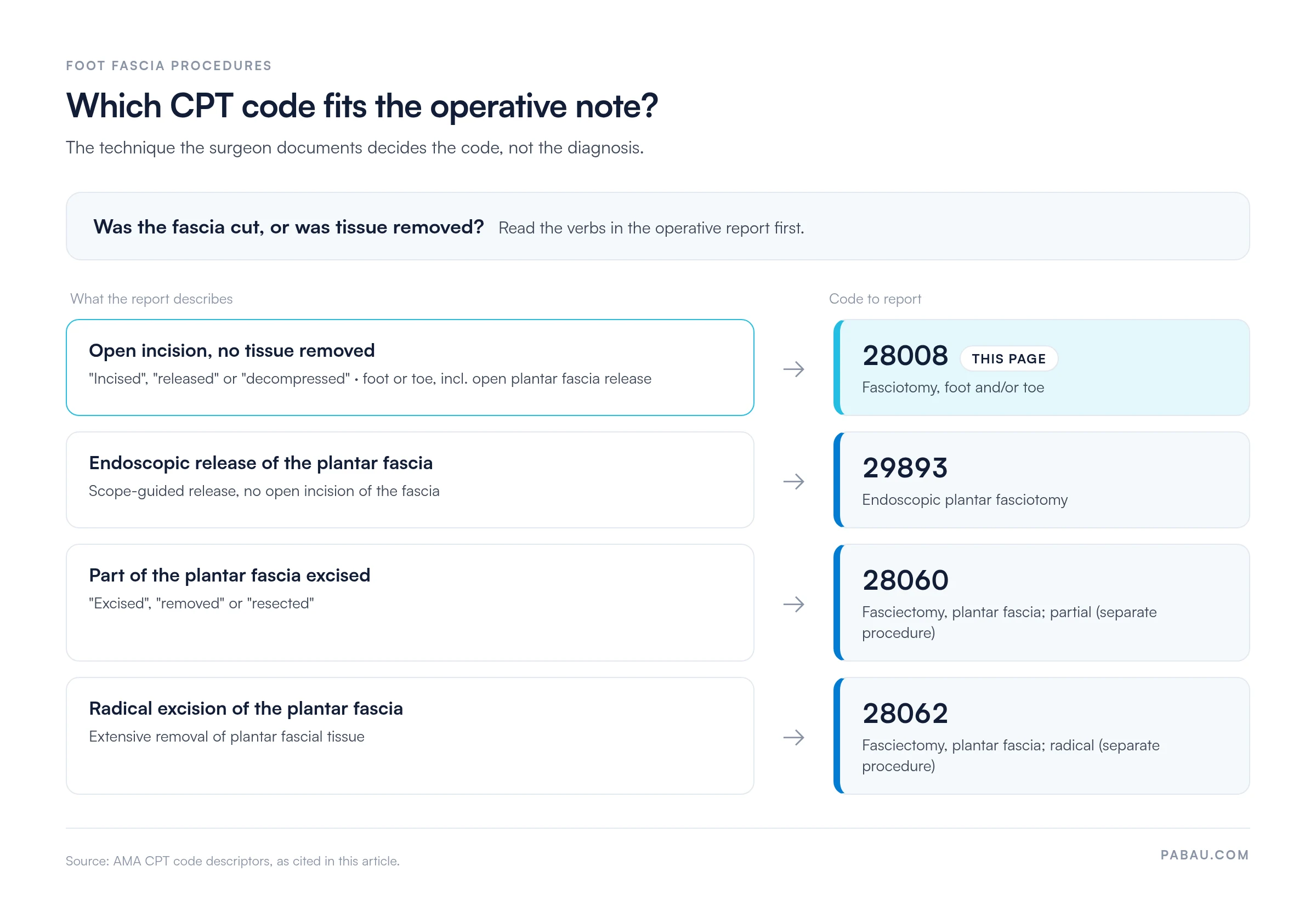
Documentation trigger: The operative report must apply the word “incision” or “incised” to the fascia and confirm that no fascial tissue was excised. It must also state that the approach was open, because endoscopic release is coded 29893, not 28008. If the report says “resected,” “removed,” or “excised,” the correct code is 28060 or 28062.
An operative report that supports CPT code 28008 must contain specific elements to withstand payer audit and medical necessity review. Missing one of them can be enough for a payer to deny the claim or request a refund on retrospective review. The operative note is where a clean claim for 28008 begins.
Modifier selection for CPT 28008 depends on laterality, concurrent procedures, and whether the service falls within a global surgery period. A wrong or missing modifier is one of the top denial causes for this code.
Bilateral billing note: Medicare pays 150% of the single-procedure rate when modifier -50 is appended to CPT 28008 on one line. Some commercial payers require two separate line items billed with -LT and -RT instead. Check payer-specific billing guidelines before submitting a bilateral claim.
Medicare reimbursement for CPT 28008 is set by the CMS Medicare Physician Fee Schedule (MPFS) and varies by locality and Medicare Administrative Contractor (MAC) region. According to the FastRVU 2026 RVU lookup tool, CPT 28008 carries a work RVU (wRVU) of approximately 4.48. Check current-year rates in the CMS Physician Fee Schedule lookup tool before quoting reimbursement. The conversion factor and geographic adjusters change every year.
At 4.48 wRVUs, CPT 28008 sits between simple incision procedures (typically 1.5-2.5 wRVUs) and complex foot reconstructions. Employed podiatry groups commonly use wRVU thresholds as a productivity benchmark.
A surgeon performing four bilateral foot fasciotomies in a month generates approximately 27 wRVUs from this code (4 × 4.48 × 1.5 under modifier -50). Use the PCC free 2026 RVU calculator to model productivity with current conversion factors and geographic adjusters.
Always look up CPT 28008 reimbursement in the CMS MPFS lookup tool, filtered to your MAC locality and the current calendar year. National average rates on third-party sites may differ materially from what you’re paid, because of geographic adjusters. Use the non-facility rate only if the procedure was performed in an office setting.
CPT 28008 carries a 90-day global surgery period under the CMS global surgery policy. Routine pre-operative and post-operative services in that window are bundled into the surgical payment and can’t be billed separately. Most follow-up visits for wound checks, suture removal, and routine post-op monitoring fall within this bundle.
Services that can be billed separately during the global period need a modifier to identify them as distinct:
A superbill for surgical services that lists post-op visits without the right modifier is a common audit trigger for 28008 claims. Medicare contractors can pull global period billing for surgical foot codes when they review a podiatry practice. Log the global period end date for every 28008 claim, and flag any E/M service billed inside that window for modifier review.
Prior authorization: Medicare does not require prior authorization for CPT 28008. Commercial payers vary significantly, and Medicaid rules are state-specific. New York’s eMedNY program, for example, covers 28008 for DPMs and participating MDs performing podiatric surgery. Prior authorization may still apply under a payer’s medical policy, so verify with the payer before scheduling an elective fasciotomy.
CPT 28008 denials cluster around three root causes: wrong code selection, missing or incorrect modifiers, and weak medical necessity documentation. Knowing the denial pattern lets billing staff correct claims before appeal deadlines and fix the intake workflows behind repeat denials. Practices with structured denial management in healthcare treat each CARC denial reason as a data point to act on.
For repeat denials, map each CARC code to its root cause with the medical billing denial codes reference before drafting appeal letters. Pabau, the practice management platform we build, matches electronic remittance advice (ERA/835 files) to the original claim through its Claim.MD integration. Billing staff see the CARC and RARC codes next to the claim without pulling remittance files by hand.
Audit every CPT 28008 claim from the prior 90 days each month, and cross-reference it against ERA denial codes. Sort the denials by root cause: wrong code, modifier, medical necessity, or global period. When one category keeps dominating, look for a systematic intake or documentation problem before blaming individual coders.
A 28008 claim is only as clean as the operative note behind it. Your coders still choose the code, the modifier line and the diagnosis from that note. Software earns its place after that point, in the transmission and follow-up work.
Pabau’s claims management software sends 837P claims through its Claim.MD integration, matches ERA/835 remittances and tracks claim status. Your team can follow a bilateral 28008 claim from submission to payment and see any denial reason as soon as the remittance arrives.
That frees billing staff for the checks that prevent denials, starting with the operative note’s verbs and the modifier line.
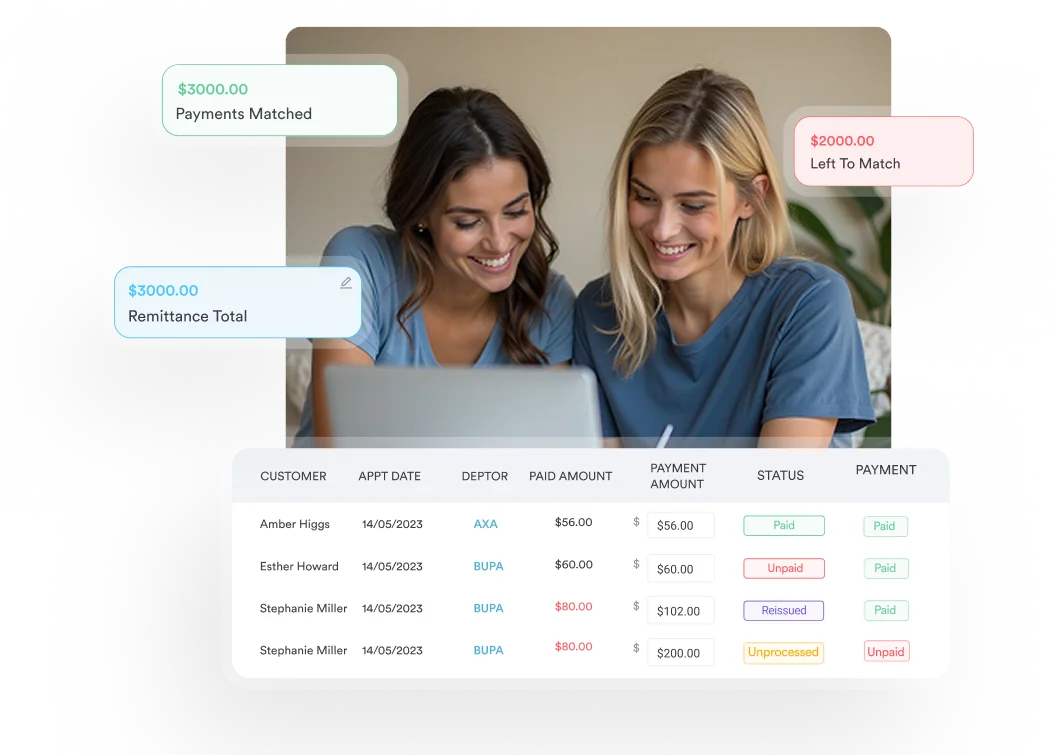

Pabau’s claims management sends 837P claims through its Claim.MD integration, matches ERA/835 remittances and tracks claim status. Your billing team sees the denial reason on each 28008 claim as soon as the remittance arrives.

CPT code 28008 is simple to define and easy to get wrong. The verbs in the operative note decide between 28008, 29893, 28060 and 28062. The modifier line decides how Medicare pays a bilateral case.
Start with the operative report template your surgeons use. A template that prompts for the approach, the action on the fascia and the side catches the usual 28008 errors before a claim is built.
Book a demo to see how Pabau sends, tracks and reconciles surgical claims for podiatry practices.

Need to understand how clearinghouse submissions work for CPT claims? Claim.MD clearinghouse overview explains how 837P files move from the billing system to payer adjudication.
Want a structured approach to reducing repeat denials? Medical billing compliance guide covers audit triggers and documentation standards for surgical codes.
Want the bigger picture on billing performance? Revenue cycle management fundamentals explains how each stage from charge capture to payment posting affects collections.
Coding foot pain alongside the procedure? ICD-10 code M79.671 covers pain in the right foot and when a more specific diagnosis should replace it.
CPT code 28008 covers a surgical fasciotomy of the foot and/or toe. That means an incision into the fascial layers to relieve pressure or treat pathology, without removing fascial tissue. It applies to emergency compartment decompression after crush injuries, post-traumatic swelling, and plantar fascial conditions treated by incision rather than excision.
It depends on the technique. An open release by incision with no tissue removed is reported with 28008. A partial excision of the plantar fascia is 28060, and a radical excision is 28062. An endoscopic plantar fascia release is 29893.
CPT 28008 carries approximately 4.48 work RVUs (wRVUs). Verify this against the current CMS RVU file, because CMS reviews RVU assignments every year. Payment comes from the total RVUs, adjusted by the GPCI for the provider’s locality and multiplied by the 2026 conversion factor. Use the CMS MPFS lookup tool for exact locality rates.
The top denial reasons for CPT 28008 are wrong code selection and a missing laterality modifier (-LT or -RT). Others are a diagnosis code that doesn’t support medical necessity, and post-op visits billed in the 90-day global period without a modifier. Unbundling also triggers denials when 28008 goes out with a CCI-edited code pair and no modifier -59.