



CCSD code G5100: Bypass of duodenum billing guide
CCSD code G5100 bills a bypass that leaves the duodenum in place CCSD code G5100...

Last Updated: Oct 16, 2026

CPT code 28060 covers partial fasciectomy of the plantar fascia, where the surgeon excises fascia rather than simply releasing it.
Medicare’s 2026 national office amount is about $525, built from 15.72 total RVUs and a $33.40 conversion factor.
The code carries a separate procedure designation, so NCCI bundles it into larger foot surgery unless modifier 59 is justified.
Major payers such as Aetna want at least six months of documented, failed conservative care before they approve the surgery.
Practice management software like Pabau pre-fills the claim from the patient record and tracks its status after submission.
CPT code 28060 covers partial fasciectomy of the plantar fascia, the surgery a podiatrist reaches for when chronic heel pain outlasts every conservative option.
One fact decides the claim. The surgeon has to remove fascia, not simply cut it. Release the fascia without excising tissue and the correct code becomes 28008, which pays about $100 less.
That distinction turns up on nearly every heel case, and payers audit it hard. Below are the 2026 Medicare amounts, the modifiers, the ICD-10 pairings, and the documentation payers ask for. So are the denials that follow when one of them is missing.
Newer coders may want our medical billing fundamentals guide open alongside this one.
A portion of the plantar fascia, taken out through an incision, usually on the medial heel. The full descriptor reads fasciectomy, plantar fascia; partial (separate procedure).
In the American Medical Association’s CPT code set it sits in the musculoskeletal chapter, under excision procedures on the foot and toes.
Removing part of the fascia drops the tension running along it, which is what settles the heel pain. A fasciotomy chases the same result by cutting the fascia and leaving it in place. Same anatomy, same patient, different code, and roughly $100 between them.
M72.2 is the diagnosis that carries this claim, and the other codes only support it.
Payers want an ICD-10 code that proves the surgery was warranted, and a vague pain code on its own rarely survives review. Laterality matters too, because the procedure line is going out with RT or LT on it.
Because M72.2 has no laterality built in, the operative note’s right or left has to arrive through a second code. Add M79.671 or M79.672 behind it.
If you want a second opinion on a pairing before you submit, CrossCoder runs procedure-to-diagnosis lookups that flag unsupported combinations.
Four modifiers do almost all the work on this code, and one of them draws audits. The separate procedure tag on 28060 means it bundles easily, so the modifier you attach often decides whether the line pays at all.
The separate procedure tag is the compliance issue worth understanding properly. Under National Correct Coding Initiative policy, a separate procedure counts as part of any larger service in the same area. That applies whenever both happen in one session.
Bill 28060 next to a bigger foot procedure with no modifier 59, and the payer folds it into the comprehensive code. Your documentation then has to show the fasciectomy served its own clinical purpose. Sitting in the same operative field is not enough.
Check the current NCCI edit file before you bill 28060 with any other foot code. The file changes every quarter, and pairs move on and off it. Appending modifier 59 to an edit that no longer exists still reads as an override attempt on audit.
About $525 in an office setting and about $344 in a facility, nationally, before your locality adjustment. Those amounts come from the code’s total RVUs multiplied by the 2026 conversion factor of $33.40. Your own payment will differ.
Check the CMS Physician Fee Schedule Look-Up Tool for your Medicare Administrative Contractor before you quote a figure.
Once the rate is confirmed, the claim still has to reach the payer. Practices can route it electronically through a Claim.MD clearinghouse integration, which connects to thousands of US payers and returns eligibility responses before submission.
Because the office rate has to cover the overhead. When the procedure happens in your own room, Medicare pays you for the staff, the supplies, and the space.
In an ASC or a hospital outpatient department, the facility bills separately for all of that, so your professional fee drops accordingly.
Locality adjustments then move both figures. Practices in Manhattan or San Francisco land above the national average, and rural localities land below it.
The FastRVU 2026 RVU lookup tool works these out quickly when you are preparing for a fee schedule negotiation. Tracking revenue cycle management metrics alongside them shows which payers pay near the benchmark and which sit well under it.
Three components build the total, and practice expense is the largest of them in an office setting.
CMS revises these values every year, and the conversion factor moves with them. Before you use any of it for benchmarking, confirm the current numbers against the MPFS data file and the AMA’s coding resources.
That is the bar most payers set, and thin documentation of it is the leading reason 28060 claims fall over on post-payment audit.
Aetna, for one, only considers plantar fasciotomy medically necessary after a failed six-month trial of conservative therapy.
Some policies stretch to twelve months. Medical billing compliance on surgical codes really comes down to whether the chart tells that story with dates.
Local Coverage Determinations set the Medicare version of the same bar, and they differ by jurisdiction. Read your MAC’s LCD for plantar fasciitis surgery before you schedule, not after the denial arrives.
Keep those pieces together rather than scattered across systems. A complete superbill documentation package holds the authorization reference, the operative note, the pre-op assessment, and the imaging reports. An auditor who cannot find one of them treats it as absent.
Most miscoding on this code starts here. Three codes cover surgery on the same strip of tissue, and only the verb in the operative report separates them. The chart below shows the split, along with what each one is worth.
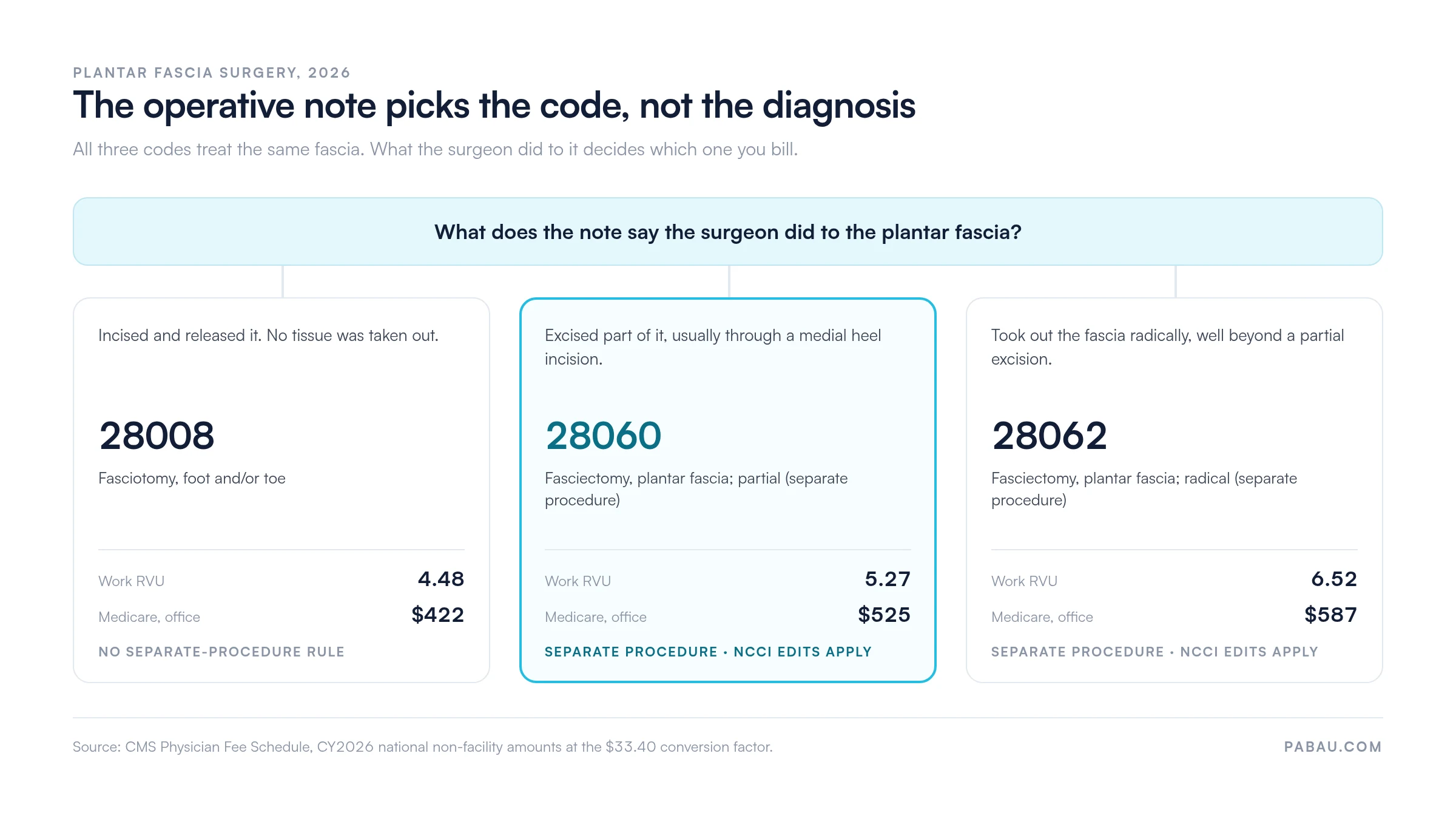
Coding 28060 when the surgeon only released the fascia is upcoding, and payer integrity programs look for it. So the note has to say that tissue came out.
If it only says the fascia was released, bill 28008 and move on. Pull the full descriptor and its parent-code notes from the AAPC CPT code lookup whenever the wording is ambiguous.
Knowing the codes next door prevents misassignment when several procedures share one operative session. These are the ones podiatric coders confuse with 28060 most often.
Not every foot excision lands on that list. If the surgeon removed a ganglion from a tendon sheath or a joint capsule, bill CPT 28090 instead.
Specificity like this repeats across every specialty code set. Our coaching CPT code reference shows the same pattern. So do the surgical procedure CPT codes for IVF, where neighboring codes split on one clinical detail.
Here is what a clean one looks like end to end. A patient with right heel pain has failed nine months of orthotics, therapy, and two steroid injections.
On March 3, the surgeon excises part of the plantar fascia in an ambulatory surgery center.
Change one detail and the path changes with it. Add a second foot procedure and step 3 becomes a bundling edit. Move the case into your own procedure room and step 4 pays $525 instead.
Denials on this code repeat, which is good news, because a repeating denial is a fixable one. Five patterns account for most of them.
Solid denial management workflows start with knowing which of the five you keep hitting.
Catching these before transmission, rather than after a rejection, is what protects your first-pass rate. Practices that build clean claim submission checks into charge entry catch most of the five while the operative note is still fresh.
Most of the errors above start as retyping. Someone reads the operative note, opens a separate billing tool, and keys the code, the diagnosis, and the authorization number again. Every re-entry is a chance for the side, the place of service, or the auth reference to drift away from the chart.
Practice management software like Pabau removes that step. Pabau’s claims management software builds the CMS-1500 straight from the record. The CPT code attached to the service lands on the charge line, and the recorded ICD-10 codes seed the diagnosis fields.
Built-in CPT and ICD-10 libraries let coders search official descriptors without leaving the claim. Required fields such as membership and authorization numbers are checked for completeness before the send button unlocks.
After that, the claim stops being invisible. US claims route through Claim.MD, which returns real-time eligibility responses, claim-status updates, and 835 remittances that post back against the charge. Our guide to electronic remittance advice explains how to read what comes back.
The same claim path serves multi-specialty groups. A practice that runs podiatry alongside physical therapy practices keeps one billing workflow instead of two. Coders working other specialties reach our CPT code reference for ADHD screening in the same system.

Pabau builds the CMS-1500 from the patient record and checks that required claim fields are complete. Claim.MD then tracks each claim’s status until the remittance posts.

CPT code 28060 is a simple procedure wrapped in three unforgiving rules. Read the verb in the operative note. Check the NCCI pair before you reach for modifier 59. Make sure six months of failed conservative care sits in the chart with dates on it. Get those right and the code pays predictably.
What tends to go wrong is not the coding knowledge. It is the distance between the operative note and the claim form, and the number of hands the information passes through on the way. Shorten that path and the denial patterns above mostly disappear.
Book a demo to see how Pabau builds a 28060 claim straight from the operative record and tracks it through to the remittance.

Need guidance on clearinghouse submission for surgical codes? Our medical claims clearinghouse guide explains how electronic claims routing reduces denial rates across payer networks.
Struggling with claim denials on surgical codes? Denial codes in medical billing covers the most common CARC reason codes and how to respond to each.
Want to understand insurance eligibility before surgery? Insurance eligibility verification explains how to confirm coverage before a patient’s procedure to prevent retroactive denials.
Yes, when that visit is where the surgeon decided to operate. Append modifier 57 to the E/M code, because 28060 is major surgery with a 90-day global period. Without it, the payer folds the visit into the surgical package.
Medicare wants one claim line, modifier 50, and one unit of service, per NCCI policy. Payment is then adjusted for the bilateral procedure. Some commercial payers reject that format and want two lines, one RT and one LT. Check the payer’s billing guide.
CO-97 and CO-236 turn up most. CO-97 means the service is already paid inside another procedure. CO-236 means the combination conflicts with an NCCI edit. Appeal with the operative note showing the fasciectomy was distinct, and use modifier 59 or an X{EPSU} subset.
Traditional Medicare runs no prior authorization program for this code. Medicare Advantage and commercial plans usually do, and their criteria are stricter. Aetna wants a documented six-month conservative trial on file. Secure the authorization before scheduling, then store the number in the chart.
The modifier depends on why. Use 58 for a planned, staged procedure. Use 78 for an unplanned return to the operating room, such as a wound complication. Use 79 for unrelated surgery, like the other foot.



