

HCPCS Code Q4185: Cellesta flowable amnion billing guide
HCPCS Code Q4185: definition and official descriptor HCPCS Code Q4185 is the Lev...

Last Updated: Nov 20, 2026
28045 is the CPT code for excision of a subfascial soft tissue tumor of the foot or toe that measures less than 1.5 cm. Subfascial means the tumor lies below the fascia, often within a muscle.
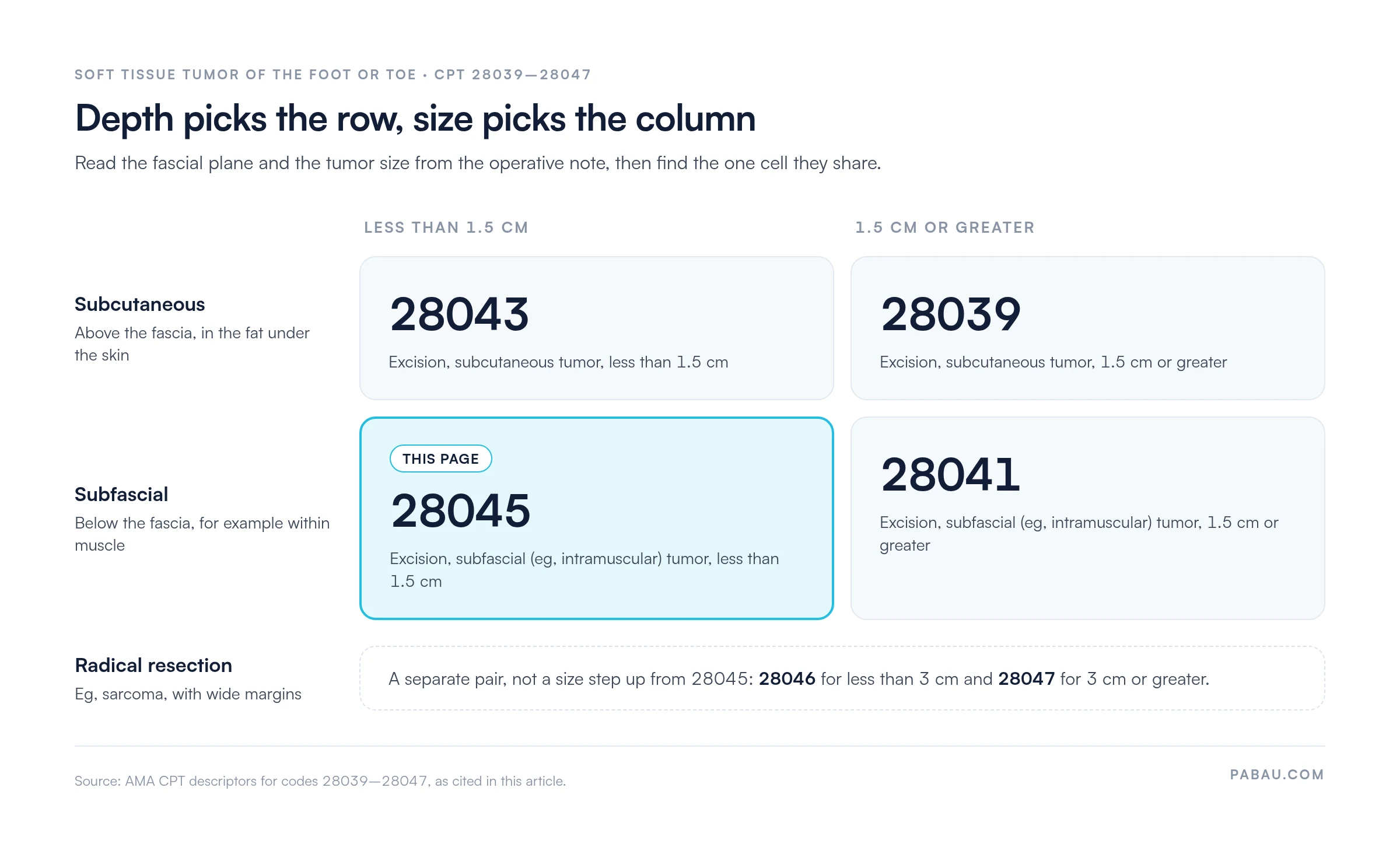
Depth and size decide the code across the 28039-28047 range. Subcutaneous tumors above the fascia belong under CPT 28043, and subfascial tumors of 1.5 cm or more belong under CPT 28041. Radical resection of a sarcoma uses 28046 or 28047 instead.
Let Pabau's smart automation suggest the right codes, reduce claim denials, and keep your practice compliant—effortlessly.
Automate repetitive tasks and focus on what matters most—your patients.
Reduce coding errors and ensure compliance with the latest regulations.
Clean claims, fewer denials, and faster reimbursements.
Powerful insights and reporting to help your practice thrive.
HIPAA compliant SOC 2 certified GDPR-compliant Trusted by 4,000+ clinics worldwide

CPT Code 28045 covers excision of a subfascial (eg, intramuscular) soft tissue tumor of the foot or toe under 1.5 cm. Subcutaneous tumors use 28043, and subfascial tumors of 1.5 cm or more use 28041.
The operative note must place the tumor below the fascia, record its size with the excision margin, and state laterality.
CPT 28045 carries a 90-day global surgery period, so routine post-op visits are bundled and need a modifier to bill separately.
Pabau, the practice management platform we build, tracks prior authorizations on the case and submits US claims through the Claim.MD clearinghouse.
CPT Code 28045 is the code for excising a foot or toe soft tissue tumor that lies below the fascia and measures under 1.5 cm. The AAPC lay description describes the same service.
The provider excises a mass from within the foot or toe muscles, and the specimen is under 1.5 cm. The code covers benign and malignant tumors on the plantar and dorsal surfaces. The official AMA descriptor reads “Excision, tumor, soft tissue of foot or toe, subfascial (eg, intramuscular); less than 1.5 cm.”
Two tests follow from it. Depth comes first: the mass lies beneath the fascia, usually within or between muscles, so the surgeon opens the fascia to reach it. Size comes second, because a subfascial tumor of 1.5 cm or more moves to a different code. Ankle structures fall outside the code’s scope and use separate musculoskeletal codes. A subcutaneous tumor at the ankle under 3 cm, for example, is code 27618.
The 28039-28047 range covers every soft tissue tumor excision of the foot and toe. Each code reflects a depth and a size band, apart from the radical resection pair at the top of the range.
Picking the wrong code from this range is a common cause of 28045 denials and downcodes. Check the operative note against the AAPC CPT code reference to confirm depth and size before coding.
When the operative note documents subfascial depth and the tumor measures 1.5 cm or more, CPT 28041 is the correct code, not CPT 28045. Billing 28045 in that scenario undercodes the service and leaves the higher payment unclaimed.
Radical resection of a tumor such as a sarcoma uses a separate pair. CPT 28046 covers tumors under 3 cm, and 28047 covers 3 cm or greater.
Put side by side, depth and size form a simple grid, and each combination lands on one code.
The surgical approach for a subfascial foot tumor excision determines what documentation the payer expects. The operative note should mirror the steps below. Vague wording about depth or tissue planes is the easiest point for an auditor to challenge on a 28045 claim.
Post-payment auditors look for wording that places the mass below the fascia, such as “subfascial” or “intramuscular.” Without it, a reviewer can reclassify the claim as 28043 and demand a refund of the difference.
Documentation for CPT Code 28045 must support five facts. The tumor existed and sat below the fascia, and the surgeon excised it. It measured less than 1.5 cm, and the site was the foot or toe.
Missing any one of them gives a payer grounds for a downgrade or denial. Running each claim against the list below in your claims management software catches a missing element before submission.
Run a documentation checklist before submitting any 28045 claim. Confirm the imaging report is on file and the operative note places the tumor below the fascia. Check that the size with margin is recorded, pathology is ordered, the LT or RT modifier is attached, and the attending attestation is present. Catching a missing element before submission costs minutes, while a denial costs staff time, appeal work, and sometimes the payment.
The ICD-10-CM diagnosis code paired with CPT Code 28045 must reflect the physician’s documented diagnosis before or at the time of surgery. Coders cannot assign a malignancy code without physician documentation of malignancy.
When the pre-operative diagnosis is “soft tissue mass, rule out malignancy,” use the most specific benign or symptom code the record supports.
None of the D21.2- or C49.2- codes is specific to the foot. They cover the whole lower limb, including the hip, so the operative note carries the foot site. Plantar fibromatosis is coded M72.2 when the excised nodule arises from the plantar fascia.
Verify every ICD-10-CM code against the current-year CMS tabular list before submission. Codes are updated annually, and a retired or invalid code is an automatic technical denial.
Medicare pays for CPT Code 28045 under the Medicare Physician Fee Schedule (MPFS). Payment equals the relative value units (RVUs) multiplied by the annual conversion factor. A geographic practice cost index (GPCI) then adjusts it for each Medicare Administrative Contractor (MAC) locality.
The table lists the 2026 values from CMS’s fourth-quarter relative value file (RVU26D). Use the CMS Physician Fee Schedule lookup tool for the exact rate in your locality.
Use the FastRVU lookup tool to estimate the dollar reimbursement for your specific locality. Non-facility rates are higher because the practice absorbs equipment and supply costs.
Facility rates are lower because the hospital or ASC bills separately for those costs. Practices billing in a Health Professional Shortage Area (HPSA) may qualify for the HPSA bonus payment.
Medicaid rates differ by state and usually sit below Medicare. Check the state Medicaid fee schedule through your state Medicaid agency before quoting expected reimbursement.
CPT Code 28045 carries a 90-day global surgery period under the CMS global surgery package. Routine post-operative visits within 90 days of the procedure date are bundled into the surgical fee and cannot be billed separately. For a broader grounding in how the global period fits the revenue cycle, see this medical billing fundamentals guide.
Medicare does not require prior authorization for CPT Code 28045 under traditional fee-for-service Medicare. Commercial payers, Medicare Advantage plans, and Medicaid managed care organizations vary widely.
Many require pre-authorization for outpatient surgical procedures including foot tumor excisions. Confirm insurance eligibility verification and authorization requirements at the time of scheduling, not on the day of surgery.
A clean claim submission carries the authorization number, when obtained, in the correct field of the CMS-1500 form before the claim leaves the practice.
Denials for CPT Code 28045 follow predictable patterns. Most trace back to what the operative note leaves out rather than to the code itself. Mapping each denial code to its root cause shortens the appeal. For a systematic framework, see Pabau’s guide to denial management workflows and the full reference on denial codes.
Track each denial reason alongside the original claim date. A run of “depth not documented” denials across several surgeons points to the op note template rather than to individual coders. Sending appeals through a medical claims clearinghouse keeps an audit trail of every submission and response.
When appealing a 28045 denial on depth, never just resubmit the original op note. Write a one-paragraph physician attestation letter that quotes the operative note wording placing the tumor below the fascia. Add its measured size with margin, and reference the imaging report by date and modality. An appeal built this way answers the reviewer’s question on the first page.
Many 28045 denials start in the hand-off between the operating room and the billing desk. The coder works from a re-keyed summary, the depth wording never reaches the claim, and an authorization number goes missing on the way.
Pabau, the practice management platform we build, keeps the operative note, the authorization and the claim on one patient record. Prior authorization codes, dates and sessions are tracked on the case, with a warning when one is missing. US claims go out as CMS-1500/837P claims through the Claim.MD clearinghouse, which reaches thousands of US payers.

Eligibility checks and ERA remittances come back against the same record, and secondary claims start from it. When a payer downcodes a 28045 claim, the corrected claim or appeal begins from the source documentation rather than from a summary.

Pabau tracks prior authorizations on the case, submits CMS-1500 claims through the Claim.MD clearinghouse, and posts ERA remittances against the patient record. See how it handles surgical billing for CPT 28045.

Two lines in the operative note decide a 28045 claim. One places the tumor below the fascia, and the other records its size with the excision margin. Write both on the day of surgery, and the choice between 28043, 28045 and 28041 follows from the note.
The cost of a missing line runs in both directions. An unstated depth invites a downcode to 28043. An unrecorded 1.6 cm tumor billed as 28045 leaves the 28041 payment unclaimed.
Build both lines into the op note template, and every claim after that starts from a defensible record. Book a demo to see how Pabau carries the operative note, the authorization and the claim through one patient record.

Billing a deep foot procedure that is not a tumor? CPT code 28192 covers removal of a deep foreign body from the foot.
CPT Code 28045 covers excision of a foot or toe soft tissue tumor that lies below the fascia and measures under 1.5 cm. It applies to benign and malignant tumors on the plantar and dorsal surfaces. Subcutaneous tumors use CPT 28043 or 28039, and subfascial tumors of 1.5 cm or more use CPT 28041.
CPT 28043 covers excision of a subcutaneous foot or toe tumor above the fascia, while CPT 28045 covers one below the fascia. Both are for tumors under 1.5 cm. If the operative note documents opening the fascia to reach the tumor, 28045 applies. If the mass was removed from the subcutaneous tissue, 28043 is correct.
CPT 28045 carries a 90-day global surgery period. Routine post-operative visits within that window are bundled into the surgical fee. Unrelated E/M visits take modifier -24, a return to the OR for a complication takes -78, and an unrelated procedure takes -79.
Not automatically. A ganglion cyst is billed under 28045 only if the operative note and imaging place it below the fascia and it measures under 1.5 cm. Subcutaneous ganglion cysts of the foot are billed under CPT 28043. The cyst diagnosis alone does not determine the code, so the note must state the depth and size.
Medicare pays CPT 28045 from its 2026 RVUs: 5.31 work, 8.67 non-facility practice expense, 4.01 facility practice expense, and 0.54 malpractice. Those totals are multiplied by the annual conversion factor and adjusted by the locality’s geographic practice cost index. Use the CMS Physician Fee Schedule lookup tool to find the exact allowable for your MAC locality.
The most common reason is an operative note that never places the tumor below the fascia, which lets the payer downcode to CPT 28043. Other triggers include a missing size measurement, a missing LT or RT modifier, and no pre-operative imaging. Missing prior authorization with commercial or Medicare Advantage plans causes denials too.





