

HCPCS Code Q4175: Billing, coverage, and documentation guide
HCPCS code Q4175: Code description and product identity HCPCS Code Q4175 is the ...

Last Updated: Nov 20, 2026
Billable Code
64704 is the CPT code for neuroplasty of a nerve of the hand or foot. The surgeon opens the area and frees an intact nerve from scar, adhesions or a constricting band.
It covers hand and foot nerves that no more specific code names. Digital nerves go to 64702, the carpal tunnel to 64721, a plantar digital nerve to 64726 and the tarsal tunnel to 28035.
Let Pabau's smart automation suggest the right codes, reduce claim denials, and keep your practice compliant—effortlessly.
Automate repetitive tasks and focus on what matters most—your patients.
Reduce coding errors and ensure compliance with the latest regulations.
Clean claims, fewer denials, and faster reimbursements.
Powerful insights and reporting to help your practice thrive.
HIPAA compliant SOC 2 certified GDPR-compliant Trusted by 4,000+ clinics worldwide

CPT code 64704 is neuroplasty of a nerve of the hand or foot. The surgeon releases an intact nerve from scar or a constricting band.
It is the fallback for hand and foot nerves that no more specific code names, so rule out 64702, 64719, 64721, 64726 and 28035 first.
Excising a Morton neuroma is 28080, and suturing a severed digital nerve is a repair code such as 64831, not 64704.
The 2026 national non-facility Medicare payment is about $308 from 9.23 total RVUs, and local rates vary by year and locality.
The operative note must name the nerve, its site in the hand or foot, and the side, because those three facts decide the code.
CPT code 64704 is the code for neuroplasty of a nerve of the hand or foot. The official descriptor reads “Neuroplasty; nerve of hand or foot,” and AAPC’s podiatry coding guidance sets it apart from the plantar digital nerve code 64726. The procedure frees an intact nerve from whatever compresses or tethers it.
In a neuroplasty, the surgeon exposes the nerve and performs external neurolysis. That means releasing it from scar tissue, adhesions, a ligament, a fibrous band or a bone spur. The nerve stays intact throughout, which separates 64704 from nerve repair and from neuroma excision.
Suturing a severed digital nerve in a finger or toe is a repair rather than a neuroplasty. That procedure is reported with 64831, not 64704.
Report 64704 when the surgeon opens the hand or foot and releases a named nerve there that no more specific code covers. The procedure must be open surgery. An injection, a nerve block or other non-surgical treatment does not qualify.
Typical 64704 cases include:
Location decides the code. CPT does not split hand and foot nerves into minor and major groups, so the size of the nerve never changes it. The operative note has to name the nerve and its location, and the coder has to rule out the more specific codes first.
64704 is the hand and foot fallback inside the 64702-64727 neuroplasty range. A more specific code always wins when one describes the nerve and site. The codes below are the ones to rule out before you settle on 64704.
Work through the selection in this order. The flowchart after the steps shows the same path at a glance.
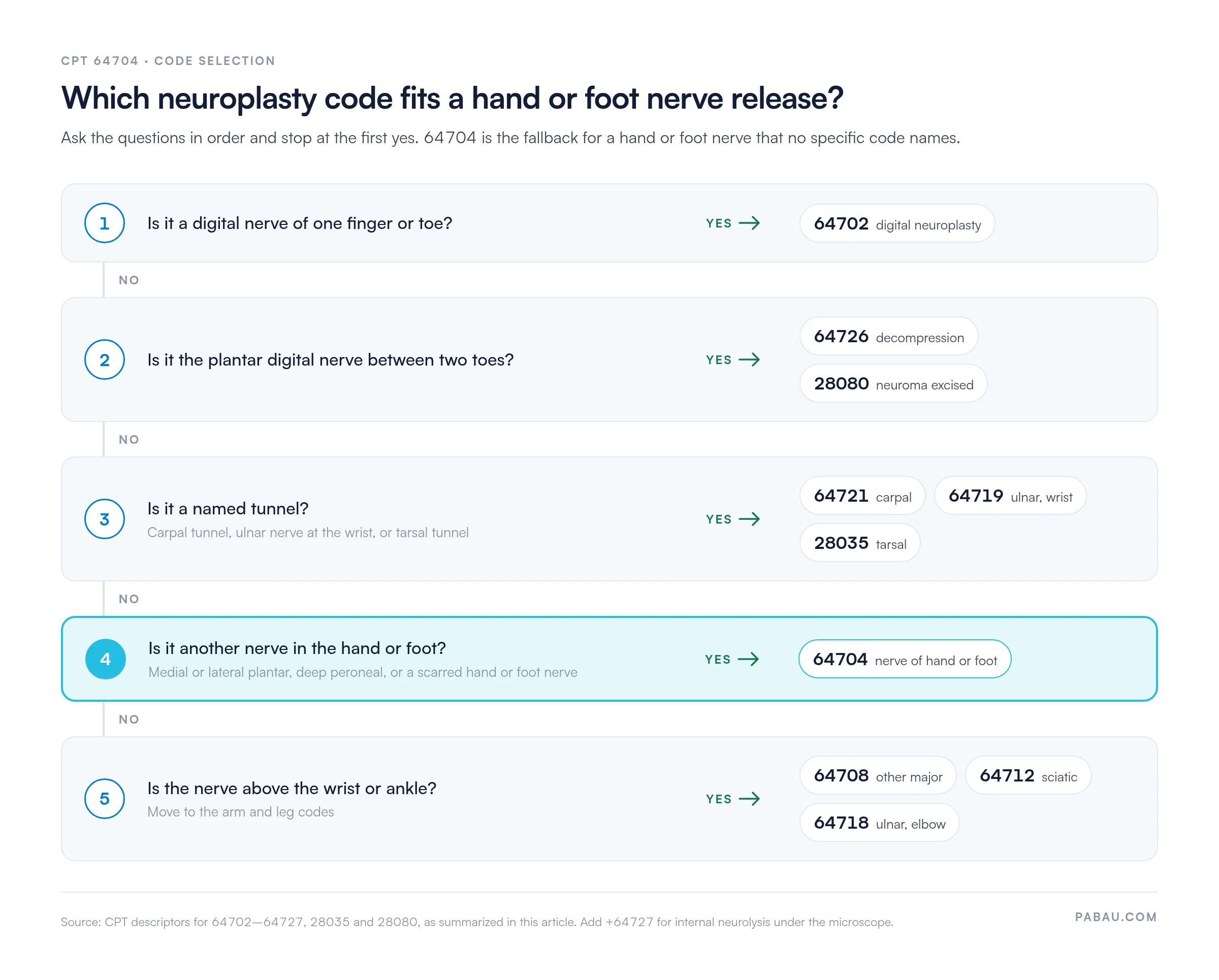
When the surgeon releases the tarsal tunnel, 28035 describes that work. Do not add 64704 for the same nerve at the same site. The same logic holds in the hand, where a carpal tunnel release is 64721 alone.
The diagnosis has to match the nerve and the side in the operative note. Hand and foot nerve entrapment usually codes to a mononeuropathy in G56 or G57. A traumatic nerve injury codes to S64 for the hand or S94 for the foot. On the first surgical claim, a left medial plantar nerve injury is S94.12XA.
Two common diagnoses point away from 64704. Tarsal tunnel syndrome (G57.51-G57.53) supports 28035, and carpal tunnel syndrome (G56.01-G56.03) supports 64721. For S codes, a neurolysis done for scarring long after the injury may call for the sequela character “S” rather than “A”.
Confirm each code in the CDC ICD-10-CM lookup tool for the current fiscal year. Use the laterality-specific code whenever the note documents a side.
The 64704 descriptor carries no side, so laterality goes on the claim as a modifier. The table covers the modifiers that come up most often with this code.
When the surgeon frees two separate nerves in the hand or foot, each release may support its own unit of 64704. The note has to name each nerve and its site. CMS limits units per day through Medically Unlikely Edits (MUEs), so check the current MUE for 64704 before billing more than one unit.
Payers also differ on claim format. Some take two units on one line, while others want a second line with XS or 59. Check the payer’s policy before the claim goes out.
Medicare pays 64704 through the Medicare Physician Fee Schedule (MPFS). For 2026, the national non-facility payment is about $308, built from 9.23 total RVUs. The facility and non-facility totals are the same for this code, 9.23 RVUs, though locality still changes the payment.
Check your locality’s figure in the CMS Physician Fee Schedule Look-Up Tool before you quote a number. FastRVU’s RVU lookup shows the component RVUs. Commercial payers set their own rates by contract, so read the fee schedule in each agreement.
The operative note decides whether 64704 holds up. It has to show that a named nerve of the hand or foot was released, and that no more specific code describes the work. A clean claim starts with that note.
Before the claim goes out, check the operative note against the selection order. Rule out the digit, the plantar digital nerve and the named tunnels, then the rest of the hand or foot. If the note cannot rule out a more specific code, query the surgeon first.
Clear notes also support medical billing compliance, because the submitted code has to reflect the documented procedure.
Most 64704 denials trace back to code selection or a thin operative note. A denial management workflow catches these before resubmission. Check these patterns first:
In many podiatry and hand surgery practices, the operative note and the claim live in different systems. A biller reads the note days later and chooses between 64702, 64704, 64726 and 28035. If the note is vague, that choice becomes a guess.
Pabau, a practice management platform with built-in billing, keeps the note, the diagnosis and the claim in one patient record. Claims go out as CMS-1500 or 837P files through Claim.MD, the clearinghouse Pabau connects to. Eligibility checks run before the surgery date, so coverage questions surface early.
When the payer responds, ERA remittances post back to the same record. Your team sees which 64704 claims paid and which were denied, without re-keying data from a clearinghouse portal. Pabau’s denial-tracking claims software keeps that loop in one place, from submission to payment posting.

Pabau submits CMS-1500 and 837P claims through Claim.MD, runs eligibility checks and posts ERA remittances, so your team spends less time chasing 64704 denials.

64704 is a location code. It applies when a named nerve in the hand or foot is released and no specific code fits, whatever the nerve’s size. Follow the selection order and most coding errors on these claims never reach the payer.
The practical step is to make every operative note answer three questions: Which nerve, where, and which side. When it does, the code, the modifier and the diagnosis follow from it. Book a demo to see how Pabau carries that note through to a paid claim.

Releasing a nerve above the wrist or ankle? CPT code 64708 covers neuroplasty of a major arm or leg nerve that has no code of its own.
Seeing a pattern of claim rejections? Electronic remittance advice explained breaks down how to read ERA files and identify denial patterns across nerve surgery codes.
Want to understand the full revenue cycle behind surgical billing? Revenue cycle management overview covers the end-to-end process from eligibility check through final payment posting.
CPT code 64704 is neuroplasty of a nerve of the hand or foot. The surgeon opens the area and frees an intact nerve from scar, adhesions, a ligament or a bone spur. It covers hand and foot nerves that no more specific code describes.
CPT 64702 covers neuroplasty of the digital nerves of a single finger or toe, one or both. CPT 64704 covers other nerves of the hand or foot. If the released nerve is a digital nerve of one digit, report 64702.
No. CPT 64712 covers neuroplasty of the sciatic nerve only. Other major arm and leg nerves go to 64708 unless a specific code exists. Examples are 64713 for the brachial plexus and 64721 for the carpal tunnel.
It depends on what the surgeon did. Decompression of the plantar digital nerve between the toes is CPT 64726, and excision of the neuroma is CPT 28080. Morton neuroma surgery is not coded with 64704.
No. Tarsal tunnel release, which frees the posterior tibial nerve, is CPT 28035. CPT 64704 covers foot nerves outside the tarsal tunnel that no specific code describes.
Yes, when the surgeon releases separate nerves of the hand or foot and the note names each one. CMS caps daily units through Medically Unlikely Edits, so check the current MUE. Payers differ on whether they want units on one line or a second line with XS or 59.
The 2026 national non-facility Medicare payment for CPT 64704 is about $308, from 9.23 total RVUs with a work RVU of 4.57. Payment varies by locality and changes every year. Check the CMS Physician Fee Schedule Look-Up Tool for your rate.





