

HCPCS Code E0272: Foam rubber mattress billing guide
HCPCS Code E0272: official descriptor and code overview HCPCS Code E0272 is the ...

Last Updated: Nov 6, 2026
28035 is the CPT code for release, tarsal tunnel (posterior tibial nerve decompression). The surgeon divides the flexor retinaculum behind the medial ankle to free the posterior tibial nerve and its terminal branches.
It sits within the podiatric surgery coding space that trips up practices most often at the modifier and laterality stage. The code carries a 90-day global period, and Medicare and commercial payers bill bilateral cases differently.
Let Pabau's smart automation suggest the right codes, reduce claim denials, and keep your practice compliant—effortlessly.
Automate repetitive tasks and focus on what matters most—your patients.
Reduce coding errors and ensure compliance with the latest regulations.
Clean claims, fewer denials, and faster reimbursements.
Powerful insights and reporting to help your practice thrive.
HIPAA compliant SOC 2 certified GDPR-compliant Trusted by 4,000+ clinics worldwide

CPT code 28035 describes release of the tarsal tunnel (posterior tibial nerve decompression) and carries a 90-day global surgery period.
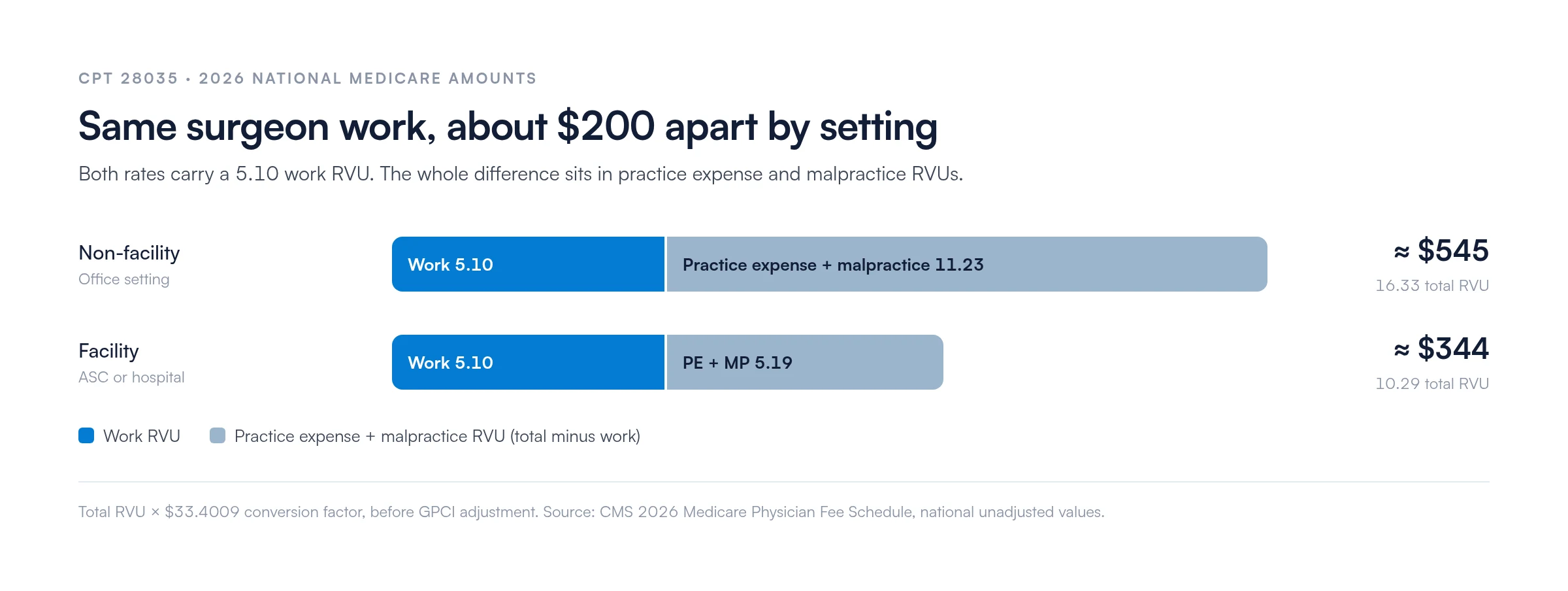
The 2026 national, unadjusted Medicare rate for 28035 is about $545 non-facility and $344 facility, before GPCI adjustment.
Medicare and commercial payers handle bilateral 28035 claims differently, so confirm whether the payer wants modifier -50 or separate -RT and -LT lines.
ICD-10 codes G57.50, G57.51, and G57.52 are the primary diagnosis codes supporting medical necessity for 28035.
Pabau’s claims management tools support podiatric billing workflows, including modifier application and claim submission through the Claim.MD clearinghouse integration.
CPT code 28035 is defined by the American Medical Association with the official descriptor: “Release, tarsal tunnel (posterior tibial nerve decompression).” It belongs to the Incision Procedures on the Foot and Toes section of the CPT code book, which spans codes 28001 through 28035.
The code captures the full surgical release of the flexor retinaculum at the medial ankle to decompress the posterior tibial nerve and its terminal branches. It is a unilateral code by default, so bilateral procedures need a modifier. The table below summarizes its key administrative attributes.
Medical necessity for CPT code 28035 rests on an ICD-10-CM code for tarsal tunnel syndrome or a clinically equivalent nerve entrapment. Payers will deny the claim if the submitted diagnosis does not appear on the payer’s local coverage determination (LCD) for peripheral nerve decompression procedures.
Confirm diagnosis codes against the applicable Medicare LCD or commercial payer policy before submission. The AAPC Codify CPT lookup includes ICD-10 crosswalk data that can help verify which diagnosis codes each payer accepts alongside 28035.
The 2026 Medicare reimbursement rate for CPT code 28035 varies by location. CMS applies a Geographic Practice Cost Index (GPCI) adjustment to the national base rates. Use the CMS Physician Fee Schedule lookup tool to retrieve the exact non-facility and facility rates for your MAC jurisdiction.
The figures below are national, unadjusted 2026 amounts, before the GPCI adjustment for your locality. Verify your local rate before quoting patients or appealing underpayments.
The FastRVU 2026 lookup tool breaks out work, practice expense, and malpractice RVUs alongside the conversion factor. That helps when you validate commercial contracts built on an RVU-based fee schedule.
The surgeon’s work RVU is identical in both settings. Practice expense and malpractice RVUs alone account for the roughly $200 difference between the two rates.
Pabau, the practice management platform we build, sends 28035 claims through its Claim.MD clearinghouse connection. The ERA remittance data that comes back can be reconciled against these expected rates.
Run a fee schedule check before the surgery date rather than at claim submission. Knowing the expected payment in advance lets you quote accurate patient cost-share estimates. It also helps you catch underpayments before the timely filing window closes.
Modifier selection for CPT code 28035 depends on the payer, the number of sides operated, and whether the case involved unusual complexity. The table below maps each common modifier to its use case.
Bilateral billing decision rule: Medicare Administrative Contractors generally prefer two separate line items rather than a single line with -50. Each line, 28035-RT and 28035-LT, is paid at 100% of the allowed amount. Many commercial payers accept -50 on a single line at 150%. Confirm the payer-specific rule before submission. Submitting -50 to a Medicare MAC that expects separate lines is a common and easily avoidable denial trigger.
CPT code 28035 carries a 90-day global surgery period under the Medicare Physician Fee Schedule. The surgical fee bundles the preoperative visit on the day before or day of surgery and the intraoperative service. It also covers routine postoperative care for 90 days after the procedure.
These services are bundled into the global period and cannot be billed separately without a modifier:
These services may be billed separately during the global period with the right modifier:
Four codes sit close enough to 28035 to be picked by mistake for a nerve or fascia release in the foot or ankle. The closest is 28008, which releases fascia without decompressing the nerve. A wrong code here triggers a denial, and a repeated one can draw an audit.
Payers require specific clinical elements in the operative note and the prior authorization request before they process a CPT code 28035 claim. Your medical billing record has to show that surgery was medically necessary and that conservative management failed. The intraoperative findings also have to match the stated diagnosis.
The operative note must include all of the following:
Pre-surgical documentation submitted with the authorization request (when required) must demonstrate:
The nerve conduction study itself is billed separately, under 95907 to 95913 depending on how many nerves were studied.
Prior authorization status for CPT code 28035 varies significantly by payer. Medicare Part B does not require prior authorization for most outpatient surgical procedures, but Medicare Advantage plans and commercial insurers frequently do. Always verify with the specific plan before scheduling surgery.
Confirm billing compliance requirements for each payer at the time of booking to avoid scheduling surgery without an approved authorization. A claim submitted without a required prior auth is a denial that cannot be corrected retroactively in most plans.
CPT code 28035 denials cluster around five root causes. The denial management workflow for podiatric surgery codes is more effective when practices track denial reason codes systematically rather than addressing each claim in isolation. The table below maps the most frequent denial categories to the relevant CARC codes and the corrective action.
Tracking medical billing denial codes at the code level shows where a denial pattern starts. It may be coder-driven (wrong modifier), documentation-driven (missing conservative-care records), or authorization-driven (no prior auth). Pabau routes 28035 claims through its podiatry claims management workflow and shows ERA denial reason codes in the claims dashboard. Billing staff see CARC data without logging into the payer portal.

Run a quarterly audit on 28035 denial patterns. Pull every denial for the code from the last 90 days and group them by CARC code. Then check whether the top cause is a modifier error, missing documentation, or a missing prior authorization. Fix that cause at the source before the next quarter’s claims go out.
Podiatric surgery practices billing 28035 often work across three systems. Conservative-care notes sit in the EHR, authorizations in a payer portal, and claims in a separate billing tool. Because modifier rules change by payer, each claim gets checked by hand.
Pabau keeps the clinical record, the billing workflow, and claim submission in one platform. Its Claim.MD clearinghouse connection submits 837P claims to over 4,000 US payers and returns eligibility results. The 835 remittance files land in the billing dashboard, beside the original claim.
The outcome is a 28035 claim whose modifiers, diagnosis, and authorization match the note it came from. Before releasing a surgical code, the clean claim checklist covers the last pre-submission checks.

Pabau supports CPT code submission, modifier application, and ERA reconciliation for podiatric surgery practices. See how the claims workflow handles 28035 and adjacent foot surgery codes.

The work that decides whether a 28035 claim pays happens before the incision. Confirm the payer’s bilateral rule, secure the authorization, and make sure months of conservative care are on record.
With that done, the operative note only has to confirm the side and the extent of the retinaculum release. Without it, the claim lands in the appeals queue, where the missing record still has to be found.
Pabau keeps conservative-care notes, the operative record, and the claim in one system, so the authorization file and the claim tell the same story. Book a demo to see a podiatric surgery claim go from operative note to submission.

Need to understand how clearinghouse submission works for surgical codes? Claim.MD clearinghouse guide explains how 837P claims are validated and routed to payers.
Seeing recurring claim rejections across multiple CPT codes? Revenue cycle management overview covers the end-to-end workflow from claim creation to payment posting.
Want to benchmark your denial rate against typical podiatric billing thresholds? Best medical billing software for US practices outlines what to look for in a billing platform that handles surgical code complexity.
CPT code 28035 is the procedure code for release of the tarsal tunnel (posterior tibial nerve decompression). The surgeon divides the flexor retinaculum at the medial ankle to relieve pressure on the posterior tibial nerve and its branches. It sits in the Incision Procedures on the Foot and Toes range (28001-28035) and carries a 90-day global period.
Yes. For bilateral tarsal tunnel release on the same day, Medicare Administrative Contractors generally prefer two line items. These are 28035-RT and 28035-LT, each at 100% of the allowed amount. Most commercial payers accept one line with modifier -50, paid at 150% of the single-unit rate. Check the payer’s bilateral rule before submission, because sending -50 to a MAC that expects separate lines is a common denial trigger.
CPT 28035 has a 90-day global period under the Medicare Physician Fee Schedule. The surgical fee covers the preoperative day, the procedure, and routine postoperative care for 90 days. Routine wound checks and related follow-up visits are bundled. Separately billable services need modifier -24 (unrelated E/M), -78 (return to the OR for a complication), or -79 (unrelated procedure).
The most common denial triggers for CPT code 28035 are missing prior authorization (CARC 197) and missing conservative-care documentation (CARC 50/167). A wrong or missing laterality modifier (CARC 4/16) is another. So is a diagnosis code that the payer’s LCD does not cover (CARC 50/97). NCCI bundling conflicts with another foot code on the same date are a fifth cause, resolved with modifier -59 and a supporting operative note.
The codes most often confused with 28035 are 28008, 64704, 64722, and 64726. Code 28008 is a fasciotomy of the foot, which releases fascia rather than the tarsal tunnel. Code 64704 is neuroplasty of a nerve of the hand or foot. Code 64722 decompresses an unspecified nerve and is the fallback when no specific nerve code exists. Code 64726 decompresses a plantar digital nerve in the forefoot, not the tarsal tunnel.
The operative note must record patient position, incision site, and identification of the posterior tibial nerve and its terminal branches. It also records how far the retinaculum was divided, the nerve’s condition, the closure, and the side operated on. Prior authorization requests usually add nerve conduction study or EMG results confirming posterior tibial nerve dysfunction. They also need records of 3-6 months of failed conservative treatment, though the minimum varies by payer.




