

CPT Code 30801: Superficial turbinate ablation billing guide
CPT Code 30801: Official descriptor and procedure overview The American Medical ...

Last Updated: Nov 27, 2026
28234 is the CPT code for tenotomy, open, extensor, foot or toe, each tendon.
It reports an open, dorsal release of one extensor tendon, most often for a hammertoe whose joint does not need surgery. Each tendon released is billed as its own unit. A plantar flexor release is reported with 28230 instead, and hammertoe correction that adds joint resection or fusion is reported with 28285.
Let Pabau's smart automation suggest the right codes, reduce claim denials, and keep your practice compliant—effortlessly.
Automate repetitive tasks and focus on what matters most—your patients.
Reduce coding errors and ensure compliance with the latest regulations.
Clean claims, fewer denials, and faster reimbursements.
Powerful insights and reporting to help your practice thrive.
HIPAA compliant SOC 2 certified GDPR-compliant Trusted by 4,000+ clinics worldwide

CPT code 28234 covers an open, dorsal release of one extensor tendon in the foot or toe, billed as one unit per tendon.
A plantar flexor tenotomy routes to 28230, and hammertoe correction with joint resection or fusion routes to 28285.
Medicare expects a T-modifier (TA through T9) on every toe surgery claim to identify the toe treated.
The 2026 national non-facility rate for 28234 is $411.83 (12.33 total RVUs), with a 90-day global period.
Pabau’s claims management software sends 28234 claims through the Claim.MD clearinghouse and runs eligibility checks before the procedure date.
CPT code 28234 is defined by the American Medical Association as “Tenotomy, open, extensor, foot or toe, each tendon.” It belongs to the AMA’s CPT code set, the five-digit codes that describe procedures performed by physicians and other qualified health care professionals.
The descriptor requires an open approach, meaning a formal incision rather than a percutaneous (blind) stab technique. The tendon being cut must be an extensor tendon, accessed from the dorsal (top) surface of the foot or toe.
Three elements of the descriptor define the billing scenario:
The procedure is most commonly performed for hammertoe deformity correction at the proximal interphalangeal (PIP) joint when the extensor tendon is the primary contracture driver. To hold up to audit, the operative report must name the tendon, confirm the open dorsal approach, and describe the incision and release.
Understanding the surgical steps helps coders audit operative notes accurately. A 28234 tenotomy follows a predictable sequence that documentation must reflect.
An operative report that omits the tendon name or describes only a percutaneous technique will not support 28234. Neither will a note that documents a repair rather than a release. A flexor tendon repair in the foot, for example, is reported with 28200.
The global surgery package for 28234 carries a 90-day global period. Knowing what is bundled and what may be billed separately prevents both underbilling and inappropriate unbundling.
These three codes share a clinical neighborhood, since all of them involve foot and toe tendon surgery. Each one still describes a different procedure. The AAPC CPT code lookup clarifies the descriptors, but the operative note decides the code.
Two facts from the operative note settle the choice, as the chart below shows alongside each code’s 2026 national rate.
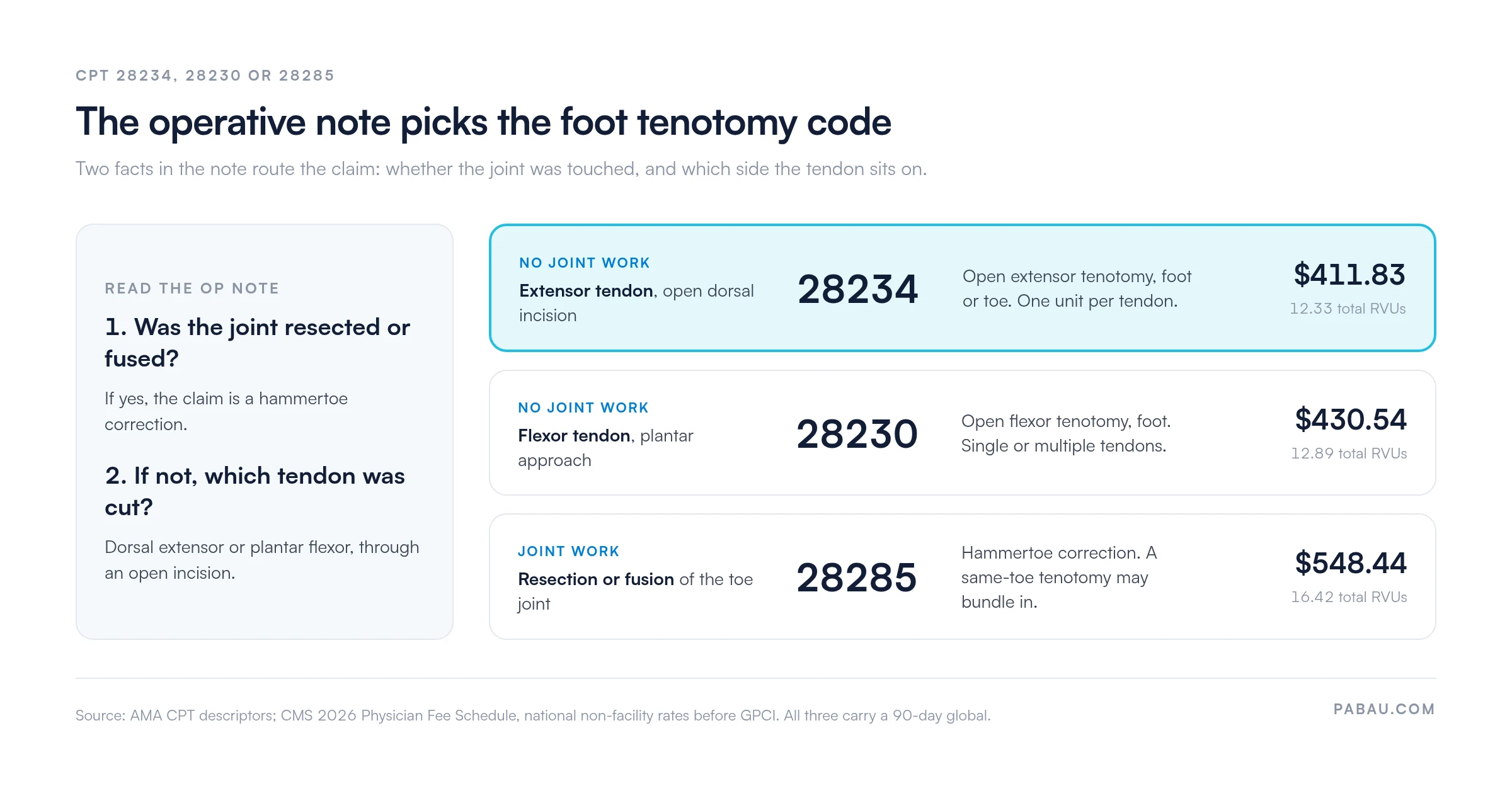
Practical routing rule: If the surgeon performs a tenotomy alongside a 28285 hammertoe correction in the same session, NCCI edits govern whether both codes survive. Verify the current National Correct Coding Initiative (NCCI) edit table before billing the combination. When edits permit, modifier 59 or an XS modifier separates the services.
Modifier selection is where many 28234 claims fail. Medicare and most commercial payers require toe-level identification and procedural context modifiers. Missing one modifier is enough to trigger a denial or a reduced payment.
Always verify the current NCCI edit pairs involving 28234 before billing it alongside 28285 on the same date. CMS updates the NCCI table quarterly, and an edit that permitted separate billing in Q1 may bundle it in Q3. Run the claim through a clearinghouse that checks NCCI edits in real time before submission.
Medical necessity for CPT code 28234 must be established through a specific, laterality-coded ICD-10-CM diagnosis. Submitting an unspecified or incomplete ICD-10 code is a frequent source of denials.
Many payers require documentation of conservative treatment failure before approving a surgical tenotomy. The office notes should include at least one entry showing that shoe modification, splinting, padding, or physical therapy was attempted and proved inadequate. Without this, a prior authorization may be denied even when the ICD-10 code is correct.
No foot-specific Local Coverage Determination governs CPT code 28234. Medicare pays for it under the general Physician Fee Schedule (MPFS) rules for surgery. Those rules cover a procedure that is reasonable and necessary to diagnose or treat an illness or injury.
For a 28234 claim, that general guidance comes down to five checks:
A medical claims clearinghouse that runs real-time eligibility checks shows when a Medicare Advantage plan needs prior authorization. Catching that before surgery avoids the costliest denial, a retrospective one after the service is rendered.
Medicare reimbursement for CPT code 28234 is calculated from relative value units (RVUs) in the CMS Physician Fee Schedule (MPFS). The figures below are 2026 national non-facility amounts at the $33.4009 conversion factor.
Actual payment varies by Geographic Practice Cost Index (GPCI) locality. Use the CMS Physician Fee Schedule lookup tool to get the exact amount for your locality. The FastRVU 2026 lookup tool also shows work and total RVUs with geographic adjustment.
Important: RVUs and the conversion factor change every year. CMS publishes the final rule each November for the following calendar year, so recheck these figures each January before using them in revenue projections.
Accurate documentation is what separates a paid 28234 claim from a denied or recouped one. The operative note and office notes together must tell a complete story from diagnosis through surgical resolution. For billing compliance requirements, the operative report should contain each of these elements.
Submitting a clean claim for 28234 means the billing team checks the operative report against these elements before submission. Building that checklist into the practice’s podiatry claims management workflow catches a missing tendon name before the claim goes out.
28234 claims deny for predictable reasons. Each denial pattern has a corrective action that resolves the issue before the appeal deadline.
A structured denial management workflow catches these patterns before the timely-filing window closes. Tracking 28234 denial reasons by payer over a rolling 90 days shows systematic issues. One example is a payer that asks for the conservative-treatment narrative on every claim.
Refer to the medical billing denial codes reference for CARC code translations when payer explanation of benefits (EOB) messages are unclear.
Before appealing a CPT 28234 bundling denial, verify the NCCI edit table for the quarter when the service was rendered. CMS publishes quarterly updates and an edit in force during Q2 may not have existed in Q1. Filing an appeal citing an edit that was not in effect at the time of service wastes both staff time and the timely-filing window.
A 28234 denial usually traces back to a missing T-modifier, a bundling edit against 28285, or an operative note that never names the tendon. Found on the remittance, each one costs the practice weeks.
In Pabau, the operative note and the claim sit in the same patient record. Billing staff can check the tendon, the approach, and the toe against the note before the claim leaves.
Claims go out through the Claim.MD clearinghouse in CMS-1500 and 837P formats. Eligibility checks run before the procedure date, and the prior authorization code is tracked on the case, with a warning when one is missing.
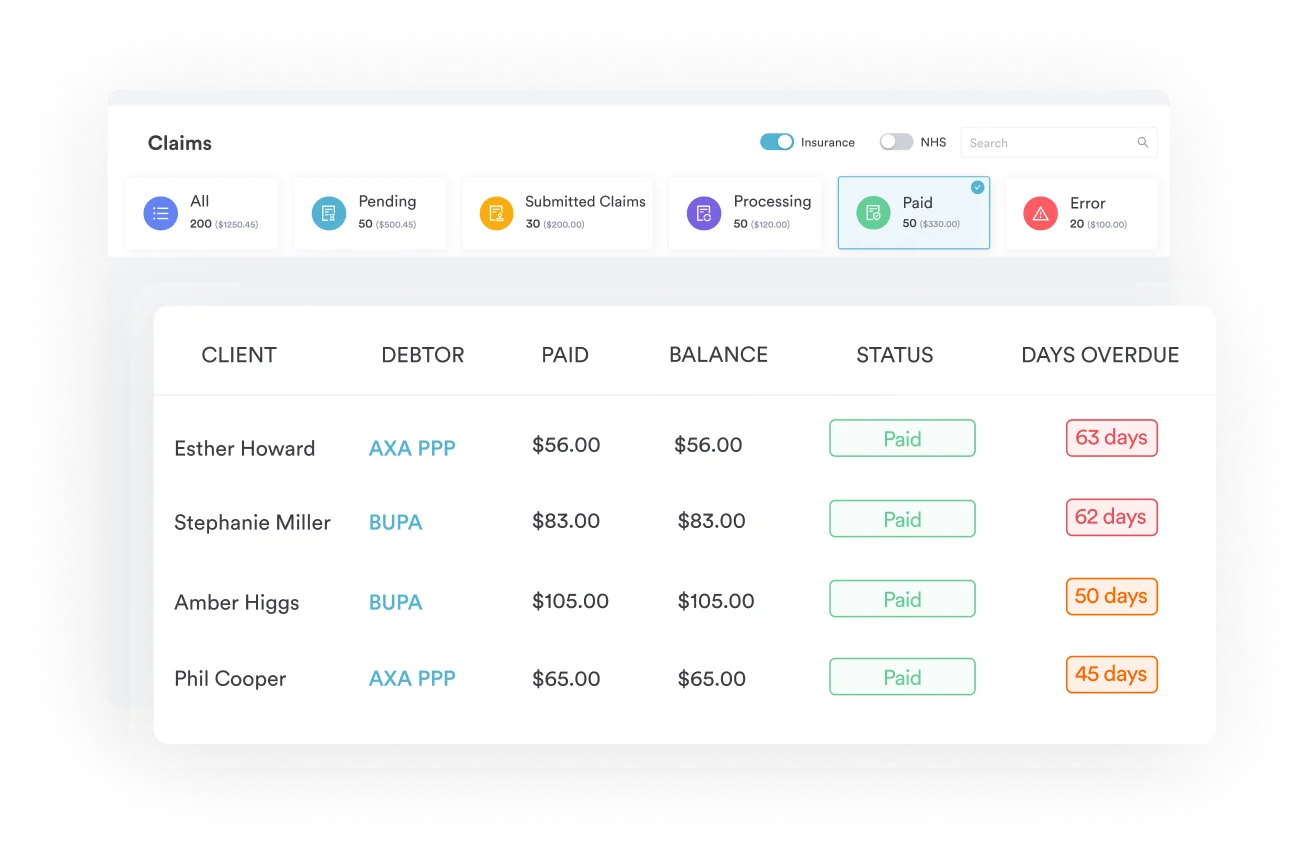
ERA remittances post back against the same record. A rejected tenotomy line is visible next to the note that should have supported it, which makes the fix and the resubmission quick.

Pabau sends CMS-1500 and 837P claims through Claim.MD, checks eligibility before surgery, and posts ERA remittances against the patient record.

CPT code 28234 is a narrow code, and that narrowness protects it on audit. A note that names the extensor tendon, states the open dorsal incision, and stops at release supports the claim on its own.
Where the surgeon also worked on the joint, bill 28285 and let the NCCI edits decide whether the tenotomy survives. Where the released tendon was plantar, bill 28230. Coding to the note keeps a 90-day global claim out of recoupment.
The cheapest place to fix a 28234 denial is the operative note template, before the claim exists. Book a demo to see how Pabau keeps the operative note, eligibility check, and foot surgery claim in one record.

Need to understand how clearinghouse submission works for foot surgery codes? 837 file format guide explains the electronic claim structure used by Claim.MD and other clearinghouses for CPT submissions.
Looking for a reference on reading ERA remittance data after a 28234 claim pays? Electronic remittance advice explained breaks down 835 ERA files and CARC/RARC denial reason codes.
Want to verify insurance eligibility before a tenotomy appointment? Insurance eligibility verification covers how real-time 270/271 transactions prevent authorization surprises on surgical claims.
CPT code 28234 is the AMA procedure code for an open tenotomy of an extensor tendon of the foot or toe. The surgeon works through a dorsal incision to release a contracted tendon causing structural deformity. It covers the incision and release of a single extensor tendon per unit billed, with no joint resection or tendon repair included.
CPT 28234 covers tenotomy only, meaning the surgeon cuts the extensor tendon without touching the joint. CPT 28285 covers hammertoe correction that includes joint-level work such as arthroplasty or partial phalangectomy. When the note describes joint resection and a tenotomy on the same toe in one session, 28285 is typically the right code. NCCI edits may bundle 28234 into it.
CPT 28230 is the correct foot tenotomy CPT code when the surgeon accesses the flexor tendon from the plantar (bottom) surface of the foot. 28234 applies only to dorsal (top) extensor tendons. Submitting 28234 when the operative note documents a plantar approach or a flexor tendon is a code-assignment error that typically triggers a denial.
Medicare pays approximately $411.83 nationally for CPT code 28234 in a non-facility setting in 2026, before GPCI adjustment. The exact amount depends on your locality’s GPCI. Use the CMS Physician Fee Schedule lookup tool at cms.gov with your ZIP code to get the precise figure for your practice location.
The operative report must name the specific extensor tendon, confirm an open (not percutaneous) dorsal incision, and describe the release. Office notes must document conservative treatment failure, a laterality-specific ICD-10 diagnosis, and the functional impairment that made surgery necessary. Missing any of these elements creates a medical necessity gap that payers and auditors can exploit to deny or recoup payment.
CPT code 28234 had no descriptor change for 2026. The code, descriptor, and global period remain stable from prior years. What changes annually is the Medicare conversion factor used to calculate payment from RVUs. Check the finalized Physician Fee Schedule on cms.gov each January for updated payment amounts.




