ICD-10 code S61.201A: Open wound of left index finger without nail damage
ICD-10 code S61.201A covers a left index finger wound of unstated type ICD-10 co...

Last Updated: Oct 16, 2026
Billable Code Specific Code
N83.8 is the billable ICD-10-CM code for other noninflammatory disorders of ovary, fallopian tube and broad ligament.
Coders lean on N83.8 as a default too often, and that's exactly where claims stall. Getting the assignment right means ruling out every more specific N83 code first. Then back the choice with documentation that names the anatomical location and confirms a noninflammatory cause.
Let Pabau's smart automation suggest the right codes, reduce claim denials, and keep your practice compliant—effortlessly.
Automate repetitive tasks and focus on what matters most—your patients.
Reduce coding errors and ensure compliance with the latest regulations.
Clean claims, fewer denials, and faster reimbursements.
Powerful insights and reporting to help your practice thrive.
HIPAA compliant SOC 2 certified GDPR-compliant Trusted by 4,000+ clinics worldwide

ICD-10 Code N83.8 describes other noninflammatory disorders of ovary, fallopian tube and broad ligament, including paraovarian cyst and broad ligament conditions not coded elsewhere in the N83 category.
N83.8 is a billable ICD-10-CM code valid for HIPAA-covered transactions and effective for FY2026 claims submission.
N83.8 carries no Excludes1 note; torsion of ovary or fallopian tube (N83.5-) is simply the more specific code, and it takes precedence whenever torsion is documented.
Pabau’s clinical notes capture ICD-10 code selection and documentation at the point of care, while claims management validates insurer fields and tracks status before submission.
That parent category falls under Chapter 14 of ICD-10-CM, diseases of the genitourinary system (N00-N99).
The code is billable and valid for HIPAA-covered claims, confirmed by the CMS ICD-10-CM code files.
Because N83.8 is a billable code rather than a header, it can go directly on a claim line. It doesn’t need a more specific subcategory code beneath it. That said, coders should always confirm whether a more precise N83.x code applies before defaulting to N83.8.
N83.8 captures adnexal conditions that are noninflammatory in nature but fall outside the more specific subcategories N83.0 through N83.7. The most common conditions documented under this code include:
Approximate synonyms recognized by ICD-10-CM coding references for N83.8 include: paraovarian cyst NOS, paratubal cyst, broad ligament cyst, and adnexal cyst (noninflammatory, NOS). When a provider documents any of these terms and no more specific code applies, N83.8 is the correct assignment.
When a patient presents with a paraovarian cyst confirmed on ultrasound, verify the documentation explicitly states ‘noninflammatory’ or rules out infectious etiology. If the note reads ‘pelvic inflammatory disease with adnexal cyst,’ the inflammatory cause takes priority and N83.8 does not apply.
The includes and excludes notes for N83.8 are where most coding errors originate. Misreading these notes is a direct route to claim denials and audit exposure for OB/GYN practices.
N83.8 does not carry an Excludes1 note. Its only annotation in the tabular list is an inclusionTerm confirming what the code is meant to capture. The parent category N83 carries a separate Excludes2 note, which applies at the category level rather than to N83.8 specifically:
Torsion of the ovary, ovarian pedicle, or fallopian tube (N83.5-) has no Excludes1 relationship with N83.8 anywhere in the tabular list. N83.5- itself carries only one inclusionTerm, for torsion of the accessory tube, and no excludes note of its own.
The reason N83.8 shouldn’t be assigned when torsion is documented is a specificity issue, not an Excludes1 edit: N83.5- is the more precise code for a torsion event, so it takes precedence whenever torsion is what’s documented.
Six conditions come up often enough in gynecology charts that they deserve their own code, never N83.8:
When documentation names one of the conditions above, coders must assign the more specific code. N83.8 is only valid when none of N83.0 through N83.7 fits the documented diagnosis. Verify using the CDC/NCHS ICD-10-CM web tool if uncertain.
Clinics treating urological conditions often run on men’s health clinic software designed for discreet, recurring care.
Accurate differential code selection within the N83 category is the most common challenge for coders working gynecology encounters. N83.8 is a residual category, meaning it applies only after ruling out every sibling code. The table below summarizes when each N83.x code applies versus N83.8.
The key distinction between N83.8 and N83.9 is specificity. N83.8 requires the provider to have documented a named condition (even if it is a catch-all term like “paraovarian cyst NOS”). N83.9 applies when the noninflammatory nature is documented but no specific condition name is recorded.
Poor documentation is the underlying cause of most N83.8 denials. Payers increasingly request clinical notes to substantiate gynecology diagnosis codes, particularly for adnexal cysts and broad ligament conditions that have surgical or imaging implications.
The HIPAA-covered claim submission requirements make accurate documentation essential for audit defense.
Before you submit a claim with N83.8, confirm the note covers each of these points:
Practices using digital intake forms can pre-structure encounter notes to capture these fields consistently, cutting down the documentation gaps that generate queries.

Three patterns account for the majority of N83.8 coding errors seen in gynecology billing audits.
Paraovarian cysts originate from remnant tissue adjacent to the ovary, not from the ovary itself. However, when imaging is non-specific, or the provider documents “ovarian cyst” without naming the source, coders can default to N83.8. N83.2- (other and unspecified ovarian cysts) is often the better fit.
The reverse also happens too. Providers sometimes document a confirmed paraovarian cyst, but coders assign N83.20 by default. Query the provider when imaging and documentation conflict.
Torsion involving an existing paraovarian or broad ligament cyst sometimes prompts coders to assign both N83.5- and N83.8 on the same claim.
There is no Excludes1 edit against this combination in the tabular list, but it is still the wrong call: N83.5- is the more specific code for the condition actually driving the encounter, so it is the one that should be assigned.
Assign only the torsion code (N83.5-) when the acute torsion event is the reason for the encounter. The underlying cyst may be noted in the record but should not drive a simultaneous N83.8 assignment unless specifically supported by the payer’s policy.
Terms like “adnexal mass,” “pelvic cyst,” or “adnexal cyst, NOS” may or may not support N83.8 depending on additional context.
Rather than assigning by assumption, query the provider to confirm the condition type, noninflammatory nature, and anatomical location. A documented query and response protects the practice in audit and may allow a more specific code assignment.
For practices managing gynecology coding at scale, integrated claims management software can flag incomplete documentation before a claim reaches the clearinghouse. That catches errors at the point of entry, not after a denial.

N83.8 is valid for both outpatient and inpatient claim submission. Billing context affects how the code is handled by payers.
In the outpatient setting, N83.8 functions as a standalone diagnosis code paired with an appropriate evaluation and management (E/M) CPT code or procedure code. Payers typically require the diagnosis to match the medical necessity of the service billed.
A paraovarian cyst managed conservatively pairs with an office visit code. One requiring surgical intervention pairs with the relevant laparoscopy or cystectomy CPT code. Always verify payer-specific LCD/NCD policies before assuming medical necessity coverage.
When N83.8 appears on an inpatient claim, it maps to MS-DRG groupings under the female reproductive system major diagnostic category (MDC 13).
The specific DRG assignment depends on whether a procedure was performed and the presence of complications or comorbidities (CC/MCC). Facilities should verify the current FY2026 MS-DRG grouper output against CMS’s ICD-10-CM/PCS definitions files, rather than relying on prior-year DRG tables.
N83.8 carries a POA indicator requirement for inpatient facility claims. Most noninflammatory adnexal disorders are chronic or pre-existing conditions and would typically be coded as POA “Y” (yes, present on admission). Confirm against your facility’s POA exempt list and current CMS guidance, as POA indicator rules are subject to annual updates. The filing deadline runs from the date of service, not the date the practice noticed the claim was unpaid.
Run N83.8 through your clearinghouse’s pre-submission edit engine before filing inpatient claims. MS-DRG groupers update annually, and a DRG assignment that applied in FY2025 may shift with FY2026 code definitions. Catching this before adjudication avoids post-payment audit risk.
Standalone code lookup tools solve one part of the problem. They tell coders what N83.8 means. They don’t capture the clinical context needed to justify it at audit.
Practices using Pabau can attach ICD-10-CM codes directly within the consultation record at the point of care.
That documentation feeds directly into the billing workflow through Pabau’s integrated claims management. Nothing gets lost between looking up a code and transcribing it onto the claim.
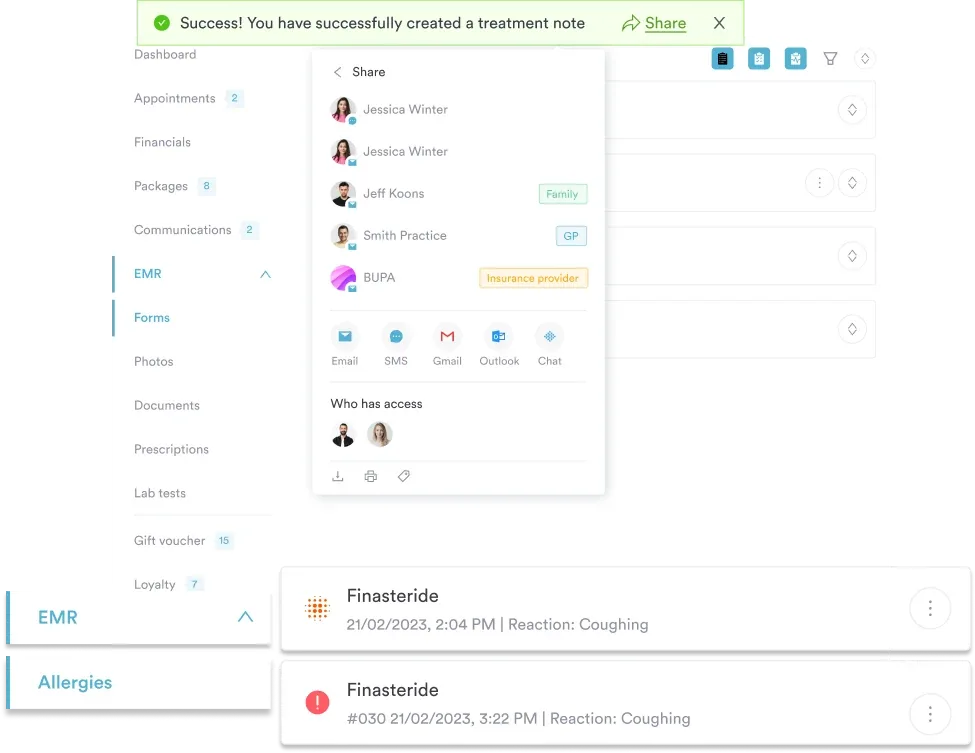
For fertility practices handling complex gynecology coding, that integration means fewer queries, fewer denials, and a cleaner audit trail.

Pabau’s clinical notes capture accurate ICD-10 coding at the point of care, and claims management validates and tracks the claim through submission. See how gynecology and women’s health practices reduce transcription errors and denials.

Treat N83.8 as a last resort, not a shortcut. Check it against N83.0 through N83.7 first, and only assign it once the note names the condition and rules out an inflammatory cause.
That extra step costs a coder a minute or two per chart. It buys back hours later, when a payer can’t challenge a claim that already answers the obvious questions.
Tighter documentation habits slow down a busy encounter today, but they’re what keeps a gynecology claim moving instead of stalling in review. Book a demo to see how Pabau keeps N83.8 documentation, coding, and claims status together from the first note to the final payment.

Coding a benign ovarian finding on the same chart? ICD-10 code D27.0 covers the documentation and code assignment for a benign neoplasm of the right ovary.
Billing the procedure side of a fertility workup? IVF CPT codes breaks down the codes billed most often alongside reproductive health diagnoses.
Coding a cervical spine injury this week? ICD-10 code S12.150K walks through the subsequent-encounter rules for a displaced C2 spondylolisthesis.
Stuck on a procedure with no matching CPT code? CPT code 01999 explains when the unlisted anesthesia code applies and what payers expect documented.
Handling DME billing for a dialysis patient? HCPCS code A4725 covers the coverage rules and fee schedule for dialysate solution.
The closest match is ICD-9-CM code 620.8, other noninflammatory disorders of the ovary, fallopian tube, and broad ligament. CMS lists it as an approximate GEM crosswalk, not a one-to-one match, since ICD-10-CM split the old category into more specific codes.
The CPT code depends on the surgical approach. Laparoscopic excision of a paraovarian or paratubal cyst is commonly billed under CPT 58662, while cyst aspiration alone uses CPT 49322. Confirm the exact code against the operative note before submitting the claim.
No. A clear operative note that names the location and rules out infection can support N83.8 without imaging, though imaging still helps confirm it.
Not always. Small, asymptomatic paraovarian cysts are often just monitored with repeat ultrasound. Surgery becomes the plan when a cyst is large, symptomatic, growing, or looks suspicious on imaging.