

ICD-10 code S61.201A: Open wound of left index finger without nail damage
ICD-10 code S61.201A covers a left index finger wound of unstated type ICD-10 co...

Last Updated: Oct 16, 2026
Billable Code Specific Code
H18.10 is the billable ICD-10-CM code for bullous keratopathy, unspecified eye.
For broader ophthalmic coding context, see the ICD-10 Code H02.9: Unspecified disorder of eyelid guide and the ICD-10 Code H26.8: Other specified cataract page for other examples of how unspecified-eye and specified-eye codes are structured.
Practices managing corneal and eye-surface conditions may also reference the ICD-10 Code H17.9: Unspecified corneal scar and opacity guide, the ICD-10 Code H35.9: Unspecified retinal disorder page.
Let Pabau's smart automation suggest the right codes, reduce claim denials, and keep your practice compliant—effortlessly.
Automate repetitive tasks and focus on what matters most—your patients.
Reduce coding errors and ensure compliance with the latest regulations.
Clean claims, fewer denials, and faster reimbursements.
Powerful insights and reporting to help your practice thrive.
HIPAA compliant SOC 2 certified GDPR-compliant Trusted by 4,000+ clinics worldwide

H18.10 (Bullous keratopathy, unspecified eye) is a billable ICD-10-CM diagnosis code for fiscal year 2026, used when the clinical record does not document which eye is affected.
H18.10 is the unspecified-eye child code under parent H18.1; laterality-specific codes H18.11 (right), H18.12 (left), and H18.13 (bilateral) must be used whenever the chart documents which eye is affected.
Payers increasingly scrutinize unspecified-eye codes – always document the specific eye in clinical notes to avoid denials and audit exposure.
CPT 92071 (fitting of contact lens for treatment of ocular surface disease), not CPT 92310, is the correct pairing for bandage lens management of bullous keratopathy.
Pseudophakic bullous keratopathy (IOL in place) is coded H18.1x with Z96.1 as the secondary code – not H59.01X, which is reserved for aphakic cases where no lens was implanted, per American Academy of Ophthalmology coding guidance.
Pabau’s claims management software and AI-assisted documentation tools help ophthalmology practices code accurately and submit clean claims the first time.
Bullous keratopathy is a condition in which fluid accumulates within the corneal epithelium, forming painful blisters or bullae on the surface of the eye. It typically results from endothelial cell loss or dysfunction, which impairs the cornea’s ability to pump fluid out of the stroma. As fluid builds up, vision blurs and the epithelial surface becomes irregular and uncomfortable.
The condition arises most commonly as a complication of intraocular surgery. Two clinical subtypes are especially relevant for coding accuracy:
Other causes include Fuchs endothelial dystrophy (coded separately under H18.51), prolonged corneal edema. Accurate patient records documenting the underlying cause support both appropriate code selection and downstream payer review.

H18.10 is a billable ICD-10-CM diagnosis code for the 2026 fiscal year. It is valid for HIPAA-covered transactions and accepted by Medicare, Medicaid, and most commercial payers.
Understanding the hierarchy prevents common coding errors:
| Code | Description | Billable? |
|---|---|---|
| H18 | Other disorders of cornea (chapter header) | No |
| H18.1 | Bullous keratopathy (parent code) | No |
| H18.10 | Bullous keratopathy, unspecified eye | Yes |
| H18.11 | Bullous keratopathy, right eye | Yes |
| H18.12 | Bullous keratopathy, left eye | Yes |
| H18.13 | Bullous keratopathy, bilateral | Yes |
The parent code H18.1 and the chapter header H18 are non-billable. Only the four child codes at the fifth-character level (H18.10 through H18.13) can be submitted on claims. Submitting H18.1 on a claim will result in rejection, as payers require the laterality-specific or unspecified-eye detail that fifth-character codes provide.
The full code path for ICD-10 Code H18.10 is: Chapter 7 (Diseases of the eye and adnexa, H00-H59) > Block H15-H22 (Disorders of sclera, cornea, iris and ciliary body) > H18 (Other disorders of cornea) > H18.1 (Bullous keratopathy) > H18.10 (unspecified eye).
Per the CMS ICD-10-CM coding resources, coders must use the most specific code available that is supported by documentation.
ICD-10-CM Official Guidelines for Coding and Reporting require coders to assign the most specific code the clinical documentation supports. For H18.1x codes, laterality must be coded unless the documentation genuinely does not specify which eye is involved.
Use H18.10 only when:
Use laterality-specific codes in all other situations:
A practical rule: if the operative report, slit-lamp findings, or clinical note identifies the eye by laterality, the coder must use that laterality code. Defaulting to H18.10 when H18.11 or H18.12 is appropriate is a documentation-accuracy error that creates audit risk.
Ophthalmology payers track unspecified-eye code patterns, and high utilization of H18.10 in a practice can trigger pre-payment review. Robust compliance management processes reduce this exposure. Practices managing related ocular conditions may also review the ICD-10 Code H67.9: Otitis media in diseases page for guidance on coding comorbid ear and eye conditions documented in the same encounter.

Before assigning H18.10, query the clinical note for any laterality reference: operative side, slit-lamp entry, or patient complaint documentation. If the eye is named anywhere, the laterality-specific code applies. Reserve H18.10 strictly for cases where the record is genuinely silent on which eye is involved.
Coders searching for a pseudophakic bullous keratopathy ICD-10 code often land on H59.01X (Keratopathy, bullous aphakic, following cataract surgery), since it’s the only “bullous keratopathy after surgery” code a quick lookup surfaces. It’s the wrong code for the pseudophakic presentation.
The American Academy of Ophthalmology’s coding guidance addresses this directly. Because the eye has an intraocular lens (IOL) in place, the correct primary diagnosis is H18.11, H18.12, or H18.13 (bullous keratopathy, coded by laterality), with Z96.1 (presence of intraocular lens) reported as the secondary code.
H59.01X is reserved for aphakic bullous keratopathy instead — cases where no lens was implanted. That’s a different clinical picture from the far more common pseudophakic subtype.
Two checks settle which code family applies:
The distinction matters beyond reimbursement. H59.01X and H18.1x sit in different ICD-10-CM chapters — postprocedural complications versus disorders of the cornea — so a misclassified claim can also misstate whether the condition is a surgical complication for quality-reporting purposes.
Several corneal conditions share overlapping clinical features with bullous keratopathy. The table below shows where each fits in the ICD-10-CM hierarchy.
| Code | Description | Key distinction |
|---|---|---|
| H18.10 | Bullous keratopathy, unspecified eye | Epithelial bullae from endothelial failure; laterality unspecified |
| H18.11 | Bullous keratopathy, right eye | Same condition, right eye documented |
| H18.12 | Bullous keratopathy, left eye | Same condition, left eye documented |
| H18.13 | Bullous keratopathy, bilateral | Both eyes affected |
| H18.20 | Unspecified corneal edema | Stromal or epithelial edema without bullae formation; less specific than H18.1x |
| H18.51 | Endothelial corneal dystrophy (Fuchs) | Hereditary endothelial dysfunction; not post-surgical |
| H18.6x | Keratoconus | Ectatic disorder; corneal thinning and protrusion, not edema |
| H59.011-H59.019 | Aphakic bullous keratopathy following cataract surgery | No IOL present; separate postprocedural code family, not for pseudophakic cases (see below) |
The most clinically important distinction is between H18.10 (bullous keratopathy) and H18.20 (unspecified corneal edema). Bullous keratopathy specifically involves the formation of epithelial bullae and represents a more advanced stage of corneal decompensation than simple edema. When the record documents bullae or blister formation on the corneal surface, H18.1x codes apply. When edema is present without bullae, H18.2x codes are more appropriate. An itemized superbill keeps the required fields in one place: dates, codes, charges and provider identifiers.
Endothelial corneal dystrophy (H18.51) is often the underlying cause that progresses to bullous keratopathy, but they are coded separately. If both conditions are documented and clinically relevant, both codes may be reported according to the WHO ICD-10 classification guidelines on sequencing multiple diagnoses.
The ICD-10-CM Official Guidelines for Coding and Reporting confirm the sequencing rule for multiple coding: report the condition chiefly responsible for the encounter first.
For practices reconciling pre-2015 billing data, the ICD-9-CM equivalent for bullous keratopathy is as follows.
| ICD-10-CM Code | Description | ICD-9-CM Equivalent |
|---|---|---|
| H18.10 | Bullous keratopathy, unspecified eye | 371.23 (Bullous keratopathy) |
| H18.11 | Bullous keratopathy, right eye | 371.23 (no laterality in ICD-9) |
| H18.12 | Bullous keratopathy, left eye | 371.23 (no laterality in ICD-9) |
| H18.13 | Bullous keratopathy, bilateral | 371.23 (no laterality in ICD-9) |
ICD-9-CM code 371.23 mapped to all variants of bullous keratopathy without differentiating laterality. The introduction of ICD-10-CM in October 2015 added laterality as a required data element for H18.1x codes, significantly increasing specificity. Use the CDC/NCHS ICD-10-CM web tool to verify current code validity and crosswalk accuracy for any code-year lookup.

Pabau’s claims management tools help ophthalmology and specialty practices submit accurate codes, track claim status, and resolve denials faster. See how practices are reducing billing errors with cleaner documentation workflows.

Payers reviewing H18.1x claims expect documentation that supports both medical necessity and the laterality decision. The correct ICD-10 code alone is not sufficient.
Ophthalmology practices using digital intake forms can pre-populate laterality fields from patient history, reducing the chance of a missing laterality at the time of coding. Templates that prompt the clinician to confirm left/right/bilateral before finalizing the encounter note create a consistent documentation standard across providers.

This is particularly valuable in high-volume ophthalmology settings.
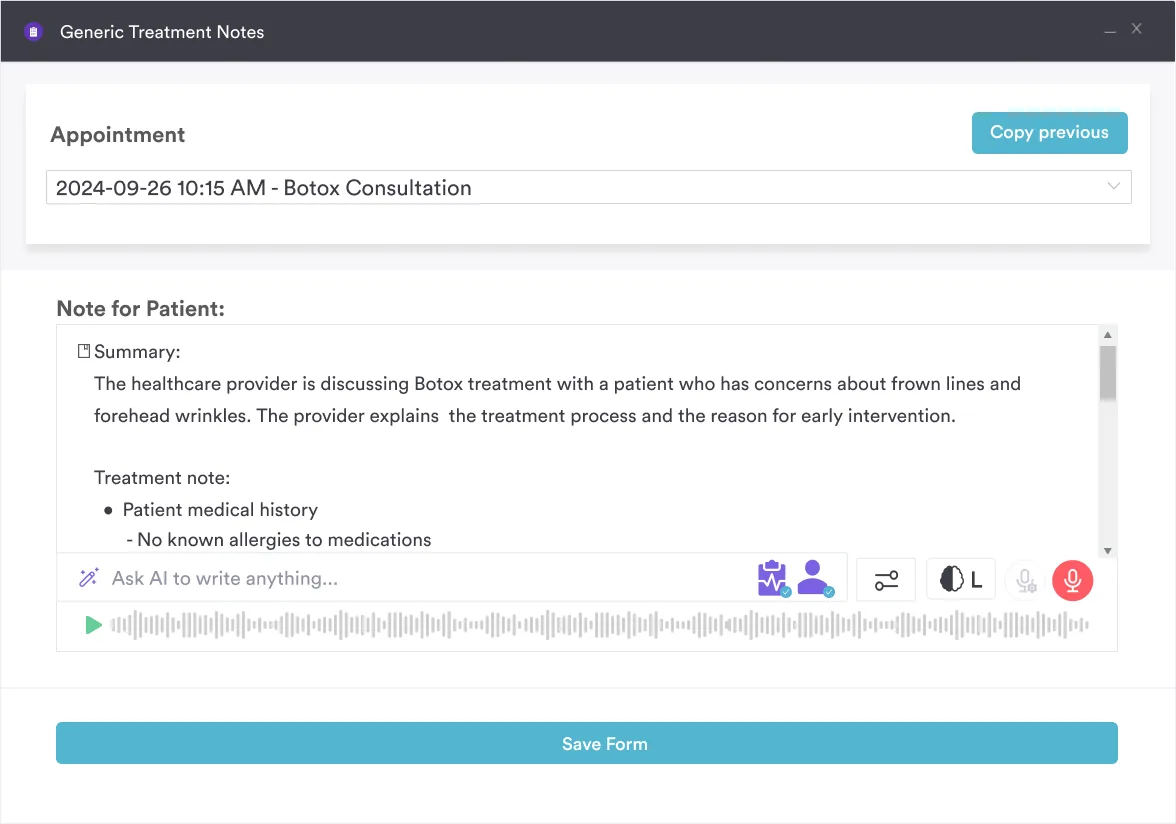
Practices with claims management software integrated into their EHR can run pre-submission edits that check for unspecified-eye codes when an eye is documented elsewhere in the encounter. This catches the most common H18.10 over-utilization error before it reaches the payer.
Review the ICD-10 Code H26.9: Unspecified cataract coding guide for another example of the documentation standard payers expect for under-specified ophthalmology diagnoses before claim submission.
Run a quarterly audit of H18.10 claim volume against H18.11, H18.12, and H18.13 in your practice. A high ratio of unspecified-eye codes relative to laterality-specific codes signals a documentation or coding workflow problem worth investigating before a payer initiates a review.
H18.10 commonly appears alongside the following CPT procedure codes:
When submitting these associated procedure codes, the ICD-10 diagnosis code must support medical necessity for each CPT code billed. Payers apply medical necessity criteria, so the clinical documentation linking the bullous keratopathy diagnosis to the specific procedure performed must be explicit.
For example, endothelial keratoplasty (CPT 65756) is increasingly used in lieu of full-thickness transplant — see the faricimab-svoa (Vabysmo) billing guide for a related ophthalmic drug often used alongside surgical planning, and refer to CMS ICD-10-CM coding resources for payer-specific coverage logic for these code pairings.
H18.10 is appropriate only when the clinical record is genuinely silent on which eye is affected. When laterality is documented anywhere in the chart, H18.11, H18.12, or H18.13 must be used.
Misapplying H18.10 creates audit risk and, in some payer environments, triggers automatic downcoding or denial. Building laterality checks into the documentation workflow before claim generation prevents this error at the source.
Pabau’s HIPAA-compliant practice management platform supports ophthalmology teams with integrated claims management, digital forms with laterality prompts, and AI-assisted documentation review. To see how practices are reducing coding errors and claim denials, book a demo with our team.

Need a compliant patient records framework for ophthalmology? Pabau’s client record management provides structured encounter documentation with laterality fields built in.
Coding yellow-orange skin discoloration? ICD-10 code E67.1 guide This guide covers coding criteria and sibling codes for hypercarotenemia, which presents without scleral icterus.
Looking to streamline documentation across multiple providers? Pabau Scribe surfaces missing laterality data before the claim is generated.
ICD-10 Code H18.10 is a billable diagnosis code for Bullous keratopathy, unspecified eye, classified under Chapter 7 (Diseases of the eye and adnexa) of ICD-10-CM. It is used when bullous keratopathy is confirmed but the clinical record does not specify whether the right or left eye is affected.
Yes, H18.10 is a billable ICD-10-CM code valid for claim submission in 2026. Its parent code H18.1 and the chapter header H18 are non-billable; only the fifth-character codes H18.10 through H18.13 can be submitted on claims.
H18.10 (Bullous keratopathy) applies when the corneal decompensation has progressed to the point of forming epithelial bullae or blisters. H18.20 (Unspecified corneal edema) is used when corneal fluid accumulation is present without documented bullae formation. When the record explicitly notes blisters or bullae, H18.1x codes take precedence over H18.2x codes.
The ICD-9-CM equivalent is 371.23 (Bullous keratopathy). ICD-9 did not differentiate laterality for this condition; all four H18.1x codes (unspecified, right, left, bilateral) map back to 371.23 when crosswalking historical records.
Query when the clinical note, slit-lamp record, and operative report are all silent on which eye is affected. If laterality appears anywhere in the encounter documentation but the coder is uncertain how to interpret it, a clinical query is appropriate before defaulting to H18.10. Never assume unspecified when laterality can be inferred from the record.
No. American Academy of Ophthalmology coding guidance confirms that pseudophakic bullous keratopathy – an eye with an intraocular lens in place – is coded H18.11, H18.12, or H18.13 by laterality, with Z96.1 (presence of intraocular lens) reported as the secondary code. H59.01X is reserved for aphakic bullous keratopathy, where no lens was implanted.
There’s no dedicated code for corneal decompensation itself – it’s coded by clinical stage. Once decompensation has progressed to epithelial bullae, use H18.10-H18.13 (bullous keratopathy, by laterality). If edema is present without bullae, H18.20-H18.23 (unspecified corneal edema) applies instead.
Z96.1 is the ICD-10-CM code for presence of an intraocular lens (pseudophakia). It’s reported as a secondary code alongside H18.1x when a patient with an IOL develops bullous keratopathy, not as a stand-alone diagnosis.



