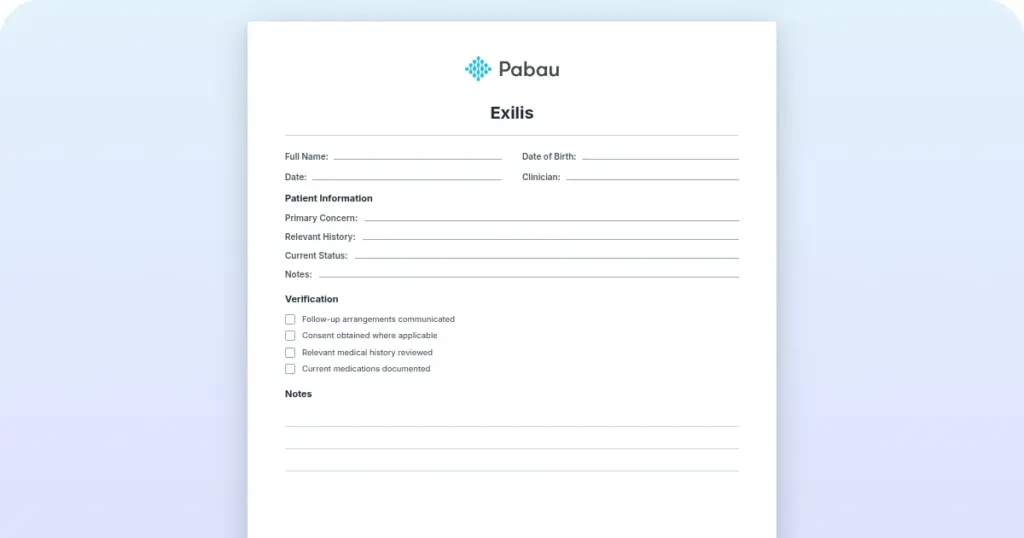
Exilis patient treatment record: Free PDF for RF sessions
An Exilis patient treatment record is the session log for BTL’s radiofrequ...

3
Last Updated: Oct 23, 2026

Medical spa POS software handles payments, inventory, and memberships inside a HIPAA-compliant clinical environment, not just a retail checkout.
Generic POS systems like Square lack native EMR, audit trails, and consent form workflows that medical spas legally require.
According to the American Med Spa Association, practice management software must function as a POS for credit card processing, membership billing, and loyalty point tracking.
Pabau’s integrated payment processing ties every transaction directly to a client’s treatment record, reducing billing errors and staff switching between systems.
Most med spas lose revenue before a client ever leaves the building. A checkout process that can’t redeem a membership credit, apply a loyalty discount, and record a retail product sale in one step creates the kind of friction that kills repeat bookings. Medical spa POS software solves this, but only when it’s built specifically for clinical environments rather than bolted on from a generic retail system. Our roundup of software for med spas ranks eight platforms on payments, memberships, and retail as well as charting. Pabau’s medical spa software integrates the full payment workflow directly into clinical operations, so nothing falls through the cracks at checkout.
This guide explains what medical spa POS software actually does, why specialist solutions outperform retail alternatives, which features matter most, and how to evaluate options for your practice.
Medical spa POS software, sometimes called a med spa POS system, is a point-of-sale system that handles financial transactions inside a healthcare-regulated aesthetic practice. Unlike a standard retail POS, it processes payments for clinical treatments, membership subscriptions, retail product sales, gift cards, and treatment packages, all within a single checkout flow that stays connected to the client’s medical record.
The distinction matters because a med spa operates at the intersection of clinical medicine and consumer retail. Every payment event carries clinical context. A Botox appointment checkout should automatically update the client’s treatment history, trigger post-care instructions, and adjust injectable inventory simultaneously. A standalone retail POS cannot do any of this without manual re-entry across multiple systems.
Pabau’s payment processing is embedded within the clinical workflow, so the checkout step is simply the final stage of a treatment record rather than a separate administrative task. Inside full medical spa practice management software, the POS is not a separate app you reconcile at the close of day.
The American Med Spa Association is clear on this: practice management software for medical spas must also function as a POS system for credit card processing, membership billing, and loyalty point tracking. This is an operational baseline, not a nice-to-have feature.
Square, Stripe, and similar retail POS platforms are built for coffee shops and boutiques. They handle card-present transactions cleanly, but they have no concept of a client’s medical history, consent status, or treatment plan. Running a med spa on a generic POS creates four specific operational problems.
A useful reference: our medical spa compliance checklist covers the full range of operational and regulatory requirements that affect your software choices, including payment and data handling.
Two compliance frameworks govern payments at a medical spa: HIPAA and PCI DSS. They address different risks and require different things from your software.
| Framework | What it governs | What it requires from POS software |
|---|---|---|
| HIPAA | Protected health information (PHI) | Encrypted records, access controls, audit trails, Business Associate Agreements (BAAs) |
| PCI DSS | Payment card data | Tokenised card storage, secure transmission, PCI-compliant payment gateway |
A med spa collecting client health history at intake and processing card payments is subject to both. Generic retail POS platforms typically address PCI DSS but are not designed for HIPAA-regulated environments. HIPAA compliant medical spa software must satisfy both standards simultaneously, not just the card-security half.
Pabau’s approach combines encrypted client records with digital consent forms that are stored securely against the client’s profile. When a treatment is checked out, the consent status is already confirmed, the clinical note is already linked, and the payment is processed through a PCI-compliant gateway. None of these steps require staff to leave the platform or re-enter data elsewhere.
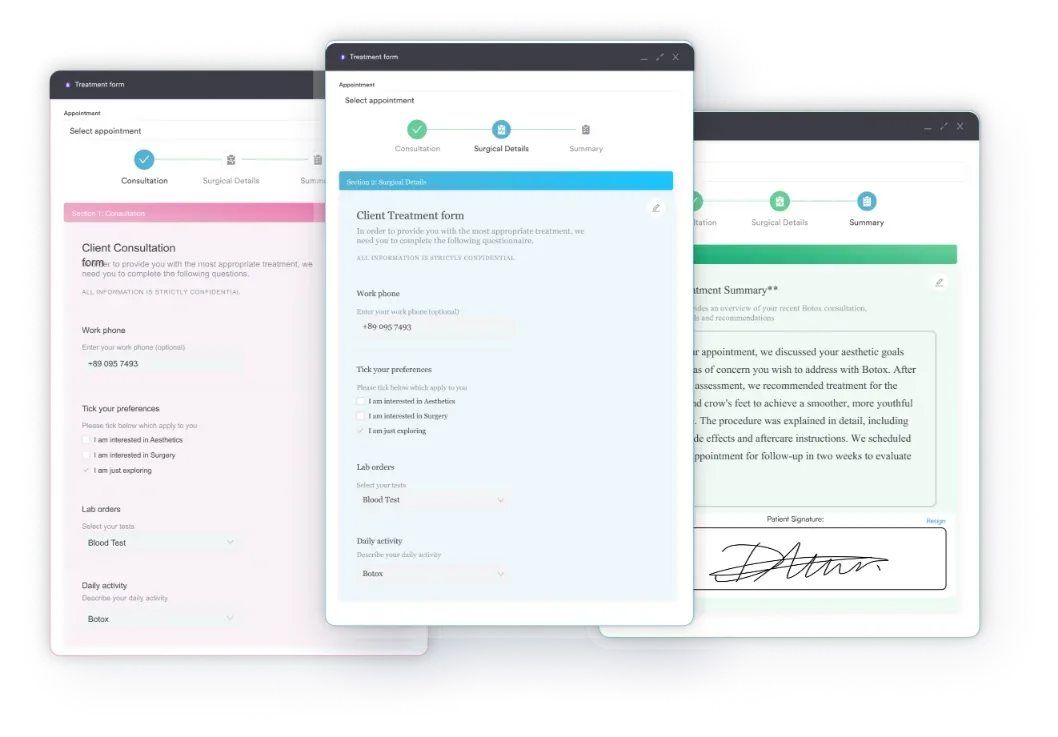
For a deeper look at integrated payment processing for spas and how it reduces compliance risk, our guide covers the key operational differences between standalone and integrated systems.

Pabau connects clinical records, consent forms, inventory, and payment processing in one platform. Book a demo to see how the checkout flow works for real med spa operations.

Not all medical spa POS software delivers the same capabilities. These are the features that separate a clinical-grade system from a cosmetically rebranded retail tool.
A single checkout session should handle a laser treatment, a retail SPF product, and a gift card redemption without toggling between screens. Payment reconciliation workflows become dramatically simpler when retail and clinical transactions share a single ledger, with automatic categorization by revenue type.
Membership billing is one of the highest-margin revenue streams for a med spa. Recurring treatments like laser hair removal or skin rejuvenation are often pre-sold as packages or billed on a monthly membership, so membership and package billing has to verify the tier at checkout, apply the correct discount or credit, and update the client’s remaining balance, all without staff manually checking a spreadsheet. Membership billing tools inside Pabau handle recurring charge cycles and treatment credit redemption natively, tied directly to the client’s account. If building a med spa membership program is part of your growth plan, your POS needs to support the full billing logic from day one.
Every retail product sold through the POS should decrement the corresponding inventory record instantly. For med spas, this matters for two product categories: over-the-counter retail (skincare, supplements) and clinical consumables (syringes, injectables, filler). For injectables, that means tracking lot numbers and expiration dates, so an expired vial never reaches a client and every unit stays traceable if a product is recalled. Inventory management built into the POS prevents the overselling and waste that costs growing practices significant money. For context on how this plays out operationally, our guide on selling retail products at a med spa covers the merchandising and tracking strategies that work best.
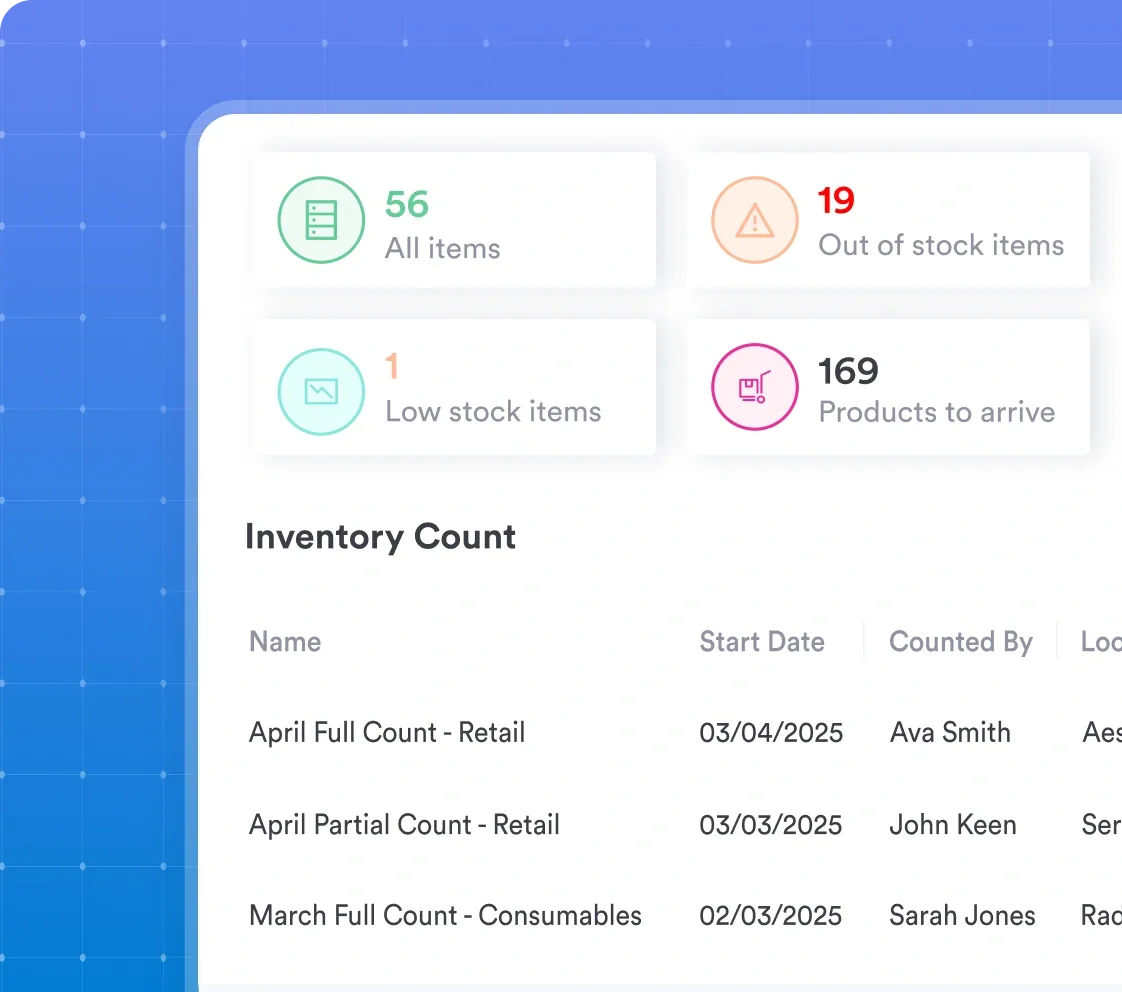
Gift cards generate upfront revenue and drive new client acquisition. Deposits reduce no-shows. Loyalty points incentivize repeat visits. A medical spa POS software system should handle all three at the checkout screen, with balances tracked automatically against each client record. Some platforms also offer buy-now-pay-later financing at checkout, which can lift average spend on higher-ticket treatment packages. Our guide to gift card tracking in med spas explains how to structure this operationally without creating reconciliation headaches at month-end.
Revenue broken down by provider, service category, retail versus clinical, and membership versus one-off gives practice managers the data they need to make pricing and staffing decisions. Medical spa POS software should surface this without requiring a manual export to a spreadsheet. The best payment processing tools for clinics combine transaction-level detail with practice-level reporting that covers both sides of the revenue mix.
Run a reconciliation report weekly, not monthly. Med spas with active membership programs and retail sales see discrepancies compound quickly when review cycles are too long. A weekly check against your POS ledger and inventory counts catches errors while they’re still small.
Choosing the right medical spa POS software comes down to how deeply the payment layer connects with the clinical layer. A system that handles payments well but keeps clinical records in a separate application will always require staff to work across two tools, creating data gaps and billing errors at volume.
For a broader evaluation of the best medical spa software beyond the POS layer, our clinic management software buyer’s guide covers the full feature checklist across scheduling, clinical records, and financial management.
Medical spa POS software is not a payment terminal. It is the financial layer of a clinical operation, and it only works properly when it’s integrated with the clinical record, inventory, membership logic, and compliance framework underneath it.
Pabau’s transaction management connects every checkout to the client’s full treatment record, keeping retail sales, clinical payments, and membership billing in one place. To see how the checkout workflow fits into a complete med spa operation, book a demo and we’ll walk through it with your specific setup in mind.

Standardizing recovery guidance after radiofrequency microneedling? Morpheus8 aftercare instructions list what to expect, what to avoid, and the signs that warrant a call.
Planning to grow your membership revenue? Tiered med spa memberships covers how to structure membership tiers and pricing to maximize recurring revenue.
Need a consistent intake form for new patients? Patient information form template gathers demographics, medical history, and emergency contacts.
Medical spa POS software is a point-of-sale system designed for aesthetic healthcare practices that handles clinical treatment payments, retail product sales, membership billing, gift card redemptions, and package credits within a single HIPAA-aware checkout flow connected to the client’s medical record.
Yes. Medical spas that collect or store protected health information (PHI) are subject to HIPAA, which means the software handling that data, including the POS, must support encrypted records, access controls, audit trails, and vendor Business Associate Agreements (BAAs). Generic retail POS systems are generally not built to meet these requirements.
Square can process card payments for med spas with a strong retail component, but it is not designed for clinical documentation, HIPAA-regulated data handling, or treatment-linked inventory management. Most medical spas that start with Square eventually need a separate EMR and inventory system, which increases cost and creates data gaps between clinical and financial records.
The core features are: unified retail and clinical checkout, membership and package redemption logic, inventory-linked product sales, gift card and deposit management, loyalty point tracking, PCI-compliant payment processing, and reporting broken down by service type and provider. HIPAA-aligned data handling is a baseline requirement, not an optional add-on.
The best all-in-one medical spa management software depends on practice size and clinical complexity. Pabau suits multi-service aesthetic clinics and med spas that need integrated EMR, scheduling, consent forms, and POS in one platform. Other options reviewed frequently include AestheticsPro, Boulevard, Mangomint, and Zenoti. Evaluate each against your specific compliance requirements, membership billing needs, and inventory volume.
There is no single best option for every practice. The strongest point-of-sale platforms for a med spa are the ones where payments run inside the same system as clinical records, memberships, and inventory, rather than through a standalone card reader. Pabau ties each transaction to the client’s chart, membership balance, and stock in one checkout, which is what separates a clinical-grade system from a rebranded retail till. Match any shortlist against your HIPAA obligations, membership billing needs, and multi-location plans.