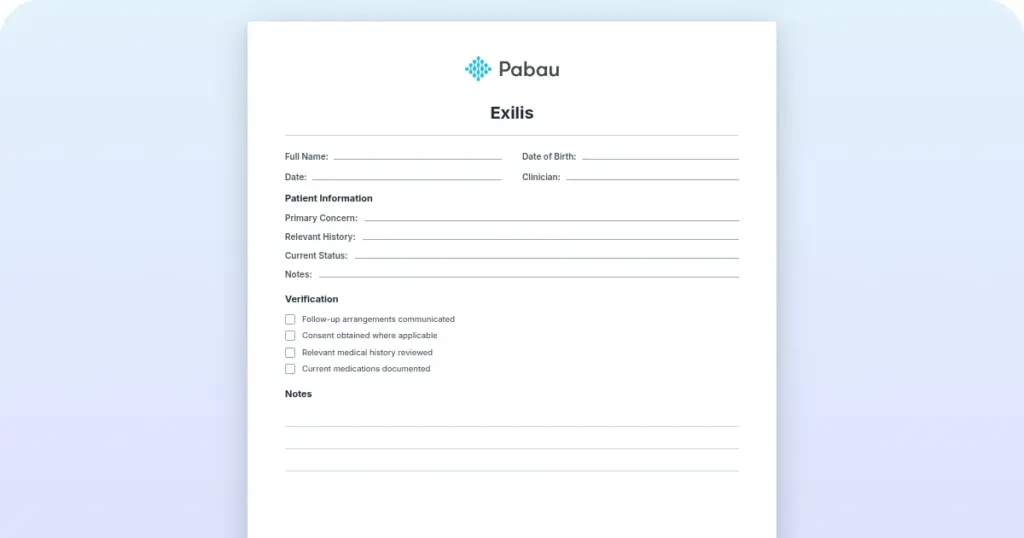
Exilis patient treatment record: Free PDF for RF sessions
An Exilis patient treatment record is the session log for BTL’s radiofrequ...

3
Last Updated: Oct 23, 2026

Med spas track clinical service revenue, retail sales, injectable stock, staff commissions, and prepaid packages in one operation, which breaks generic accounting setups.
QuickBooks Online is the strongest standalone accounting pick for med spas, and Pabau is the strongest integrated platform for daily financial operations.
Software covered: 1. QuickBooks Online, 2. Pabau, 3. Xero, 4. FreshBooks, 5. Wave Accounting, 6. Zoho Books, 7. Sage Accounting, 8. NetSuite, 9. Tebra.
Standalone accounting tools need manual configuration for med spa revenue categories, so plan for setup time and possibly a bookkeeper.
Pabau syncs natively with Xero and reaches QuickBooks Online through Zapier, Make, or its API, so booking data lands in your books without exports.
Most med spa owners find their accounting problem only after revenue starts leaking. Packages sell in one system, retail moves through another, and injectable stock gets reconciled on a spreadsheet. Payroll then runs through a service that never quite matches the bookkeeper’s numbers. Alongside the accounting tools reviewed below, our ranking of the best medical spa software covers payments, memberships and retail across eight platforms.
The American Med Spa Association (AmSpa) counts financial mismanagement among the top operational challenges for growing practices. The right software closes the distance between what your calendar records and what your ledger shows.
This review covers nine medical spa accounting software options, from standalone accounting platforms to purpose-built practice systems. Each entry carries pricing, strengths, limits, and the practice profile it suits. Match a tool to your size and workflow without three weeks of demo calls.
QuickBooks Online takes the top spot as the standalone accounting platform almost every US bookkeeper already knows. Pabau ranks second as the integrated option for practices whose bookings, stock, and invoices currently sit in separate systems.
A standard retail business tracks sales and costs. A med spa tracks all of that, plus clinical service revenue and injectable consumption tied to specific treatment records. Then come staff commission splits, membership billing cycles, package redemptions, and deposits collected weeks before the appointment.
That complexity breaks generic accounting setups in predictable ways. IRS guidance on small business accounting treats all revenue as revenue. A med spa owner needs to know whether the money came from a Botox treatment, a retail sale, or an unredeemed package.
Those distinctions drive cash flow reporting, tax classification, and the pricing strategy you set for each service line. Without them, a strong month on paper can hide a treatment that loses money on every appointment.
Some features matter far more for a med spa than for a generic small business. These are the criteria used to evaluate every option in this review.
Here is how the nine options compare on the criteria that matter most for med spa financial operations, ranked as they appear below.
QuickBooks Online is the most widely used accounting platform in the US, and medical spas are no exception. It takes the top spot here because it is a complete accounting system that almost every CPA and bookkeeper already knows. That matters when you need someone to run your books without a learning curve first.
QuickBooks needs configuration upfront to work for a med spa. You set up a chart of accounts that separates service revenue from retail sales, then create product categories for injectable stock. After that, map your booking data across from whatever practice management tool you use.
That configuration pays off for practices with an established bookkeeper, and it takes a day or two of someone’s attention first. Budget for that setup rather than expecting a working med spa ledger on day one.
QuickBooks Online holds a 4.3/5 rating from over 6,800 Capterra reviews. The review volume reflects its market dominance. Reviewers consistently praise the breadth of integrations and the accountant ecosystem. The most common complaint is pricing, with many noting that subscription costs have risen significantly over the years.
| Plan | Price | Key inclusions |
|---|---|---|
| Simple Start | $38 / month | Income and expense tracking, invoicing, basic reports |
| Plus | $115–$140 / month | Inventory tracking, project profitability, more users |
Intuit raised US subscription prices in August 2026, and payroll stays a separate add-on on every tier.
Pabau is a purpose-built medical spa software platform covering scheduling, clinical records, client management, and financial operations in one system. It ranks second here because it runs the operational finance layer rather than replacing formal bookkeeping.
Pabau syncs natively with Xero, pushing invoices and payments out of the practice management layer without CSV exports. QuickBooks Online connects through Zapier, Make, or the Pabau API, so a QuickBooks practice keeps its ledger and drops the manual re-entry.
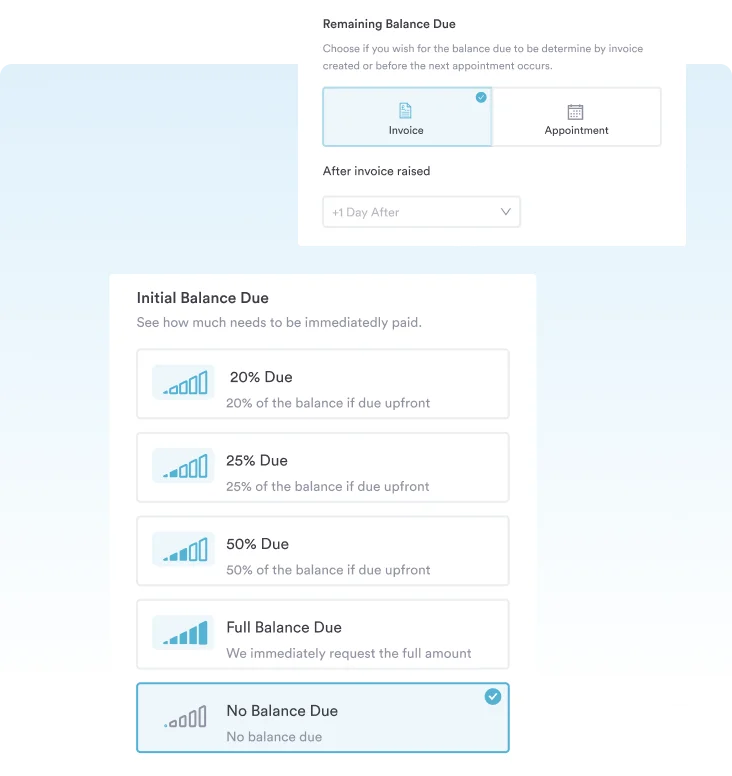
Where standalone accounting tools start with a blank chart of accounts, Pabau starts with med spa financial workflows already built in. Deposits collected at booking sit as liabilities until the appointment completes, and package payments are tracked against redemption.
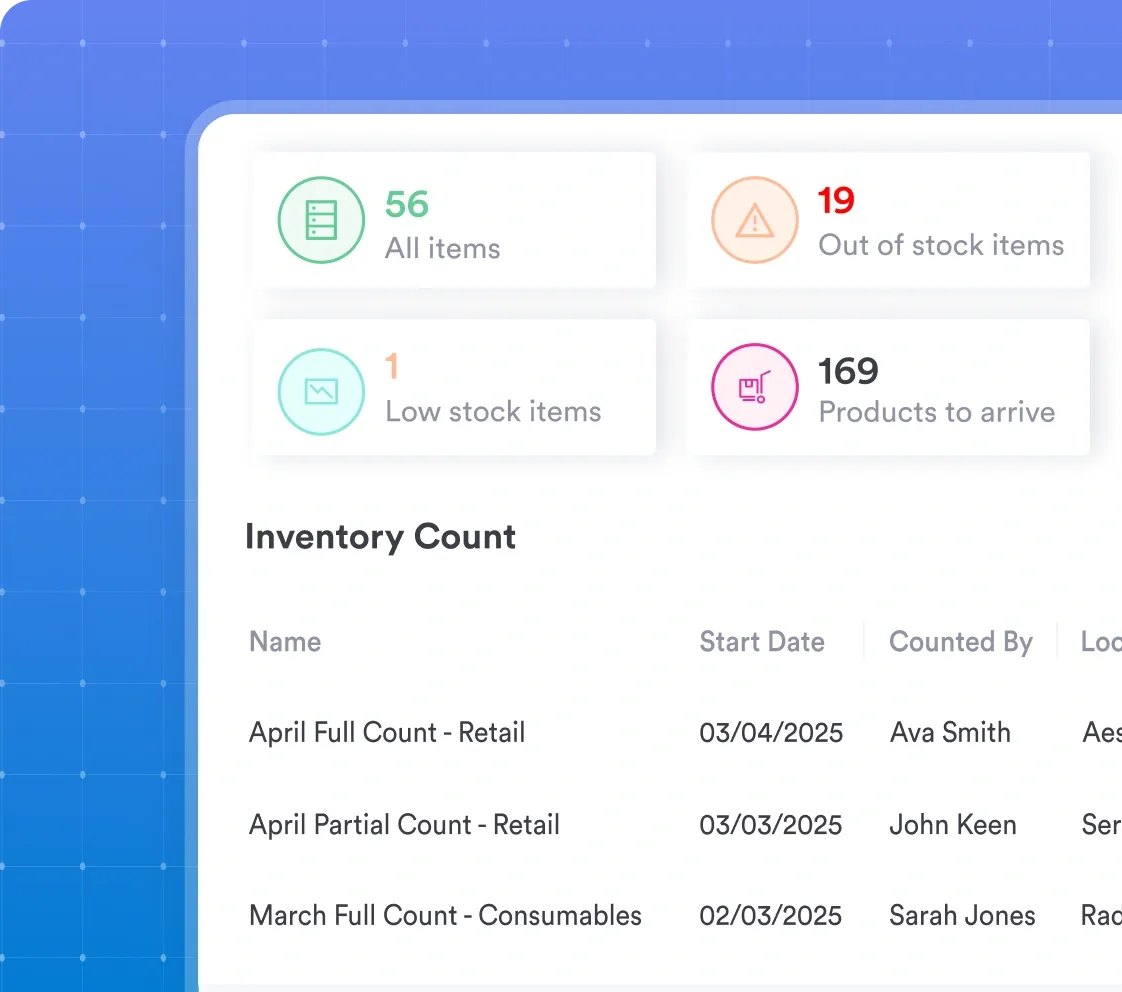
Inventory management ties stock depletion to treatment records automatically, so product costs stay current without a weekly manual count. Revenue splits by provider feed commission tracking directly.
For growing practices, this matters most during reconciliation. Owners running Pabau alongside Xero skip the weekly job of exporting booking data, cleaning it, and importing it into the ledger. That job costs a busy single-location practice two to four hours a week, and multi-location finances compound it.
Pabau holds a 4.7/5 rating from 600+ verified reviews on Capterra. Reviewers consistently highlight the depth of clinical and financial integration as a key differentiator. One reviewer noted: “Having inventory, appointments, and invoicing all in one place has saved us hours every week on reconciliation.” Common constructive feedback centers on the initial learning curve and occasional software update friction.
| Plan / Tier | Price | Details |
|---|---|---|
| Starter | From $62/month | 1 user, up to 100 clients |
| Team to Group | Scales with user count | 2 to 15 users, unlimited patients |
| Enterprise | Custom pricing | 16+ users, multi-location support |
Every plan carries the full platform, so no feature sits behind a higher tier. Current rates for your region are on Pabau’s pricing page.
Xero is the usual QuickBooks alternative for practices that want a cleaner interface and broader international support. For med spas planning multi-location expansion, or running UK or Australian sites, its cloud-native design and regional payroll coverage make it a logical choice.
Xero’s integration marketplace is extensive, and Pabau connects to it natively. That pairing suits owners who want the operational depth of a purpose-built practice platform alongside a professional accounting layer. Xero’s bank reconciliation is also among the best in the market.
Xero holds 4.4/5 on Capterra from nearly 2,900 reviews and 4.3/5 on G2. Positive themes cluster around the clean interface and reconciliation experience. The no-phone-support policy is the most consistently raised drawback.
| Plan | Price | Key inclusions |
|---|---|---|
| Early | $25 / month | Capped invoices and bills, bank reconciliation |
| Established | $90 / month | Multi-currency, projects, expense claims |
Every Xero plan includes unlimited users, and US payroll runs through a third-party add-on.
FreshBooks is purpose-built for freelancers and small service businesses. That maps well to independent injectors, nurse practitioners running boutique practices, and solo providers who do not need the complexity of QuickBooks or Xero.
Invoicing is where FreshBooks earns its place, with customizable templates, automated payment reminders, and a client portal for viewing and paying online. For a solo practitioner billing for aesthetic services, that covers the essentials cleanly. The limits show up as soon as you need inventory tracking, payroll, or clinical data flowing in.
FreshBooks holds 4.5/5 on Capterra and 4.5/5 on G2. It consistently scores highest among accounting tools for ease of use and customer support. Reviews from product-heavy service businesses highlight the inventory limitations.
| Plan | Price | Key inclusions |
|---|---|---|
| Lite | $23 / month | Invoicing, expense tracking, lowest client limit |
| Plus | $43 / month | Recurring billing, proposals, higher client limit |
Client limits sit on the lower tiers, so a growing client list forces an upgrade before the features do.
Wave is the only free option on this list for core accounting. Invoicing, expense tracking, and financial reporting cost nothing, while payroll and payment processing carry fees. For a new practice, that removes one monthly subscription at a point when opening costs already stretch the budget.
The trade-off is depth. Wave’s inventory module is thin, its integration list is short next to QuickBooks or Xero, and free-plan support is minimal. It handles a solo practitioner tracking income and expenses. It runs out of room once you need injectable stock counts, commission splits, or a link to your booking system.
Wave holds 4.4/5 on Capterra and 4.4/5 on G2. Reviews are positive on the free model and ease of use. The most common complaint is the jump in cost when you add payroll or payment processing on top of the free base.
| Plan | Price | Key inclusions |
|---|---|---|
| Core accounting | Free | Invoicing, income and expense tracking, basic reports |
| Payroll | $40 / month plus $6 per employee | Payroll runs and tax forms |
| Payments | Per-transaction fees | Card and bank payment processing |
Wave unified US payroll pricing in April 2025, so the base fee now reads the same in every state.
Zoho Books offers one of the best value propositions in accounting software, with a solid inventory module and strong automation. A free plan covers businesses under $50K in annual revenue. For a med spa that already uses other Zoho products (Zoho CRM, Zoho Inventory), the ecosystem integration adds real value.
Outside the Zoho ecosystem, the case for Zoho Books rests on price and feature-to-cost ratio. Its inventory module beats FreshBooks and Wave, and its automation handles recurring invoices and payment reminders without anyone touching them. US payroll options stay limited, which matters for most med spa operators.
Zoho Books holds 4.4/5 on Capterra from around 670 reviews and 4.4/5 on G2. Positive reviews highlight value for price and automation quality. Critical reviews often mention the Zoho ecosystem dependency and thin US payroll options.
| Plan | Price | Key inclusions |
|---|---|---|
| Free | $0 | Businesses under $50K in annual revenue |
| Standard | $20 / month | Recurring invoices, inventory tracking, automation rules |
Paid tiers climb from Standard, and US payroll still needs a third-party service alongside it.
Sage comes in two relevant forms for med spas. Sage Accounting serves smaller operations, and Sage Intacct serves larger multi-entity groups. Intacct is where the platform separates itself, with multi-entity consolidation, project accounting, and the healthcare-specific financial reporting that enterprise chains need.
For a single-location med spa, Sage Accounting competes with QuickBooks and Xero without their broader ecosystems. Sage sharpens at three or more locations, where its multi-entity reporting and consolidation pull ahead of the alternatives. That is why it sits below the budget options here for most readers.
Sage Accounting holds 4.1/5 on Capterra from around 2,800 reviews. Reviews skew positive on financial reporting depth and multi-entity capability. They turn critical on support responsiveness and implementation complexity.
| Plan | Price | Key inclusions |
|---|---|---|
| Sage Accounting | From $20 / month | Invoicing, bank reconciliation, cash flow forecasts |
| Sage Intacct | Custom quote | Multi-entity consolidation, advanced reporting |
Sage retired Sage Business Cloud Accounting in the US in January 2025, and Sage Accounting replaced it.
NetSuite is an enterprise ERP that handles accounting alongside inventory, CRM, HR, and supply chain in one platform. For most med spas it is overkill and too expensive. For a chain with ten or more locations and serious operational complexity, it is worth evaluating.
Implementation runs for months and needs either an in-house NetSuite administrator or an implementation partner. Oracle publishes no rate card, so your budget starts with a quote covering licensing, modules, implementation, and ongoing administration. That investment suits organizations that have outgrown QuickBooks, Xero, and Sage, and not practices under $5M in annual revenue.
NetSuite holds 4.1/5 on Capterra from around 1,400 reviews and 4.0/5 on G2 from over 3,100 reviews. Reviewers agree on two themes. It is powerful for complex needs, and overwhelming and expensive for smaller organizations.
| Plan | Price | Key inclusions |
|---|---|---|
| Licensing | Contact sales, no published pricing | Quoted by module list and user count |
| Implementation | Contact sales, no published pricing | Partner-led setup, quoted per project |
Oracle publishes no NetSuite rate card, so every figure comes from a quote against your own module list.
Tebra, formed from the merger of Kareo and PatientPop, is a healthcare-native billing and practice management platform built for practices that bill insurance. Most cash-pay aesthetic med spas will find it a poor fit.
Its healthcare billing infrastructure earns attention in medically integrated practices. Think dermatology offices with aesthetic add-ons, or practices running medical weight loss alongside insurance-billable care.
Tebra’s strength is clinical billing, covering superbill generation, insurance claim submission, and medical billing workflows. If your practice never bills insurance, none of that helps, and the extra complexity becomes a cost with nothing on the other side of it.
Tebra (Kareo) holds 3.8/5 on Capterra. Reviews from healthcare billing professionals note the strength of the clinical billing workflows. Post-merger support quality has been a recurring concern among recent reviewers.
| Plan | Price | Key inclusions |
|---|---|---|
| All plans | Contact sales, no published pricing | Quoted by practice size and billing volume |
Tebra publishes no rates, so pricing follows a needs assessment with their sales team.
Most software searches start from the wrong question. The reflex is to shop for an accounting product, when the constraint usually sits between the practice management system and the ledger. Choosing the right med spa software for the operational layer decides how much manual work the accounting layer inherits.
For most owners the practical answer is both. Run an integrated platform like Pabau for operational finance, then connect it to Xero or QuickBooks for formal bookkeeping and accountant access. That combination gives you med spa workflows on one side and accounting infrastructure your CPA can work in on the other. Mapping your med spa KPI needs first shows which layer to fix now.
The same logic applies to client data: a dedicated medical spa CRM keeps invoices, packages, and client histories in one reconcilable place.
Five factors decide this, and they usually point at the same answer once you work through them.
Before choosing standalone accounting software, calculate how much time your team spends each week reconciling booking data with financial records. Multiply that by your hourly rate (or your bookkeeper’s hourly rate). For most practices, that number is larger than the cost difference between an integrated platform and a standalone accounting tool.
Most practices run this workflow by hand. The front desk takes a deposit in the booking system, and the card terminal settles somewhere else. Someone then exports both into a spreadsheet before the bookkeeper opens the ledger. Injectable stock gets counted on a Friday, when it gets counted at all.
Pabau, our all-in-one practice management system, records the deposit, the package payment, and the stock movement against the appointment that produced them. The Xero sync then moves invoices and payments into your accounts automatically. Pabau Pay, our card terminals, settle into those same records, so in-person payments need no separate reconciliation.
Month-end gets shorter as a result. Revenue by treatment, retail versus service split, and membership income all report without a manual rebuild, and every plan includes those reports. Med spas such as Ageless Enhancements run bookings, payments, and stock in one system for that reason.
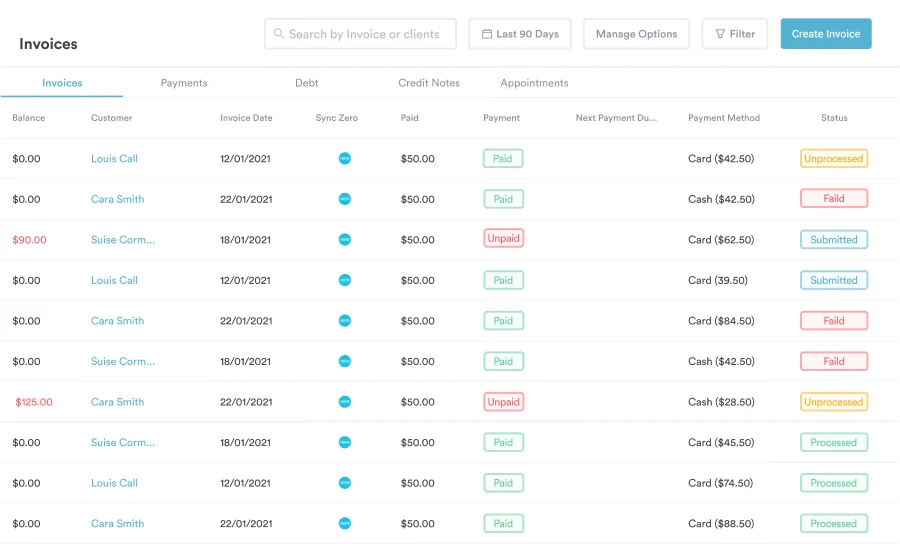

Pabau connects bookings, clinical records, inventory, and financial reporting in one platform. See how the Xero sync removes your weekly reconciliation, in a live demo with our team.

Accounting software cannot fix numbers that never leave your booking system. Clinical activity generates financial data all day, and someone has to carry it into the ledger. Every option here solves part of that job, so the choice comes down to which part costs you most each week.
If your bookkeeper already lives in QuickBooks Online, stay there and connect your practice system to it. If the reconciliation hours are the expensive part, the integrated route saves more than a cheaper ledger ever will. Wave and Zoho Books keep early costs down, then run out of room once stock and memberships arrive. Sage and NetSuite only earn their price at multi-entity scale.
Time one week of reconciliation, then add up what your current tools cost together. That single number decides this faster than any feature list. Book a demo to see how Pabau keeps med spa bookings, stock, and invoices ready for your accountant.

Handling sensitive patient data at your med spa? Med spa patient data security explains how practice management software helps protect records, photos, and stored card numbers.
Tracking the right financial KPIs for your med spa? Med spa KPI guide outlines which revenue and operational metrics matter most for growing practices.
Managing finances across multiple locations? Financial management for med spa franchises covers the accounting complexity that arrives when you expand beyond one site.
Keeping retail and treatment revenue separate at checkout? Medical spa POS software compares the systems that split those two revenue streams cleanly.
Still deciding what to charge per treatment? How to choose a med spa pricing strategy walks through margin, package, and membership pricing decisions.
The best choice depends on your practice structure. QuickBooks Online is the strongest standalone accounting platform for established practices with a bookkeeper. Pabau suits owners who want clinical workflows, invoicing, inventory, and financial reporting in one platform, with a native Xero sync. Wave is the best free option for a startup, and FreshBooks offers the simplest invoicing for solo practitioners.
Pabau includes operational financial management features: invoicing, deposits, package billing, membership recurring payments, commission tracking, inventory management, and med-spa-specific financial reporting. It syncs natively with Xero, and reaches QuickBooks Online through Zapier, Make, or the Pabau API, so your accountant keeps the ledger they know. Pabau is not a standalone accounting replacement but works alongside your accounting tool to eliminate manual data reconciliation.
Yes, QuickBooks Online works well for medical spas, but it requires configuration. You need a custom chart of accounts covering clinical services, retail sales, and inventory. You also need to enter booking data by hand or connect an integration to your practice management system. It works best when paired with a bookkeeper familiar with med spa accounting, or when connected to a platform like Pabau that syncs data automatically.
QuickBooks has the larger US accountant ecosystem and more mature payroll options. That makes it the safer choice if your bookkeeper or CPA already prefers QuickBooks. Xero offers a cleaner interface, unlimited users across all plans, and a slightly better bank reconciliation experience. Xero connects to Pabau natively, and QuickBooks connects through Zapier, Make, or the Pabau API. Choose QuickBooks if your accountant already uses it; choose Xero if you are starting fresh and want a more modern interface.
Wave’s core accounting features (income/expense tracking, invoicing, and basic reports) are free with no time limit. Payroll and payment processing carry additional fees. For a med spa, the free tier covers basic bookkeeping in the early stages. It lacks inventory tracking and med spa management integrations. Most practices outgrow Wave once they add services, retail products, or multiple providers.
HIPAA compliance in accounting software is a nuanced question. Most accounting tools (QuickBooks, Xero, FreshBooks, Wave) are not inherently HIPAA-compliant and do not sign Business Associate Agreements (BAAs) for standard plans. For most cash-pay aesthetic med spas, the financial data in accounting software covers amounts, dates, and payment methods. That is not protected health information (PHI), so strict HIPAA accounting compliance may not apply. However, if your financial records are tied to identifiable patient health data, consult a HIPAA compliance advisor before selecting any accounting tool. Tebra, built for healthcare billing, does operate within a HIPAA-compliant framework.