Fertility clinic marketing: Strategies that attract & convert patients
Fertility clinic marketing is how a fertility practice attracts, educates, and c...

Last Updated: Oct 14, 2026
Tiered med spa memberships are monthly plans sold in two to four levels, each costing more and including more treatments, discounts and perks. Overall, most practices do best with three tiers. Compare how each platform handles memberships in our ranking of the top med spa software before you set up these tiers.
Offer a low-commitment entry plan, a mid tier priced as the obvious choice, and a VIP tier for top spenders. Price each tier from the cost of the treatments inside it, then let the middle tier anchor the decision.
This guide builds an example ladder at $99, $179 and $299 a month and costs one tier line by line. In addition, it sets that example against the real practice ladder: the live, published plans of three UK practices, from £50 to £499 a month.
Seeing how Esteem Life, Intrigue Cosmetic Clinic and Kaizen Medical climb from entry to VIP shows which medspa membership mechanics hold up in practice.

Tiered med spa memberships sell one recurring relationship at two to four price points, so patients self-select by budget and goals.
Three tiers is the working default: an easy entry plan, a mid tier that anchors the price, and a VIP tier built on access.
Price every tier from the costed treatments inside it, not from a discount off your menu, and check the margin before launch.
Running tiers day to day takes recurring billing, a usage ledger on each patient record, and clear pause and cancellation terms.
The real practice ladder shows three workable mechanics: prepaid credit at Intrigue, unlimited core treatment at Esteem Life and annual bundles at Kaizen.
The costliest mistakes are discounting instead of tiering and leaving no clear upgrade path between rungs.
Overall, membership tiers give a med spa recurring revenue that smooths busy and quiet weeks, and let each patient buy the level of care they want. Predictable income makes it easier to plan staffing, order inventory and keep the schedule full without last-minute promotions.
Tiers also match patients’ very different ideas of maintenance. For one patient, it’s a facial and a serum. For another, it’s a standing Botox appointment and a laser hair removal series.
Then there are the explorers, who want to try each new treatment on your menu. In short, a tiered medspa membership gives each group a plan without twisting your pricing into a pretzel.
Broken down, tiered memberships do three jobs:
As a result, that climb steadily raises patient lifetime value, the clearest sign of a healthy med spa business. Similarly, salons use the same model, so a monthly salon membership for blow-dries can climb the same ladder.
Amish Patel, owner of Intrigue Cosmetic Clinic, saw the shift after moving his patients to monthly payments that build credit on their accounts.
Before, I was spending around an hour each month just double-checking everything. Offering monthly payments where clients build credit on their accounts has driven my business further forward. It keeps revenue consistent and makes it easier for clients to stay engaged.
Amish Patel, BEM, Owner, founder and director of Intrigue Cosmetic Clinic

A med spa loyalty program rewards every visit with points, while tiered memberships sell a fixed monthly plan, so the strongest setups run both together. Meanwhile, points reach patients who aren’t ready for a monthly fee, and membership captures the ones who already book on a rhythm.
Three ways to connect the two programs:
In other words, dedicated loyalty program software logs points against each patient record, so staff never work out balances by hand.
Structure membership tiers as a ladder of three: an easy entry plan, a balanced mid tier for regulars, and a VIP tier for top spenders. Each rung should be easy to join, simple to manage and appealing enough to keep.
For example, some med spas add a fourth premium level when their menu spans skincare to injectables. In fact, Intrigue Cosmetic Clinic and Kaizen Medical both run four.
If you’re starting from zero, our guide on how to build a membership program covers the groundwork. Here’s how each rung looks on a live price list.
Your entry-level tier should be easy to say yes to. In other words, it’s low-cost, low-commitment and suited to new or price-conscious patients who want to start small.
Most entry tiers include one simple treatment a month, a light discount or a small birthday perk. As a result, that’s just enough value to build trust and bring patients back.
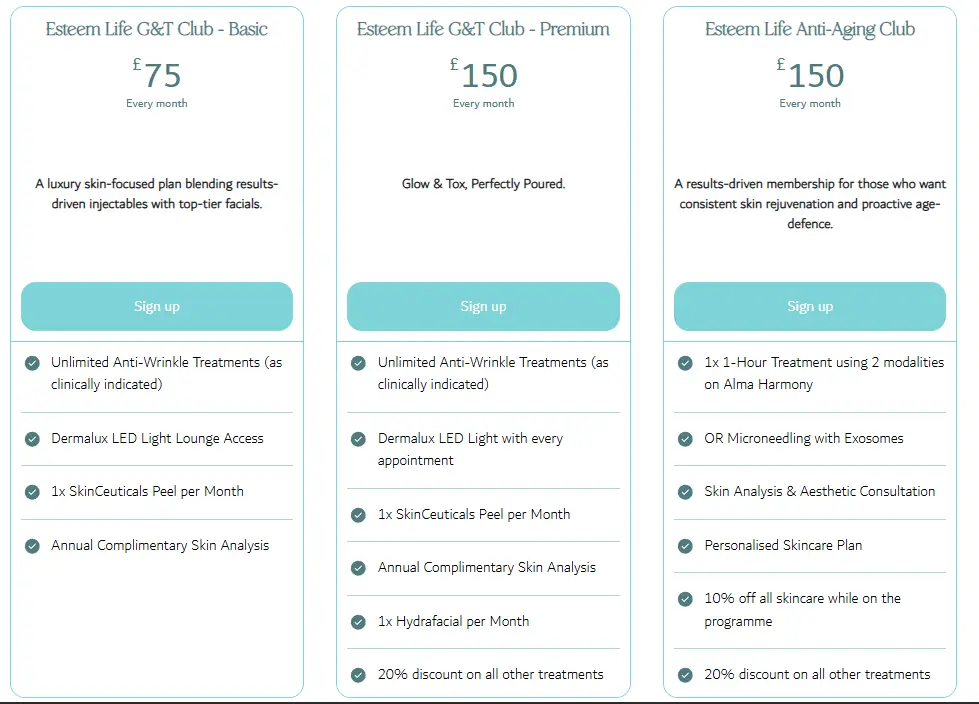
Example: Esteem Life Medical Group runs this rung with its G&T Club Basic tier at £75 a month. Members get unlimited anti-wrinkle treatments (as clinically indicated), Dermalux LED light lounge access and one SkinCeuticals peel a month.
As a result, the price feels attainable, the benefits are clear, and the included treatments drive repeat visits. That’s the whole job of an entry tier.
Tip: Keep joining friction-free. Signing up should be as easy as booking a facial, and the terms should fit on one screen.
In fact, this is your sweet spot, and it’s where most loyal patients land. In short, the mid tier offers enough value to feel worthwhile without the cost of your top tier.
Think one premium treatment or two basics a month, early booking and members-only promotions. In fact, it suits patients who treat your practice as part of their routine.
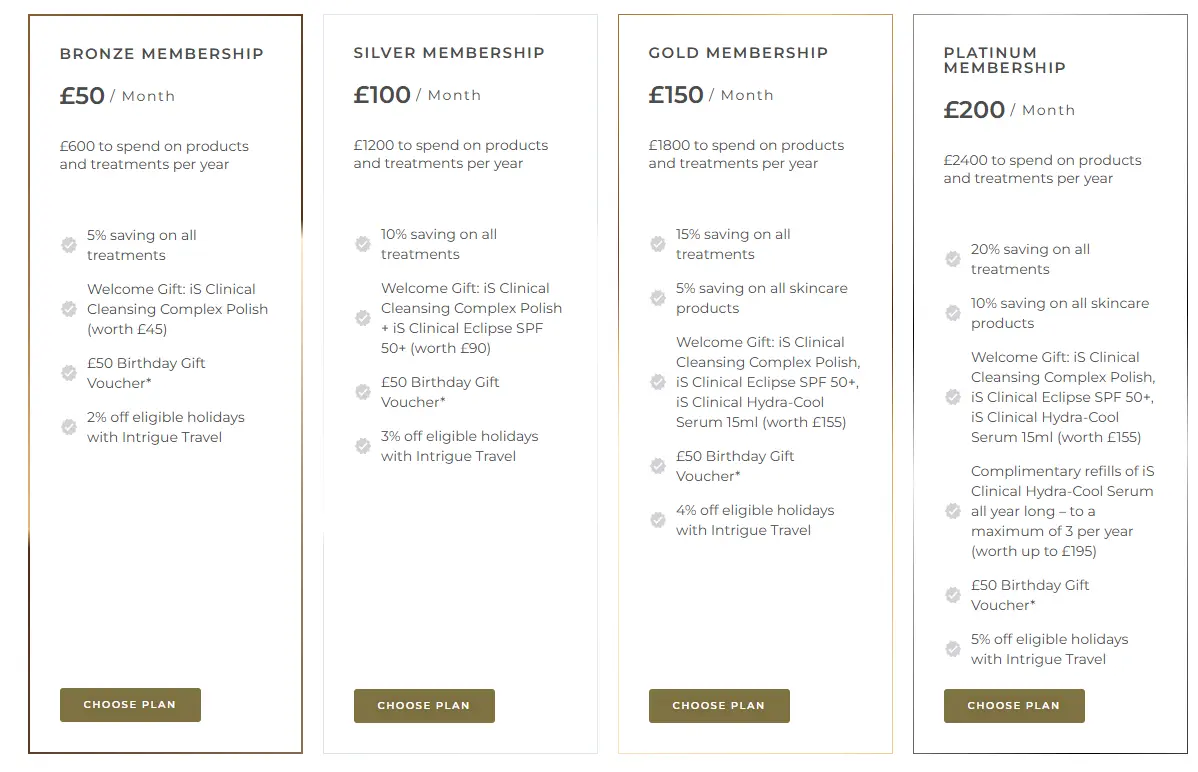
Example: Intrigue Cosmetic Clinic’s Gold Membership shows how to get this tier right. Members pay £150 a month and get £1,800 a year to spend on products and treatments.
On top of that credit sit 15% off treatments, 5% off skincare and a £50 birthday voucher. The credit model keeps choice flexible while giving patients a reason to stay all year.
Tip: Bundle your crowd-favorite treatments into the mid tier. Consequently, it saves patients the guesswork and makes this rung the easiest one to keep.
Overall, the VIP or elite tier is built for your highest-spending regulars. Specifically, they want early access, personal attention and a little extra sparkle.
The focus here is experience, with benefits like unlimited basic treatments, provider priority, birthday gifts and complimentary upgrades.
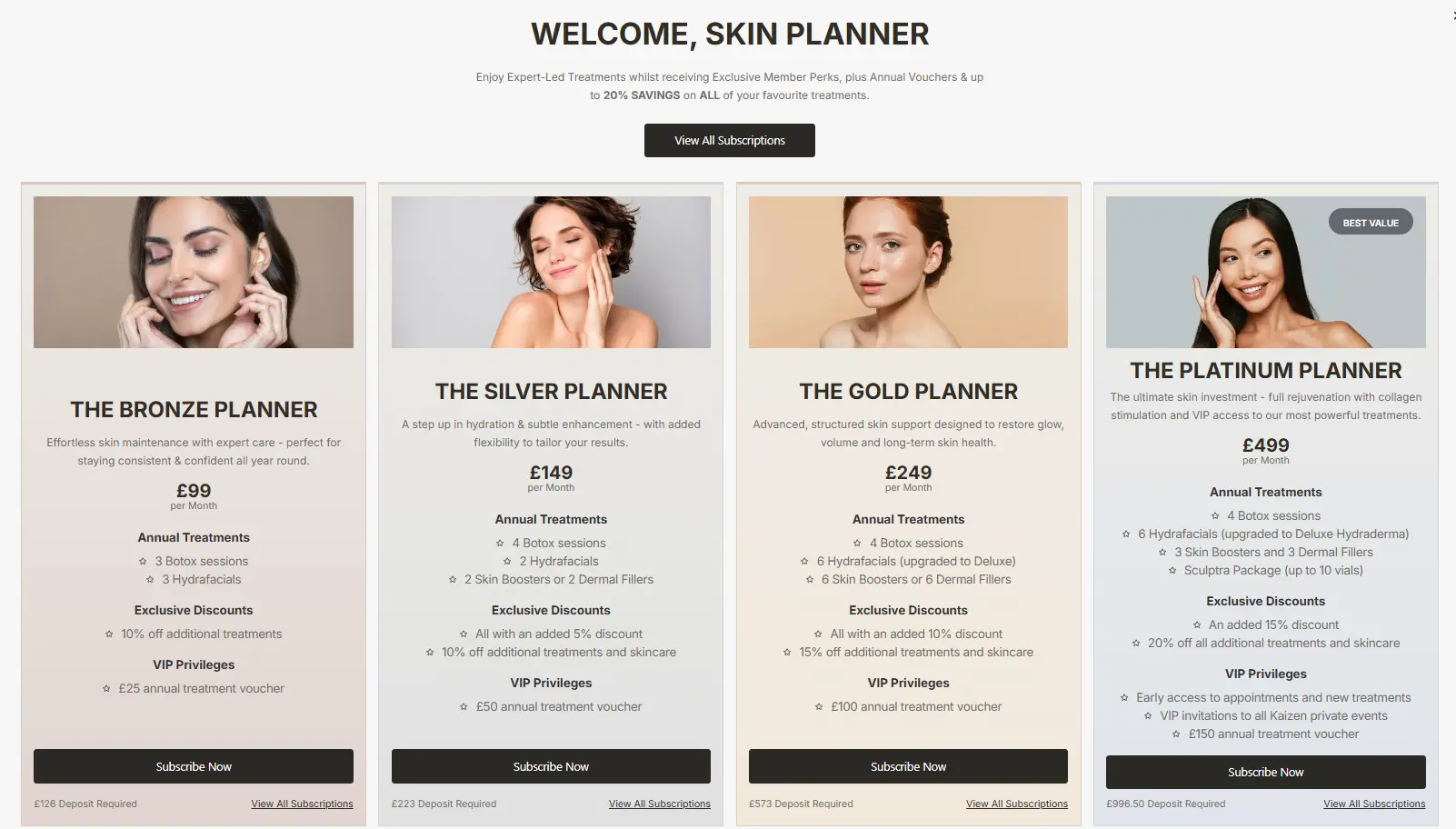
Example: Kaizen Medical sets a high bar with its Platinum Skin Planner at £499 a month. It includes four Botox sessions, six Hydrafacials, skin boosters, dermal fillers and a Sculptra package each year.
Members also get 15% off included treatments, 20% off other treatments and skincare, VIP event invitations and early booking. Kaizen Medical pairs every tier with a 12-month minimum commitment paid by Direct Debit.
Tip: Treat this tier like your practice’s inner circle. Early booking, private events or a small surprise will outshine another 10% off.
Good med spa membership program ideas are built on one clear mechanic, such as prepaid treatment credit, unlimited core treatment or an annual treatment bundle. By comparison, the real practice ladder below puts the three live examples side by side.
In particular, each practice climbs from entry to VIP in a different way, and the mechanic decides what your team has to track.
| Practice | Mechanic | Entry tier | Top tier | What each step adds | What you track |
|---|---|---|---|---|---|
| Intrigue Cosmetic Clinic | Prepaid credit | Bronze, £50/month | Platinum, £200/month | £50 more a month, 5% more off treatments | Credit balance per patient |
| Esteem Life Medical Group | Unlimited core treatment | G&T Club Basic, £75/month | G&T Club Premium, £150/month | A monthly Hydrafacial and 20% off other treatments | Clinical sign-off for each toxin visit |
| Kaizen Medical | Annual treatment bundle | Bronze Skin Planner, £99/month | Platinum Skin Planner, £499/month | More fillers, boosters and Hydrafacial upgrades | Sessions left in each bundle |
We checked these prices on each practice’s own website in September 2026. All three are UK practices, so fees are in pounds sterling.
Other ideas worth testing once the core ladder works:
Include treatment credits, tiered retail discounts, priority booking, upgrades, member events and loyalty rewards, scaling each perk up as patients climb. Overall, keep every tier simple enough for your front desk to explain in one breath.
Before you build, answer three questions:
Here’s how each perk category scales:
For a quick starting point, here’s what a complete three-tier setup can look like.
| Feature | Tier 1: Glow | Tier 2: Radiance | Tier 3: Elite |
|---|---|---|---|
| Monthly fee | $99/month | $179/month | $299/month |
| Annual cost | $1,188 | $2,148 | $3,588 |
| Included treatment | 1 basic facial or peel | 1 advanced treatment (Hydrafacial, microneedling, etc.) | 2 premium treatments or injectables |
| Retail product discount | 10% off | 15% off | 20% off |
| Upgrades | Not included | 1 mini upgrade per month | Unlimited standard upgrades |
| Priority booking | Not included | Yes | First access to top providers |
| Birthday gift or credit | Not included | $25 credit | $50 credit or free premium add-on |
| Loyalty rewards multiplier | Standard points | 1.5x points | 2x points |
| Guest passes | Not included | 1 pass every 6 months | 2 passes per year |
| Exclusive events or perks | Not included | Member-only promos | VIP events access and sneak peeks |
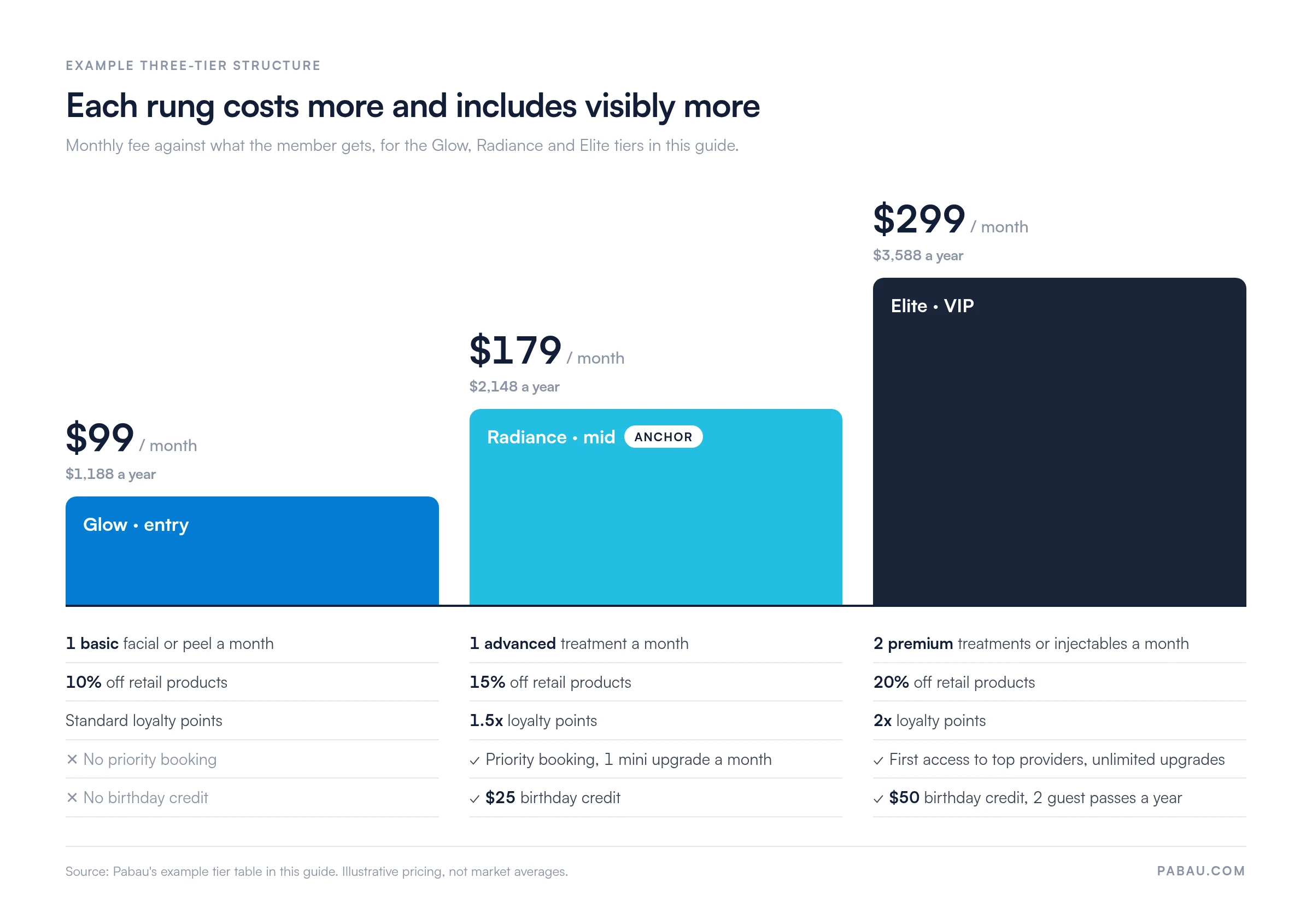
Each tier builds on the one before it, with enough extra value to move up and no extra admin. In short, the chart shows how the fee and the inclusions climb together.
Similarly, this skincare membership guide applies the same ladder to practices whose menu is mostly facials, peels and products. Skincare tiers depend on consistency, so build each rung around a treatment rhythm.
Esteem Life’s Anti-Aging Club shows the VIP pattern in practice. The £150 plan pairs a monthly treatment with a skin analysis, a personalized skincare plan and 10% off skincare.
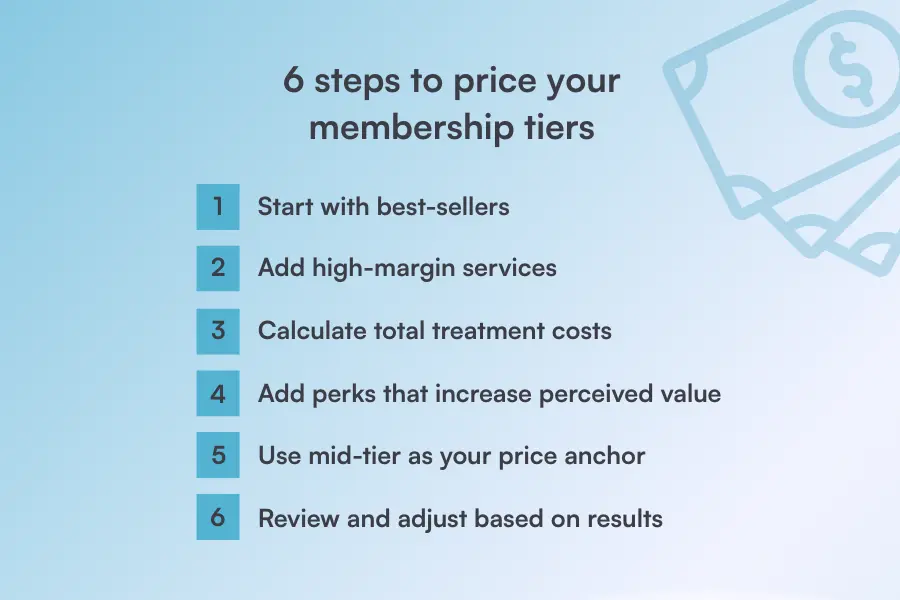
Price each membership tier by costing the treatments it includes, adding perks with high perceived value, and setting the middle tier as your price anchor. In short, good med spa pricing rests on what patients already book, what each treatment costs you, and what nearby practices charge.
It’s the same costing you’d do in a business plan for a med spa, applied to a recurring product. Overall, seven steps get you from menu to price list, and the graphic shows the six core ones.
In short, repeat visits are where membership profit comes from. According to AmSpa’s 2024 report, 73% of med spa patients are repeat patients, up from 65% in 2022.
In other words, patients already come back on their own, and a well-priced membership turns that habit into committed revenue. In short, the best spa membership, from a patient’s view, covers treatments they’d book anyway.
When we onboard practices onto Pabau, a practice management system for med spas, the middle tier usually takes longest to price. So the worked example starts there.
Here’s the costing step applied to the $179 Radiance tier. The cost lines are example figures that show the method, not benchmarks, so swap in your own.
| Line | Monthly | Yearly |
|---|---|---|
| Membership fee paid by the patient | $179 | $2,148 |
| One advanced treatment: product, provider pay and room time (example cost) | $70 | $840 |
| One mini upgrade (example cost) | $10 | $120 |
| Birthday credit | n/a | $25 |
| Priority booking | $0 | $0 |
| Cost to deliver | $985 | |
| Contribution before retail discounts | $1,163 (54% of the fee) |
Two checks follow. First, the contribution must cover the 15% retail discount on what members typically buy, which your sales history will show.
Second, compare the fee with the menu price of the inclusions. If the advanced treatment alone sells for more than $179, the tier reads as a bargain without further discounting.
In that case, if the contribution looks thin, raise the fee or swap in a treatment that costs less to deliver. Then repeat the exercise for Glow and Elite.
In short, medspa membership management means running recurring billing, tracking each member’s usage, and giving the front desk clear rules for upgrades, pauses and cancellations. Marketing gets patients to join, but operations decide whether they stay.
Five tasks come around every month:
In fact, payments are where disconnected tools cause the most trouble. A practice that tracks leads in a CRM such as Salesforce needs membership payments to sync, or staff end up reconciling two lists by hand.
Finally, reporting closes the loop. Track active members by tier, monthly churn and credit use, because a tier nobody redeems is a tier nobody renews.
If your current system can’t handle this, our roundup of the best aesthetic clinic software compares platforms on memberships and recurring billing.
Overall, promote membership tiers at every patient touchpoint, from consultation to checkout, and back them with member stories, targeted emails and signup inside online booking. Even a well-built tier won’t sell if patients never hear about it.
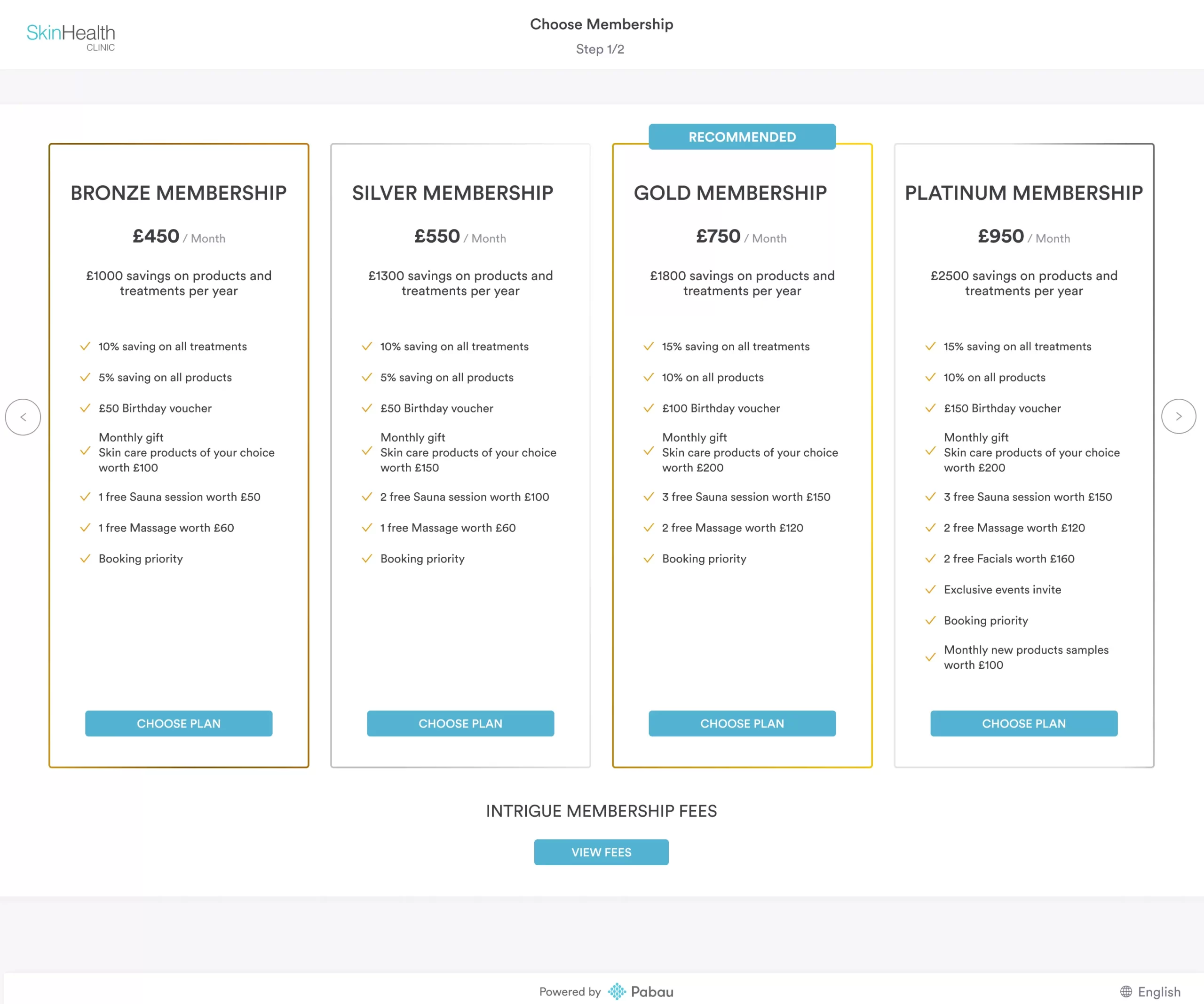
Overall, talk about your tiers often and keep them visible. When patients see what’s in it for them, joining becomes an easy decision.
The common mistakes med spas make with memberships are discounting instead of tiering, pricing before costing, and leaving no clear upgrade path. Each one is cheap to avoid before launch and expensive to fix afterward.
Intrigue Cosmetic Clinic’s even £50 steps are the simplest upgrade path to copy. Each rung costs the same amount more and adds the same 5% more off treatments.
In other words, without a membership system, tiers live in a spreadsheet, a card terminal and staff memory. Amish Patel’s hour a month of double-checking is what that setup costs.
For instance, Pabau Memberships lets you build bronze, silver and gold-style tiers with free or discounted treatments. You can charge weekly, monthly or yearly fees, and patients can buy a plan through online booking.
Overall, each patient record shows the member’s tier, join date, remaining sessions and expiry date, so staff answer usage questions in seconds. Pabau can also waive deposits for members, a perk that costs you nothing to offer.
In fact, every Pabau subscription includes memberships alongside booking, patient records and payments. As a result, that makes it scalable med spa software as you add tiers, providers or locations.

Pabau sells membership tiers through online booking, bills them on schedule and tracks each member’s remaining sessions on the patient record. Your team stops reconciling credits by hand.

Start with three tiers and cost the middle one first. In fact, it carries most of your members and sets the price everyone compares against.
Then pick one mechanic from the real practice ladder, whether credit, unlimited core treatment or bundle. Keep it for at least two quarters before you judge it.
Remember the trade-off: richer tiers win sign-ups but eat margin. In short, a lean tier with clear upgrade steps usually outlasts a generous one priced by feel.
Book a demo to see how Pabau sells, bills and tracks tiered memberships, so your recurring revenue runs without a spreadsheet.

Want to know which numbers prove a membership works? Med spa KPI guide covers the retention and lifetime value figures worth reviewing every month.
Need bundles to slot into each tier? Med spa membership packages lists package ideas you can build into an entry, mid or VIP plan.
Checking whether your tiers can carry their discounts? Aesthetic clinic profit margin breaks down where treatment margin comes from and what erodes it.
Planning recurring revenue into a new practice? Aesthetic clinic business plan walks through the numbers a lender or partner will want to see.
Practice management software with built-in memberships, such as Pabau, sells plans through online booking and bills them on schedule. It also tracks remaining sessions on each patient record, which is what medspa membership management depends on day to day.
Sauna tiers work best when they are structured by access rather than treatments. Offer an off-peak entry plan with a set number of sessions and a mid tier with anytime access. A VIP tier then adds guest passes and add-ons like massage.
For example, a laser or skin rejuvenation course is usually sold as a prepaid package with a fixed number of sessions. By comparison, a membership instead bills a recurring monthly fee with credits. In either case, each session is logged against the patient record so remaining treatments and expiry dates stay visible.
Overall, a tiered med spa membership usually costs between about $99 and $299 a month. Meanwhile, entry plans sit at the low end, and VIP tiers with injectables sit at the top. The live UK plans in this guide run from £50 a month at Intrigue Cosmetic Clinic to £499 at Kaizen Medical.