Professional development record
A professional development record is a structured log of a healthcare practition...

8
Last Updated: Oct 8, 2026

HIPAA requires medical spas that handle Protected Health Information (PHI) to follow the Privacy Rule and Security Rule, covering how patient data is accessed, stored, and shared.
A HIPAA compliance checklist covers appointing a compliance officer, documenting security policies, managing business associate agreements, running risk assessments, and training staff.
HIPAA violations carry statutory fines from $145 to $2,190,294 per violation, depending on the tier and whether the issue was corrected, with an annual cap of $2,190,294 for identical violations.
Practice management software like Pabau supports HIPAA compliance with encrypted data storage, access controls, audit logs, and secure online booking.
Regular staff training and ongoing monitoring help medical spas catch compliance issues before they turn into violations or costly investigations.
If you run a medical spa or healthcare practice, you’ve probably heard of HIPAA — and for good reason. It’s both a must-know and a must-implement regulation for every US healthcare organization. Compliance also extends to the platform holding your patient records, so see how our med spa software roundup covers HIPAA.
You might have already implemented security measures like two-factor authentication (2FA). But HIPAA is the only US regulation that legally requires you to protect sensitive patient data, from patient IDs to treatment details.
Navigating compliance for your med spa can be tricky, but it’s necessary. This guide covers what HIPAA compliance is, why you need it, how to follow it, and how practice management software like Pabau can help.
If you’re also mapping the bigger picture beyond HIPAA, this guide on med spa compliance covers the key areas owners need to stay on top of in 2026.
We also included a HIPAA checklist to help you navigate compliance like a pro — get it for free.
HIPAA, or the Health Insurance Portability and Accountability Act, is a federal law designed to safeguard sensitive patient data in the United States.
HIPAA compliance is mandatory for medical spas that handle physical and electronic Protected Health Information (ePHI/PHI), including personal client details (e.g. name, address, ID number) and treatment details (e.g. medical records, diagnostic codes such as R61, facial images, notes).
For medical spas, HIPAA outlines several compliance rules, with a particular focus on security and privacy.
Overall, medical spas need to comply with HIPAA to properly handle patient records, secure virtual consultations, and share PHI safely, be it with staff or patients.
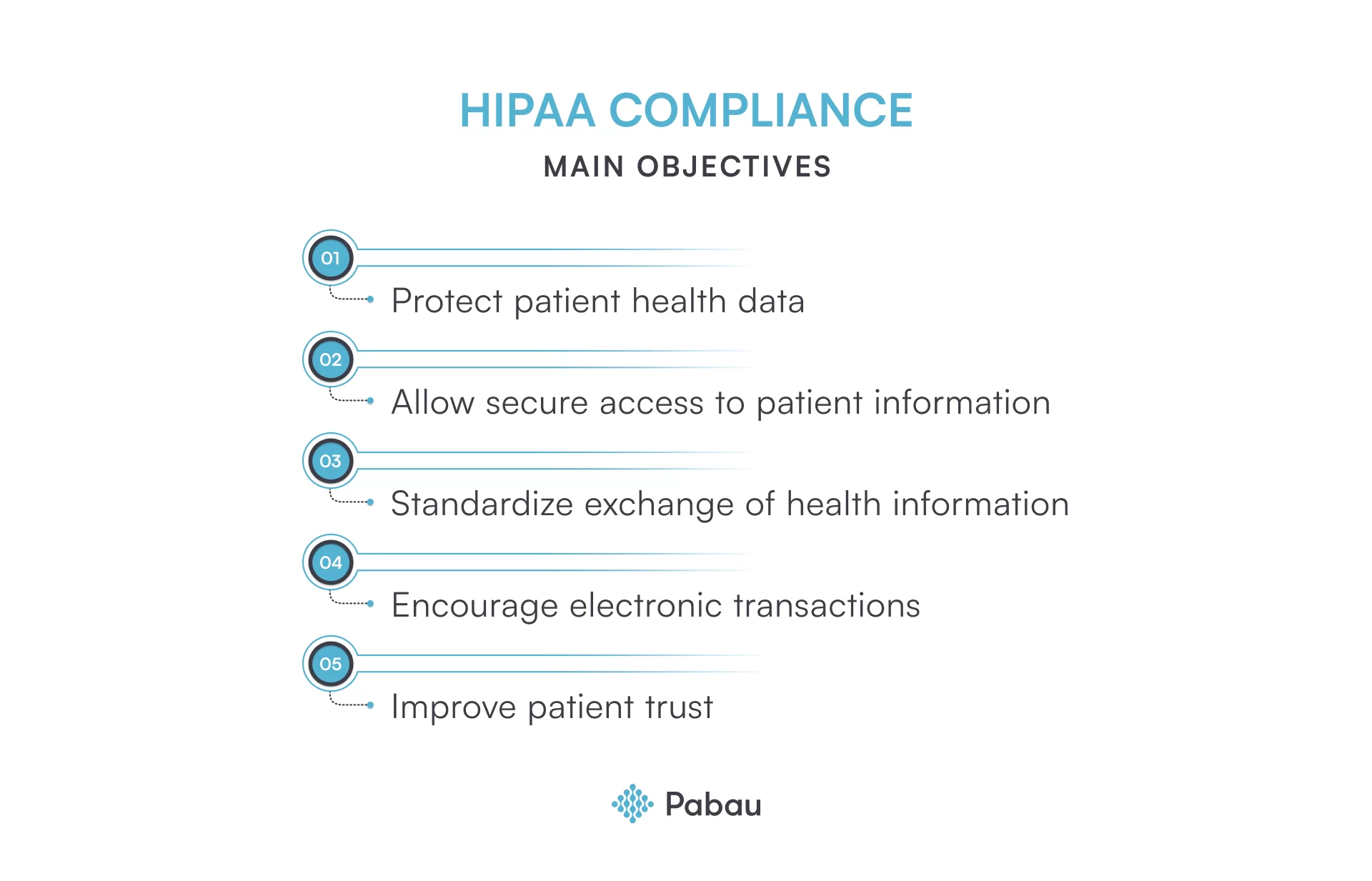
Once you handle PHI, the same core HIPAA compliance requirements apply to every medical spa, whatever its size:
Managing HIPAA compliance can be complex, especially if it’s your first time doing it. Whether due to neglect or oversight, violating HIPAA compliance in any way can break your patients’ trust, damage your reputation, and make you subject to fines.
To prevent these risks and ensure full-on compliance, we created a handy guide.
First things first, you have to appoint a compliance officer. Typically, a compliance officer is a workforce member at your practice (the covered entity), or the role is filled by an outside business associate you collaborate with. They will oversee HIPAA compliance, making sure security and privacy rules are followed, and that employee training is provided.
If you run a larger med spa, practice management software can help you delegate and track compliance responsibilities across multiple officers.
HIPAA compliance is all about documentation. You must create HIPAA-friendly procedures that ensure private, secure, and breach-free PHI management. Many med spas manage this by going paperless, which cuts down on lost records and makes audits easier. Your HIPAA compliance officer will be responsible for creating this documentation and reports, including the following:
Ready-made templates can speed up building this documentation. An advanced treatment consultation form and a bariatric intake form show how standardized intake records keep PHI consistent and easier to secure.
The same goes for treatment notes: An anxiety nursing care plan or a pain management treatment plan structures clinical notes so PHI stays consistent across your team.
The same logic covers intake and agreements. A family medical history form standardizes patient history intake, and a client agreement documents the terms both sides sign before treatment starts, so nothing is left as a verbal understanding.
Treatment-specific documentation deserves the same structure. A hyaluron pen filler record, for example, keeps procedure notes in the same standardized format as everything else in the patient file.
Laser sessions need the same paper trail. An Excel V laser record captures the wavelength, the settings used, and the aftercare given, so those details stay in the encrypted patient file.
Sometimes, business associates may come into contact with your practice’s PHI. Just like covered entities (your practice or salon), business associates (like your accountants) are also obligated to protect the patient data they handle.
You will also need to sign a legal business associate agreement (BAA) to keep your PHI secure on all sides.
To protect PHI all the way, the HIPAA Security Rule imposes three safeguards: Administrative, physical, and technical.
Following a HIPAA compliance checklist, you’ll need to perform regular risk assessments to detect any risk of cyber-attacks and data breaches. While risk assessments are mandatory, how you conduct them is entirely up to you, but should include the following steps:
HIPAA compliance training is mandatory for all med spa, practice, or salon teams and the BAs who handle their PHI. Through HIPAA training, teams can better understand how compliance works, why it matters, and what non-compliance looks like.
Ideally, you should enforce HIPAA training annually for the whole team and as part of the onboarding process for new employees. For successful training, ensure your employees are aware of all existing compliance policies, potential violations, and emergency protocols.
Learn more
Businesses now take an average of 158 days to identify a data breach and another 83 days to contain it once found, a combined 241 days and the lowest figure in nine years, according to IBM’s data breach report. That’s still a long time to leave sensitive patient data exposed.
Breaches contained within 200 days cost an average of $3.61 million, compared to $5.49 million for breaches that took longer to contain, a $1.88 million difference. This makes quick responses to threats crucial. Whenever a breach occurs, you must conduct a thorough investigation to determine the underlying causes, then impose stronger controls to prevent similar issues.
Be safe, not sorry — learn more about HIPAA violations to address issues head-on.
A regular HIPAA compliance audit prevents costly HIPAA violations and strengthens data protection. To stay on top of it, enforce:
By regularly tracking HIPAA compliance, you’ll boost data protection, ensure legal adherence, and minimize the risk of breaches. In turn, you will build trust among patients and protect your business, both legally and financially.
A checklist catches the HIPAA violations medical spas make most often. Here are six, and how a checklist prevents each one.
The more people can access your PHI, the bigger the risk of mishandling that data. To sidestep this common HIPAA violation, it’s crucial to regulate access to client data.
A HIPAA compliance checklist can help you take all steps to securely manage sensitive patient information, minimizing the risk of critical data exposure.
Conducting a thorough risk analysis for your medical spa is better than dealing with the aftermath of a security breach. Doing regular risk analysis not only helps you identify and prevent potential breaches but also protects you from committing HIPAA violations. The good thing is, you don’t have to do homework alone.
A compliance checklist can easily guide you in carrying out a successful and timely risk analysis that aligns with HIPAA standards.
Security breaches can happen unexpectedly:
However, overlooking any of these is a significant HIPAA violation.
That’s where a compliance checklist ensures you can cover all security bases, like learning where breaches might occur, how to spot them, and when to take action to address them.
No matter how well you secure sensitive data from others, your patients will always have the right to their own health information. Violating this right can make your medical spa look unreliable and might cause patients to file a HIPAA complaint with the Office for Civil Rights (OCR).
A compliance checklist can help you set up a way for patients to securely access their records.
Avoiding HIPAA violations isn’t just about how well you protect PHI, but also about how well you dispose of it.
Whether you’re dealing with paper or digital records, a HIPAA checklist can guide you on how to properly destroy patient information you no longer manage, so no sensitive details are left out in the open.
Before-and-after photos count as PHI whenever a patient is identifiable. Posting them as part of your social media marketing or using them in ads without written, HIPAA-compliant consent is one of the most common med spa slip-ups — and the one most likely to live on a practitioner’s personal phone instead of a secure system.
A checklist keeps a signed marketing authorization on file before any image goes public.

Violating HIPAA can happen even without you realizing you’re doing it. The best way to prevent it is by fulfilling all HIPAA regulations. For one, you’ll need to keep patient information — personal and treatment-related — secure, while also informing your clients how their data is used and protected.
You’ll also need to keep any device or location storing patient data protected, granting access only to authorized members or staff. Finally, running regular reports can help you detect any compliance vulnerabilities early on. Regulation goes beyond privacy, too — our French-language guide des taxes pour les salons et spas covers US tax obligations for spa owners.
Without protective measures, HIPAA might look into your compliance efforts. Or worse, a patient might notice you handled their data wrongly and file a complaint against your practice, alarming HIPAA to launch an investigation.
Social media and in-person interactions with patients can also be subject to violations. For example, revealing patient information online or while they’re in the waiting room (like, “Your laser results are looking fabulous!”) directly violates your compliance.
It’s the same with any patient images (yes, even intentionally blurred ones!) that you manage. Sharing them without consent might trigger patients to report your violation.
Breaking HIPAA’s rules can lead to steep fines, depending on the violation’s severity and intent behind it. Effective January 28, 2026, the statutory penalty tiers are as follows:
Fines for identical violations are capped at $2,190,294 per calendar year. Here are the potential HIPAA violations and fines:
Those fines settle the question of whether to comply. What’s left is what HIPAA compliance costs a med spa to get right. For a small practice, budget roughly $5,000 to $15,000 in year one and $3,000 to $10,000 a year after that with a software-first approach. The main line items:
Two things push the number up. The proposed 2026 Security Rule update, if finalized, would make safeguards like encryption, multi-factor authentication, and annual audits mandatory, so many practices are budgeting ahead for the estimated 15% to 30% increase in compliance costs.
The biggest hidden cost, though, is a stack of disconnected tools, where a separate booking system, forms app, and payment terminal each hold PHI.
Med spas weighing their options often compare AestheticsPro alternatives for exactly this reason: Consolidating everything into one platform, like Pabau’s medical spa software, keeps patient records, consent, and audit logs in a single HIPAA-supported system, so you spend less time and money reconciling vendors.
Whatever you spend, it’s a fraction of a single violation, which can reach $2,190,294. Staying compliant is far cheaper than the cleanup.
Yes, Pabau’s spa software supports HIPAA compliance for all US-based healthcare businesses that need to adhere to HIPAA regulations. However, keep in mind that supporting HIPAA compliance and enforcing it are two different things.
Enforcing HIPAA compliance includes several steps that medical spas need to fulfill on their own, from reporting to risk analysis. Pabau, on the other hand, helps maintain your compliance within the system. To support your HIPAA compliance, Pabau has various features you can activate from your account, in the dedicated HIPAA compliance field.
Go to Setup → Business details → Security. Click on HIPAA Compliance Support to enable it — all done!

HIPAA compliance allows Pabau practices and salons to give patients greater control of their data, protecting the trust your practice works to build. It also regulates how patient EHRs will be managed. Let’s go over the key ways Pabau can support HIPAA compliance.
You can easily take charge of your HIPAA compliance and manage various compliance aspects, like your paperwork. Your health information will stay safe, making document management a breeze. By enabling HIPAA from your Pabau security settings, you can activate your compliance, and never worry about it again.
Keep in mind that to ensure full-on support, from Pabau your practice has to meet all HIPAA compliance requirements on its own.
Pabau HIPAA compliance makes online bookings safer. It protects personal health information (PHI) shared during online bookings and reduces the risk of unauthorized access. The same security also applies to patient health plans, lab results, files, and medical history details.
With Pabau, you can safely share before-after photos with patients via secure emails, monitor their journey via iPad, and manage consent forms.
Pabau uses special encryption protocols to keep patient information safe, from medical records to contact details. You can also set up access controls, making sure that only selected people can see sensitive patient information, like specific doctors, for example.
Alongside HIPAA support, Pabau also allows you to do regular data backups and enforce disaster recovery protocols to minimize any security risks.
Audit logs are key for maintaining your HIPAA compliance. They make it easier to see who accessed specific data, like that on patient appointments, what actions they took, and what information they viewed.
With Pabau, everything is done for you, so you can keep a close eye on how users manage sensitive appointment information (like the reason for the visit, patient treatment plans, costs, etc.). Having detailed records of your findings is great for detecting any security incidents fast, and making sure your med spa is fully compliant.
Manually tracking HIPAA compliance means chasing down signed consent forms, cross-referencing who accessed which record, and hoping your paper trail holds up if the Office for Civil Rights ever asks. Practice management software like Pabau keeps that documentation in one system instead of scattered across drives, folders, and personal devices.
With Pabau, patient records, consent forms, and before-and-after photos are encrypted and tied to role-based access controls, so only the staff who need to see a file can open it. Every login and edit is logged automatically, which turns an audit from a scramble into a report you can pull in minutes.
Automated session timeouts and two-factor authentication close off common Security Rule weak points, and secure online booking keeps intake data off email and personal phones from the first touchpoint. Together, that cuts the manual paperwork and audit prep that eats into a compliance officer’s week.

Pabau’s encrypted records, access controls, audit logs, and secure online booking support HIPAA compliance workflows for medical spas, cutting manual paperwork and audit prep time.

HIPAA compliance for a medical spa comes down to documentation and discipline more than any single piece of technology. A compliance officer, a signed BAA with every vendor, and a risk assessment you actually keep current are what hold up if the Office for Civil Rights comes asking questions.
The practices that struggle with HIPAA usually aren’t ignoring it. They’re running compliance across too many disconnected tools, so a consent form lives in one app, before-and-after photos sit on a personal phone, and nobody can say for certain who accessed a given record last month.
Consolidating that trail into one system doesn’t remove the requirement to run your own risk assessments and staff training, but it does mean you can produce the paperwork on demand instead of rebuilding it after the fact. Book a demo to see how Pabau keeps HIPAA documentation and access logs in one place for your medical spa.

Sending patients home after mesotherapy treatment? Mesotherapy aftercare guide covers the recovery timeline, injection site care, and warning signs to share with patients.
Handing off aftercare instructions for microblading? Microblading aftercare instructions walk clients through the full healing timeline, daily steps, and warning signs.
Explaining recovery after a microchanneling session? Microchanneling aftercare guide covers the day-by-day recovery timeline, from redness fading to when SPF starts.
Comparing nonsurgical lift options for patients? Nonsurgical breast lift guide compares seven treatment options and costs, and includes a downloadable consent form.
Prepping a patient handout for NuEra Tight? NuEra Tight aftercare template covers the first hours after treatment, the healing window, and long-term maintenance.
HIPAA (Health Insurance Portability and Accountability Act) is a federal law that requires medical spas to safeguard sensitive patient data, including personal details and treatment records. HIPAA compliance is mandatory for all US medical spas that handle Protected Health Information (PHI) or electronic PHI (ePHI), and failure to comply can result in serious legal and financial penalties. Practices outside the med spa space follow similar requirements, as covered in our primary care checklist.
Medical spas must protect both personal client details (such as names, addresses, and ID numbers) and treatment details (including medical records, facial images, and clinical notes). Any information that could identify a patient or relate to their healthcare is considered Protected Health Information and must be secured according to HIPAA regulations.
The two primary HIPAA rules for medical spas are the Privacy Rule, which governs how you maintain confidentiality and control access to patient data, and the Security Rule, which requires administrative, physical, and technical safeguards such as risk assessments, encryption, and securing devices that store patient information.
Medical spas can implement HIPAA compliance through measures like two-factor authentication, performing regular risk assessments, encrypting patient data, securing physical facilities storing PHI, and controlling staff access to sensitive information. Using a compliant practice management platform like Pabau can streamline these security measures and help ensure ongoing compliance.
Work through a HIPAA compliance checklist: Appoint a compliance officer, document your policies, sign business associate agreements, run a security risk assessment, train your staff, and audit yourself regularly. Meeting these HIPAA compliance requirements, and keeping the paperwork current, is what moves a med spa from mostly compliant to audit-ready.
HIPAA compliance means following the Health Insurance Portability and Accountability Act’s rules for protecting patient data, chiefly the Privacy Rule and the Security Rule. For a med spa, that covers how you store, access, and share Protected Health Information (PHI), from intake forms to before-and-after photos.
If the Office for Civil Rights investigates and finds HIPAA violations, your med spa faces statutory fines from $145 to $2,190,294 per violation, plus mandatory corrective action. Beyond the money, a breach or complaint can cost patient trust and trigger a public listing if 500 or more records are exposed.
Yes. If your clinic records patient health details electronically, such as intake forms, injection notes, and photos, and transmits any of it for billing or referrals, you are a covered entity and HIPAA applies. Injectable treatments generate exactly the kind of medical and image data HIPAA is designed to protect.
No. HIPAA applies to covered entities and their business associates, so alongside practitioners it also covers front-desk staff, managers, and any vendor that touches PHI, such as your accountant, marketing agency, or software provider. Each business associate needs a signed agreement.
Start with a security risk assessment to find where PHI lives, then close what it finds: Encrypt records and devices, set role-based access, sign business associate agreements, train your team every year, and store consent forms and photos in a HIPAA-compliant system rather than on personal phones.
Keep consent forms in an encrypted, access-controlled system tied to each patient record, not in email, a shared drive, or a filing cabinet anyone can open. Capture them digitally at intake, log who views them, and keep them for at least six years. The same rule applies to before-and-after photos, which count as PHI when a patient is identifiable.