A fall risk assessment is a structured evaluation of the patient factors and environmental factors that make a fall more likely.
About one-third of community-dwelling adults over 65 fall each year, so screening everyone in that age group is worth the few minutes it takes.
The downloadable template scores four domains out of 20: recent falls, medications, psychological factors, and cognitive status.
Bands run low 5-11, medium 12-15, and high 16-20, and two automatic high-risk factors override the total score.
Practice management software like Pabau stores each completed screen in the patient record and automates the reassessment reminders tied to risk level.
Download your free fall risk assessment template
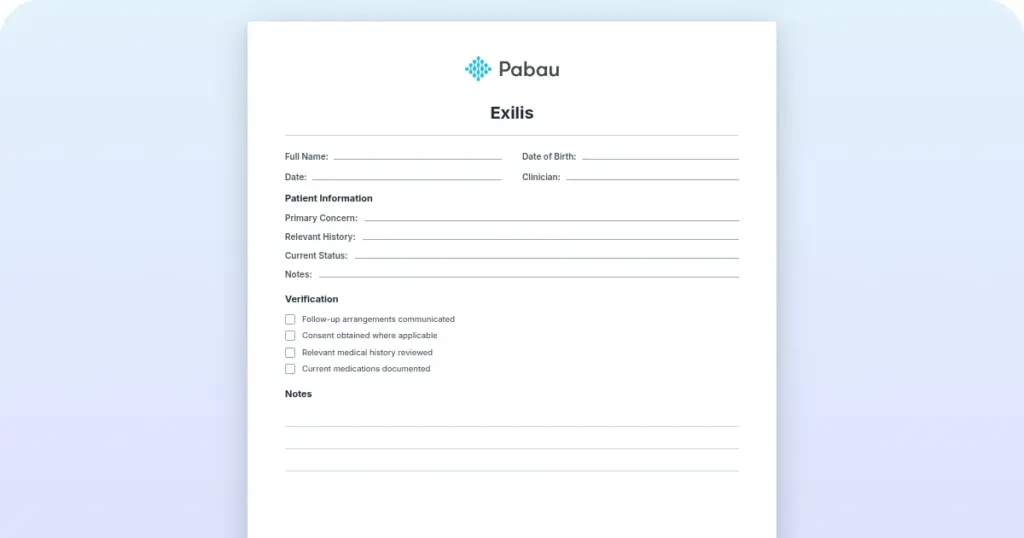
A one-page scored screening form covering four domains: recent falls, medications, psychological factors, and cognitive status. It totals out of 20, sets a low, medium, or high risk band, and flags two automatic high-risk factors.
Falls are the leading cause of injury-related death and disability in older adults. About one-third of community-dwelling adults over 65 experience a fall each year. A systematic fall risk assessment separates the risk factors you can change from the ones you cannot. That lets you intervene before an injury and match prevention to the patient.
Pabau’s form builder turns this fall risk template into a digital form your team completes during the visit.
This guide covers how to run a fall risk assessment in your practice. It works through screening, risk stratification, and evidence-based prevention. It also covers the validated tools clinicians rely on.
The free template above is a quicker instrument than any of those. You can complete the one-page screen in a few minutes and file it in the record.
A structured approach to fall risk is a patient safety priority in every setting. That includes primary care, acute hospitals, home health, rehabilitation, and specialty practices.
For hospitals and critical access hospitals, the Joint Commission replaced its National Patient Safety Goals chapter with National Performance Goals on January 1, 2026. NPSG.09.02.01, the fall reduction goal, now applies to nursing care center and home care programs only. Whichever set applies to you.
Pabau’s automated messages remind high-risk patients about their follow-up, so nobody has to chase them by phone.
Found our content helpful?
What is a fall risk assessment?
A fall risk assessment is a standardized evaluation that identifies the factors making a patient more likely to fall. A structured assessment uses validated instruments such as the Morse Fall Scale and the STEADI algorithm. It sorts patients into low, moderate, and high-risk categories. That keeps prevention targeted and the reasoning easy to document.
The assessment covers intrinsic factors: age, muscle weakness, gait and balance impairment, vision loss, cognitive decline, polypharmacy, and orthostatic hypotension. It also covers extrinsic factors, such as home hazards, footwear, lighting, and assistive devices. Each factor is weighted according to the tool’s evidence base, and the score informs how intensive your response should be.
Clinical settings from primary care to inpatient rehabilitation benefit from a fall risk framework. The CDC’s STEADI initiative, short for Stopping Elderly Accidents, Deaths and Injuries, gives primary care clinicians a three-step algorithm. Hospitals use tools like the Johns Hopkins FRAT or the Morse Scale to identify high-risk inpatients and trigger safety protocols.
That supports continuity and keeps reassessment intervals easy to track. It also evidences reasonable care if an adverse event follows. Accreditation standards emphasize proactive, documented fall prevention.
Pabau’s patient record holds every completed screen, so the current risk band is easy to find at the next visit.
Who should be screened for falls
Fall risk screening is indicated for specific populations across multiple settings. Adults 65 and over are the primary group, because strength, balance, and vision decline with age. Screening also suits younger patients with risk factors. Those include recent falls, neurological or mobility disorders, polypharmacy, vision loss, and cognitive impairment.
Primary care practices: Screen all patients 65 and over annually. Assess any patient reporting a fall, dizziness, unsteadiness, or a near-fall. The CDC STEADI framework fits primary care workflows.
Acute hospitals and inpatient rehab: Assess every admission. Morse and the Johns Hopkins FRAT quickly flag patients who need bed alarms, frequent checks, and help with mobility.
Home health and community care: Assess at the first visit and after any acute change in health. Home-specific tools such as MAHC-10 weigh environmental hazards alongside intrinsic factors.
Specialty practices:Physical therapy, occupational therapy, sports medicine, and orthopedics all see patients with balance disorders. So do teams managing post-operative mobility limits and chronic musculoskeletal problems that affect gait.
Long-term care: Nursing homes and assisted living facilities screen on admission. They then reassess regularly as functional status and medications change.
Any setting caring for patients at elevated risk benefits from systematic screening to guide care coordination and follow-up. That includes teams treating the aftermath of a fall, such as fracture recovery and post-stroke rehabilitation.
Common fall risk factors
Fall risk factors split into intrinsic and extrinsic categories. Knowing which apply to a patient guides the type and intensity of intervention. Most falls come from a combination. A patient on sedating drugs with weak legs and a cluttered bathroom carries several overlapping risks.
Risk factor category
Examples (modifiable and non-modifiable)
Clinical implication
Age and frailty
Age 65 and over is non-modifiable. Frailty and sarcopenia may respond to strength work.
Resistance and balance exercises targeted to the deficit, plus a therapy referral.
Balance and gait
Impaired single-leg balance, abnormal gait, and cerebellar signs. Physical therapy improves most of these.
Refer to physical therapy, prescribe balance exercises, and consider a walking aid.
Medications
Sedatives, antihypertensives, antidepressants, opioids, and five or more drugs in total. All are modifiable.
Deprescribe or adjust timing, monitor orthostatic blood pressure, and explain side effects.
Orthostatic hypotension
A systolic drop of 20 mmHg or more on standing. Hydration, compression stockings, and a medication review all help.
Check orthostatic vitals, increase fluid intake, and adjust antihypertensive timing.
Vision
Uncorrected refractive error, cataracts, glaucoma, and impaired depth perception. Some are correctable.
Refer to eye care, update the eyeglass prescription, and improve the lighting.
Cognition
Dementia, delirium, confusion, and reduced awareness of risk. Advanced stages are not modifiable.
Increase supervision, use bed alarms, and move the room closer to the nursing station.
Home hazards
Loose rugs, poor lighting, cluttered pathways, slippery bathrooms, and missing grab bars. All are modifiable.
Arrange a home safety assessment, then add handrails, non-slip mats, and brighter lighting.
Footwear
Ill-fitting shoes, unsecured slippers, high heels, and worn soles. All are modifiable.
Counsel on safe footwear, and refer to podiatry if foot pain limits balance.
Storing completed assessments in patient management software keeps every score searchable within the patient’s record.
How to conduct a fall risk assessment step by step
A complete assessment brings together history-taking, physical examination, functional testing, and a look at the patient’s environment. How deep you go depends on the setting and the patient in front of you. The steps below work across settings.
Take a history and check vitals
Obtain fall and mobility history: Ask directly whether the patient has fallen in the past year, felt unsteady, or nearly fallen. Document each prior fall with its date, mechanism, injury, and context. Also document fear of falling, which limits activity and raises risk on its own.
Review medications: List every current drug, including prescriptions, over-the-counter products, and supplements. Flag the fall-risk categories: sedatives, antihypertensives, anticonvulsants, opioids, anticholinergics, and NSAIDs. Check timing too, since some blood pressure drugs cause orthostatic effects in the morning. Consider a dose reduction or an alternative agent.
Check for orthostatic hypotension: Measure blood pressure lying down, then again after one to three minutes standing. A systolic drop of 20 mmHg, a diastolic drop of 10 mmHg, or symptoms such as dizziness all indicate orthostatic risk.
Test function, vision, and cognition
Assess visual function: Screen vision with a Snellen chart, or ask about glasses and recent eye problems. Note any uncorrected refractive error or known cataracts. Refer to eye care if the vision loss is new.
Test balance and gait: Use these validated performance tests.
Timed Up and Go: Time the patient rising from a chair, walking 10 feet, turning, and sitting back down. Over 12 seconds indicates increased fall risk.
30-second chair stand: Count how many times the patient stands in 30 seconds. The cutoff is age- and gender-adjusted, so read the score against the STEADI norms table. The threshold runs as high as 14 stands for men aged 60 to 64.
4-stage balance test: Ask the patient to hold four foot positions for 10 seconds each. They run from feet together to a single-leg stance. Failing to hold the tandem stance indicates a balance deficit.
Screen for cognitive impairment: Run a brief cognitive screen such as the Mini-Cog, the Montreal Cognitive Assessment, or simple orientation questions. Cognitive decline raises fall risk by blunting awareness and judgment.
Assess environment, score, and document
Assess the home environment: Ask about stairs, bathrooms, lighting, rugs, assistive devices, and any falls that happened at home. An in-home visit is the gold standard but is not always feasible. A conversation with the patient and family is enough for initial triage.
Assign a risk category: Score the patient with the tool your setting has chosen, whether Morse, STEADI, the Johns Hopkins FRAT, or STRATIFY. Record the resulting low, moderate, or high category.
Document findings: Record every component in structured clinical notes, along with the risk category, the planned interventions, and the follow-up date. Automated alerts can then prompt reassessment at three to six months.
Validated screening tools compared
Several validated instruments exist for fall risk stratification, each built for a particular setting and population. Picking the right one keeps the work efficient and the result clinically useful. The table below compares the tools most widely used today.
Tool name
Items
Risk categories (score range)
Best used in
Morse Fall Scale
6 (history of falls, secondary diagnosis, ambulatory aid, IV or heparin lock, gait, mental status)
Low 0-24, moderate 25-44, high 45 or above
Acute hospitals, inpatient rehab
Johns Hopkins FRAT (JHFRAT)
7 (age, fall history, mental status, medications, assistive device, transfer ability, wandering)
Low 0-5, medium 6-13, high 14 or above
Acute hospital inpatients
Hendrich II Fall Risk Model
8 (confusion, disorientation or impulsivity, symptomatic depression, altered elimination, dizziness or vertigo, male gender, antiepileptics, benzodiazepines, get-up-and-go test)
10 (age, prior falls, cognition, footwear, home hazards, medication, vision, balance, gait, strength)
Scored for the home care setting
Home health, community care
CDC STEADI algorithm
Screening questions plus Timed Up and Go, 30-second chair stand, 4-stage balance test
Screen, assess, intervene framework
Primary care, outpatient practices
The Morse Fall Scale is the most widely adopted tool in hospitals. Its six domains score quickly to a single number that maps directly to the table above. The resulting band tells you how intensive your prevention protocol needs to be.
CDC STEADI is the preferred framework in primary care. It screens every older patient first, and only those who screen positive move on to performance testing. That clears low-risk patients quickly while flagging the ones who need a detailed functional assessment.
How to fill out and score the form
The downloadable template is a one-page scored screen rather than a full assessment record. It covers four domains, adds them into a total out of 20, and turns that total into a risk band. Two checkboxes can override the total on their own. The format follows the falls risk status section of the Peninsula Health Falls Risk Assessment Tool.
Score the four domains
Score recent falls: Check one box only. No falls in the last 12 months scores 2 points. A fall between three and 12 months ago scores 4 points. A fall in the last three months scores 6 points, or 8 if the patient was an inpatient at the time.
Score medications: Count the patient’s drugs from the classes named on the form. Those are antidepressants, antihypertensives, sedatives, antiparkinsonian drugs, diuretics, and hypnotics. None scores 1 point, one scores 2, two scores 3, and more than two scores 4.
Score psychological factors: Rate anxiety, depression, poor cooperation, and poor insight or judgment about mobility. Unaffected scores 1 point. Mildly, moderately, and severely affected score 2, 3, and 4 points.
Score cognitive status: Administer the Hodkinson Abbreviated Mental Test Score, a 10-item orientation and recall screen. A score of 9 or 10 earns 1 point. Then 7 to 8 earns 2, 5 to 6 earns 3, and 4 or below earns 4.
Total the score and finalize the risk status
Add up the total out of 20: Every domain scores at least 1 point, so the lowest possible total is 5. The form prints the bands: low is 5-11, medium is 12-15, and high is 16-20.
Check the automatic high-risk factors: Tick either box if it applies. The first covers a recent or expected change in functional status or in medications affecting safe mobility. The second covers dizziness or postural hypotension. Either box makes the patient high risk whatever the total says.
Mark the fall risk status: Circle HIGH, MEDIUM, or LOW on the status line. Colleagues read that line first, so check that it matches both the total and any automatic factor you ticked.
Use the additional notes box: The form has no fields for exam findings, home hazards, an intervention plan, or a signature. Record the detail that matters in the notes box. Keep the rest in your clinical notes and mobility care plan.
The form gives you a band without explaining what is driving it. Treat a medium or high band as the trigger for the deeper work above. That means balance and gait testing, plus a medication review with the prescriber. It also means vision screening and a check for hazards at home.
Date every completed form and store it in the patient’s record, so the next clinician can see whether the band has moved. Rescore after a fall, a medication change, a hospital stay, or any decline in function.
Pro Tip
Track reassessment intervals with automated reminders. A screen dated last year tells you nothing about this year. Set a recurring task in your practice management system to flag patients for reassessment every three to six months. A hospital stay, a medication change, or a new fall should pull that date forward. Consistent monitoring catches emerging risk early and keeps your documentation defensible.
Fall prevention strategies after assessment
Once the patient has a risk category, prevention follows. Match the intensity of the intervention to the risk level. Low-risk patients need education and a date for next year’s screen. Moderate and high-risk patients need targeted, multi-component interventions aimed at the factors you found.
Medical and physical interventions
Medication management: Review every drug with the prescriber. Deprescribe sedatives, opioids, or unnecessary antihypertensives where you can. Adjust timing too, for example by moving a blood pressure dose to bedtime. Explain the side effects and the fall risk to the patient.
Physical conditioning: Refer the patient to physical therapy for balance and strength training. Two to three sessions a week is the dose the evidence supports.
Vitamin D: Recommend supplementation if serum vitamin D falls below 30 ng/mL. Vitamin D supports bone density and muscle function. Deficiency raises both fall and fracture risk.
Environmental and sensory interventions
Home safety changes: Refer to occupational therapy for a home assessment, or hand the patient written guidance. Poor lighting, loose rugs, and missing grab bars are the usual culprits. Removing a rug or fitting a bathroom rail costs little and works.
Footwear and assistive devices: Counsel on safe footwear with a firm sole, good support, and a proper fit. Prescribe a walker, cane, or orthotics if balance or lower-body strength is impaired. A poorly fitted device raises risk, so arrange fitting and gait training.
Vision and hearing: Refer to ophthalmology or optometry when vision loss is present, and update eyeglass prescriptions. Correcting vision lowers fall risk, and better hearing supports spatial awareness and balance.
Cognitive support and follow-up
Cognitive support: Increase supervision and simplify the environment for patients with cognitive impairment. Consider bed alarms on the ward, orientation aids such as clocks and large signage, and frequent check-ins. Bring the family into the safety plan.
Reassess and document: Plan the next assessment for three to six months, or sooner for high-risk patients. Record what you delivered and how the patient responded, using a measure such as the Global Rating of Change. If falls continue, adjust the plan and consider vestibular or neuropsychological testing.
Rehabilitation teams deliver many of these interventions alongside primary care. A coordinated approach across primary care, therapy, and pharmacy produces the best outcomes. Physical therapy clinics that host these follow-up visits face their own state licensing and record-keeping requirements before they open.
Related templates
Heart Attack Troponin Levels Chart
Blood sugar levels chart
Fat burn heart rate chart
How Pabau keeps fall risk screening on schedule
On paper, this form is quick to complete and easy to lose track of. It gets scanned in after the visit, or filed somewhere nobody opens until the next fall. The score exists, but the clinician who needs it cannot see it.
Practice management software like Pabau turns the same four domains into a digital form your team completes on the spot. The scores save straight to the patient’s record, so the current band sits beside the notes, allergies, and medication list. Pabau GO, our iOS app for practitioners, lets a home-visit clinician complete the same form at the bedside.
From there, automated workflows handle the reassessment for you. A high band can trigger a follow-up task for the clinician and a reminder for the patient. A low band can simply schedule next year’s screen. Either way you get a dated trail of who was screened and what happened next.
Keep every fall risk screen scored and stored
Pabau’s digital forms and client records make fall risk documentation quick to complete and easy to find. Store each screen securely, set automated follow-up reminders by risk level, and review every patient on schedule.
Screening is the cheap part of fall prevention. The template above takes a few minutes, gives you a number and a band, and tells you which patients need the longer workup.
What changes outcomes is what happens after the score. A high band that leads to a medication review, balance training, and a home safety check reduces falls. A high band that is filed and forgotten does not.
So use the template as your standard first pass, and put reassessment on a schedule rather than on memory. Book a demo to see how Pabau keeps every fall risk screen scored, stored, and due for review on time.
Continue your research
Checking for ankle ligament instability? The ankle posterior drawer test template documents procedure steps and positive sign interpretation in a standardized format.
Grading spinal cord injury severity? The ASIA Impairment Scale worksheet scores sensory and motor function to determine AIS grades A through E.
Looking at the hip mechanics behind an unsteady gait?Ober’s test covers the positioning, the interpretation, and the errors to avoid.
Assessing joint hypermobility in a patient? The Beighton Score template tests five body areas to determine generalized joint laxity.
Evaluating a patient’s fall risk? The Berg Balance Scale template captures static balance, dynamic balance, and functional mobility for treatment planning.
Frequently asked questions
What is a fall risk assessment and who needs one?
A fall risk assessment is a structured evaluation that identifies patients at increased risk of falling. Validated tools include the Morse Fall Scale, CDC STEADI, and the Johns Hopkins FRAT. All adults 65 and over should be screened annually in primary care. Screen patients of any age who have fallen, have mobility or cognitive impairment, or take multiple medications.
Which tool should I use: Morse, STEADI, or Johns Hopkins FRAT?
Choose based on setting. Morse is standard in acute hospitals and inpatient rehab. STEADI is designed for primary care and fits outpatient workflows. The Johns Hopkins FRAT also suits acute inpatients, and home health teams typically use MAHC-10. All of them are evidence-based, so match your choice to your setting and the time you have.
What medications increase fall risk?
Sedatives, antihypertensives, antidepressants, opioids, anticonvulsants, and anticholinergics all increase fall risk. Taking five or more medications compounds it. Review medications as part of every fall assessment. Deprescribe or adjust timing with the prescriber where you can.
How do I document the assessment in the patient’s record?
Complete the form, score the risk level, note the planned interventions, and file it in the structured clinical record. A timestamped digital record shows when each entry was made and supports HIPAA compliance. Include the risk factors you found, the test results such as the Timed Up and Go time, and your reasoning for the category. That documentation supports continuity and evidences reasonable care.