Professional development record
A professional development record is a structured log of a healthcare practition...

8
Last Updated: Oct 8, 2026

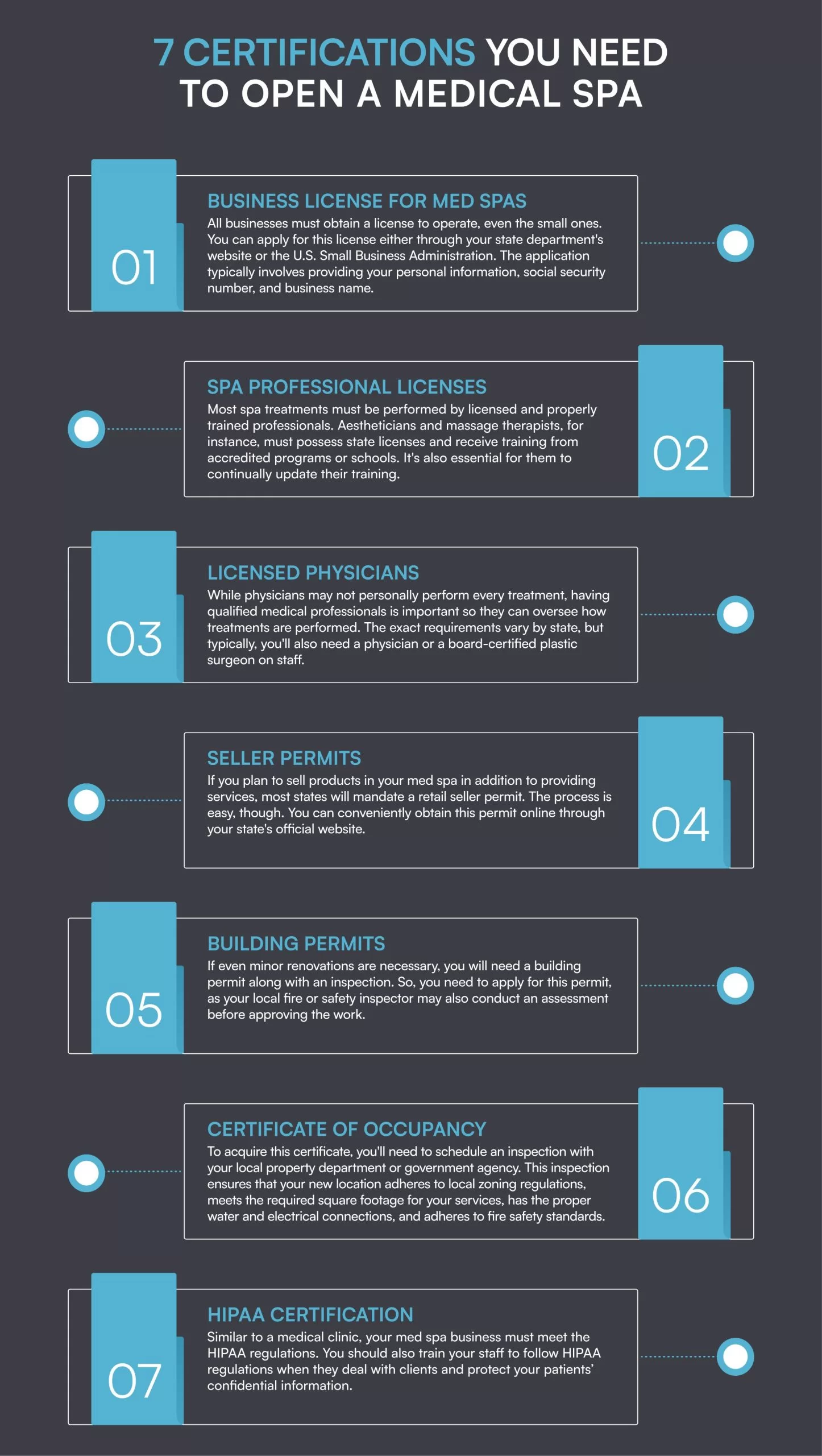
Meeting med spa requirements means stacking several approvals before you open: a business license, spa professional licenses, a seller’s permit, a building permit, a certificate of occupancy, and HIPAA certification.
Most states require a licensed physician to own or supervise a medical spa, though a few allow nurse practitioner ownership under physician oversight.
Non-physicians can still open a med spa by structuring the business as a Management Services Organization (MSO) with a physician partner.
HIPAA compliance covers staff training and patient data handling, including how your practice uses client photos and testimonials on social media.
Requirements vary by state, so confirm the specifics with your state’s medical board and licensing office before you sign a lease.
Getting your medical spa requirements in order before you open separates a smooth launch from a costly delay. Charting and payment tools belong on your pre-opening checklist too, with vendors compared in our med spa management software guide.
Miss a license, permit, or compliance step, and you risk fines or a failed inspection. Your launch date could slip by months.
The list runs from business licenses and building permits to HIPAA certification and physician oversight. And if you aren’t a licensed physician yourself, plan for a few extra steps too.
This guide walks through exactly what you need, state by state, so nothing catches you off guard.
A medical spa blends medical treatments with spa services. Think anti-wrinkle injections, laser hair removal, and chemical peels alongside massages and facials.
Med spas generally fall into one of two business models: aesthetic spas and medical aesthetic spas.
Aesthetic spas focus on noninvasive treatments like anti-aging facials and relaxation massages, and typically don’t require a physician on-site.
Medical aesthetic spas offer treatments that only physicians, nurses, or medical aestheticians can legally provide. These include anti-wrinkle injections, dermal fillers, and dermatological treatments.
In many states, you can’t own a medical spa unless you’re a licensed physician. The treatments a med spa offers — injectables, laser procedures, and skin treatments — count as the practice of medicine, so a licensed physician has to perform them or directly supervise the people who do.
That’s why most states bar non-physicians from owning a med spa outright, or from employing doctors to work under them. There are exceptions. In Alaska and Florida, a physician only needs to supervise the practice, not own it. In states like New York and Minnesota, a nurse practitioner can co-own a medical spa under physician oversight.
Here’s how ownership and treatment rights tend to break down by role. Rules vary by state, so confirm the specifics with your state medical board before you commit.
| Role | Can own a med spa? | Can perform medical treatments? |
|---|---|---|
| Physician (MD or DO) | Yes, in every state | Yes, the full range |
| Nurse practitioner (NP) | In some states, under physician oversight | Yes, under approved protocols |
| Physician assistant (PA) | Usually only through an MSO | Yes, under physician supervision |
| Registered nurse (RN) | Only through an MSO | Only under a prescriber’s direction |
| Esthetician | Only through an MSO | Surface-level treatments only |
Estheticians and other non-medical staff can work in a med spa, but in most states they’re limited to surface-level services like facials and microdermabrasion. They can’t administer injectables or operate lasers.
Licensing requirements differ by state. Check your state’s official rules on who can legally open a medical spa before you commit to a location.
Every med spa needs a business license to operate legally, regardless of size. You can apply through your state department’s website or the U.S. Small Business Administration, providing your personal information, Social Security number, and business name.
Having a business plan ready before you apply speeds this up, since you’ll know your entity structure and ownership details.
Keep digital copies of every business license, permit, and certification in your practice management software so you can pull them up instantly during an inspection, an insurance renewal, or a lease negotiation.
Licensed, trained professionals must perform most spa treatments. Aestheticians and massage therapists, for example, need state licenses and training from accredited programs. They also need ongoing continuing education to keep those licenses active.
Physicians don’t need to personally perform every treatment. Most states require qualified medical professionals on staff to oversee how treatments happen.
Exact rules vary, but you’ll typically need a physician or board-certified plastic surgeon on staff. Their oversight role often shapes how you structure staff pay and commission.
If you plan to sell retail products alongside your services, most states require a seller’s permit. You can usually apply online through your state’s official website.
Even minor renovations require a building permit and inspection. Apply for the permit with your local building department. Expect a visit from a fire or safety inspector before final approval.
You’ll need to schedule an inspection with your local property department or government agency to get this certificate.
The inspection checks that your location meets zoning rules and has the required square footage for your services. It also confirms proper water, electrical, and fire safety.
Similar to a medical practice, your med spa must meet HIPAA regulations. Train your staff on these requirements so they know how to protect patient information — ideally within a HIPAA compliant CRM — when dealing with clients.
If you’re unsure whether med spas have to be HIPAA compliant, this checklist breaks down when HIPAA applies. It also covers what you need to put in place.
Posting client photos or testimonials without proper consent is one of the most common HIPAA slip-ups at med spas. Read what you need to know about HIPAA compliance and social media before you post.
In states that require physician ownership, you can still open a med spa without being a doctor. Structure the business as a Management Services Organization (MSO) with a Management Service Agreement (MSA).
You sign an MSA with a licensed physician who becomes the legal owner of the practice. That physician takes responsibility for supervising, performing, and making decisions about treatments.
As the MSO, you handle the business side — bookkeeping, payroll, marketing, and HR. You work closely with the physician to keep day-to-day operations within state medical standards.
Med spa laws by state vary significantly, and in some cases a specific service needs a specific license. It’s worth getting guidance from a local legal and financial expert before you launch.
Here’s a look at three states with stricter requirements.
Get a signed release before posting any before-and-after photo or testimonial, even ones a client sends you unprompted — a written release protects both the client’s privacy and your practice.
If you want the specific requirements for your state, check with the American Med Spa Association.
Staying on top of licensing requirements is easier with the right tools in place. Practice management software like Pabau helps you keep every patient record, form, and compliance document organized in one place.
Our medical spa software includes:
so you can focus on patient care instead of paperwork.
Compliance is the foundation, but running the day-to-day well matters just as much. That includes scheduling, service menus, the packages you sell, and even patient compliance with aftercare and follow-up. A medical spa CRM keeps those client details, packages, and follow-ups organized in one place.
Opening a med spa is exciting, but the requirements take careful planning. They vary by state, and most states require a licensed physician’s involvement because of the medical nature of the treatments.
At minimum, you’ll need a business license, a building permit, and HIPAA certification. The exact list depends on where you’re opening.
Research your state’s regulations early and get legal and financial guidance before you launch. Some states let nurse practitioners or other medical professionals own or operate a med spa.
Documenting patient records properly and running a well-organized practice matters just as much as the paperwork. That’s where a practice management vendor like Pabau earns its keep. Look for med spa platforms that sign a BAA to protect patient data. Non-compliance carries costs, from fines to lost licenses that cut directly into what medical spa owners earn.
Check out what we consider the best medical spa software right now.
Ready to see how Pabau keeps your practice compliant while your team focuses on patients? Book a demo to see it in action.

Offering eMatrix treatments at your spa? eMatrix aftercare protocol covers downtime expectations, skincare restrictions, and follow-up scheduling after the treatment.
Ready to move from planning to opening? How to start a med spa walks you through every step, from business structure to your first booking.
Trying to budget your launch? How much it costs to open a med spa breaks down startup costs and the revenue you can expect.
Want to fill your calendar once you’re open? Med spa marketing strategies cover the tactics that bring new clients through the door.
There’s no single medical spa license. You’ll typically need a business license, a seller’s permit if you retail products, a building permit, and a certificate of occupancy, plus the state licenses your treatment providers hold. In most states, a licensed physician must also own or supervise the practice, which is the rule that catches new owners off guard.
In most states, yes. Because these treatments are medical procedures, a licensed physician has to own the practice or supervise it as medical director. A handful of states let nurse practitioners take on that role under physician oversight, but a qualified prescriber signing off on treatment protocols is almost always part of the setup.
It depends on the state and the nurse’s qualification. In several states, a nurse practitioner can own a medical spa under physician oversight. A registered nurse usually can’t own one outright, but can open a med spa as a nurse by setting up a Management Services Organization with a physician partner who takes clinical responsibility.