Fertility clinic marketing: Strategies that attract & convert patients
Fertility clinic marketing is how a fertility practice attracts, educates, and c...

Last Updated: Oct 14, 2026
To sell more retail at med spas, prescribe products as aftercare for the treatment the patient just had, instead of pitching them at checkout.
The practices that do this well run a three-step loop we call Prescribe, record, replenish. The practitioner names the products in the treatment room and the purchase goes on the patient file. A reorder reminder then goes out before the product runs out.
Run consistently, that loop can make retail a meaningful line in your accounts. Published benchmarks put retail at roughly 15% to 40% of med spa revenue, depending on the source. Our ranking of the best med spa management software covers the retail and membership tools that track it.
Below are 10 strategies in the order a patient meets them, from the data you already hold to the numbers that show retail working.

The fastest way to sell more retail at med spas is to prescribe products as aftercare in the treatment room, not at checkout.
Run retail as a loop called Prescribe, record, replenish: recommend in the room, log it on the patient file, then send a reorder reminder.
Industry benchmarks put a healthy retail share at roughly 15% to 40% of med spa revenue, depending on the source.
Repeat buyers carry the category, since Skytale Group found 17% of skincare buyers generate nearly half of skincare revenue.
Practice management software like Pabau ties treatments, product sales, stock and reorder reminders to one patient record.
Retail adds med spa revenue without adding treatment-room hours, and repeat product buyers keep spending with you between appointments.
How big a share should you aim for? The benchmarks vary by source:
Skytale’s purchasing analysis also shows where that money comes from. Sixty-two percent of skincare buyers purchase only once. The 17% who buy three or more times generate nearly half of all skincare revenue.
So working out how to increase retail sales is mostly about repeat purchases. The first sale matters, but the second and third are where the revenue builds.
Retail isn’t your highest-margin line. Its value is continuity. A patient using your products at home stays connected to your practice between visits.
Your patient records already tell you what to stock. Treatment history, skin concerns noted at consultation and past purchases show which products your patients need and what they’ll pay.
If you run your practice on software for med spas, pull three reports before your next stock order:
Then turn the data into a buyer persona. The example below describes a busy professional who researches online and prefers recommendations from trusted professionals.
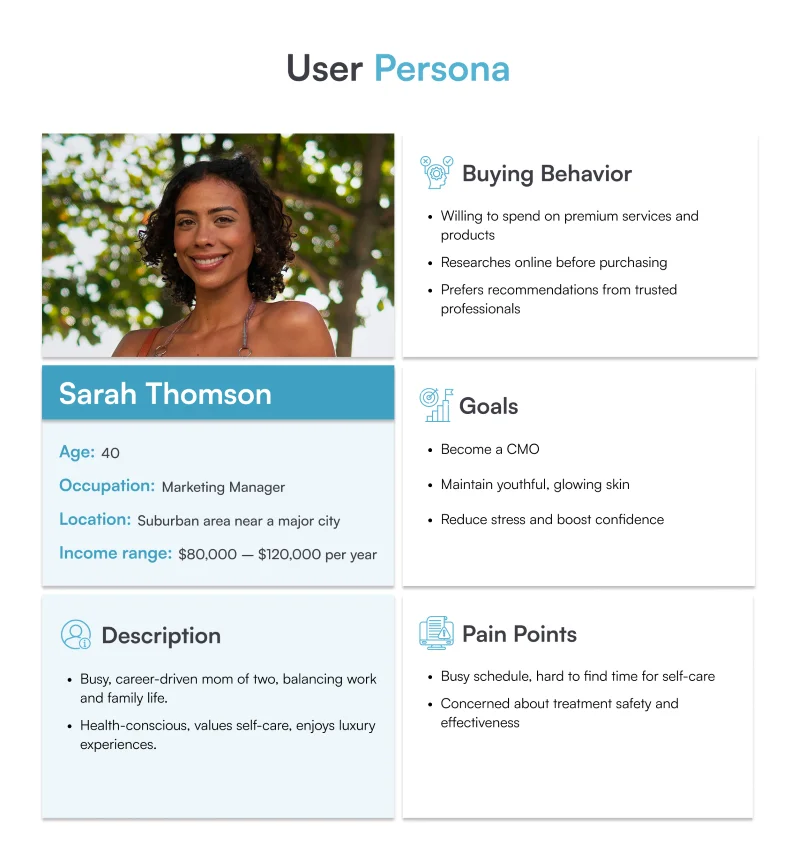
For a patient like Sarah, a shelf card won’t close the sale. The recommendation has to come from the person who just treated her. That’s why the rest of this guide puts the practitioner at the center of retail.
Stock a tight range mapped to your top treatments, starting with SPF, a gentle cleanser, a barrier-repair moisturizer and a few targeted actives.
A shorter range is easier for your team to learn and easier for patients to choose from. Group it into regimens, such as:
Many practices carry both. Here’s how the two compare:
The difference between wholesale vs retail price is your retail margin. Retailers traditionally price at double the wholesale cost, a convention called keystone pricing.
Professional skincare brands usually publish a manufacturer’s suggested retail price (MSRP), and some restrict discounting below it. Before you add a line, check three numbers:
If a product can’t earn its shelf space at MSRP after your member discount, leave it out.
Prescribe products as part of the written aftercare plan for each treatment, so the patient hears them as instructions rather than a sales pitch.
Prescribing is the first step of the loop we call Prescribe, record, replenish. Retail consultant Patti Biro, quoted by AmSpa, puts it bluntly: “Not offering a retail product recommendation means you have not finished delivering the service.”
The diagram below shows the full loop, and the reorder rule that closes it.
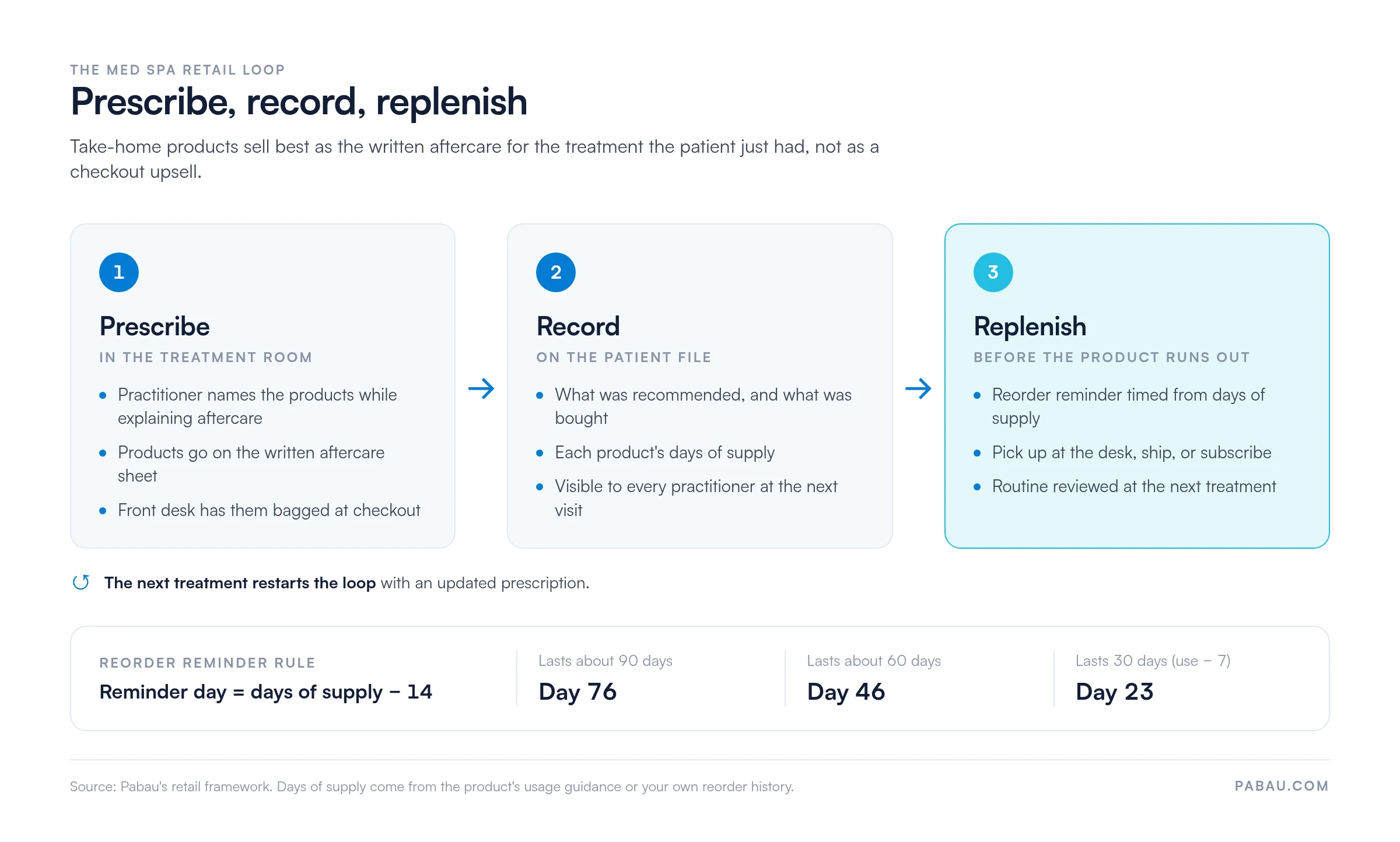
The treatment-to-retail matrix below maps common treatments to the product categories their aftercare usually calls for. Use it as a starting point for your own protocols.
Your practitioner’s own aftercare protocol decides what goes on the sheet. How long to pause actives varies by treatment depth and skin type, so the matrix names categories rather than brands or day counts.
If lasers are core to your menu, laser clinic software can attach the aftercare products to each treatment record.
Recommend products in the treatment room while the practitioner explains aftercare, then confirm them at the front desk, instead of starting the conversation at checkout.
By the time a patient reaches the desk, they’re thinking about payment and parking. In the room, the practitioner has their full attention and their trust. Three touchpoints make the timing work:
That follow-up window matters. Patti Biro told Med Spa Growth and Profitability that many people buy a product within 48 hours of a treatment.
When we set up aftercare forms with practices during onboarding, a products section is one of the first additions we suggest. It turns a verbal tip into a written instruction the patient can act on.
A good spa retail display repeats your aftercare advice on the shelf, grouping products by treatment or skin concern instead of by brand.
Retail merchandising in a med spa follows a few simple rules:
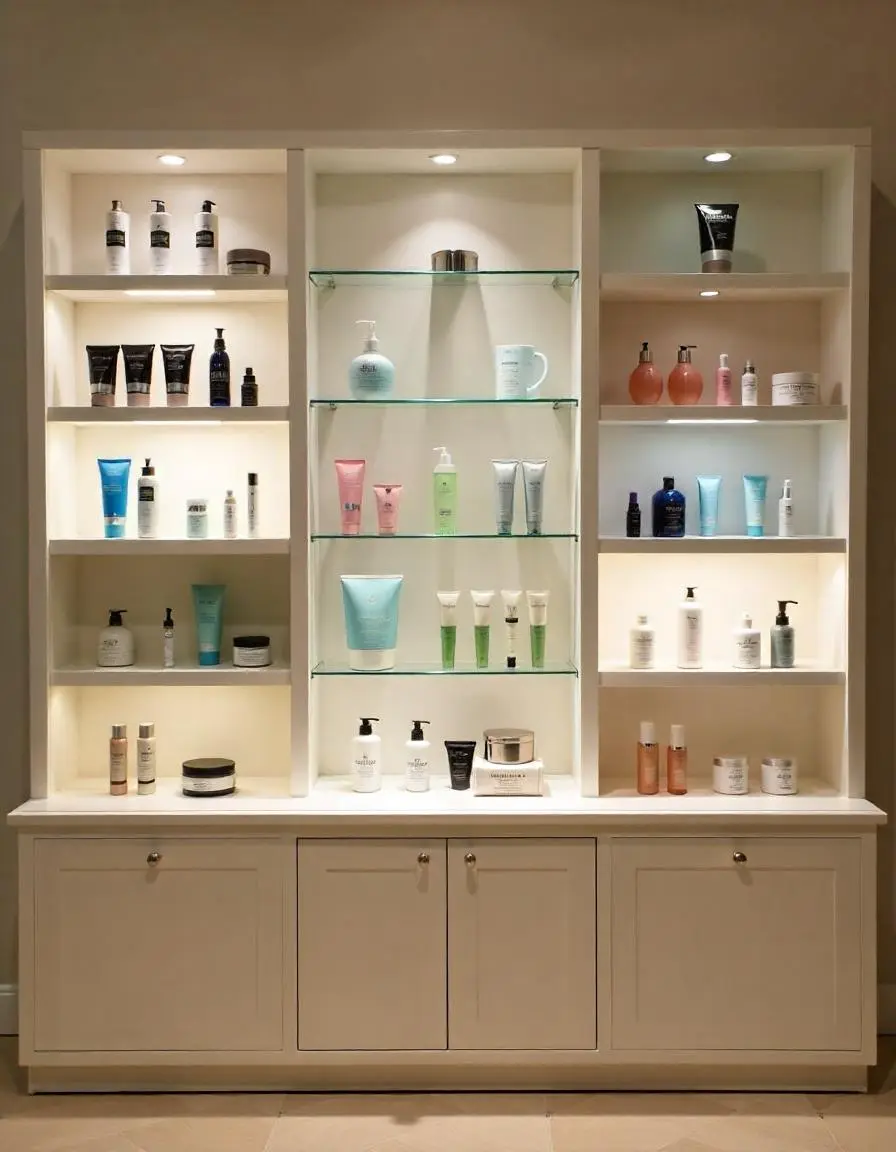
The display should match the rest of the practice. If your treatment rooms look clinical and calm, the shelves should too.
Knowing how to sell skincare products in a med spa comes down to one habit: your team recommends what the treatment needs and explains why.
Patients already buy skincare from ads, influencers and department-store counters. Your practitioners’ clinical knowledge is what those channels can’t offer. Build training around three skills:
A script can be this short: “Your skin will be sensitive for a few days. Use this cleanser and SPF until I see you next. I’ve put both on your aftercare sheet.”
Incentives help too. A retail commission, tracked per team member, rewards staff for keeping the conversation going. Keep it modest so recommendations stay clinical.
A personalized retail experience means every patient leaves with a routine built for their skin and treatment plan, written down and saved on their file.
Personalization is the record step of the loop. When the recommendation lives on the patient file, the next practitioner can see what the patient uses, what they skipped and what to adjust.
Remind patients to reorder before the product runs out, timing each reminder from the product’s days of supply rather than a fixed monthly blast.
Replenish is the step that turns one-time buyers into the repeat buyers who drive retail revenue.
Use this rule for every product you sell:
So a cleanser that lasts about 90 days gets its reminder around day 76. Patti Biro describes the same logic, calling at two and a half months about a cleanser that lasts almost three.
Subscriptions take the reminder out of the loop entirely. Illumination Consulting describes 30-, 60- and 90-day subscription options, with 10% off skincare for subscribers. Before you launch one, decide:
Retail marketing works best when it points patients back to the routine they already started, through bundles, seasonal offers and results from other patients.
Kits also work inside treatment packages. Our med spa package ideas include bundles that pair a course of treatments with the products that go with it.
Email and SMS are the most direct channels for all of this, because you’re writing to patients who already trust your practice.
Track six retail key performance indicators (KPIs) every month, from attach rate to inventory turnover. The numbers show which products stay and where staff need coaching.
Review attach rate by practitioner first, because it shows who is prescribing. For the wider business numbers, see our med spa KPI guide.
Inventory is the other half. Running out of the SPF you just prescribed breaks the loop at the worst moment. Stock management software keeps it intact with:
If you’re comparing tools, our review of med spa inventory software covers nine options.
Keep product claims to appearance, and charge sales tax on retail products wherever your state requires it.
The US Food and Drug Administration (FDA) classifies a product by its intended use, judged partly from claims on labels, websites and promotions. A moisturizer that makes lines look less noticeable is a cosmetic.
A product claimed to remove wrinkles or boost collagen is regulated as a drug. Sunscreens and acne treatments sold in the US are drugs too, so their labels carry drug facts.
The rule covers your team’s words as well as the label. Train staff to say “helps skin look smoother” rather than “repairs collagen.”
Sales tax works differently. Forty-five states and Washington, DC, collect a statewide sales tax, according to the Tax Foundation. Many tax retail products even where treatments are exempt, so check your state’s rules.
Many med spas run retail across a patchwork. Product notes sit in a chart, sales go through a separate card terminal, stock lives in a spreadsheet and reminders go out by hand.
Pabau runs the whole Prescribe, record, replenish loop from one patient record:
Every Pabau subscription includes the full platform. Structured onboarding sets up your products, aftercare forms and reminders with you, so the loop runs from your first week.

Pabau links aftercare, point of sale, stock and reorder reminders to one patient record. Every product you prescribe gets recorded and replenished on time.

If you want to sell more retail at med spas, the shelf is the last place to start. Start in the treatment room, where a recommendation carries clinical weight.
The trade-off is discipline. The loop only works if every practitioner prescribes, every sale is recorded and every reminder goes out on time. Skip one step and the patient restocks from an online retailer instead.
This month, pick your three highest-volume treatments, write their products onto the aftercare forms and start tracking attach rate. Book a demo to see how Pabau keeps aftercare, product sales and reorder reminders on one patient record.

Want more patients coming back for treatments? Med spa marketing ideas covers campaigns that attract and retain patients.
Thinking about product discounts for members? How to build a profitable med spa membership program walks through pricing tiers and perks that keep patients subscribed.
Mapping where retail fits in the visit? The patient journey in aesthetics breaks the journey into seven stages and how to improve each one.
Need an aftercare sheet to add products to? Chemical peel aftercare template gives you a ready-made sheet to hand patients after a peel.
Laser and other energy-based treatments usually carry the highest margins once the device is paid off, according to AmSpa. Body contouring and injectables follow. Retail sits lower on that list. But every one of those treatments creates an aftercare need, which adds med spa revenue on top of the service.
Skincare is the beauty industry’s largest category, ahead of fragrance, hair care and makeup, according to McKinsey’s State of Beauty research. In a med spa, skincare is also the natural focus, because SPF, cleansers, moisturizers and serums tie directly to your treatments.
Most benchmarks put retail at roughly 15% to 40% of a med spa’s revenue. Illumination Consulting cites 15% to 30%, Skytale Group reports 20% to 30% at high performers, and consultant Dr. Lisa Jenks suggests 20% to 40%.
Recommend products as part of the aftercare plan in the treatment room, explain why each one matters for that treatment, and let the patient decide. Listing the products on the aftercare sheet and following up within 48 hours keeps the recommendation going without a hard sell.
Retail products are traditionally priced at about double the wholesale cost, a convention called keystone pricing. Many professional skincare brands also publish a suggested retail price, so check the brand’s pricing policy before you discount.