EHR ROI: How to calculate and maximize your return
EHR ROI is the financial return a practice earns on its electronic health record...

Last Updated: Oct 15, 2026

AI clinical documentation uses ambient listening and NLP to auto-draft notes during patient visits, freeing clinicians from post-appointment charting.
Multiple peer-reviewed studies confirm AI scribes reduce documentation time and improve clinician well-being, though the magnitude varies by specialty and workflow.
HIPAA compliance, a signed Business Associate Agreement, and mandatory clinician review before finalizing notes are non-negotiable requirements for any AI documentation tool.
Pabau Scribe, our AI scribe, generates structured clinical notes, treatment plans, and aftercare instructions directly inside your practice management system, no separate tool required.
Clinicians now spend more time on paperwork than with patients, and AI clinical documentation is the technology practices are adopting to reverse that.
This guide explains how ambient AI drafts notes during the visit, what the peer-reviewed evidence actually shows, the compliance rules you cannot skip, and how smaller aesthetic and private practices can deploy it without an enterprise EHR project.
Clinical notes are one half of a practice’s paperwork. The other half is the admin around the appointment, and it’s being handed over on the same terms. Practice management software like Pabau runs AI agents built for healthcare alongside its scribe. They text back missed callers, invite no-shows to rebook, chase unsigned forms, and follow up unpaid invoices. Every action starts as a draft someone approves, which is the same review step this guide keeps coming back to.
Clinicians in the US spend an average of two hours on documentation for every one hour of direct patient care, according to a JAMA Network Open clinical trial.
That ratio has driven significant investment in AI clinical documentation. These tools listen to the patient encounter and automatically generate structured clinical notes for the clinician to review. Documentation is only one part of AI in healthcare, alongside healthcare chatbots that answer patient questions before the visit.
Most ambient clinical documentation tools follow the same basic pipeline. A microphone, on the clinician’s device or a dedicated wearable, captures the conversation during the visit. Ambient listening runs quietly in the background, so no one has to start a dictation command or read notes aloud.
The audio is processed using speech recognition and then passed through a large language model (LLM) trained on clinical language. The result is a structured draft note, typically a SOAP format or specialty-specific template, ready for the clinician to review and sign. Plain medical transcription software stops at the transcript and leaves the structuring to you.
Speaker differentiation is a key technical requirement here. The system must reliably separate the clinician’s voice from the patient’s, otherwise the note will conflate what was asked with what was answered. Leading tools handle multi-speaker environments with high accuracy, though performance can degrade in noisy settings or with strong accents.
The University of Wisconsin School of Medicine confirmed in December 2025 that ambient documentation can securely draft notes during a patient visit, freeing the provider to interact with the patient directly. There is one critical caveat. Every AI-generated note must be reviewed and edited by the clinician before it enters the official record. The AI drafts, and the clinician owns the final record.
Beyond basic transcription, AI medical dictation software handles additional workflows including treatment plan generation, referral letters, aftercare instructions, and pre-visit summaries pulled from prior notes. This is where artificial intelligence documentation moves past simple speech-to-text into genuinely useful clinical output. Understanding this difference in capability matters when evaluating tools for your practice.
Clinician burnout is largely driven by documentation load. Charting after hours, cognitive switching between care and data entry, and complex EHR interfaces all compound across a full day. AI clinical documentation, sometimes searched for as AI medical documentation, addresses several of these pressure points at once.
The benefits compound. Less charting time translates to more appointments without extending hours, or the same appointment volume with a more sustainable workday. For a discussion of how AI scribes affect patient care quality, the relationship between documentation quality and clinical outcomes is worth examining separately.
Clinical documentation improvement (CDI) is the work of making a record complete, accurate, and codable, so the note actually supports the diagnosis and the claim attached to it. Traditionally that meant a dedicated specialist reviewing charts after the visit. AI moves the check to the point of care instead. Many of the same completeness standards that govern nursing documentation apply here, since accuracy and legal defensibility matter regardless of who or what drafts the note.
The PMC systematic review found that AI tools strengthen documentation by structuring data, annotating notes, evaluating quality, identifying trends, and detecting errors before they reach a claim.
For a solo injector or a two-provider practice, that is the difference between catching a vague note while the patient is still in the room and fielding a payer denial three weeks later.
The payoff for a smaller practice is specific. Fewer claims are rejected for missing detail, coding stays cleaner without a full-time documentation specialist on payroll, and the record holds up if a payer or regulator asks to see it. CDI stops being a back-office audit function and becomes something the documentation tool handles as the note is written.
Not all AI clinical documentation tools are built for the same clinical environment. Whether you are shopping for a full ambient scribe, an AI medical notes generator, or a lighter clinical documentation assistant, evaluating options requires looking beyond marketing claims at the practical features that determine whether the tool actually fits your workflow.
| Feature | Why it matters | Questions to ask |
|---|---|---|
| Specialty-specific templates | Generic SOAP templates miss specialty-specific fields (oncology staging, aesthetic treatment zones, behavioral health progress markers) | Does the tool support your specialty out of the box, or does customization cost extra? |
| EHR / PMS integration | A standalone AI scribe that produces notes you then copy into a separate system doubles your admin work | Does it write directly into your existing records system? |
| Speaker differentiation | Accurate note structure depends on separating clinician voice from patient voice | How does accuracy hold up in noisy or multi-person environments? |
| Clinician review workflow | AI drafts are not final records; the review and editing flow must be fast and intuitive | How many clicks to review, edit, and sign a note? |
| HIPAA / data compliance | Audio of patient encounters is protected health information (PHI) requiring specific safeguards | Does the vendor sign a Business Associate Agreement (BAA)? |
| Audit trail | Any correction to an AI-generated note should be logged with a timestamp and clinician identifier | Is every edit to a generated note traceable? |
Integration is where many tools fall short for smaller practices. Standalone AI scribes that generate notes in their own dashboard require the clinician to copy content across to the EHR or practice management system.
For AI practice management tools to deliver real time savings, the documentation must land in the patient record automatically, not via manual transfer. The best AI for clinical notes writes straight into the system the clinician already uses.
That integration question applies to the tools around the note too. Practices comparing Klara alternatives or Weave alternatives for patient messaging weigh a point tool against one platform.
Before committing to any AI documentation tool, run a 30-appointment pilot using your most documentation-heavy appointment type. Measure actual time-to-finalize per note before and after. Marketing claims about time savings vary widely; your specialty mix, note complexity, and review habits will determine the real figure.
Audio recordings of patient encounters contain some of the most sensitive protected health information a practice handles. When AI clinical documentation tools process that audio, several compliance obligations apply simultaneously.
HIPAA (US): Any AI documentation vendor processing PHI on your behalf must sign a Business Associate Agreement (BAA). Without a BAA, using the tool is a HIPAA violation regardless of how secure the vendor claims to be. The HHS Office for Civil Rights (OCR) takes a strict view here.
For a comprehensive look at HIPAA compliance requirements for clinic software, the specifics around AI data flows are increasingly relevant.
GDPR and UK ICO (UK / EU): Audio data collected during a clinical consultation falls under special category health data. Clinics in the UK and EU need a lawful basis for processing and must disclose AI use in their privacy notices. The UK Information Commissioner’s Office (ICO) has published guidance on AI and automated decision-making that applies here.
Patient consent: Even where the legal threshold is “legitimate interests,” many practices choose to obtain explicit patient consent before activating ambient recording. A brief verbal notice at the start of the encounter builds trust. For example: “I use an AI assistant to help with note-taking today.” Some platforms require signed consent. Others leave it to the practice’s discretion.
Data residency: If patient audio is processed on servers in a different country, cross-border data transfer rules may apply. Confirm with any vendor where audio is processed, how long it is retained, and whether it is used to train future AI models.
For clinics operating in the UAE, the NABIDH health data framework adds additional data localization requirements. Verify that any AI documentation tool you deploy has confirmed compliance with the relevant jurisdiction, not just HIPAA.

Pabau Scribe generates structured notes, treatment plans, and aftercare instructions directly inside your practice management system. Book a demo to see how it works in a practice like yours.

Most AI clinical documentation tools are standalone products. They generate notes, but those notes live in a separate app until someone transfers them. For aesthetic, wellness, and private medical clinics, that fragmentation creates new admin work rather than eliminating it.
Pabau Scribe, our AI scribe, is built differently. It operates inside the Pabau practice management platform, so the note generated during a consultation lands directly in the patient’s record, linked to the treatment, the appointment, and the practitioner who delivered care.
There is no copy-and-paste step, no reconciliation between two systems, and no risk of a note being filed under the wrong patient.
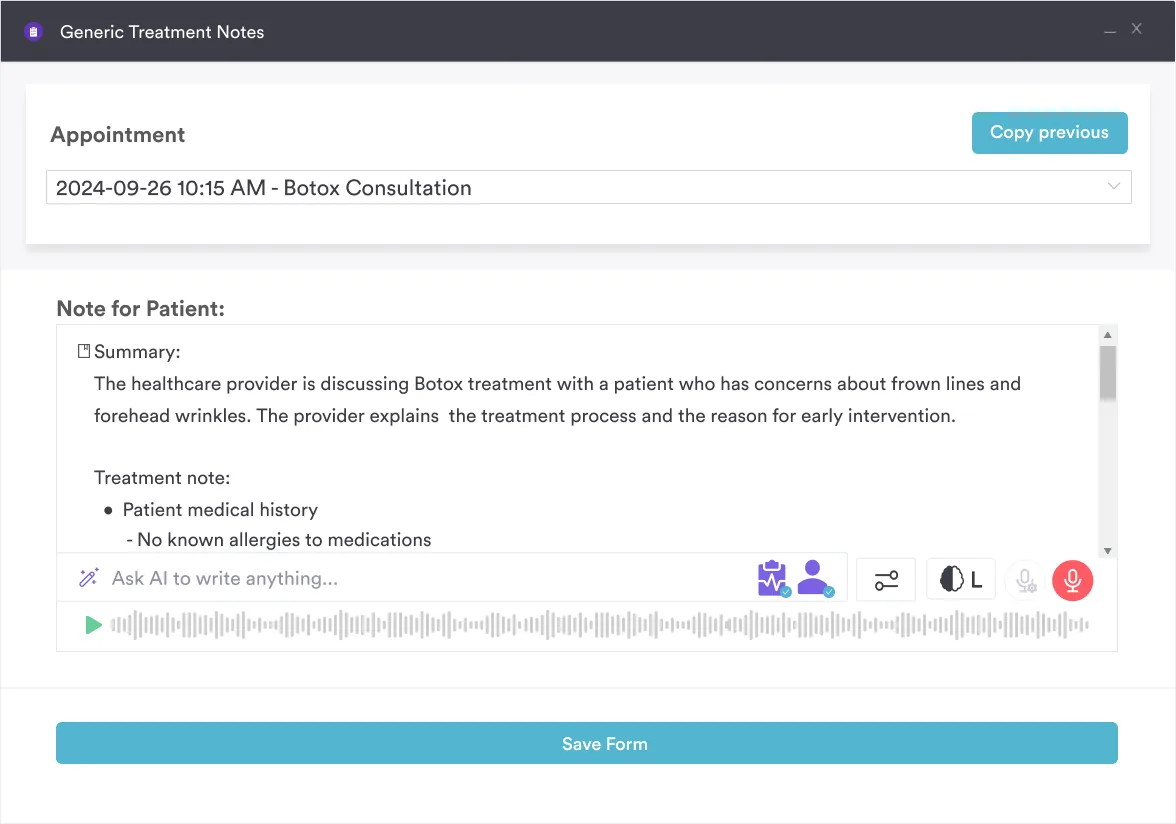
For aesthetic and wellness clinics, Pabau Scribe goes beyond standard SOAP notes. It generates customized treatment plans, patient-facing aftercare instructions, and pre- and post-consultation summaries. These feed directly into the patient record. This is especially valuable for clinics managing high appointment volumes with multiple treatment types per patient.
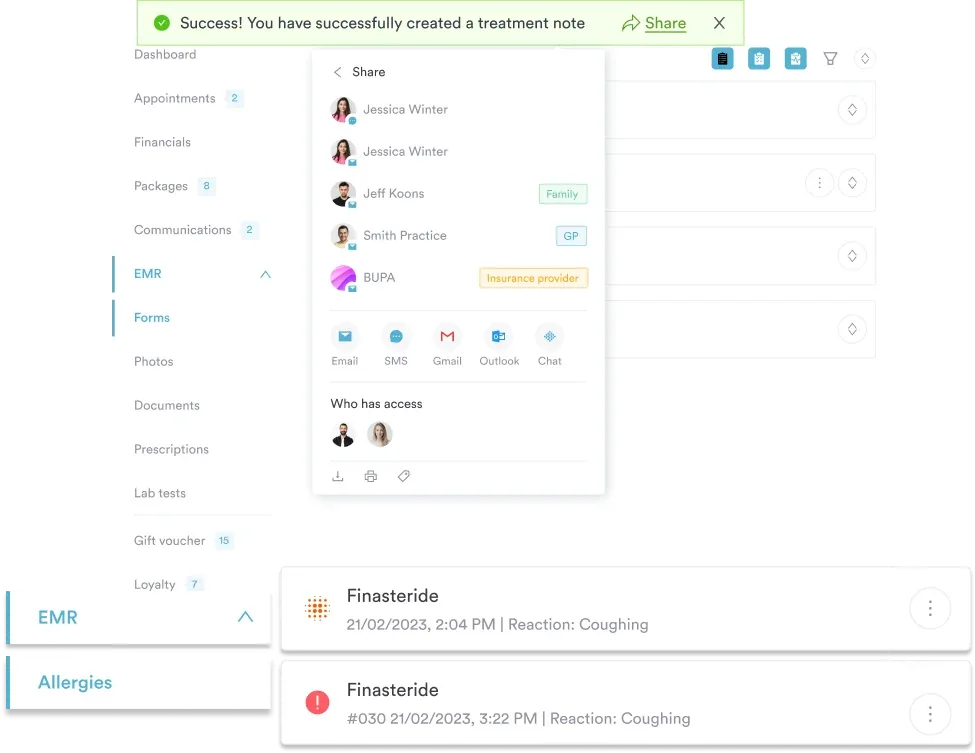
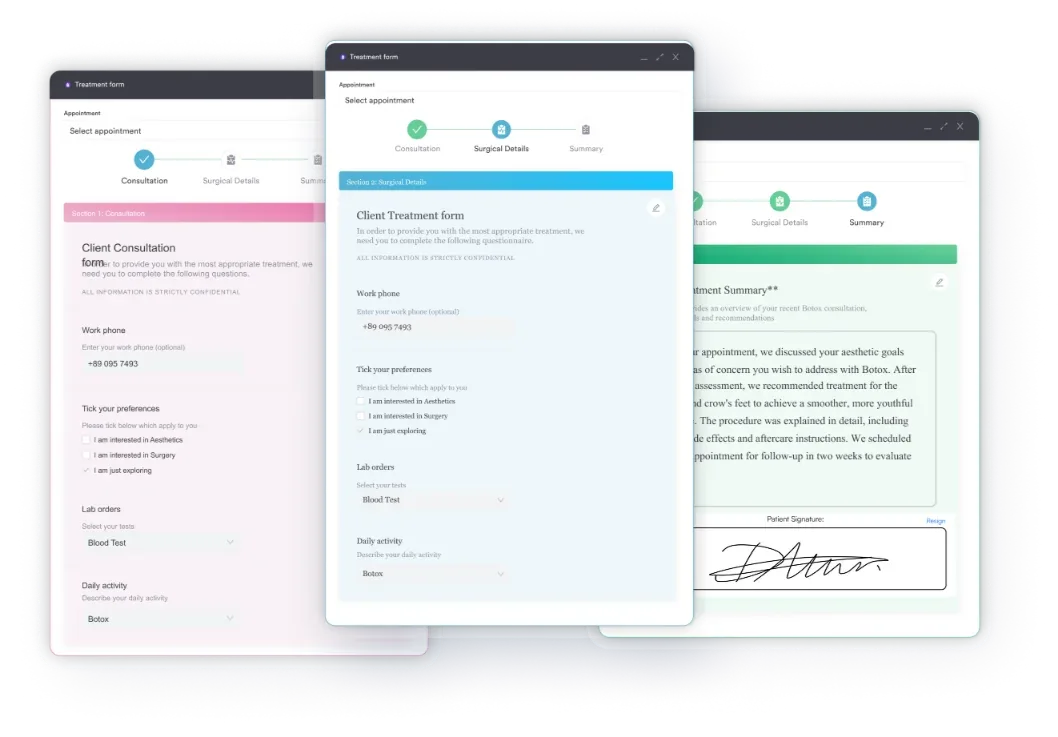
The integration also extends to digital intake forms. When a patient completes a pre-appointment health questionnaire, Pabau Scribe can reference that data when generating the consultation note, reducing repetition and improving documentation consistency across the care episode. That is the same principle behind AI patient intake, which gathers patient history before the visit begins.
For a direct comparison of how Pabau Scribe performs against other AI documentation options, see our Pabau Scribe vs Heidi comparison. For a broader view of what AI in practice management looks like across the full clinic workflow, beyond just documentation, our guide below maps where automation is adding the most value.
The Mass General Brigham research published in April 2026 found that AI scribes are linked to modest but consistent reductions in EHR documentation time. The key word is “modest”: these tools improve workflows, they do not eliminate the need for thoughtful clinician engagement with the record.
Pabau’s design reflects that. Pabau Scribe assists, the clinician reviews, and the record always reflects a human-verified account of the encounter.
Pabau extends that same review step to front-desk work. Its AI agents for healthcare start in training, drafting out-of-hours replies and no-show rebookings that staff sign off before a patient sees them.
AI clinical documentation is still maturing. A 2024 PMC systematic review noted that moderate accuracy limits broad implementation in some contexts. The technology is improving rapidly. However, it has not yet reached the reliability needed for unsupervised use in high-stakes specialties.
As ambient AI in healthcare matures, several trends are shaping where it heads next:
For clinic owners thinking about the benefits of AI scribes for physicians and practitioners more broadly, the decision today is less about whether to adopt AI documentation and more about which integration model suits your practice size, specialty, and existing technology stack.
Documentation overload is a structural problem in clinical practice, not a willpower problem. Clinicians are spending hours each day on charting that adds no clinical value and directly contributes to burnout. AI clinical documentation tools change that equation by drafting notes during the encounter, so the clinician reviews rather than authors from scratch.
For aesthetic, wellness, and private medical clinics, the opportunity is especially clear. Pabau Scribe delivers ambient documentation inside a fully integrated practice management platform, generating notes, treatment plans, and aftercare instructions without requiring a separate app or a manual transfer step. If you want to see how it works in a clinic like yours, book a demo and we will walk you through it.

List Item #1
List Item #2
AI clinical documentation is software that uses ambient listening, speech recognition, and large language models to automatically generate structured clinical notes during a patient encounter. The clinician reviews and approves the draft before it enters the official record. It differs from traditional transcription by understanding clinical context and producing structured formats like SOAP notes without manual dictation commands.
AI clinical documentation tools can be HIPAA compliant, but compliance depends on the vendor, not the technology category. The vendor must sign a Business Associate Agreement (BAA) with your practice, process PHI on compliant infrastructure, and provide audit trails for every note modification. Never deploy an AI documentation tool without a signed BAA in place.
Accuracy varies by specialty, note complexity, and environmental conditions. A 2024 PMC systematic review found that moderate accuracy levels currently limit broad implementation in some high-stakes clinical contexts. General and aesthetic practice use cases tend to show better results than highly complex specialty documentation. All AI-generated notes require clinician review before they become part of the official record.
Many AI documentation tools offer EHR integrations, but the depth varies widely. Some write directly into the patient record in real time; others produce a note in their own interface that the clinician must then copy across. For aesthetic and wellness clinics, tools built natively inside a practice management platform (like Pabau Scribe) avoid the manual transfer step entirely.
AI clinical documentation reduces physician burnout primarily by eliminating after-hours charting. When notes are drafted during the encounter rather than reconstructed from memory at the end of the day, clinicians reclaim time outside clinic hours. Multiple studies, including research from UCLA Health and the University of Wisconsin School of Medicine, have linked ambient AI documentation to improved physician well-being and reduced EHR burden.
Pricing usually follows one of two models. Some tools charge a flat per-clinician monthly subscription, while others bill by usage, so you top up credits and pay for what you actually transcribe. Free tiers exist but often cap the number of notes or lock specialty templates. Pabau Scribe runs on a credit-based model inside the wider platform subscription, so a solo injector and a multi-provider practice each pay in line with their real documentation volume. Run a short pilot before committing, because your specialty mix and note length drive the true per-note figure more than the headline price does.
Yes. The goal of CDI is to make records more complete, accurate, and codable, and AI tools contribute directly to that. A peer-reviewed review found they strengthen notes by structuring data, annotating entries, evaluating quality, and flagging errors before they reach a claim. For a smaller practice, that means fewer denials traced back to vague or missing notes, without hiring a dedicated documentation-quality specialist.
Yes. An AI note generator listens to the encounter and drafts a structured record for you to review, correct, and sign, so you are editing rather than typing from scratch. The one hard rule is oversight: the clinician stays responsible for the final record, and the tool must run under a signed Business Associate Agreement if it processes protected health information.
There is no single best tool, because fit depends on your specialty, your existing records system, and your compliance obligations. Judge any AI medical documentation option on specialty-specific templates, direct integration with the system you already use, speaker accuracy, and a signed BAA. For aesthetic, wellness, and private practices, Pabau Scribe writes notes straight into the patient record, which removes the copy-and-paste step standalone scribes leave behind.
Free options exist, but read the limits before you rely on one. A no-cost scribe usually caps how many notes you can generate each month, locks specialty templates behind a paid plan, or keeps notes in its own dashboard so you still transfer them by hand. For a practice documenting every appointment, a usage-based or subscription model that writes into your records system tends to cost less in reclaimed time than a capped free tier.