Fertility clinic marketing: Strategies that attract & convert patients
Fertility clinic marketing is how a fertility practice attracts, educates, and c...

Last Updated: Oct 14, 2026

Most practices don’t struggle to grow because of lack of demand, but because of inefficient systems, admin overload, and poor patient retention.
Small operational fixes like automated reminders, online booking, and digital forms can have an immediate and measurable impact on revenue.
Tracking a handful of key metrics, like no-show rate, retention rate, and revenue per patient, gives you a clear picture of where to focus next.
An all-in-one practice management platform removes the need to juggle disconnected tools and gives your practice the infrastructure to scale without chaos.
You’ve built something real. Patients you know by name, you have a private practice that runs smoothly, and a reputation you’re proud of.
But somewhere between back-to-back appointments and mounting admin, the question creeps in: how do I actually grow this thing?
This guide gives you the answer. Here are 10 proven strategies to grow your medical practice in 2026, without the chaos that usually comes with scaling.
Growing a medical practice isn’t usually a demand problem. In many cases, patients are there, but the systems behind the practice can’t keep up.
Many healthcare professionals still rely on manual processes, disconnected tools and pieces of practice software, or outdated workflows.
That creates bottlenecks in scheduling, billing, patient communication, and follow-ups. Over time, these small inefficiencies limit medical practice growth.
Administrative work is one of the biggest barriers. A study in the Annals of Internal Medicine found physicians spend 27% of their day with patients but 49.2% of their time on EHR and desk work. Many also spend one to two hours each evening finishing practice records and other admin tasks.
When teams are buried in admin, there’s little time left to focus on growing a medical practice or improving patient experiences.

Illustration: Pabau / Data: Annals of Internal Medicine
Plus 1–2 hours every evening finishing records.
Many clinics also lack clear reporting. Without data on bookings, revenue, and patient engagement and patient retention, it’s hard to see what’s working.
The good news is that these barriers are operational and fixable. The next section shows how to grow your medical practice with simple, practical strategies.
Growing a healthcare business today requires more than attracting new patients. Sustainable growth comes from strong systems, efficient workflows, and patient retention.
The same foundations hold well beyond medicine, and our guide to how to grow your private practice maps out the retention, workflow, and scaling moves that apply across any healthcare specialty.
Below are ten proven strategies that help clinics grow their medical practice without creating operational chaos.
Medical Practice Growth Roadmap
| Step | Strategy | Why It Matters |
| 1 | Optimize online booking | Makes it easier for patients to schedule |
| 2 | Reduce no-shows | Protects revenue and improves utilization |
| 3 | Improve patient retention | Returning patients drive steady growth |
| 4 | Streamline documentation | Reduces admin and increases provider capacity |
| 5 | Track performance metrics | Identifies growth opportunities |
| 6 | Strengthen billing processes | Prevents revenue leakage |
| 7 | Expand profitable services | Increases revenue per visit |
| 8 | Build referral partnerships | Drives consistent patient flow |
| 9 | Automate patient communication | Saves staff time |
| 10 | Invest in scalable systems | Enables long-term medical practice growth |
Making booking effortless is one of the fastest ways to grow your medical practice.
Online scheduling allows patients to book visits anytime without calling the office. This improves access and reduces front-desk workload.
And the opportunity is bigger than you’d think. According to the Medical Group Management Association (MGMA), 71% of medical groups have fewer than 25% of patients using online self-scheduling.
The benefits are immediate:
Add booking links to your website, Google Business profile, and social media pages.
No-shows are silent revenue killers. One missed appointment might seem small, but multiply that across a week, a month, a quarter, and it adds up fast.
The fix is simple: automated reminders.
A study in the Journal of Medical Internet Research found that email and SMS reminders alone can reduce no-show rates by up to 38%. That’s a meaningful difference for any private practice with almost zero extra effort on your end.
Most practice management software can automatically send:
Send reminders at 48 hours and 24 hours before the appointment. Two touchpoints dramatically improve show-up rates compared to just one.
The patients you keep are worth more than the ones you chase.
Returning patients trust you. They follow treatment plans. They book follow-up visits without needing much convincing. And when patient satisfaction is high, they refer friends and family, growing your patient base without any extra marketing spend.
So if you’re serious about growing a medical practice for the long term, retention isn’t a nice-to-have. It’s a core strategy.
Small changes make a big difference here:
Losing a single dissatisfied patient doesn’t just mean one missed appointment. When you factor in future visits, referrals, and long-term treatment relationships, studies estimate that one lost patient can cost a practice over $200,000 in lifetime revenue.
Simple recall systems help patients stay engaged and maintain long-term care. For more ideas, explore our guide on marketing for clinics.
Admin doesn’t feel like a growth problem. But it is.
When your physicians are spending more time on documentation than on actual patient care, something has gone wrong. And according to above research published in the Annals of Internal Medicine, that’s exactly what’s happening in most practices — for every hour spent with patients, nearly two hours go to EHR and desk work.
That’s a structural problem that quietly caps how far your practice can grow.
Digital forms and templates fix this.
Instead of chasing down handwritten intake forms or retyping the same notes for the tenth time this week, you get:
Structured templates speed up clinical assessments too. Our guide to scoring the Vanderbilt ADHD rating scale shows how digital forms make scoring faster and more consistent.
Learn more about how to make sure patients complete forms before their appointment.
You can’t grow what you can’t measure.
Most practices have a gut feeling about how things are going. But gut feelings don’t tell you why patient retention dropped last quarter, which services are actually driving revenue, or where the biggest scheduling inefficiencies are hiding.
Data does.
The practices that figure out how to grow your medical practice sustainably are almost always the ones paying close attention to a handful of key metrics:
Benchmarks make those numbers easier to judge. Our guide to dental practice growth sets targets for new patient volume, case acceptance, and patient retention.
Many good practice management systems include built-in reporting dashboards. These connect key parts of your practice, showing metrics like most booked appointments, revenue per provider, patient retention, and no-show rates. This makes it much easier to spot revenue leaks and growth opportunities.
Billing is one of those things that feels fine until you actually look at the numbers.
A study in JAMA Network found that billing and insurance admin costs anywhere from $20 to $215 per patient visit. That’s up to 25% of professional revenue quietly walking out the door.
The culprits? Manual claim entries. Late insurance verification. Errors that trigger rejections and delays. None of it is dramatic, but it compounds fast.
The good news is that most of it is preventable:

Illustration: Pabau / Data: JAMA Network
A clean claim submitted on time is worth far more than a corrected one submitted late. Getting it right the first time is the fastest way to get paid.
Seeing more patients isn’t the only way to grow revenue. Sometimes the smarter move is getting more value out of the patients you already have.
By adding high-value services that complement what you already do, you increase revenue per visit without necessarily needing to fill more appointment slots. Medical weight loss is the clearest current example. The GLP-1 statistics show about one in eight US adults now takes one.
Clinics like River Aesthetics show what this looks like when the systems behind new services keep pace with demand.
Some of the best opportunities for medical practices right now:
Mental health services follow the same logic. Structured activities for ADHD in therapy keep sessions engaging and bring patients back for regular visits.
If you’re exploring new services, read our guides on how to start an aesthetics business or opening a physiotherapy clinic to understand the costs, planning, and growth opportunities.
Word of mouth has always been powerful in healthcare. But a referral network takes that one step further — turning trusted relationships with other providers into a steady, predictable stream of new patients. For specialty practices, that network is one piece of a wider plan, and these marketing ideas for dermatology clinics show how referrals, reviews, and local search reinforce each other.
Other physicians, specialists, and allied health professionals see patients every day who need exactly what you offer, and the same referral logic drives specialty growth playbooks like chiropractic marketing.
Specialty systems help here too. Chiropractic software and osteopathy practice software both track where referred patients come from, so you know which partnerships pay off.
Building that kind of visibility doesn’t have to be complicated:
Don’t just wait for referrals to come in. A short, friendly email introducing yourself to a nearby specialist takes five minutes and could send patients your way for years.
Your front desk staff are great. But they shouldn’t be spending half their day sending appointment reminders, chasing follow-ups, and manually reaching out to patients who haven’t booked in six months.
That’s what automation is for.
Here’s what good automated communication looks like in practice:
A patient finishes a consultation on Monday. By Tuesday morning, they’ve received aftercare instructions, a satisfaction survey, and a reminder to book their follow-up — all without a single staff member lifting a finger.
Patient portals take this even further. Patients can book appointments, fill out forms, view their records, and message the practice — all in one place.
Here’s a growth problem nobody warns you about: the tools that got you to 500 patients often can’t get you to 5,000.
Spreadsheets, sticky notes, disconnected software — they work until they really don’t. And by the time you notice, the cracks are already showing in your scheduling, your billing, and your team’s sanity.
Investing in one of the best medical practice management software platforms isn’t just an operational decision. It’s a growth decision.
Already on a system that’s holding you back? Our roundup of Kareo alternatives compares platforms built for practices that plan to scale.
The right platform brings everything together in one place:
Look for a platform that combines clinical, operational, and financial workflows in one place, so it grows with you, not against you.
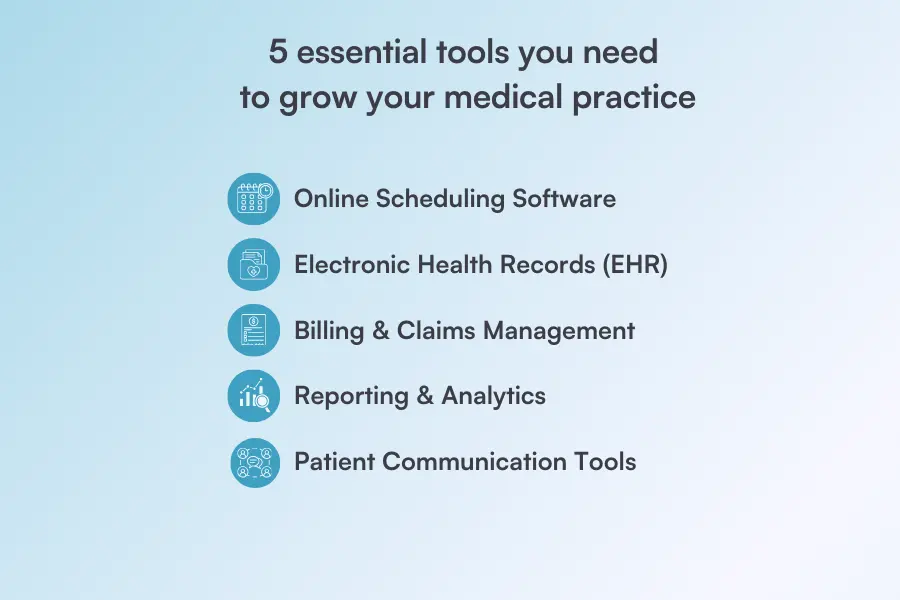
Running a growing practice means juggling a lot of moving parts. Here are the core tools you need to do it well. For a side-by-side look at complete platforms, see our comparison of the best medical software for clinics.
Source: Pabau
If patients can’t book easily, they’ll book somewhere else. Patients expect to book on their own terms — any time, any device, without making any phone calls. The right scheduling system makes that effortless.
Look for a system that handles:
The best scheduling tools integrate directly with your patient records — so booking, intake, and clinical notes all live in the same place. Learn more about what to look for in our guide to practice management software features.
Paper records and scattered files are a growth ceiling in disguise. A solid EHR system keeps patient records accurate, accessible, and organized (see our roundup of the best EHR for private practice), so your clinical team spends less time hunting for information and more time using it.
Look for systems that support digital intake forms, customizable templates, and easy access across your whole team. See how modern clinic management software handles this end-to-end. Cloud-based options deserve priority. Our comparison of the best SaaS EHR platforms explains why.
Revenue leakage is silent but costly. A dedicated billing tool helps you verify insurance upfront, automate claim submissions, and track denials before they become patterns.
The goal is simple: fewer errors, faster payments, and a cleaner picture of your practice’s financial health. For a deeper look at what the right platform can do, check out our practice management software guide.
You can’t grow your medical practice on gut feeling alone. Built-in reporting gives you visibility into the metrics that actually matter — patient retention, no-show rates, revenue per provider, and appointment trends.
A good healthcare CRM platform ties this data directly to your patient relationships, making it easier to spot opportunities and act on them fast.
From appointment reminders to post-visit follow-ups, communication tools keep patients engaged between visits.
Automated recall reminders, review requests, and targeted campaigns all run in the background, keeping your practice front of mind without adding to your team’s workload.
And if your practice offers remote consultations, telehealth software extends your reach even further without adding physical capacity.
Managing five separate tools for each of these areas gets complicated fast. That’s where an all-in-one platform like Pabau comes in — bringing scheduling, records, billing, reporting, and communication together in one place, so your team spends less time switching between systems and more time focused on growth. Pabau GO brings this system to your phone, so staff aren’t tied to the front desk to check schedules.
Even well-run practices fall into these traps. Here’s what to watch for and how to fix it.
Spreadsheets and paper forms might feel familiar, but they quietly create errors, slow your team down, and make scaling almost impossible. Moving to a paperless, HIPAA-compliant system earlier than you think you need to is almost always the right call.
Fix: Audit one manual process per month and find a digital alternative.
Most practices know that no-shows are a problem. Few actually track them closely enough to do something about it. Left unchecked, even a 10% no-show rate can drain significant monthly revenue.
Fix: Start tracking no-shows by appointment type and provider. Then read our guide on how to improve your patient no-show rate.
If your team is still manually sending reminders, chasing follow-ups, and copy-pasting recall messages, you’re spending time you don’t have on tasks a system can handle in seconds.
Most practices are sitting on automation tools they’re not fully using. Documentation counts too. AI medical scribe tools now draft clinical notes during the consultation itself.
Fix: Explore clinic automations that directly drive revenue growth and start with the highest-impact ones first.
Data protection and HIPAA compliance aren’t just legal boxes to tick. A breach, even a small one, can damage patient trust in ways that take years to rebuild. And as practices grow, the risks multiply.
Fix: Build compliance into your systems from day one. Our guides on HIPAA compliance for clinic software and data protection best practices are a good place to start.
Acquisition gets all the attention. But if patients aren’t coming back, you’re filling a leaky bucket. Retention is cheaper, more predictable, and more profitable than constantly chasing new leads.
Fix: Set up automated recall reminders and post-visit follow-ups so staying connected happens without extra effort from your team.
You’ve got the strategies. Now you need the right system to back them up.
We’ll let you be the judge, but Pabau brings together everything we’ve talked about in this guide: scheduling, billing, patient communication, records, and reporting, and more, all in one place.
Don’t take our word for it. Book a free demo and see it for yourself.
Want to check out more resources? Explore how to run a more efficient clinic or level up your practice marketing.
Fast wins like reducing no-shows can show results within weeks. Bigger shifts — like improved retention or referral networks — typically take three to six months of consistent effort.
Yes. Patients increasingly expect to book on their own terms. Practices without online scheduling risk losing new patients to competitors who make the process effortless.
Retention. Keeping existing patients engaged through automated reminders, follow-ups, and recall systems costs far less than acquiring new ones — and delivers more predictable long-term revenue.
No. An all-in-one practice management platform handles all of these in one place — reducing admin, cutting costs, and giving your whole team a single source of truth.