Fertility clinic marketing: Strategies that attract & convert patients
Fertility clinic marketing is how a fertility practice attracts, educates, and c...

Last Updated: Oct 14, 2026
Behavioral health marketing is how a mental health practice attracts patients, books them, and keeps them in care under HIPAA, APA, and FTC rules.
For most outpatient practices, the return concentrates in local search, referral relationships, and retention. Paid search adds volume faster than any other channel, and it carries the heaviest compliance load.
Demand is not the constraint. In 2022, only 50.6% of US adults with any mental illness received mental health treatment in the past year. That figure comes from the National Institute of Mental Health. Roughly 29 million people needed care and did not receive it.
This guide covers the channels worth funding, the rules that shape each one, and the booking steps where practices lose the patients marketing won.

Behavioral health marketing has to satisfy HIPAA, APA ethics guidance, and FTC advertising rules on every channel you use.
Local SEO and a complete Google Business Profile return more per dollar than any other channel for most practices.
Retention marketing costs less than acquisition, and recalls, follow-ups, and review requests are where it happens.
Referrals from primary care, schools, and employee assistance programs convert better than any paid channel.
Practice management software turns a marketing click into a booked session by automating booking, intake, and recalls.
Behavioral health marketing operates under constraints that general consumer marketing does not. Three layers of regulation govern every campaign decision a practice makes.
These constraints narrow the playbook, but they do not eliminate it. Practices that understand the rules can build compliant campaigns that are more trustworthy because they do not overpromise.
Differentiation is the harder problem. Telehealth, online scheduling, and digital intake are now standard across behavioral health, and patients treat them as the baseline.
That favors practices that already run those tools well. What separates them now is narrower:
The strategies below are listed in rough priority order for most outpatient behavioral health practices. Start with the first two, then layer in the rest as budget and capacity allow.
When someone types “therapist near me” or “anxiety treatment [city],” the Google Business Profile (GBP) decides whether your practice appears in the local map pack. Those three results capture the majority of clicks.
Claiming and optimizing a GBP profile is free, and it is consistently one of the highest-return activities for local behavioral health practices.
Key actions for GBP and local SEO:
Example: A four-clinician group practice in Florida adds separate pages for anxiety, OCD, ADHD, and trauma. Long-tail organic traffic and “near me” impressions usually climb within two quarters, because each page targets one search intent rather than competing with itself.
Educational blog content, condition guides, and clinician-authored resources serve two purposes at once. They rank in organic search for long-tail queries such as “how to find a trauma therapist in [city].” They also show clinical credibility to prospective patients who are comparing providers.
Content authored by the practice’s own clinicians, and attributed to them by name, signals the kind of first-hand expertise that generic content cannot match.
A realistic publishing cadence for most practices is one substantive clinical article per month, paired with quarterly updates to existing pages. Steady publishing compounds as pages accumulate links and rankings.
Example: A solo psychiatrist in a college town publishes one piece a month on what her referrers ask about. Medication management for ADHD and SSRIs in young adults are the topics that land. Those articles then go into referral packets, which doubles their working life.
Google Ads and Meta Ads can drive fast volume for new practices or new service lines. Compliance exposure is the trade-off. A tracking pixel on a page like “addiction treatment” can pass health information to the ad platform, which breaches HIPAA.
Practices using PPC should work with a HIPAA-compliant marketing agency and use server-side tracking rather than standard browser-based pixels.
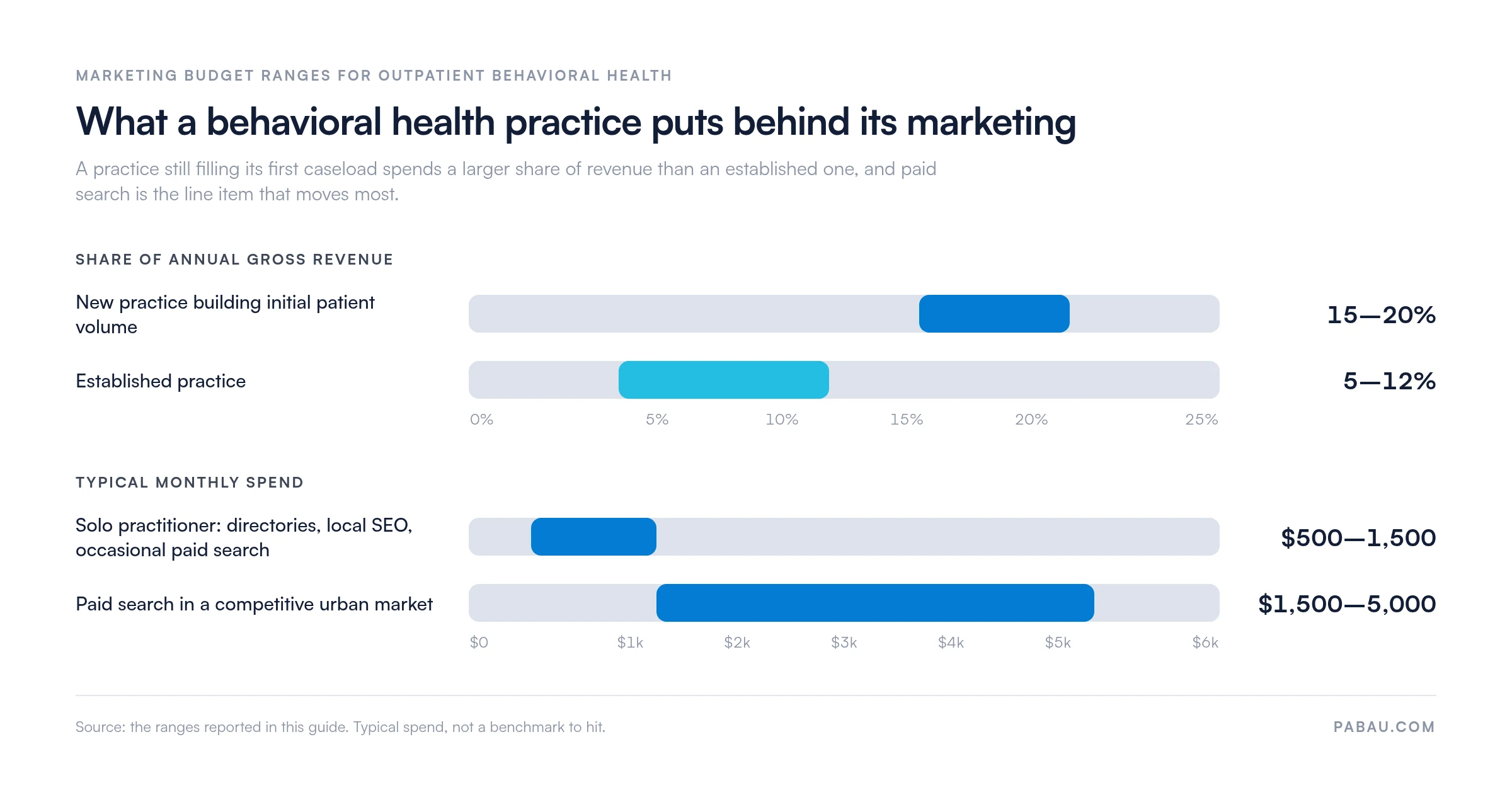
Budget ranges vary by market. Practices in competitive urban areas typically spend $1,500 to $5,000 per month on paid search to generate meaningful new patient volume.
Example: A two-location group practice in Texas opens a perinatal mental health service line. It runs a geo-fenced Google Ads campaign on “postpartum depression therapist [city]” and routes clicks to one dedicated page. Spend pauses once the new clinician’s schedule is full.
Social media carries the most compliance risk of any channel here. Handled properly, it also builds the most direct connection with prospective patients.
Under APA guidance, social posts carry general mental health education rather than individual clinical advice. Practices should never respond to clinical inquiries in public comments.
What works on social for behavioral health:
Before running any paid social campaign, review the platform’s special ad category rules. Both Meta and Google classify mental health and addiction services as sensitive categories with extra restrictions. Those restrictions limit interest-based targeting, so campaigns lean on location, search terms, and creative instead.
Example: A group practice runs a 30-day “what to expect in your first session” video series on Instagram and TikTok. Comments route to a booking link, and every public reply stays generic and non-clinical.
Audit your social profiles quarterly for any comments that mention specific patient names, symptoms, or treatment outcomes. If a follower tags someone in a post about depression symptoms, delete the tag immediately. Under HIPAA, acknowledging a person’s status as a patient, even indirectly in a public reply, can constitute a breach.
Referrals are often the highest-converting source of new patients for outpatient behavioral health practices. They come from primary care physicians, pediatricians, school counselors, employee assistance programs (EAPs), and other community providers.
A referred patient typically arrives with existing trust in the clinical relationship. That trust raises the likelihood they will complete intake and attend the first session.
Building referral networks is not passive. It requires deliberate outreach, consistent follow-through, and a referral experience that makes it easy for referrers to send patients.
Key elements of a strong referral program:
Example: A two-clinician trauma practice in the Midwest sets a monthly check-in with three local pediatricians and the district’s lead school counselor. That cadence alone fills a new clinician’s caseload within two quarters.
Give those partners something they can hand to a family. A one-page note on what intake covers, and how fast a referral is seen, does the job.
Behavioral health practices can use email and SMS campaigns to re-engage patients who have lapsed. Seasonal wellness content, service announcements, and awareness-month campaigns all give a lapsed patient a reason to come back.
These campaigns require explicit patient consent under HIPAA and should be sent from a HIPAA-compliant platform, not a standard consumer email service.
Pabau, practice management software built for healthcare practices, can trigger a message when a patient goes 30 days without booking. One-off campaigns and recurring recalls both run from the same patient record, so no list gets retyped into a separate mailing tool.
That matters for behavioral health specifically, where lapsed patients often need a gentle nudge rather than a fresh acquisition spend.
Example: A group practice schedules a seasonal affective disorder check-in SMS for every October. It goes to any patient who has not booked in 60 days, with a link to the next telehealth slot.
Reviews drive a meaningful share of local search ranking and patient choice. Recent reviews, arriving steadily, are one of the few signals that consistently move a practice up the map pack.
Pabau can send the request automatically by SMS or email, a set number of hours after a completed appointment. That keeps the pipeline active without spending clinical staff time on follow-up.
For behavioral health, the message must not reference diagnosis or treatment, and the patient chooses where to leave the review.
Example: A solo therapist turns on automated post-appointment review requests. Her Google review count grows from a handful to several dozen over a year, which lifts her ranking for “therapist [neighborhood]” searches.
Check how you collect reviews before launching any digital marketing campaign. Google Business Profile rankings are heavily influenced by review volume and recency. Set up an automated post-appointment review request through your practice management software. A system that sends a review link via SMS 24 hours after each completed appointment consistently generates more reviews than manual requests.
Acquisition gets most of the budget and most of the attention. Retention marketing keeps current patients engaged, reduces dropout, and supports treatment completion, which delivers better economics and better clinical outcomes.
Acquiring a new patient costs substantially more than retaining an existing one, with figures often cited at five to seven times. This Harvard Business Review summary of retention economics sets out why.
For behavioral health specifically, treatment dropout is a documented clinical and operational challenge. Many patients disengage after only a handful of sessions, well before reaching their treatment goals.
| Retention tactic | Implementation | Impact area |
|---|---|---|
| Automated appointment reminders | 48-hour SMS plus 24-hour email | Reduces no-shows by 20-30% |
| Post-session follow-up messages | Automated 24-hour check-in (general wellness, not clinical) | Increases re-booking rate |
| Session recall for recurring patients | Automated outreach when a patient goes 30+ days without booking | Reduces passive dropout |
| Outcome monitoring surveys | PHQ-9 or GAD-7 at set session intervals | Demonstrates clinical progress |
| Seasonal wellness campaigns | Email campaigns tied to seasonal affective disorder periods | Re-engages lapsed patients |
Each of these tactics is most effective when automated. A practice that relies on staff to send reminders or follow-up messages by hand will see inconsistent execution.
Automation is what makes the table above hold up week after week, and it lives in the same system as the calendar. Software for therapy practices runs the reminders, the recalls, and the outcome surveys from the patient record.
Practices still choosing that system can compare the options in our guide to behavioral health practice software.
Spend that nobody measures turns into overhead. Behavioral health practices should track a small set of metrics consistently rather than chasing a long list of vanity numbers.
Review the four together each quarter. Behavioral health referral cycles run long enough that one month of data reads as noise.
Budgets themselves vary more by practice stage than by channel mix. A new practice building its first caseload commonly puts 15% to 20% of gross revenue into marketing. An established practice runs at 5% to 12%. Solo practitioners typically spend $500 to $1,500 a month across directory listings, local SEO, and occasional paid search.
Read the two views together. The percentage sets the ceiling, and the monthly figure shows what that ceiling buys.
A prospective patient who finds the practice through search or a referral still has to get through intake. If booking means a phone call during business hours, a faxed form, or a week-long wait for a callback, a share of them drop off.
That stretch between the click and the first session is where the revenue leaks. It is also the part practice management software can close.
Pabau’s online booking is built for healthcare practices, including mental health and behavioral health providers. It embeds in the practice website and links from the Google Business Profile. A patient who finds you at 9pm on a Sunday books the first session there and then, instead of waiting until Monday.
What separates it from a generic scheduler is the clinical context. Bookings are HIPAA-compliant and can be set per clinician for telehealth or in-person session types. The right intake form attaches to the appointment automatically, so the patient answers the right questions before the first session.

After booking, intake friction is the second biggest dropout point. Patients who book a first session and then face a stack of PDF forms at the front desk often quietly cancel.
Pabau’s mental health EMR sends digital intake forms automatically as soon as the appointment is booked. The forms capture consent, insurance information, presenting concerns, and safety screening before the first session.
Clinicians then walk into the first appointment knowing what the patient is presenting with. The first 20 minutes go to the work rather than to paperwork. For the patient, it signals a practice that is organized, which lifts confidence in the clinical work that follows.
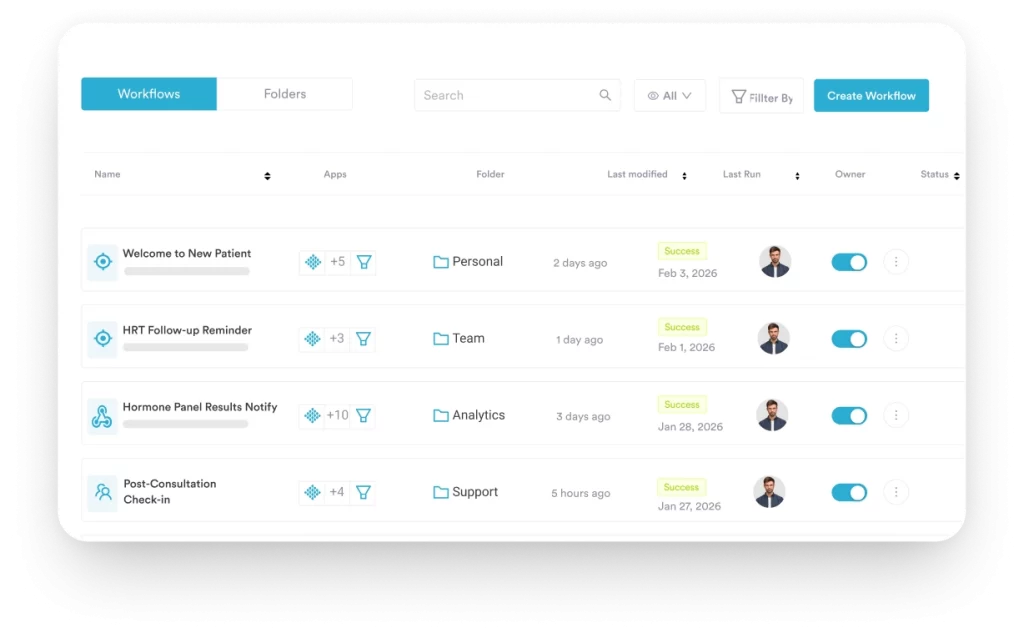
The same record then drives the recall and review workflows described above, so acquisition and retention run off one system. The outcome is fewer no-shows, fewer half-completed charts, and more billable session time.

Pabau connects online booking, automated intake forms, and patient recall workflows in one platform. Every marketing click can become a scheduled appointment instead of a lost lead.

Behavioral health marketing rewards practices that treat compliance as part of the design rather than a review step at the end.
Growth tracks the systems behind the marketing more closely than the advertising budget. Fast online booking, automated intake, and consistent follow-up convert a click into a completed course of care. Review requests that run without staff time keep the next click coming.
Pick the two channels you can sustain, measure them properly, and leave the rest until those two are producing.
Book a demo to see how Pabau connects booking, intake, and recalls for a behavioral health practice.

Need a structured approach to tracking clinical outcomes alongside your marketing metrics? Psychiatry Intake Form provides a standardized framework for intake documentation that supports both clinical quality and reporting.
Evaluating software options specifically for behavioral health? Best EHR Software for Mental Health compares the leading platforms on clinical and operational fit.
Behavioral health marketing is how a mental health or addiction practice attracts, converts, and retains patients within HIPAA, APA, and FTC rules. It typically combines local SEO, Google Business Profile optimization, content, paid search, referral development, and automated retention workflows. The defining constraint is regulatory: every channel choice must protect patient privacy and avoid misleading clinical claims.
Effective behavioral health marketing combines local SEO, Google Business Profile optimization, referral network development, and automated patient retention workflows. The step that matters most is connecting those channels to self-service booking. A prospective patient can then schedule without a phone call.
Local SEO targeting condition-specific search terms (anxiety, depression, ADHD) consistently delivers strong ROI for outpatient practices. Paid search (Google Ads) can accelerate volume for new practices but requires a HIPAA-compliant tracking setup. Content marketing builds long-term authority. Social media works best for psychoeducational content and clinician visibility rather than direct patient conversion.
Ethical behavioral health marketing follows APA ethics guidance. That means no false or misleading claims, no guarantees of outcomes, and honest representation of qualifications and licensure. Testimonials must not exploit the therapeutic relationship. Patient testimonials require explicit written consent and should not reference specific conditions or treatment details. The FTC additionally requires that any outcome claims reflect typical results, not exceptional cases.
Industry guidance suggests 5% to 12% of gross revenue for an established practice. A new practice building initial volume runs at 15% to 20%. Solo practitioners typically spend $500 to $1,500 per month on a combination of directory listings, local SEO, and occasional paid search. Group practices with more clinicians to fill benefit from larger budgets spanning paid search, content, and referral development.
The terms are often used interchangeably, but behavioral health marketing is the broader category. It encompasses marketing for mental health services, addiction treatment, substance use recovery, and related services. Mental health marketing typically refers to outpatient therapy and psychiatry specifically. Both operate under the same HIPAA and APA ethical frameworks, but addiction treatment marketing faces additional FTC scrutiny and state-level advertising regulations.