GLP-1 usage by state: Who’s taking, searching and paying in 2026
GLP-1 usage by state peaks in West Virginia, America’s GLP-1 capital, with...

Last Updated: Oct 16, 2026

Botox face mapping is the technique of planning and marking the exact injection points on a client’s face before treatment.
A complete face map records patient details, facial landmarks, the muscles being treated, the injection sites, and the units used at each point.
Recommended units vary by area — from around 4 units for lip lines to 25–50 units for neck bands — so a good map doubles as a dosing and inventory record.
Practice management software like Pabau lets you plot injection points onto a client photo, auto-deduct stock, and keep every map in one secure record.
You can always tell when Botox is done right. It’s subtle and natural-looking. Injection charting, in which mapped points are recorded after treatment, is among the features reviewed in our guide to software for med spas.
The secret to achieving this level of finesse? It combines practitioner skill and expertise, as well as thoughtful planning with Botox face mapping.
Botox face mapping is a technique used by practitioners to plan and mark the exact injection points they should follow before they start injecting a client with Botulinum toxin (Botox).
For med spas, this technique is a secret weapon for delivering Botox cosmetic procedures, targeting the exact muscles and areas that need a touch-up. A well-designed face map is essential to enable accuracy and optimal results, especially when it’s paired with dedicated aesthetic clinic software that keeps every treatment record in one place. Neuromodulators lead the cosmetic procedure statistics by a wide margin, at nearly 9.9 million treatments a year.
The map itself is only half the job, though. How you record it decides whether the next practitioner can reproduce a result the client loved.
In this article, we’ll break down where to inject and how much, what to include in a Botox face map, and how to keep every map on file without a paper chase.
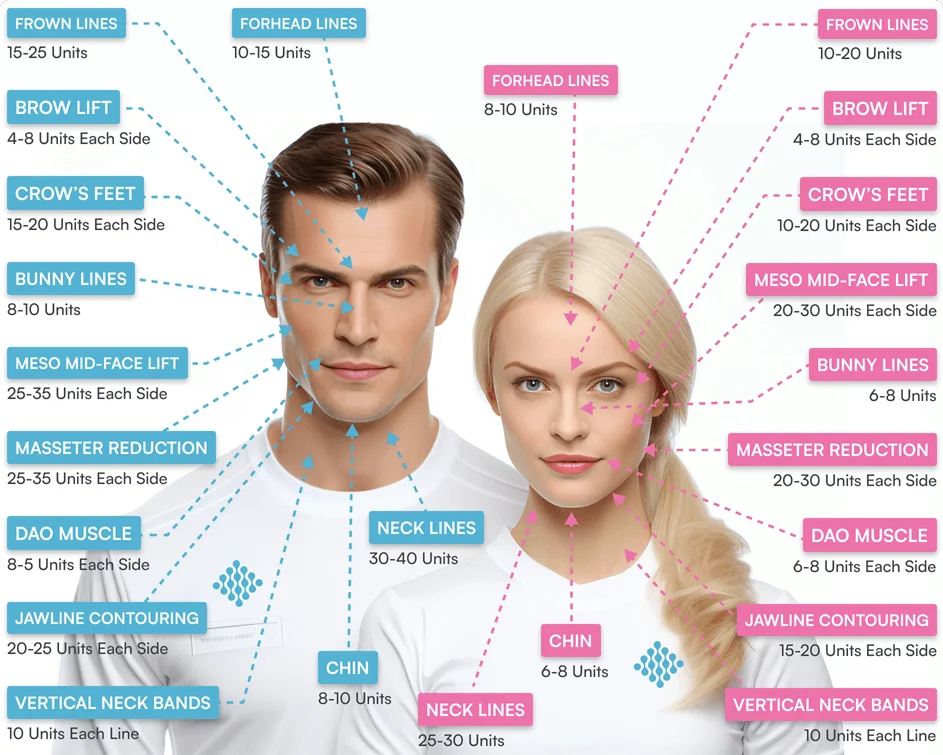
Every face map starts with the same two questions: where does the needle go, and how much goes in. Each injection site sits over a specific muscle, and the number of units changes from one area to the next.
The forehead is the most requested area. Botox forehead wrinkles, like the horizontal lines that show when a client raises their eyebrows, respond well to small, evenly spaced doses.
These are the most common treatment areas to map, along with the muscle each one targets:
Photograph the client’s face before you map it, then plot your injection points straight onto that image. A dated photo map is far easier to compare at the follow-up than dots on a paper diagram, and it doubles as before-and-after proof for the client.
Knowing where to inject is one thing. Knowing how much Botox to use is another.
A well-built face map records the recommended units for each area, so results stay consistent between visits and between practitioners. The ranges below are a typical starting point. Every patient is different, so always apply your own professional judgment.
Record the exact units you use per area on every face map, not just the total dose. When the numbers live in the client record, the next practitioner can reproduce a result the client loved, and your stock counts stay accurate without a separate spreadsheet.
Sites and units are what you write down. The map is what holds them together — and it needs a few more parts before it works as a record for med spas and skin clinics alike.
Every Botox face map opens with a patient information section. It comes first for a reason: it establishes who you’re treating and what they’re after before any dose is decided. In many states, treatment also needs a good faith exam from a physician, NP, or PA first.
The patient information section collects key details like:
Imagine navigating a map without landmarks — it’s tough, right?
In Botox face mapping, those landmarks are the treatment areas you just saw in the table: the frown lines, the forehead lines, the crow’s feet. Marking them on the map is what turns a list of doses into something a practitioner can follow at the chair.
In other words, Botox face mapping is like a facial GPS, helping practitioners document Botox injection points with precision, safety, and accuracy.
Identifying key facial landmarks enhances the accuracy of Botox injections and aligns with the client’s overall skincare goals. It’s a win-win situation: practitioners perfect their injection technique, and clients get the results they want.
Understanding the facial muscles and the facial anatomy is crucial since Botox’s job is to relax them. Dentists in some states are also permitted to administer injectables, given their training in facial anatomy — though who may legally administer them depends on state rules such as California’s licensing laws. Florida’s med spa rules go further, requiring a medical director behind every treatment.
Different areas — like the forehead or crow’s feet — have unique muscles, and understanding this anatomy helps you tailor treatments for anti-aging results.
Of course, a Botox face map can only go so far.
Extensive training is essential, since improper technique can cause complications such as asymmetry or a droopy eyelid (ptosis). Training routes are set locally, and becoming a nurse injector in Ontario takes five defined steps.
You now know what belongs on the map. The question is where it lives afterwards.
On paper, a face map gets filed, and filed maps get lost. Nobody compares last visit’s dose to this one because nobody wants to dig through a folder between clients. Pabau — practice management software built for med spas and aesthetic clinics — has face mapping built into the client record instead, so the map is right there the next time the client sits down.
Here’s what that changes in practice.
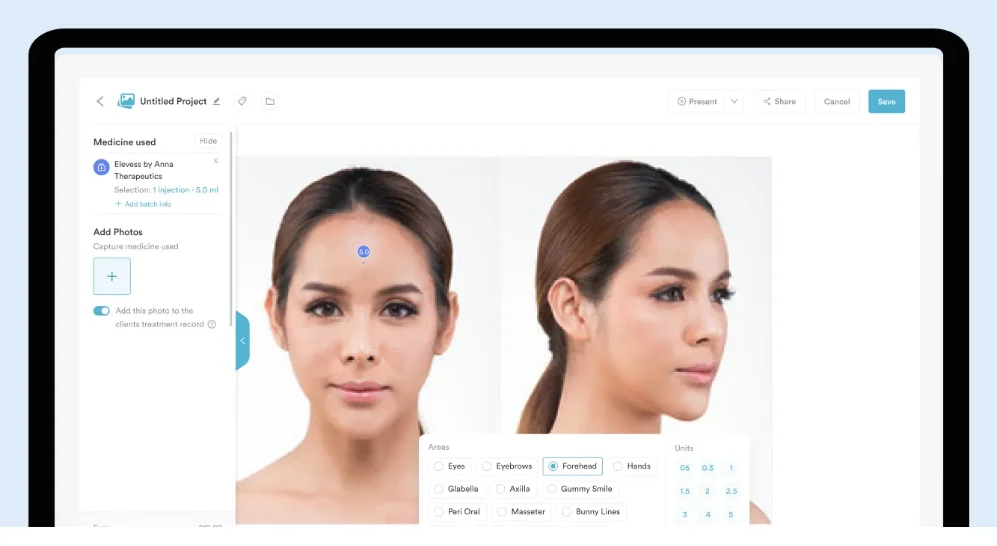
Pabau’s injection plotting tool (also known as an image markup tool) lets practitioners plot injection points directly onto a client’s photograph, rather than onto a generic diagram.
Take a pre-Botox photo of your client and, with a few taps, mark the specific injection points. A few weeks later, you can compare the result against the original image — so both you and the client can see what the treatment actually did.
There’s no free-typing involved, either. Add the product you’re using to your inventory once, then select it as you plot to:
A map is only useful next to the last one. That means it has to live with everything else you hold on the client.
With Pabau, appointment scheduling and comprehensive medical spa EMR software sit in the same place. Treatment history, plotted images, and progress over time all attach to the client — the same shift that helped Ageless Enhancements Med Spa move off pen-and-paper records entirely.
Open a client card and you can see:
That history is what makes the map worth keeping. It also documents the customer journey across every appointment, so results are traceable rather than remembered.
One secret of running a successful med spa is keeping track of inventory. Product cost is also the first layer of any aesthetic clinic profit margin check.
Pabau takes the hassle out of this by linking your injectable stock to the plotting tool. Say you inject four units of Botox. Add them to the client record as you plot, and Pabau automatically deducts those four units from your inventory.
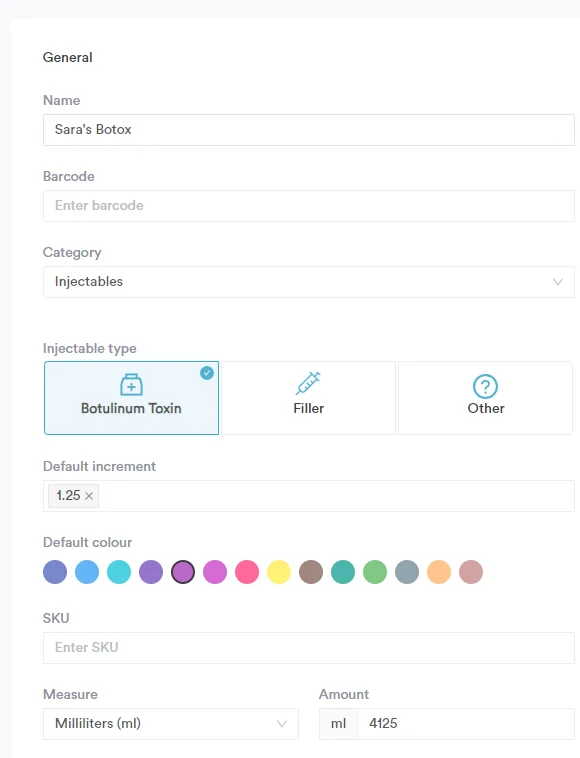
Because usage and stock stay in sync, you can:
Plotting photos are clinical images of a client’s face, so they carry real privacy weight. You don’t want everyone on the team browsing them, and you certainly don’t want them leaking.
With Pabau, plotting photos and client data are stored on the client card behind restricted access controls, so you decide which staff can open what.
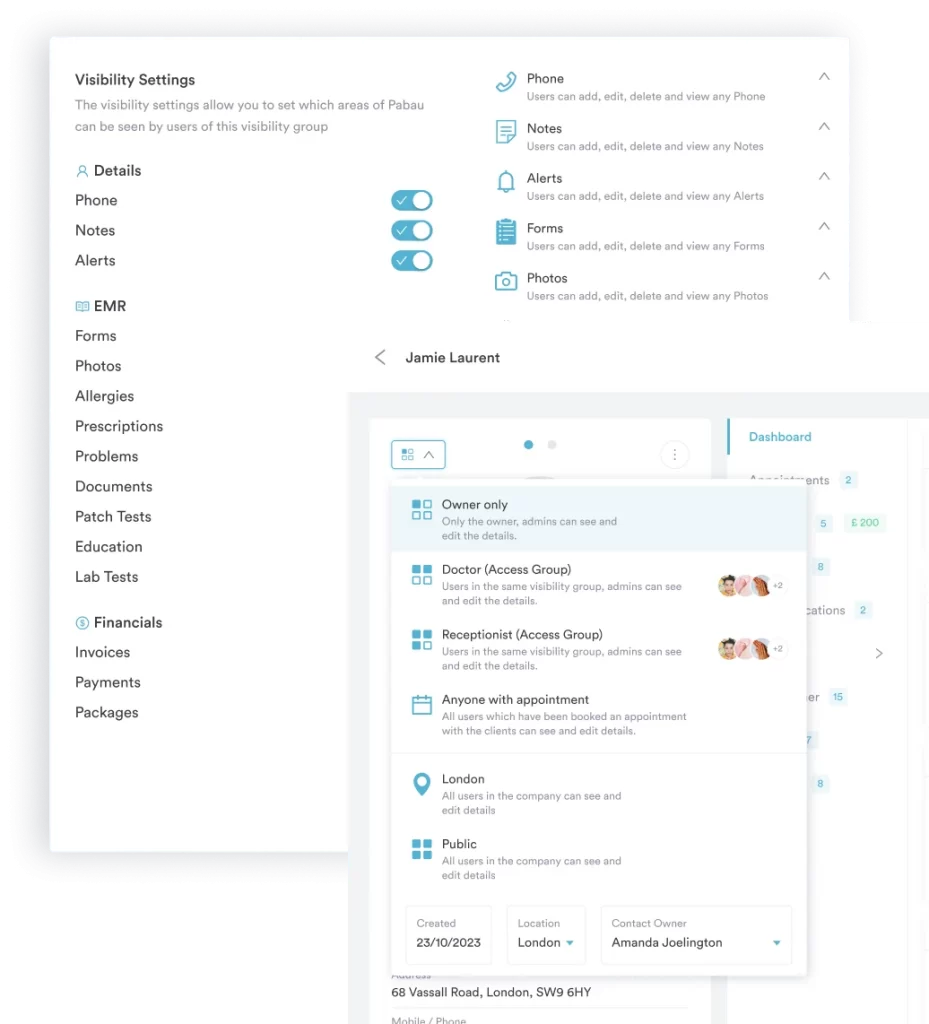
Between them, those four things cover the part of face mapping that has nothing to do with technique: plotting onto a real photo, keeping the history attached to the client, tracking the product you used, and controlling who sees it.
Whether you’re mapping Botox or facial dermal filler, it’s the same workflow, and it’s included in every Pabau subscription — practices weighing up Zenoti alternatives or Boulevard alternatives often start with exactly this feature.

Pabau’s injection plotting tool lets practitioners mark Botox injection sites on a client’s own photo, log the units and batch numbers used, and deduct the product from stock automatically. Every map stays on the client card for the next appointment.

Software handles the record. The rest is the workflow around it — what you capture before the client sits down, what you look for when choosing a tool, and what happens after they leave.
Face mapping is more than dots and numbers. It’s documentation — accurate in the moment and readable months later, which is the same reason AI clinical documentation is catching on across modern practices.
Efficient intake forms and consultations mean more time with clients and less time on paperwork, particularly when they’re backed by reliable medical spa scheduling software. They matter for gathering medical history, flagging pre-existing conditions with a code like I99.9, and capturing the client’s aesthetic goals.
There are a couple of ways to do this:
Arrive at the appointment already knowing the client’s history and goals, and you can spend the consultation planning the map instead of collecting paperwork.
Plenty of practice management tools claim to handle charting, but far fewer let you map a face properly. If you’re comparing options, check that the tool can:
Miss any one of those and you’re back to a spreadsheet alongside the software, which is where accuracy tends to slip.
Automation is a powerful tool for med spas.
It’s excellent for sending automated appointment confirmations, reminders, and even automated aftercare emails — all without you lifting a finger. That way, a client gets the same standardized care no matter which practitioner they see. Campaign emails work the same way, and med spa email templates cover welcomes, promos, and rebooking nudges.
Recalls matter just as much for injectables. Set one to fire 12 weeks after treatment — or four months, or whatever interval you use — and clients get nudged to rebook while the last map is still relevant. Regular injectable clients are also the natural fit for a med spa membership program, which turns repeat visits into recurring revenue.
Finally, want to send a review request? You can follow up every single appointment with a feedback request, which will provide you with a steady stream of reviews.
Face mapping is one workflow inside a business with a lot of moving parts. Where you practice decides who may inject, who may own the place, and what the treatment room has to be licensed for. These guides cover that setup side, by route and by region.
It’s probably clear by now that the hard part of Botox face mapping isn’t deciding where the needle goes. Most practitioners get that right on instinct after enough faces.
The hard part is that the decision disappears the moment the appointment ends — the sites, the units, the exact photo you were looking at. So the map worth investing in isn’t the prettiest diagram. It’s the one your team fills in the same way every time, and the one you can pull up 14 weeks later when a client asks for exactly what they had last visit.
A paper diagram can do that, if someone remembers to scan it. A map inside the client record does it without anyone remembering. That’s the trade-off worth keeping in mind: precision in the treatment room is only ever as valuable as the record that survives it. Book a demo to see how Pabau keeps every injection point, unit count, and batch number on the client card.

Cellulaze aftercare instructions covers the compression schedule, recovery timeline, incision care, and warning signs for patients.
Collagen stimulating injections consent form covers contraindication screening, risk disclosures, and aftercare instructions for patients.
Want a consistent record for every Botox visit? Our Botox treatment note template keeps documentation the same across your team.
Mapping a migraine-specific Botox plan? Our migraine Botox consent template is built for that case.
The most common areas of face for Botox are the forehead, the frown lines between the eyebrows, and the crow’s feet around the eyes. Bunny lines on the nose, lip lines, chin dimpling, and neck bands are also frequently mapped. A face map records each of these injection sites so the whole treatment is planned before the needle goes in.
It depends on the area and the client. Forehead lines usually take 10–30 units, frown lines 20–40 units, and crow’s feet 5–15 units per side. Recording the amount used on each face map keeps dosing consistent and makes stock easier to track.
They describe the same thing. A Botox face chart or map is the visual record of injection points and units for a client. Doing it digitally means the chart lives inside the client’s record instead of on a loose sheet of paper.