List of vitamins: All 13 with RDAs and deficiency signs
A list of vitamins names the 13 essential vitamins the body needs from food or s...

3
Last Updated: Oct 8, 2026

Generic marketing doesn’t work for functional medicine. Your patients decide slowly, and they want education, trust, and personalization before they book.
SEO, email, and referrals return the most. Symptom-based search, automated email sequences, and a strong review profile all beat paid advertising on its own.
Education is your best conversion tool. Practices that publish symptom-focused content on a steady schedule attract more patients and keep them longer.
One system should hold the follow-up. Practice management software like Pabau keeps clinical records, marketing, and patient follow-up in the same place.
Functional medicine patients take longer to decide than almost any other healthcare audience. They read, compare, and question for weeks before they book a first appointment.
That changes the job your marketing has to do. It has to teach, prove, and stay in touch for months, rather than push a booking button.
This guide covers the channels worth your budget in 2026, the strategies working right now, and the software that keeps follow-up from falling apart.
Functional medicine is growing fast. The US complementary and alternative medicine market hit $36.65 billion in 2025, and is projected to reach $293.57 billion by 2035.
More practices also means more competition. You can’t win that competition with the playbook a walk-in clinic uses.
Four things make marketing a functional medicine practice different:
TechTarget reports that 94% of patients want educational content from their providers, and a third never receive it. Patients who do get it are 68% more likely to return to the same provider.
Generic “book now” campaigns fall flat here. Your marketing also has to match how you charge, because membership, package, and insurance practices each attract patients differently. Our guide to functional medicine business models covers that side of the decision.
Some channels suit holistic and functional medicine far better than others. Here’s what each one is good for, what it costs you in effort, and what it returns.
| Channel | Best for | Effort level | ROI potential |
|---|---|---|---|
| SEO and content | Long-term patient acquisition | Medium | ⭐⭐⭐⭐⭐ |
| Social media | Trust-building and education | Medium | ⭐⭐⭐⭐ |
| Email marketing | Patient retention and nurturing | Low | ⭐⭐⭐⭐⭐ |
| Paid ads (PPC) | Fast lead generation | High | ⭐⭐⭐ |
| Referral programs | Word-of-mouth growth | Low | ⭐⭐⭐⭐ |
| Webinars and events | Authority building | Medium | ⭐⭐⭐⭐ |
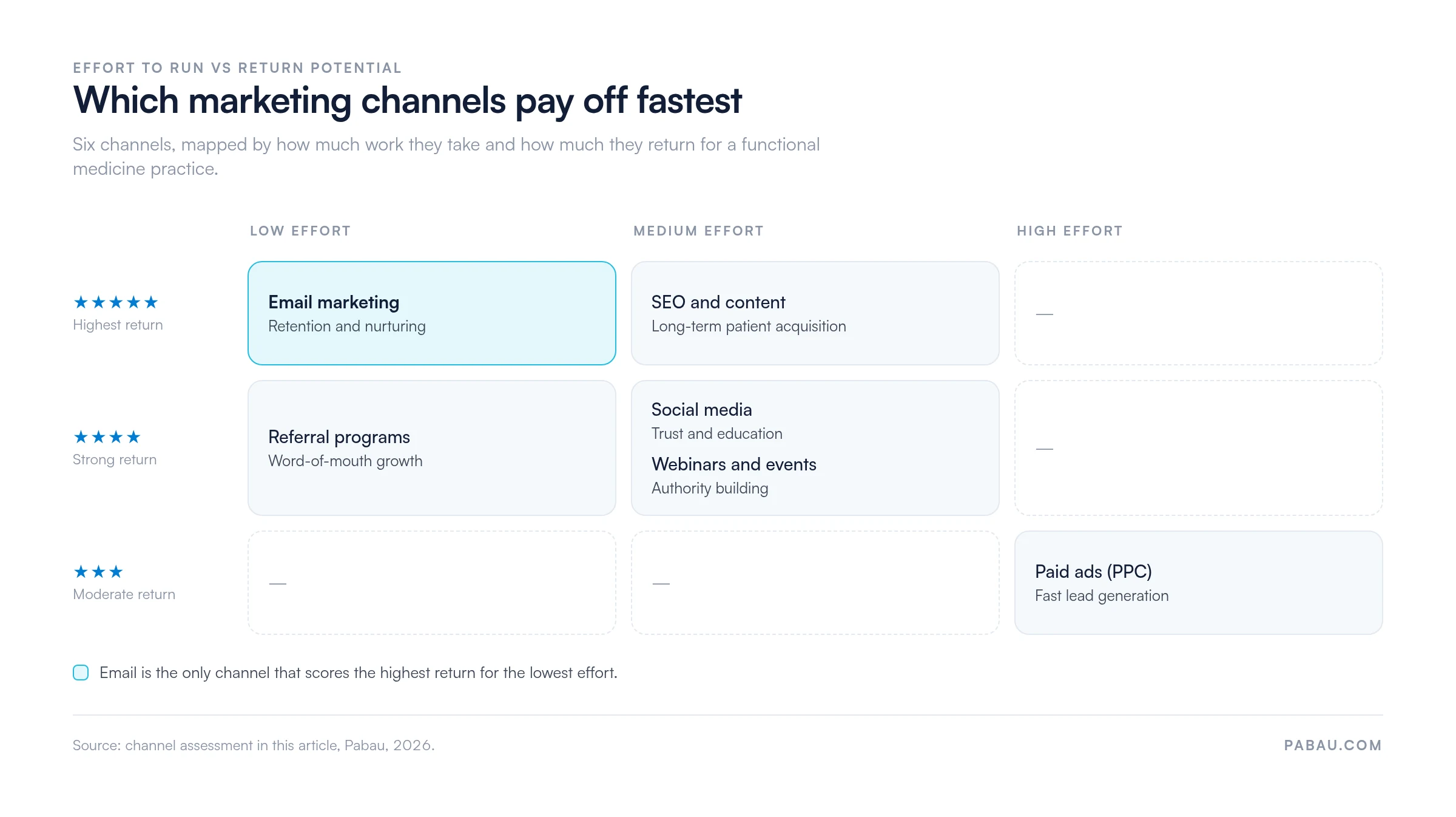
Plotted against each other, the six channels sort into a clear order of priority.
Search is your biggest long-term asset. Most patients start a healthcare journey on Google, and functional medicine patients are especially research-driven.
Your ideal patients are deep divers. They search “why do I always feel tired” or “root cause of autoimmune disease” months before they consider booking.
A functional medicine SEO strategy puts you in front of those specific, intent-driven searches. The page they land on then has to answer the question and make booking obvious.
What works:
Common mistake to avoid: Chasing a broad term like “functional medicine” instead of a local one like “functional medicine doctor in [city]“. Broad keywords attract browsers. Local, intent-driven keywords attract patients ready to book.
Social media does more than brand awareness here. For functional medicine, it’s one of the best tools you have to educate patients and build trust at scale.
A 2025 report on patient choice found that 35% of patients have chosen a provider based on social media presence.
What to focus on:
Educational posts consistently out-perform promotional ones in healthcare feeds. Talk less about your services and more about the problems your patients are trying to solve.
Red flag: A feed that is only promotional. “Book now” and “new service available” with no teaching behind it, and patients tune you out fast. Your feed should read like a resource.
Email is badly underused in functional medicine, which is good news for you. MailerLite’s benchmarks put average healthcare open rates above 43%.
Returns are strong too. In Litmus’s 2025 survey, 35% of companies reported $10 to $36 back for every $1 spent. Another 30% reported $36 to $50, and 5% reported more than $50.
For functional medicine specifically, email suits the long nurture cycle your patients need before they book.
What to send:
Automated nurture sequences out-perform one-off sends by a wide margin. One benchmark study of B2B software campaigns puts triggered nurture emails at a 52% open rate. Healthcare figures differ, but the pattern holds: build sequences instead of blasting your list.
Timing matters. Engagement peaks early in the week. HubSpot’s research has 27% of marketers naming Tuesday as their best day, ahead of Monday at 19% and Thursday at 17%.
What to avoid: Generic health tips with no link to your practice or the patient’s own journey. Segmented, personalized emails beat one-size-fits-all blasts every time.
Paid ads put you in front of high-intent patients quickly. They work best alongside your organic channels, not instead of them.
Paid search is the highest-converting channel in healthcare, at roughly 2.6%. That is a good return, but it stops the moment you stop paying.
Where to focus your budget:
Red flag: Running ads without a dedicated landing page. Sending paid traffic to your homepage instead of a focused page wastes most of the budget.
Word-of-mouth is still one of the highest-converting channels in healthcare. In functional medicine, where the treatment plan asks a lot of the patient, trust decides the booking.
Your star rating gets checked before anyone opens your website. Dropping below four stars quietly costs you a chunk of the bookings you would otherwise get.
How to build this channel:
A text asks for a review far more successfully than an email does. Send one the same afternoon as a good appointment, with the review link in it, and you have the easiest win on this page.
Free educational events get overlooked, and they suit functional medicine unusually well. Running one online or in person positions you as the expert and warms up patients who aren’t ready to book.
Topics that fill seats:
One event feeds three channels. It builds your email list, generates referrals, and gives you a recording to cut into social clips and blog posts.
Put your webinar behind an email signup. You grow the list every time you host one, and the recording keeps collecting addresses long after the live session ends.
Channels are where you show up. These five strategies decide whether showing up turns into booked appointments.
Trying to appeal to every patient is the most expensive mistake a functional medicine practice makes.
Patients rarely search for a philosophy. They search for help with fatigue, weight resistance, perimenopause, brain fog, or an autoimmune flare.
Get specific about who you serve and what you treat:
Your differentiator might be diagnostic depth, advanced lab testing, a virtual care model, or an integrative approach. Whatever it is, lead with it. Don’t bury it on your About page.
Search behavior is shifting fast. Patients now ask AI tools things like “why hasn’t anyone fixed my hormones?” and expect a trustworthy answer with sources.
In 2026, appearing in AI-generated summaries from ChatGPT, Perplexity, and Google AI Overviews matters as much as a blue-link ranking.
How to position for AI search:
Few functional medicine practices have started on this yet. That is the window.
Education is your most powerful conversion tool. Functional medicine patients arrive with a long list of questions, and the practice that answers them best wins the booking.
Pre-education also shortens the path to a first appointment. Publishing to a tight niche is the cheapest way to attract more patients without raising your ad spend.
An education engine has four moving parts:
Common mistake: One blog post a month is not a content strategy. A tight editorial calendar of even two posts a month beats sporadic publishing.
Plenty of practices deliver excellent care and still lose patients, because the follow-up never happened. Automation is what closes that loop.
What to automate first:
Keeping current patients engaged is the highest-return move on this list. Once the sequences are built, they run for every patient at no extra cost.
Automated doesn’t have to mean impersonal. The best follow-up sequences reference the patient’s treatment plan, their last visit, or the health goal they came in with.
Not knowing which marketing efforts pay off is the biggest blocker to growth. Tracking a handful of numbers replaces guesswork with a decision you can defend.
Measure these five:
| Metric | Why it matters |
|---|---|
| Cost per new patient | Shows which channels are most efficient |
| Patient lifetime value | Tells you how much you can afford to spend |
| No-show and cancellation rates | Flags weak communication or missing automation |
| Conversion rate by channel | Reveals where leads drop off |
| Retention rate | The clearest measure of patient satisfaction |
If you can’t answer where a patient came from, your tracking is broken. Set up source attribution from day one, through your practice management software, UTM links, or a question on the intake form.
Your software decides how much of this you can automate. Practices running longevity and functional programs usually shop for software for longevity practices, so records, payments, and marketing sit in one system.
Pick the record system first and the rest gets easier. Our comparison of functional medicine EMR options weighs them on charting depth and lab integrations.
Here are the three platforms worth shortlisting in 2026.
| Tool | Standout feature | Starting price | Best for | Rating |
|---|---|---|---|---|
| Pabau | All-in-one: EMR, marketing and automations | $62/month | Growing and multi-location practices | 4.7/5 |
| Practice Better | Wellness-focused EHR with telehealth | $25/month | Solo practitioners and health coaches | 4.8/5 |
| OptiMantra | Deep lab integrations and custom templates | $99/month | Multi-modality integrative practices | 4.8/5 |
All three prices above are the annual-billing rate published on each vendor’s own site.
Pabau runs the clinical record and the marketing follow-up out of the same patient file.
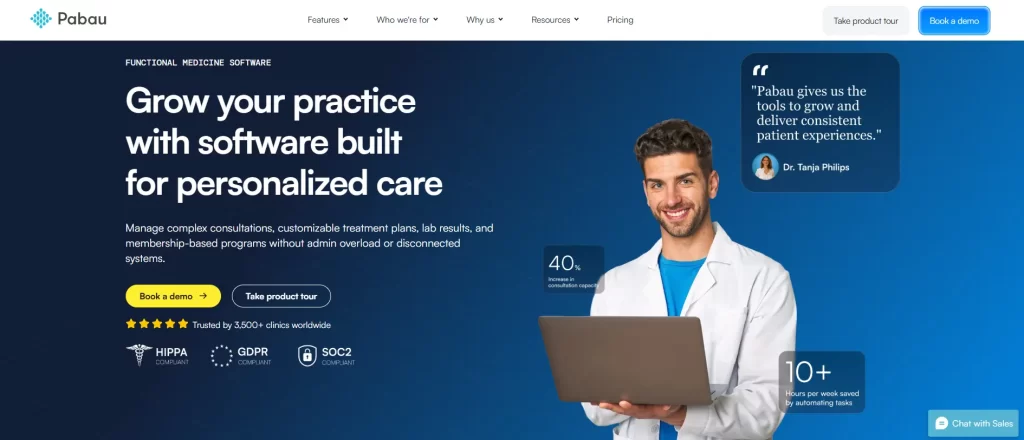
Pabau is practice management software used by 4,000+ practices across 40+ countries. It’s built for the kind of long, detailed, patient-led work functional medicine involves.
It handles long consultations, customizable treatment plans, and multi-stage clinical workflows without the admin overload. What separates it from a straight EMR is that marketing and business operations live in the same place.
Key features:
Best for: Growing practices and multi-location groups that want one connected system instead of five separate tools.
Pros:
Cons:
Because the marketing tools are built in, you don’t need a separate CRM or email platform. Lead capture through to post-visit follow-up runs from one dashboard.
| Plan | Price | Users | Key inclusions |
|---|---|---|---|
| Starter | From $62 / month | 1 | Full feature set, up to 100 clients |
| Solo | Quoted by region | 1 | Full feature set, unlimited patients |
| Team | Quoted by region | 2–3 | Full feature set, unlimited patients |
| Enterprise | Custom quote | 16+ | Full feature set, dedicated onboarding |
Plans differ by user count, never by features, and annual billing saves up to 20%. Pabau publishes the current figures for each region on its own pricing page.
Practice Better fits a solo practitioner selling coaching programs alongside clinical care.
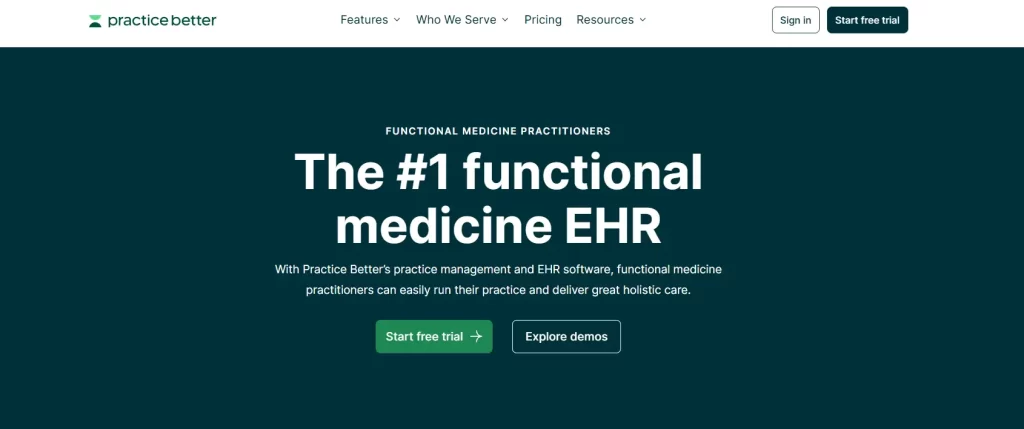
Practice Better is an all-in-one platform for holistic health and wellness professionals. That includes functional medicine practitioners, naturopaths, dietitians, and health coaches.
It suits a solo practitioner or a small team focused on lifestyle-based care, telehealth, and patient engagement. It’s a lighter fit if you need full practice management depth.
Key features:
Best for: Solo or small functional medicine practices with a strong lifestyle and coaching focus.
Pros:
Cons:
| Plan | Price | Users | Key inclusions |
|---|---|---|---|
| Sprout | Free | 1 | Up to 3 clients, 100 MB storage |
| Starter | $25 / month | 1 | Up to 10 clients, 1 GB storage |
| Professional | $59 / month | 1 | Up to 300 clients, 5 GB storage |
| Plus | $89 / month | 1 plus 3 admins | Unlimited clients and storage |
| Team | $145 / month | 2+ | Unlimited clients, extra seats $50 each |
Those are the annual-billing rates from Practice Better’s own site. Paying monthly adds roughly $10 a month to every paid tier.
OptiMantra suits a practice running several modalities that leans hard on lab data.
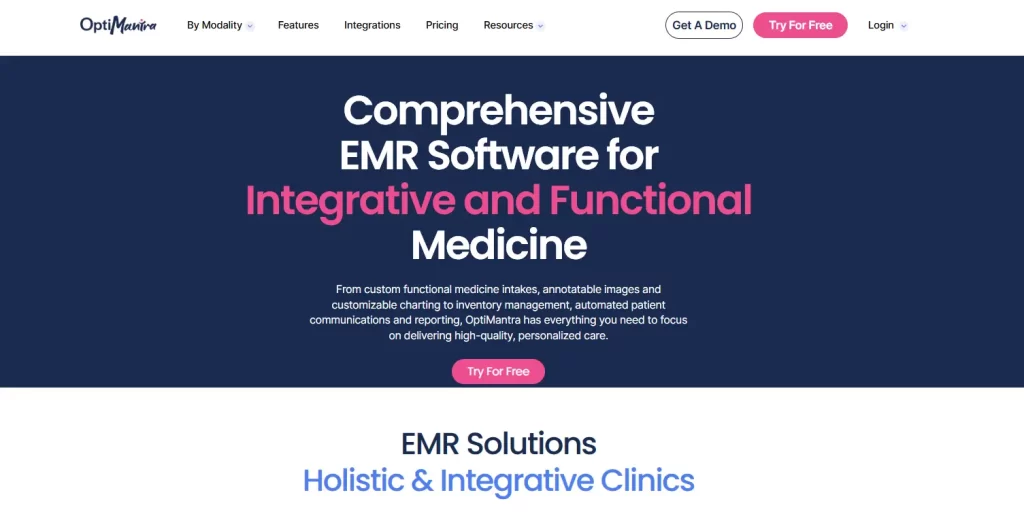
OptiMantra is an EMR and practice management platform built for integrative and holistic providers. It’s a solid fit for practices running several modalities under one roof.
Its real strength is lab work. The integrations and the customizable charting templates are designed around functional medicine workflows.
Key features:
Best for: Multi-modality integrative practices where naturopaths, chiropractors, acupuncturists, and functional medicine providers work side by side.
Pros:
Cons:
| Plan | Price | Users | Key inclusions |
|---|---|---|---|
| Base platform | $99 / month | First practitioner | Booking, charting, telehealth, payments |
| Extra practitioner | $49 / month | Per provider | Same full platform access |
| Clinical staff seat | $25 / month | Per staff member | Clerical staff seats are free |
| Add-ons | From $25 / month | Per practice | Fax, e-prescribing, two-way texting |
OptiMantra publishes these rates on its own site, along with discounts for students, part-time providers, and community practices.
Use this as a quick audit of your marketing foundations.
🏷️ Brand and positioning
🔍 SEO and online presence
📱 Social media and content
📧 Email and patient nurturing
⭐ Reputation and referrals
📊 Tracking and ROI
Don’t try to fix the whole list at once. Pick two or three unchecked items and work on those first. Small, steady improvements compound fast.
Most functional medicine practices run marketing in one place and clinical care in another. The email tool holds the leads, the EMR holds the patients, and a spreadsheet tries to connect them.
That split is where follow-up dies. Nobody can see which campaign produced a booking, so the re-engagement email goes to the wrong list and the lab-result follow-up never gets sent.
Pabau’s functional medicine software keeps both jobs in one record. Intake forms, reminders, recall campaigns, and post-visit follow-ups all fire off the same patient file, so the sequence knows what treatment plan someone is on.
You also get the number the checklist above asks for. Source attribution is captured at booking, so you can see which channel brought each patient in and what they went on to spend.

Pabau keeps intake, reminders, recall campaigns and post-visit follow-ups in the same patient record as the clinical notes. You can see which channel brought each patient in, and what happened after they booked.

The channel mix matters less than the order you build it in. Start with email and reviews, because they cost the least and return the most. Add SEO and content next, and treat paid ads as a top-up once the rest is running.
The trade-off worth remembering is patience. Functional medicine marketing pays back over months, not weeks. Practices that quit at week six end up funding a competitor’s ad auction.
Whatever you build, keep it attached to the patient record. Marketing that can’t see who booked, who returned, and who went quiet is marketing you can’t improve. Book a demo to see how Pabau links your campaigns to the patients they bring in.

Want more patients from the same budget? How to attract more patients to a functional medicine practice goes deeper on positioning and referral sources.
Still setting the practice up? How to start a functional medicine practice covers licensing, staffing, and the first year of costs.
Shopping for a record system? The best functional medicine EMR options compares charting depth, lab integrations, and pricing.
Need a better first appointment? Our functional medicine intake form collects the history and lifestyle detail a root-cause consultation depends on.
Deciding how to charge? Functional medicine business models that scale weighs memberships, packages, and insurance against each other.
Education-first marketing works best. Functional medicine patients research deeply before booking. Practices that answer their questions through content, email, and social media consistently attract more of the right patients.
It depends on the channel. Paid ads can generate leads within weeks. SEO and content marketing usually take three to six months to gain traction, but deliver far better long-term returns.
Yes, significantly. Functional medicine patients are some of the most search-driven in healthcare. Ranking for the right symptom-based keywords puts you in front of people already looking for your approach.
Yes. Social media is one of the most effective trust-building tools available to you. Short educational videos in particular help potential patients understand your approach before they book.
Not strictly, but the right platform makes a large difference. Tools like Pabau combine patient management with built-in marketing automations, so follow-ups, reminders, and recall campaigns run without a second system.