Fertility clinic marketing: Strategies that attract & convert patients
Fertility clinic marketing is how a fertility practice attracts, educates, and c...

Last Updated: Oct 14, 2026
Medical practice marketing covers the channels that bring new patients to your door and keep existing ones coming back. Those are local search, paid ads, social media, patient referrals, and email or SMS follow-up. Each one serves a different stage of the patient journey.
For most independent practices the priority order is settled. A complete Google Business Profile and local service pages earn the highest return for the least money. Automated recall, review requests, and re-engagement come next, because keeping a patient costs about a fifth of what winning a new one does. Paid search and content follow once those two are running.
Some primary care doctors now report that 60-70% of their new patients arrive through online channels, according to a Physicians Practice article citing Medical Economics. This guide covers each channel, the budget benchmarks, the HIPAA rules on patient data, and the practice marketing software that automates the follow-up.

Medical practice marketing works as one system across local search, paid ads, social media, referrals, and email or SMS follow-up.
A complete Google Business Profile is the highest-return action most independent practices can take in a single afternoon.
Retention beats acquisition on cost, so automated recall and review requests usually pay back faster than extra ad spend.
HIPAA and FTC rules govern testimonials, patient lists, and ad targeting, and penalties start at $145 per violation.
A growth budget runs 4-5% of revenue, which is $32,000 to $40,000 at $800,000 in annual revenue.
Before you choose channels, you need an answer to one question. Why should a patient choose your practice over the one three streets away? Without a defined unique value proposition (UVP), every dollar you spend on advertising promotes a commodity.
A UVP is a specific, honest answer to what your practice does better, faster, or differently. That might be same-day appointments, a particular clinical specialty, or a paperless intake process that removes friction from the first visit.
The American Medical Association advises practices to ground their marketing identity in a genuine community need rather than aspirational language. That means doing basic research first. What do patients in your catchment area struggle to access? Are wait times a pain point? Is a specialty missing locally?
Your patient acquisition strategies will only be as effective as the positioning underneath them. Lock in your UVP before you write a single ad or post a single social update.
Niche specialties need their own positioning. A mental health practice, for example, competes on trust and discretion far more than on promotions.
For most independent practices, Google Business Profile (GBP) is the single highest-return action you can take in an afternoon. A complete, verified GBP listing puts your practice in the local map pack. That is the three-result block above organic results when someone searches “physical therapist near me” or “dermatologist in [city].”
Practices that treat GBP as a living document outperform those that set it up once and forget it. For a practice that fills its schedule from the surrounding few miles, it is the lowest-cost, highest-visibility lever available.
Search, social, and paid advertising serve different parts of the patient decision journey. Treating them as interchangeable wastes budget. Knowing what each one does, and when a patient is ready to act, separates practices that spend efficiently from those that spend reactively.
| Channel | Best for | Time to results | Relative cost |
|---|---|---|---|
| Local SEO and GBP | High-intent search traffic | 3-6 months | Low (time investment) |
| Google Ads (search) | Immediate patient inquiries | Days to weeks | Medium to high |
| Social media (organic) | Brand awareness and trust | Ongoing | Low to medium |
| Facebook and Instagram ads | Aesthetic, elective services | Days to weeks | Medium |
| Email and SMS campaigns | Retention and reactivation | Immediate | Very low |
| Patient referral programs | New patient acquisition | Weeks to months | Low |
Search engine optimization for a medical practice is mostly a local game. Your goal is to rank for service-specific, location-specific queries such as “sports medicine clinic in Denver” or “Botox consultation Chicago.” Each core service deserves its own landing page, written for the query a patient types when they are ready to book.
Beyond service pages, a consistent blog answers the questions patients ask before they book. A dermatology practice writing about acne triggers, treatment options, and aftercare builds topical authority that compounds over 12 to 24 months. SEO is the most durable channel on this list. It is also the slowest to pay out.
Social platforms behave differently by specialty. Aesthetic and cosmetic practices see strong results on Instagram and TikTok, where visual transformations drive engagement. Primary care and therapy practices build trust on Facebook and LinkedIn, which reach an older audience evaluating ongoing care. Matching the platform to your audience matters more than posting everywhere.
Wellness practices rank their channels differently. Local search, fresh reviews, and automated recall outweigh paid social for them, as our guide to wellness practice marketing shows.
Google Search Ads put your practice in front of patients who are actively searching for what you offer. That is the highest-intent traffic available anywhere. For a new practice with no organic rankings, paid search can produce bookings within days. For an established practice launching a service, it carries demand while SEO builds.
The most common mistake is running broad keyword campaigns with no negative keywords. Ads for “physical therapy” attract people looking for insurance coverage, sports injury information, and career advice. None of them book a private appointment.
Tight geo-targeting, service-specific keywords, and a dedicated landing page cut cost per acquisition sharply. For most medical practices, Google Ads and local SEO outperform Facebook advertising, though results vary by specialty and patient demographic.
Run Google Ads with a radius of 5-10 miles around your practice and a dedicated landing page per service. A single ad group sending traffic to your homepage wastes up to 70% of click budget on visitors who cannot find what they searched for.
New patient acquisition costs roughly five times more than keeping an existing patient active. For most practices, improving retention by 10% moves revenue further than doubling the advertising budget. Retention is also easy to overlook, because the only signal is patients quietly not coming back.
Effective retention starts with the post-appointment experience. Does the patient leave knowing their next step? Did they receive aftercare instructions? Were they asked for feedback? Practices that send a digital survey 24 hours after the visit catch dissatisfaction before it turns into a public review.
For medical practices, review volume and recency on Google, Healthgrades, and RateMDs decide whether a prospective patient calls or keeps scrolling. A practice with 12 reviews from two years ago loses to one with 80 reviews from the past six months. That holds even at a lower average rating.
The most effective way to grow review count is a systematic post-appointment request. Send it by SMS or email within 24 to 48 hours of the visit. Most patients who had a good experience will leave a review when asked directly. Few think to do it unprompted.
Review management software can automate the request and route the replies, so a patient who flags a problem gets a phone call rather than silence. Ask every patient the same way, and let the reviews land where they land.
Compliance note: The FTC’s endorsement guidelines and HIPAA both govern how medical practices use patient testimonials. Never offer incentives for positive reviews, and never suppress the negative ones. Never publish a testimonial without the patient’s explicit written consent. Never respond to a public review in a way that confirms the person was seen at your practice, because that is a HIPAA disclosure. Acknowledge, empathize, and invite them to continue privately.
Engagement across the whole care journey, rather than only at the booking stage, is what turns occasional visitors into long-term patients who refer their network. A structured patient referral program gives your team a consistent way to ask.
HIPAA does not prohibit marketing. It regulates how patient data can be used in marketing activities. Practices that avoid marketing entirely out of compliance anxiety give up growth they could have had safely.
Getting it wrong carries civil penalties under the U.S. Department of Health and Human Services enforcement framework. Inflation-adjusted Tier 1 minimums start at $145 per violation. Tier 4 willful-neglect penalties reach over $2 million per violation under the January 2026 HHS adjustments.
Three areas require careful handling:
For UK practices, the equivalent framework is the ICO’s guidance on marketing under GDPR. Opt-in consent is required for any promotional messaging, and unsubscribing has to be easy. Check a marketing tool’s HIPAA compliance before you connect it to patient data.
The practical safeguard is to run your marketing automation inside a platform that is already HIPAA-compliant by design. Patient data then never has to be exported to a third-party tool that has not signed a BAA.
Audit your patient intake forms once a year. If your consent language does not explicitly cover promotional email marketing, you cannot legally send promotional campaigns to that patient cohort under HIPAA. One extra checkbox at intake covers every future patient.
There is no universal figure, but Baker Marketing Laboratory’s industry benchmarks give a practical starting framework. Allocate 2-3% of revenue to maintain current patient flow, 4-5% to grow it, and 5% or more for aggressive expansion.
Those percentages look very different once you put a revenue figure behind them. At $800,000 a year, the three bands work out at $16,000-$24,000 to hold steady, $32,000-$40,000 to grow, and $40,000 and up to expand hard.
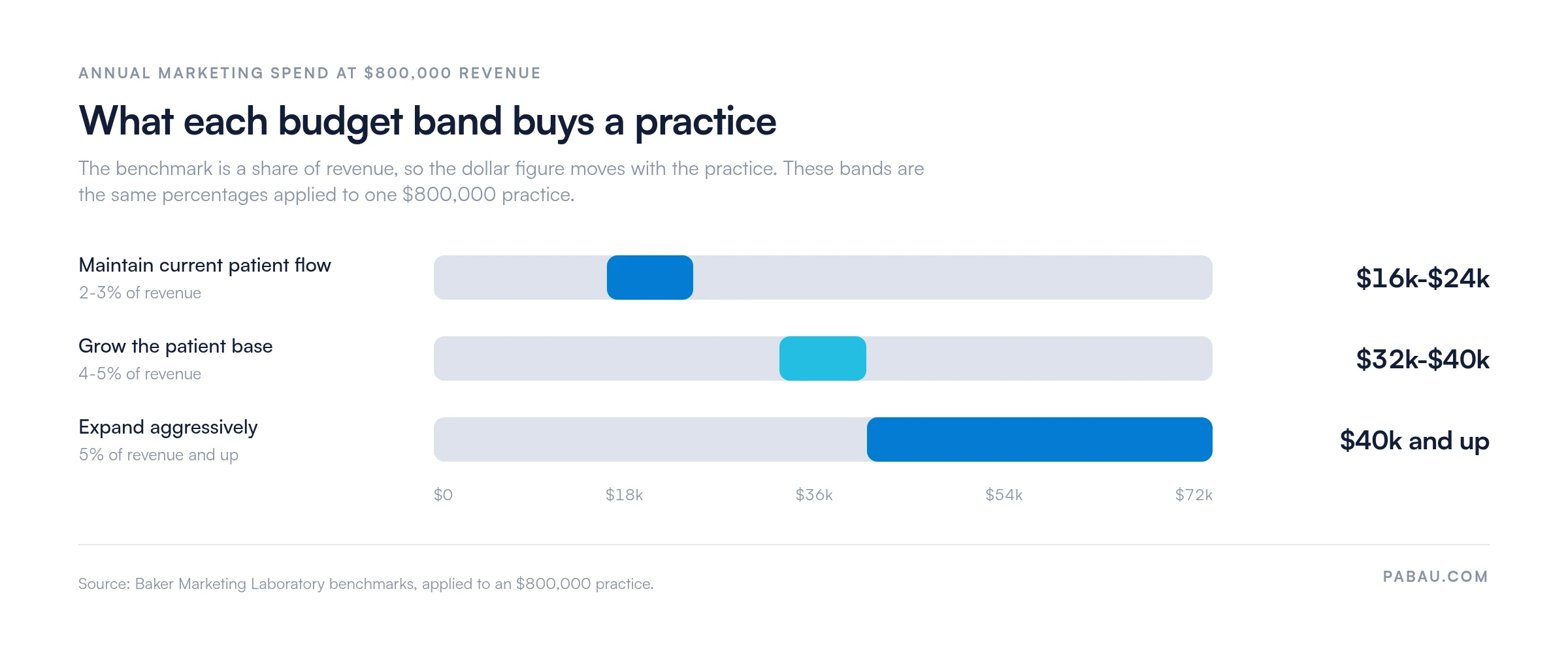
Where you allocate that budget matters more than the total. For most independent practices, the priority order looks like this:
The automation that returns most reliably is retention-focused, because those patients already trust your team and already live nearby. A systematic recall and re-engagement program typically lifts appointment volume from the existing patient base by 15-25%, with no advertising spend at all.
Want the whole allocation on one page before you commit? Our healthcare marketing plan template sets out the channels, the owners, and the monthly metrics.
A marketing strategy without measurement is a spending plan, not a growth plan. The metrics that matter for a medical practice are simpler than most marketing dashboards suggest:
Review these numbers monthly. A quarterly cycle lets a declining recall conversion rate run for three months before anyone sees it.
Most practices already know which follow-ups they are missing. Time is what stops them sending. A practice owner running a full patient list, a team, and compliance paperwork has no three spare hours a week. That is roughly what manual recall emails, review requests, and birthday messages cost by hand.
Practice management software like Pabau runs those touchpoints from the same system that holds the appointment and the treatment note. Our guide to marketing for clinics goes deeper on the campaign side. These five touchpoints compound into most of the growth:
Pabau’s email and SMS campaigns handle all five from the same place appointments are booked and clinical notes are stored. So you get no separate marketing tool to reconcile, no manual export, and no patient data leaving a HIPAA-compliant environment.

Pabau automates recall campaigns, review requests, and patient re-engagement from the same system that holds your calendar and notes. See the full workflow in a live demo of your own practice setup.

Most practices have more marketing capacity than they use. The constraint is usually follow-through rather than budget or strategy. A practice that runs recall, reviews, and re-engagement on a fixed schedule will outperform one that buys ads and ignores the patients it already treated.
So start with the two cheapest moves. Finish your Google Business Profile this week, and switch on an automated post-visit review request. Both take an afternoon, and both keep working long after you stop thinking about them.
Pabau’s automated recall campaigns, email and SMS workflows, and built-in review requests cover the operational layer of medical practice marketing. You need no separate tool and no marketing hire. Book a demo to see a full recall and review workflow running in a live practice.

Want a broader patient acquisition strategy? Patient acquisition strategies covers the coordinated tactics that bring in new patients and optimize revenue.
Struggling to fill your schedule in the first place? How to get more patients covers the acquisition strategies that fix visibility and booking friction.
Start with your UVP and target patient demographic, then map the channels to each stage of the patient journey: awareness, consideration, conversion, and retention. Set a budget using the 2-5% of revenue benchmark, assign clear ownership for each tactic, and pick the monthly metrics you will review. A one-page plan reviewed monthly beats a detailed strategy nobody opens.
For most practices offering private or elective services, yes, and particularly for new practices with no organic search visibility. The keys are tight geo-targeting, service-specific keywords, and a dedicated landing page per service. Broad campaigns without those guardrails can cost $50-80 per click and convert poorly. Well-structured campaigns often reach $15-30 per booked appointment in competitive markets.
Any patient testimonial used in marketing needs explicit written authorization from the patient. That includes screenshots of reviews, video endorsements, and before-and-after photos. The authorization has to describe how the content will be used and where it will be published, and verbal consent does not count. The FTC additionally requires that testimonials reflect typical results unless the typical result is clearly stated.
The most reliable driver of referrals is a consistently good patient experience rather than a formal referral program. A structured approach still helps. Ask satisfied patients directly at the end of the visit. Make referring easy with a shareable booking link or a printed card. A loyalty reward can work too, where HIPAA and local rules permit incentives for non-treatment referrals. Physician-to-physician networks need separate cultivation through professional contact and shared outcomes data.
For recurring treatments such as aesthetics, dental, and physical therapy, a well-configured automated recall converts 15-25% of recipients into booked appointments. Take a practice with 500 active patients and an average appointment value of $150-300. Run the whole list through one recall campaign and the math lands between $11,250 and $37,500 in booked revenue, at near-zero cost per message.