7 Best Fresha alternatives for salons and med spas (2026)
Fresha alternatives fall into two camps, and the split decides your monthly bill...

Last Updated: Oct 6, 2026
Blog / How to calculate your patient no-show rate (and bring it down)

Your no-show rate is missed appointments divided by total scheduled appointments, multiplied by 100.
No published benchmark is comparable to your number unless its denominator matches yours, so write your inclusion rule down.
MGMA benchmarking data put the no-show rate for single-specialty practices at 6.81% in 2023, against 7% in 2019.
Track cancellations separately from no-shows, then segment both by provider, visit type, and how far ahead the patient booked.
Practice management software like Pabau automates reminders, deposits, and fee enforcement, so the policy gets applied the same way every time.
Learning how to calculate no-show rate takes about ten seconds. Divide missed appointments by total scheduled appointments, then multiply by 100.
Comparing that number to a published benchmark is the harder job. Few sources say whether a late cancellation sits in their numerator or not.
So this guide gives you the formula, a worked example, and a rule for deciding what counts as a missed appointment.
After that come benchmarks by setting, each one carrying its source, and the tactics that bring the number down.
A no-show rate is the share of scheduled appointments where the patient neither turns up nor cancels in time for you to refill the slot.
Clinical research and UK health services call the same measure the non-attendance rate, or the DNA rate, short for did not attend.
The metric earns its place because an empty slot still costs you. Staff were rostered, the room was held, and the revenue never arrives.
It also says something about care. A missed follow-up pushes treatment further out, and repeat misses tend to cluster in the same patients.
Divide the number of missed appointments by the total number of scheduled appointments, then multiply by 100.
How to calculate no-show rate is the simple part. Deciding what belongs in each of those two numbers is where practices differ.
Three steps get you there:
Say your practice scheduled 412 appointments in March and 31 patients never arrived. Divide 31 by 412 and you get 0.0752.
Multiply that by 100 and your March no-show rate is 7.5%. Run the same sum every month, because the trend tells you more than any single figure.
You can calculate patient no-show rate figures from any appointment report that separates attended, canceled, and missed bookings.
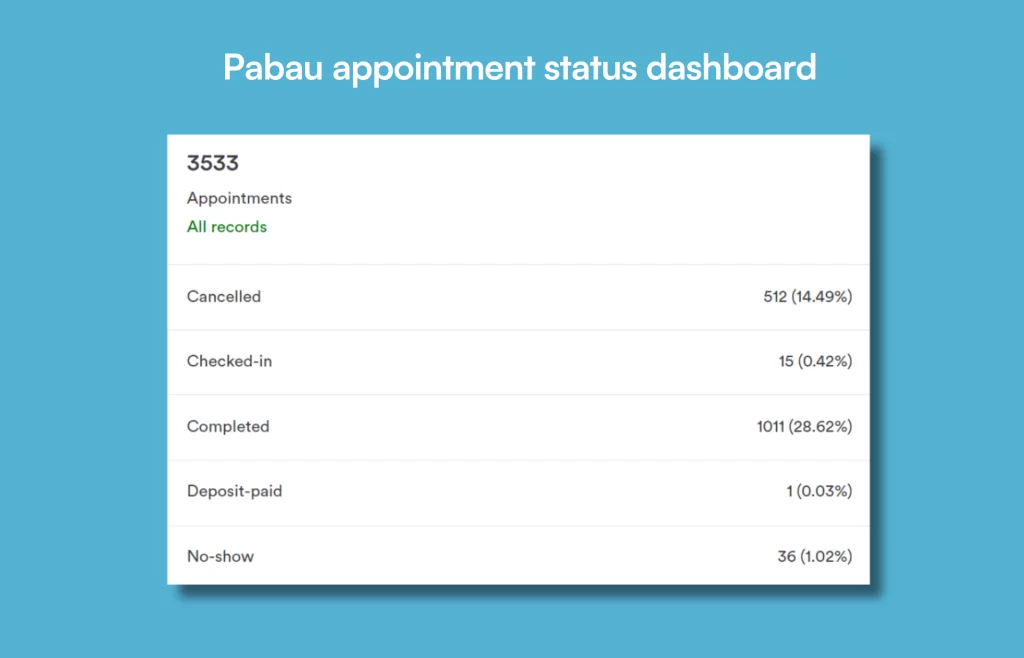
Whichever system you pull the numbers from, use the same report every month so the trend line stays honest.
A no-show is an appointment the patient neither attended nor canceled with enough notice for you to refill the slot.
That last clause is where practices diverge, and it decides whether your no-show rate calculation is comparable to anyone else’s.
| Scenario | Counts as a no-show? | Counts in total scheduled? | Why it matters |
|---|---|---|---|
| Patient never arrives and gives no notice | Yes | Yes | This is the one case every published definition agrees on. |
| Patient cancels inside your notice window, say under 24 hours | Your call, but write it down | Yes | Counting these can double your rate against a source that leaves them out. |
| Patient cancels outside your notice window | No | Yes | The slot was refillable, so this belongs in your cancellation rate instead. |
| Patient arrives too late to be seen | Your call, but write it down | Yes | Treat it the same way every time and log the reason behind it. |
| Your practice cancels or bumps the appointment | No | No | Removing it keeps a staffing problem out of a patient behavior metric. |
| Patient cancels and rebooks on the same call | No | Count the booking once | Counting both bookings inflates the denominator and flatters your rate. |
Write your inclusion rule down in one sentence, then apply it to every report. Changing it partway through the year makes your own trend line unreadable.
The rule matters most when you start comparing. Two honest practices can report very different numbers purely because one counts same-day cancellations.
Track them as two separate numbers, because a cancellation and a no-show have different causes and different fixes.
MGMA gives the same advice in its benchmarking guidance. Its 2025 report put the 2024 appointment cancellation rate at 19.95%, with 27.40% of those visits rebooked within 30 days.
One practice-wide percentage tells you the size of the problem and nothing about where it sits. Break both metrics down by:
Once you can see which segment drives the number, the fix stops being guesswork. A reminder change and a deposit policy solve different problems.
There is no national average patient no-show rate in the US, because no federal agency publishes one.
HRSA’s Uniform Data System, which every federally funded health center reports into, does not collect missed appointments at all.
So every figure you will find comes from a single study or a membership survey. The working range for a US outpatient practice is roughly 5% to 15%.
The MGMA no-show rate benchmark is the closest US practices get to a like-for-like comparison. It comes from medical group reporting rather than one hospital.
Most no-show benchmarks a private practice finds online come from academic or safety-net settings, where rates run a good deal higher.
| Setting or specialty | Reported no-show rate | Source (year) |
|---|---|---|
| Family medicine, 15 US clinics, 1.1 million appointments (2019 to 2023) | 6.9% no-shows, plus 6.8% late cancellations | Tuan et al., Annals of Family Medicine (2025) |
| US medical groups, single-specialty aggregate | 6.81% in 2023, against a 7% pre-pandemic mark in 2019 | MGMA DataDive Practice Operations, reported by MGMA (2025) |
| General practice, 19 studies within a 26-study international systematic review | 3.3% to 48.1%, mean 15.2%, median 12.9% | Parsons et al., British Journal of General Practice (2021) |
| Hospital outpatient network, 1.97 million encounters across nine specialties | 4.27% overall, with mental health carrying the highest odds | Amagai et al., npj Digital Medicine (2024) |
| Mental health clinics against primary care clinics, one VA health system | 18.0% to 21.9% in mental health, against 10.5% to 12.1% in primary care | Journal of General Internal Medicine (2023) |
| Outpatient physical therapy, or physiotherapy, across 828 clinics in 26 states | 15% to 31%, depending on clinic, state and provider | Bhavsar et al., PLOS ONE (2021) |
| Community health centers, 55 Texas FQHC clinics, 278,171 appointments | 18% overall, from 13.1% in senior care to 20.2% in family practice | Adepoju et al., Annals of Medicine (2022) |
| Outpatient imaging, 2.9 million visits over 16 years | 2.26% to 3.36% by year, with mammography highest at 6.99% | Rosenbaum et al., Journal of the American College of Radiology (2018) |
| Pediatric dental, academic clinic in Western New York | 14.3%, against a cited national range of 5% to 38% | International Journal of Dentistry (2025) |
| Telehealth against in-person care, 45 cohort studies pooled | Telehealth carried about 0.61 times the odds of non-attendance | Greenup and Best, BMC Health Services Research (2025) |
Read that table with one caution. Some of these studies count only true no-shows, while others fold in late or same-day cancellations.
That definitional split is the single biggest reason published patient no show rates spread from about 2% to 31%.
The spread by setting is wide too. The average no show rate for primary care lands near 7% in the two largest US datasets.
Physical therapy sits at the top. Across 828 clinics in 26 states, rates ran between 15% and 31% depending on the site.
The FQHC no-show rate in the largest Texas study was 18%, and insurance status predicted missing better than any other patient factor.
There is no national average no-show rate for mental health either. Every dataset that compares specialties puts behavioral health at or near the top.
Two other factors widen the range. The first is population.
A community health center and a cash-pay med spa do not serve the same patients. Ability to travel drives attendance more than any reminder does.
The second is booking lead time. Long waits generate missed appointments on their own.
In the imaging study above, visits booked more than six months ahead were missed about three times as often as same-week bookings.
One setting is missing from the table because nobody has measured it. No published study reports a no-show rate for med spas or aesthetic practices.
Figures quoted for aesthetics are borrowed from other specialties, so treat them as guesses rather than targets.
So compare yourself to the same setting, or compare yourself to your own last quarter. The second comparison is usually the more useful one.
Work it out from three numbers you already have. Multiply your weekly appointment slots by your no-show rate, then multiply that result by the average value of a visit.
A practice running 120 slots a week at a 7% no-show rate loses roughly eight slots. At an average visit value of $180, that is $1,440 a week.
Over a year it comes to about $75,000. Run your own numbers before you accept any headline figure you find online.
You will see a $150 billion figure quoted for the whole US system. It traces to a 2017 trade commentary rather than a study.
The author was the marketing chief of a patient scheduling vendor, and no methodology was published alongside it.
Peer-reviewed costings are narrower and clearer about their scope. One study of a large VA medical center put the average cost of a no-show at $196 in 2008.
Lost revenue is only part of the bill. Fixed overhead runs whether the room is used or not, and a missed follow-up delays the next one.
The tactics below are ordered by the evidence behind them, not by how easy they are to set up.
Reminders, a stated fee or deposit policy, and self-service rescheduling come first. The four that follow cost less to run and compound over time.
The same order works whether you run a single treatment room or a multi-provider practice.
Practices under pressure to move the number this quarter should start at the top of the list.
None of these works as a one-off. Reducing no-shows is a policy you run every week, not a project you finish.
A Cochrane review of eight randomized trials found text reminders lifted attendance from 67.8% to 78.6%.
Phone calls did marginally better at 80.3%, but the texts cost 55% to 65% less to send.
The effect is consistent rather than dramatic, so treat reminders as the floor of your no-show policy rather than the whole of it.
For maximum effect, customize what you send:
These reminder text examples show the kind of message that gets read instead of ignored.
A January 2025 MGMA poll of 622 medical group leaders found 42% charge a no-show fee, against 58% who do not.
Practices charging one were more likely to report an improvement during 2024, at 25% against 16%.
The published research is more cautious. The only randomized trial of a fee, covering 6,746 orthopedic outpatients in Denmark, found no difference between the groups.
Fees also land hardest on the patients least able to pay them. Set yours where a missed visit costs you less than losing the patient would.
MGMA reports typical primary care fees of $25 to $50, with higher amounts or deposits in surgical settings.
It also suggests a 24 to 48 hour notice window, which gives you a fair chance of refilling the slot.
In practice this means storing a card securely at booking, then charging the agreed amount if the patient does not arrive.
Upfront deposits work on the same principle and are refunded on attendance. They are common in aesthetics, though the published evidence for them is thinner than it is for reminders.
Whichever you pick, say so at booking and again in the confirmation. A sliding scale and an exception for a first miss keep the policy defensible.
Patients have emergencies, shift changes, and calendars they forget to check. If moving the appointment is hard, they stop trying.
Few people want to call and explain themselves to a busy front desk, so make the alternative obvious:
An easy reschedule turns a would-be no-show into a filled slot on a different day, which is the cheapest save available to you.
One channel is never enough. Some patients read email the same day, others only notice a text.
Running those channels through a shared practice inbox means the reply comes back to one place.
A few tactics help:
Patients need to know the rule before they can follow it, so put your booking and cancellation policies where they will be read.
That means on the booking page, in the confirmation, and in the reminder. Aesthetic practice Secret Enhancements shows its policy at the point of booking.
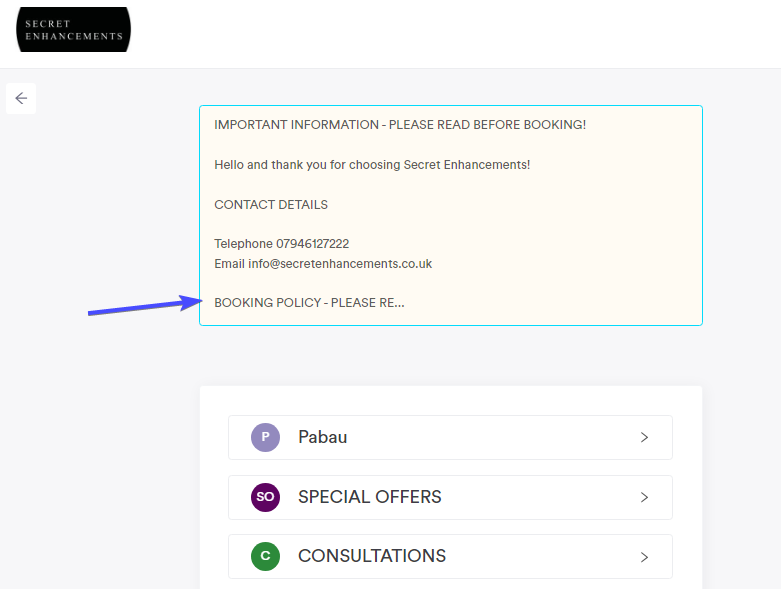
Pabau’s online booking features let you publish policy pages on your booking portal, so patients see the terms before they pick a slot.
If a patient tries to cancel late, they get a clear warning about the fee. If they miss the appointment, the fee comes off the saved card without a phone call.
A written process keeps your response consistent, which matters both for fairness and for the accuracy of your own reporting.
Mark the appointment as a no-show the same day, so your monthly figure does not depend on someone’s memory. Apply any fee as your policy states.
Then send a short message offering to rebook, and repeat the policy in it. For a first miss, a phone call asking what happened works better than a fee.
Writing each of those follow-ups by hand still eats into the front desk’s day. Pabau’s AI agents draft the rebooking invite with a booking link, and staff approve it before it reaches the patient.
Log the date, the reason where you know it, and the follow-up. That log is what turns a monthly percentage into something you can act on.
For no-show patients who miss repeatedly, a direct conversation beats another automated message. Some practices limit them to same-day slots instead.
Asking why costs you a two-minute call and tells you which of your fixes will work.
A 2021 systematic review of 26 general practice studies ranked the reasons patients give. Work or family commitments came first, then forgetting, then transport or weather.
Only one of those three is solved by a reminder, which is worth remembering before you buy another messaging tool.
Keep the question open and the tone neutral. Patients who feel accused do not rebook, and the answer you want is the one they are reluctant to give.
Every tactic above depends on repeating the same steps every week. The same inclusion rule, the same reminder schedule, the same fee for the same patients.
That consistency is what a spreadsheet and a busy front desk cannot guarantee. Practice management software like Pabau applies the rule for you.
The practical answer to reducing patient no-shows is a policy that runs without anyone having to remember it.
Appointment statuses are recorded against the booking, so your no-show and cancellation numbers come from one report rather than a hand-kept tally.
Reminders go out on a schedule you set once, across email and SMS, so nobody has to remember to send them.
Deposits and cancellation fees are collected against a stored card, which removes the awkward conversation that stops most policies being enforced.
The same rules apply across every provider and location. That is how medical spa software like Pabau keeps a three-room practice and a ten-site group reporting alike.

Pabau's booking deposits, automated reminders, and enforced cancellation policies work together to cut missed appointments and recover the revenue they would otherwise cost.

No-shows never reach zero. They do reach a level you can predict, budget for, and hold steady, which is a different kind of win.
Get the definition right first. A number you measure the same way every month is worth more than a number you can compare to a study.
Then work down the tactics in order. Reminders first, a written policy second, and deposits or fees once patients know the rule.
Measure the change before you add the next one, or you will never know which of them did the work. Book a demo to see how Pabau’s reminders, deposits, and cancellation policies cut no-shows for your practice.

Want to fill last-minute cancellations? Med spa waitlist benefits explains how a digital waitlist automatically fills empty slots freed up by no-shows.
Considering a deposit policy? Deposits for aesthetics businesses breaks down how much to charge and how to introduce it without scaring off new patients.
Looking to overhaul scheduling more broadly? Patient scheduling software covers the full appointment workflow beyond just tackling no-shows.
Need a policy patients can actually read? Appointment cancellation policy template gives you ready-to-use wording for confirmations and booking pages.
Want to cut down on missed messages? Patient communication software compares platforms for sending reminders across channels.
Under 10% is a reasonable target for most US outpatient practices. MGMA benchmarking data put single-specialty practices at 6.81% in 2023. A rate above 15% is worth breaking down by provider and visit type before you change policy. Judge yourself against your own last quarter first, because your definition and your patient mix are your own.
Divide the number of missed appointments by the total number of scheduled appointments, then multiply by 100. For example, 31 no-shows out of 412 scheduled appointments works out to a 7.5% no-show rate. Decide in advance whether late cancellations count, and apply that same rule every month.
Yes, provided the policy is stated at booking and repeated in the appointment confirmation. A January 2025 MGMA poll of 622 medical group leaders found 42% charge one. MGMA reports typical primary care fees of $25 to $50, with higher amounts or deposits in surgical settings. Check your payer contracts, since some restrict what you can bill a patient.
A 2021 systematic review of 26 general practice studies found work or family commitments were reported most often, then forgetting, then transport or weather. Reminders only solve the second of those three. Transport and work conflicts need flexible hours, telehealth, or an easier way to move the appointment.
Yes, on average. A 2025 meta-analysis of 45 cohort studies found telehealth appointments carried about 0.61 times the odds of non-attendance compared with in-person visits. The review also flagged very high variation between studies, so treat telehealth as a lever worth testing rather than a guaranteed fix.
A confirmation costs the patient nothing, so it predicts attendance far more weakly than a deposit or a card on file does. Tapping "confirm" takes a second and commits nobody. Lead time matters more. Appointments booked weeks ahead get missed far more often, and the top reasons patients give are work and family conflicts rather than forgetting.
There is no single national figure, and no US federal agency publishes one. MGMA benchmarking data put single-specialty medical practices at 6.81% in 2023. A 2025 study of 1.1 million family medicine appointments found 6.9%. Hospital outpatient, community health, and physical therapy settings report higher rates again. The table above gives each figure with its source.
No. There is no billable CPT or ICD-10 code for a missed appointment, because payers do not reimburse time that was not delivered. Any charge goes to the patient directly under your own written policy, not through a claim. Medicare and Medicaid rules on billing patients for missed visits differ, so check before you apply a fee.