Positive self-talk worksheet
A positive self-talk worksheet is a structured therapy tool for catching a negat...

1
Last Updated: Oct 13, 2026
Opening a physiotherapy clinic takes seven stages: research and a business plan, licensing, a compliant space, equipment, a team, practice systems, and launch marketing. Most independent practices spend $50,000 to $150,000 and six to 12 months getting there, and insurance credentialing is usually the slowest step.
This guide to physical therapy practice setup shows how to start a physiotherapy clinic stage by stage. The same order applies to opening a physical therapy clinic, the usual US term. The guide breaks the physiotherapy clinic startup budget into six cost categories, then gives you four signals for when to open a second location.

Opening a physiotherapy clinic typically costs $50,000 to $150,000, with lease, build-out, and equipment taking the largest share.
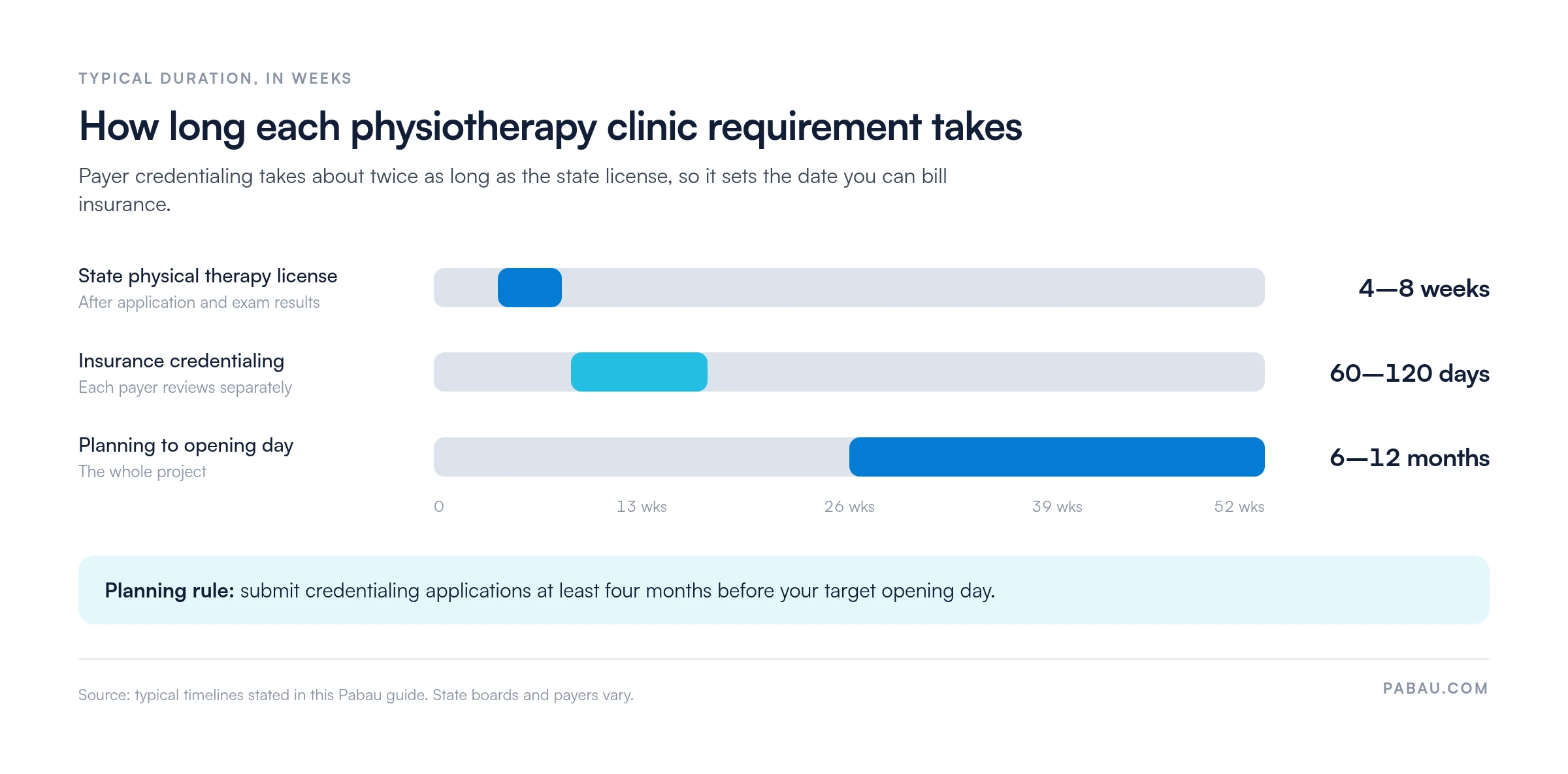
Start licensing and credentialing first, since state licensing takes about four to eight weeks and payer credentialing often takes 60 to 120 days.
Choose independent, franchise, or acquisition, and cash-pay, insurance, or hybrid billing, before you write the business plan.
Build the team and systems around your niche, with practice management software like Pabau running booking, records, and billing in one place.
Plan a second location only when at least three of the four second-location signals hold for a full quarter.
Research and planning show whether the numbers work before you sign a lease. Mistakes made at this stage are still cheap, because they only exist on paper. Starting a physiotherapy clinic well means settling five questions here: demand, niche, ownership model, business plan, and budget.
Market research tells you whether enough local patients need the services you plan to offer, and what they already pay elsewhere. If you’re working out how to start a physical therapy clinic, begin with four checks:
Your niche is the patient group you want to be known for, such as sports rehab, post-operative orthopedics, pediatrics, pelvic health, or vestibular care. It decides your equipment, your hires, and where referrals come from.
A sports rehab practice needs open gym space and ties with local clubs. A pelvic health practice needs private treatment rooms and relationships with OB-GYNs. Picking one early keeps your build-out and marketing focused.
Going independent gives you full control and all the profit, while a franchise physical therapy brand trades upfront fees and royalties for a proven playbook. Settle this before you write the business plan, because it changes your costs, your control, and how fast you can open.
An independent practice lets you choose the name, the niche, the pricing, and the build-out. The trade-off is that you build every system yourself and carry all the risk.
A PT franchise hands you a recognized brand, supplier deals, and marketing support on day one. In return, you pay a franchise fee plus ongoing royalties, and you follow the franchisor’s rules on how the practice runs.
A middle path is buying an existing practice. You inherit a patient base and a trained team. You’ll also need legal and financial help to find out why it’s for sale and whether the price matches its books.
Pick independent if you want to set the clinical model of your PT business yourself. Pick a franchise or an acquisition if you’d rather trade some margin for a faster, lower-risk start.
A physical therapy business plan sets out your services, patient volume, pricing, staffing, and cash flow for the first two to three years. Lenders and investors expect to see one before they fund you.
If you’re working out how to start your own physical therapy practice with a bank loan, this is the document the loan officer reads first. Starting private practice without one makes a month-four cash shortfall much harder to see coming.
A business plan for private practice should cover:
The plan also has to name your payment model, because it shapes your pricing, your paperwork, and your cash flow. You have three options:
For anyone researching how to start a physical therapy business with outside funding, the financial section carries the most weight. The budget below gives you its starting numbers.
The cost of setting up a physiotherapy clinic is typically $50,000 to $150,000, depending on your lease, build-out, and how much equipment you buy new.
The physiotherapy clinic startup budget below splits that range into six categories. Use it to see where a lean opening saves money and where it can’t.
| Cost category | Typical range | What it covers | Where a lean opening saves |
|---|---|---|---|
| Licensing and insurance | $4,000–$12,000 | State and facility permits, entity filing, legal and accounting setup, first-year liability and workers’ comp premiums | Bundle policies with one broker |
| Lease and build-out | $15,000–$45,000 | Security deposit, first months’ rent, treatment bays, accessibility work, signage | Lease a former medical suite that needs little fit-out |
| Equipment | $15,000–$40,000 | Treatment tables, exercise kit, diagnostic tools, ultrasound and electrical stimulation units | Buy big-ticket modalities used or leased |
| Initial staffing | $8,000–$25,000 | Recruiting, credential checks, training, and pre-opening payroll for your first hires | The owner covers some front desk hours at first |
| Software/EMR and IT | $2,000–$6,000 | Computers, phones, network, and the first year of practice management software | Choose one system for booking, notes, and billing |
| Marketing and working-capital reserve | $6,000–$22,000 | Website, launch marketing, referral outreach, and cash to cover payroll while the first insurance payments process | Lean on physician referrals over paid ads |
| Total | $50,000–$150,000 | A typical independent, single-location practice | — |
Lease and build-out is where a physiotherapy clinic business setup swings hardest. Get contractor quotes before you sign, since accessibility work on an older unit can double the fit-out bill.
Startup cost is only half the picture. Physio clinic operating costs, including rent, payroll, software, insurance, and supplies, recur every month. Hold three to six months of them in reserve, because insurance payments arrive weeks after the visit.
The core physiotherapy clinic requirements are a state physical therapy license, a registered business entity, local facility permits, and insurance. If you bill insurance, payer credentialing joins the list and usually takes longest.
Run these in parallel rather than one after another. The chart below shows why the slowest item sets your opening date.
Every physical therapist who treats patients in your practice needs an active license in the state where you practice. You and every therapist you hire must meet those qualifications before the first appointment.
Requirements vary by jurisdiction, but generally include:
Once your application and exam results are complete, state boards usually process a license within four to eight weeks. If you’ll treat patients across state lines, check whether your state belongs to the Physical Therapy Licensure Compact.
Register your physical therapy business as a legal entity before you sign a lease or apply for credentialing. The structure you choose affects your taxes, your personal liability, and how easily you can bring in partners.
The most common business structures for a practice are:
After registering, get an employer identification number (EIN) from the IRS and a Type 2 NPI for the practice. Payers credential the business under both, so neither can wait. A business attorney or accountant can confirm the right structure before you file.
Beyond a professional license, your practice may need local permits and inspections before it can open. These typically include:
Book inspections as soon as the build-out finishes. A failed fire or accessibility check can push back your opening date and add fines on top.
A new physical therapy practice needs professional liability, general liability, and workers’ compensation insurance once it employs staff. APTA’s guidance on private practice covers the basics. At a minimum, plan for:
Payer credentialing is the other insurance job, and it takes longest. Each insurer reviews your application separately, which often takes 60 to 120 days.
Submit applications as soon as your entity, NPI, and practice address are confirmed. Until you’re in-network, you can only see a payer’s patients as out-of-network or cash-pay.
Your space is the biggest single decision in physiotherapy clinic setup. It decides how easily patients reach you, how many treatment bays you can run, and your biggest fixed monthly cost.
The right location is easy to reach for patients with limited mobility, close to your referral sources, and big enough for your planned treatment bays. Check each shortlisted space against these factors:
If a lease isn’t viable yet, a mobile model that treats patients at home or on-site at gyms and workplaces can test demand first.
Your physical therapy equipment list should start with treatment tables, exercise equipment, diagnostic tools, and the modalities your niche uses most. Add specialist kit as your caseload grows.
For budgeting, WebPT puts new treatment tables at around $1,500 each and ultrasound stimulators at around $3,600. You don’t have to buy all of it new:
Your first hires set your capacity and your patients’ experience, so plan the roles before you post a single job.
A lean physio clinic team structure at launch is the owner-therapist, one more licensed therapist or assistant, and a front desk coordinator. Billing can sit in-house or go to an outside service.
Wages are your largest monthly outgoing, so tie each hire to a caseload number in your business plan. Start with part-time hours where you can, then increase them as the schedule fills.
Your own role changes as the team grows. Anyone asking how to become a CEO of a physio clinic, rather than its busiest therapist, has to cut their own caseload deliberately. That frees time for referrals, hiring, and finances.
Hire licensed therapists whose specialty matches your niche, and front desk staff who can handle scheduling, insurance checks, and patient questions calmly.
Verify every therapist’s license with the state board before the offer. In interviews, ask how they document a visit and how they handle a patient who stops showing up. Both answers affect your revenue as much as their clinical skill does.
For the front desk, look for people who are organized and good on the phone. They’ll manage scheduling, billing questions, and first impressions, so a patient-first mindset matters more than industry experience.
Knowing how to run a physio clinic comes down to systems: how patients book, how notes get written, and how claims get paid. Set them up before opening day, so your first patients test them rather than break them.
Choose physiotherapy practice management software that handles scheduling, documentation, billing, and patient communication in one system, so staff aren’t copying data between tools.
It’s one of the biggest decisions in setting up a practice, so shortlist software for physical therapists rather than a generic booking tool. The same evaluation criteria apply if you’re also comparing occupational therapy practice software.
For example, practice management software like Pabau keeps booking, patient records, billing, and reporting on one patient record. A few workflows pay off quickly for a new practice:
In the practices we onboard, the smoothest launches configure booking rules, forms, and reminders before the first patient books.
Write policies for intake, scheduling, cancellations, billing, staff roles, and privacy before you open, so every team member handles the same situation the same way.
For a new practice, the fastest source of patients is usually local physician referrals. Introduce yourself to nearby orthopedic surgeons, primary care doctors, and sports medicine practices, and make referring to you a one-step job.
Start with a simple website and a complete Google Business Profile, which local searchers often see before your website. Your website should clearly show:
Optimize both for local search, so your practice appears when people nearby search for physical therapy. Ask early patients for reviews, since review count and recency both affect local rankings.
Social media and content marketing work best when they show expertise: a two-minute exercise demo, an injury-prevention tip, or a consented patient story.
Post around your niche rather than general wellness. A sports rehab practice gets more from return-to-running videos than from generic stretching tips. Blog posts and downloadable home-exercise guides on your website keep that content working for search too.
Community outreach puts you in front of local patients before they need you, through free workshops, gym partnerships, and introductory assessment offers.
Workshops on back pain, posture, or running injuries give people a taste of your approach. Partnerships with gyms, yoga studios, and running clubs send you patients who already trust the referrer. If you bill Medicare, check discounts and free services with your attorney, since patient inducement rules apply.
Once licensing, space, team, and systems are in place, launch is about filling the schedule and keeping patients coming back. Our guide to starting a chiropractic practice covers the same launch stage for a neighboring specialty.
A strong opening day introduces your practice to referral sources and neighbors, and books first appointments on the spot. Invite local physicians, gym owners, and nearby businesses, then try:
Collect feedback after the first visit and again at discharge, then act on patterns rather than single complaints. Three channels cover it:
Open a second physio clinic location once your first site stays nearly full, new patients wait over a week, and profits hold without you.
Deciding when to open a second physio clinic is easier with a fixed test. We call it the second-location test: four signals, and you’re ready when at least three hold for a full quarter.
These thresholds are our rule of thumb rather than an industry standard, so adjust them to your payer mix. Budget the new site with the same $50,000–$150,000 table above, minus whatever you can share with the first site.
The answer to how to scale a physiotherapy clinic starts with systems. Your second site should run on the same booking rules, forms, pricing, and reports as the first. Owners working out how to open multiple physio clinics should also decide early whether each site gets its own manager.
By opening day, you’ve made decisions about your niche, your location, your team, and your equipment. Pabau turns them into booking rules, intake forms, and reports, so the plan still holds once patients start booking.
New practices often start with sign-up sheets and paper intake forms, then rebuild the same workflows six months later. Pabau’s digital intake and consent forms, treatment notes, and before-and-after photo tracking are ready from day one, so your team never migrates patient records mid-year.
Pabau also includes exercise videos and an automated pre- and aftercare system, so patients get consistent home-exercise guidance between visits. Inventory tracking covers supplies like resistance bands and TENS pads, and payments run through the same platform.
When you pass the second-location test, Pabau runs both sites from one system, so schedules, patient records, and reports stay side by side. Every subscription includes the full platform, whether you’re one practitioner or a multi-location group.

Pabau brings scheduling, patient records, billing, and pre- and aftercare together. A new physiotherapy practice runs day-to-day operations from one place instead of separate tools.

The fastest way to open on schedule is to start the slow items first. File your entity, license, and credentialing applications in month one, and let the build-out run alongside them.
The trade-off worth remembering is independence against support. Going independent gives you full control over pricing and brand, but you build every system yourself. A franchise or a connected software platform buys a head start on operations, so your energy goes into patient care.
Once you’re open, the startup budget becomes your growth benchmark. Track schedule fill and wait times from month one, and the second-location decision gets much easier. Book a demo to see how Pabau supports a physiotherapy practice from opening day to its second location.

Still weighing your business plan? Physical therapy business plan walks through the financial projections and milestones lenders expect to see before they fund a new practice.
Still narrowing down your niche? Physical therapy specialties breaks down the most common niches and what each one demands from your team and equipment.
Deciding whether to skip insurance? Cash-based physical therapy explains how the cash-pay model works for PTs and what it changes about pricing and patient volume.
Getting ready to bill payers? Physical therapy billing covers the CPT codes, timed units, and Medicare rules a new practice needs before its first claim.
Building your intake process? Physical therapy intake form gives you a ready-made form to collect history, symptoms, and consent before the first evaluation.
Most independent physiotherapy clinics cost between $50,000 and $150,000 to open, depending on location, equipment, and whether you lease or buy your space. Rent, equipment, licensing fees, insurance, and initial staffing are the largest upfront costs, so building a detailed budget before you sign a lease is essential.
Opening a physiotherapy clinic typically takes 6 to 12 months from initial planning to opening day. Licensing and credentialing can take several months on their own. Start those applications as early as possible while you finalize your location and equipment.
State licensing for physiotherapists is usually processed within 4 to 8 weeks once your application and exam results are complete. Insurance credentialing takes longer, often 60 to 120 days, since each payer reviews your application separately. Submit credentialing applications well before your planned opening date.
A physician referral network isn’t a legal requirement, but it’s one of the fastest ways to fill your schedule as a new practice. Building relationships with local orthopedic surgeons, primary care doctors, and sports medicine practices before you open can help you see patients from day one.
You can’t treat patients without a state physical therapy license, but some states let non-therapists own a practice that employs licensed therapists. Other states require licensed PTs to own the practice through a professional corporation or PLLC. Ownership is one of the physiotherapy clinic requirements to confirm with your state board before you form the business.
A physical therapy practice owner’s salary often starts below a staff therapist’s pay in year one. Early revenue goes to physio clinic operating costs like rent and payroll. Owner income then grows with the billable visits your whole team delivers. For comparison, the BLS reports a median salary of $102,760 for employed physical therapists as of May 2025.