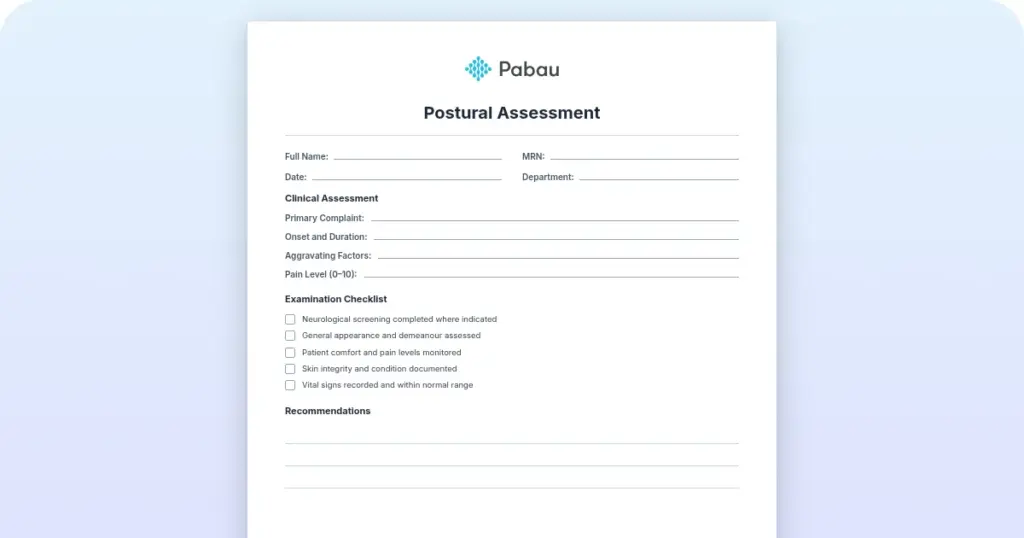
Postural assessment: Free template and step-by-step guide
A postural assessment is a structured clinical evaluation of how a patient’...

Last Updated: Oct 13, 2026

A daily medication chart is a tracking tool where patients and caregivers record medication names, dosages, frequency, and time of day to prevent missed doses and improve safety.
Every medication chart should include drug name, dose, how often, time taken, prescriber, reason for taking, and notes about side effects, matching FDA and AHRQ guidance.
Medication charts reduce medication errors and help clinicians identify drug interactions during appointments by showing real-time adherence data.
Practice management software like Pabau replaces paper charts with digital medication records and structured treatment notes, cutting down on manual entry errors.
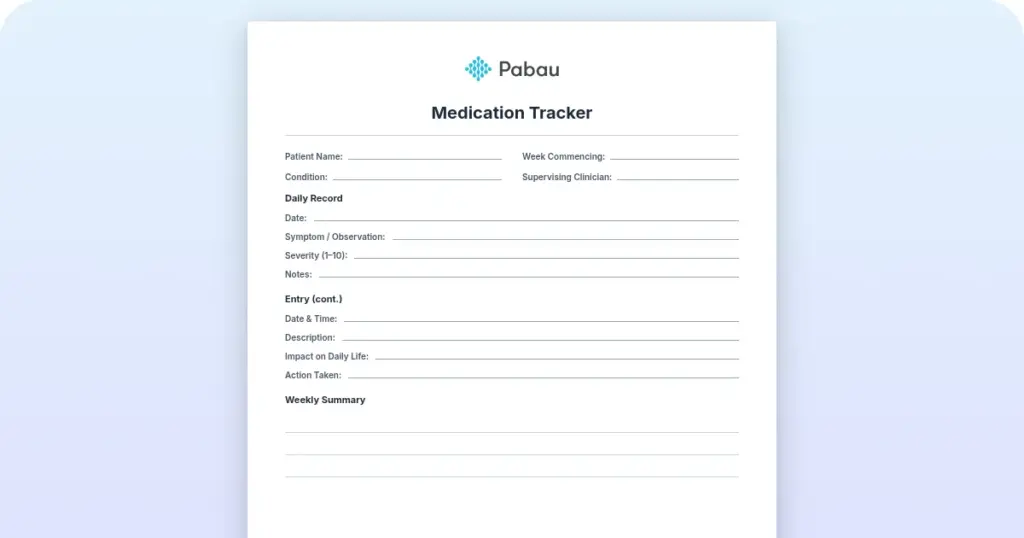
A ready-to-use tracking form covering patient details, medication names, dosages, frequency, time of day, prescriber information, and space for caregiver notes and side effects observations.
Download templateMedication errors happen when patients miss doses, forget timing, or fail to track over-the-counter drugs alongside prescriptions. A daily medication chart transforms this chaos into a simple, structured record that patients and caregivers can share with every healthcare provider.
This guide covers what a daily medication chart is, what to include on it, how to use it effectively, and why it matters for patient safety, plus a free printable PDF template you can download and use immediately.
A daily medication chart is a printed or digital form where patients or caregivers record every medication taken each day, from the moment it’s prescribed until the last dose in the evening. Unlike a medication list (which is static), a chart tracks when each dose was actually taken, creating a dynamic record of medication adherence and timing. Treatment photos attached to the note make the progression readable without hunting through a phone gallery.
The Agency for Healthcare Research and Quality (AHRQ) recommends that every patient keep both a medications list and a tracking chart. The list documents all drugs in use, while the chart documents when they were taken. Clinicians use this adherence data to adjust dosing, spot drug interactions, and understand why a treatment isn’t working.
For patient care management workflows, the chart acts as the single source of truth between appointments, especially for patients with multiple medications or complex dosing schedules.
A medication chart is only valuable if completed consistently. Here are five operational steps practices and patients should follow:
For client record management, digital charts can auto-populate with prescribed medications, cutting down on manual entry errors and keeping records current between visits.
Practices that digitize paper scales with software for capturing forms cut scoring errors and filing time.

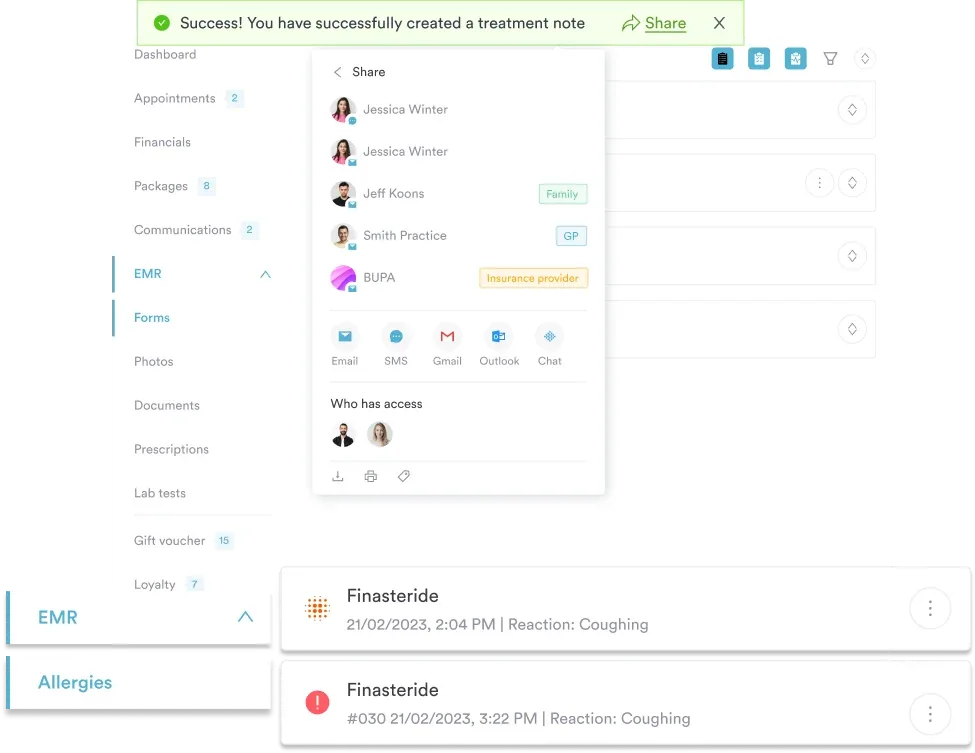
Pabau’s EMR keeps digital medication records and treatment notes in each patient’s file, so your team can track prescriptions without relying on paper charts.

Elderly patients and their caregivers: Older adults often take 5-10+ medications with complex dosing schedules. A daily chart prevents confusion about whether a dose was taken and helps adult children monitor parent compliance from a distance.
Mental health practices: A chart documents compliance and side effects, essential for treatment adjustment.
Primary care and therapy practices: Any practice prescribing multiple medications benefits from patient-generated adherence data during routine visits.
Patients with chronic conditions: Long-term regimens change often, and the chart shows which doses were taken between reviews. Someone managing rheumatoid arthritis can pair it with a rheumatoid arthritis medication list so the timing and the full drug record stay in step.
Prevents missed doses. A visible, marked chart shows exactly which doses have been taken and which are due, eliminating the cognitive burden of memory and reducing accidental double-dosing.
Identifies medication interactions. When clinicians see the complete medication list and adherence data on the chart, they can spot dangerous drug-drug interactions or duplicative therapies that a static list alone might miss.
Improves clinical decision-making. If a patient’s blood pressure isn’t controlled, the chart reveals whether the problem is non-adherence or inadequate dosing. That distinction changes the treatment plan. Recording the readings on a separate vital signs chart lets the prescriber compare adherence and response side by side.
Supports compliance documentation. For state health department surveys, accreditation bodies, or internal audits, the chart proves that the practice documented medication adherence and monitored for side effects, a legal and safety requirement.
Enables caregiver coordination. When multiple people (family, home care, practice staff) are involved in medication administration, the chart becomes the shared source of truth about what was given, when, and by whom.
The FDA recommends that patients bring their medication chart to every healthcare appointment, with the dentist, the eye doctor, the specialist, and the primary care practice. Why? Providers who don’t see the complete picture might prescribe a medication that conflicts with something the patient is already taking.
Include on your chart:
Antiplatelet drugs belong on the chart too, because a missed dose of aspirin or clopidogrel after a stent raises clot risk.
When reviewed with standardized healthcare forms during appointments, the chart allows clinicians to catch errors, adjust doses, and discontinue unnecessary medications. Every decision is grounded in real adherence data, not guesswork.
Set a daily alarm on your phone at the time you take your main medication. When the alarm goes off, take the dose and immediately mark it on the chart. This habit loop (alarm → medication → mark chart) ensures nothing is missed and the chart stays current.
A daily medication chart is the simplest tool a patient or caregiver can use to prevent medication errors and stay accountable to a complex regimen. Download the free template above and print it today.
Bring your completed chart to every appointment and share it with every provider you see. The data on that chart is yours. Use it to advocate for your health.

Tracking blood glucose or other lab values between visits? Sedimentation rate blood test template standardizes ESR documentation, interpretation guidance, and longitudinal monitoring.
Tracking blood values alongside medications? Anemia chart classifies anemia by MCV and layers WHO hemoglobin thresholds to guide diagnosis.
Ordering lab work during a medication review? Bilirubin blood test template streamlines ordering and interpreting total, direct, and indirect bilirubin levels.
A daily medication chart is a tracking form where patients and caregivers record the name, dose, time, and adherence for each medication taken each day. Unlike a static medication list, the chart shows real-time adherence and identifies missed doses.
Include medication name, dose, frequency, time of day, prescriber name, reason for taking, and a notes section for side effects or missed doses. Always include over-the-counter drugs and supplements too, since they can interact with prescriptions and must be documented.
Download the free printable template above, fill in each medication’s name and prescribed time in the rows or columns, and mark off each dose after it’s taken. Update it daily and bring it to every healthcare appointment.
Yes. The FDA recommends including all prescription drugs, over-the-counter medications, vitamins, and herbal supplements on any medication list or chart. Many OTC drugs interact with prescriptions and can cause serious side effects if not documented.
Yes. The template at the top of this page is printable, large-print friendly, and works for elderly patients and caregivers. Print multiple copies and fill in one per week, or laminate and use dry-erase markers for reusable charts.
Update the chart immediately after each dose is taken. Don’t wait until evening to fill it all in from memory. Accuracy is the point; real-time marking prevents errors and gives clinicians reliable adherence data at your next visit.