How to ask patients for reviews: Timing, channels and scripts
Knowing how to ask patients for reviews comes down to four habits. Ask every pat...

Last Updated: Oct 8, 2026

A patient portal is a secure online space where patients book, message, view results, and pay from any device, around the clock.
The wins split two ways: patients get 24/7 access and convenience, while your practice cuts calls, no-shows, and paperwork.
Portals improve access to records, communication, engagement, care coordination, and satisfaction, and can save around $89.73 per patient over three years.
Benefits only show up once patients log in, so promoting the portal matters as much as having one — nearly 40% of patients say their provider never offered them portal access.
Practice management software like Pabau builds the portal into scheduling, records, and payments, so everything a patient does flows straight into their record.
A patient portal gives your patients a secure online space to view their health information, book appointments, complete forms, pay bills, and message your team from any device, around the clock. For your practice, that translates into fewer phone calls, fewer no-shows, and far less paperwork.
A well-run client portal is one of the highest-leverage tools a healthcare practice can offer. Below are the seven benefits that matter most, split by what your patients gain and what your practice gains, plus the one step that decides whether any of it actually happens.
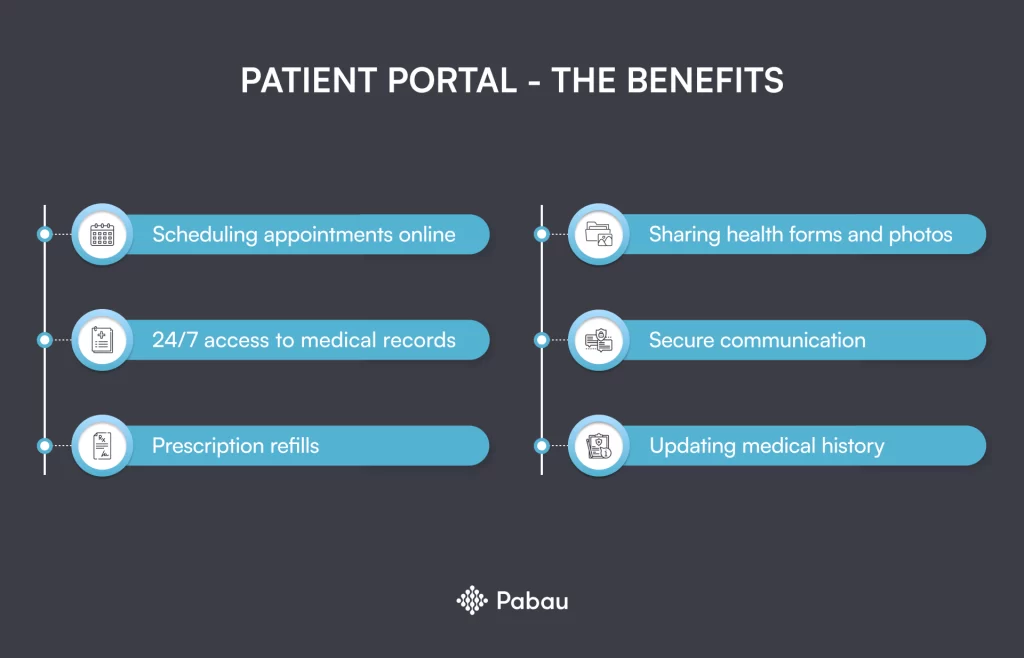
The benefits of a portal land on two sides at once: patients get self-service access on their schedule, and your practice gets back the time it used to spend on calls, forms, and reminders. Here is how the seven benefits break down.
| Benefit | What patients get | What your practice gets |
|---|---|---|
| Access to information | 24/7 view of results, history, and treatment plans | Fewer “can you resend my results?” calls |
| Communication | Secure messaging without waiting for office hours | Faster replies and an end to phone tag |
| Engagement | A clear view of their whole care journey | Fewer no-shows and better follow-through |
| Less admin | Forms and payments handled before arrival | Less manual data entry and invoicing |
| Care coordination | One place for every provider’s notes | Fewer duplicate tests and errors |
| Cost savings | No extra trips or phone calls | Around $89.73 saved per patient over three years |
| Satisfaction | Control and convenience | Higher retention and more referrals |
A patient portal is a secure website or app where patients manage their healthcare online, from viewing lab results and medical history to booking appointments, signing consent forms, and paying bills. Much like online banking, it puts a patient’s own information a few clicks away instead of behind a phone call.
So what are patient portals doing that a phone line cannot? They give patients direct, self-service access on their own schedule, whether they are booking with a GP practice or a medical spa. Whether your team calls it a client portal or simply “the patient portal,” the idea is the same: one secure place where patients see their records and handle routine tasks without needing your front desk.
A patient portal gives patients direct, 24/7 online access to their own health data, so they rarely need to call or visit just to check something. In just a few clicks they can view lab results, treatment plans, and up-to-date medical history, request prescription refills, complete consent forms, and book at their convenience.
This is the benefit patients use most. In 2022, 90% of people who accessed their records online did so to view test results, and 70% to read clinical notes, according to the Office of the National Coordinator for Health IT. Giving patients that access removes paperwork, cuts wait times, and makes the whole experience more convenient.
A portal lets patients reach your team without waiting for office hours, turning slow phone tag into secure, on-record messaging. Care teams can send follow-up instructions, photos, and payment updates, and patients can reply when it suits them.
That speeds up responses, especially around time-sensitive questions, and keeps every exchange tied to the patient record. Your team stops repeating the same information across calls, and nothing gets lost in a voicemail.
Patient portals and patient engagement go hand in hand: when patients can see and act on their care online, they stay more involved in it. The old model, phone calls and in-person visits, does not suit younger patients who avoid the phone or older patients for whom travel is a burden, and it falls apart entirely for remote care.
One of the clearest advantages of patient portals is that patients can book, reschedule, or cancel, read aftercare instructions, and view treatment notes and progress photos from any device. With their entire journey online, they engage more, which means fewer no-shows and smoother days for your practice.
Cutting paperwork is one of the biggest benefits of patient portals for your team. When patients update their own details, complete forms, and pay online, that work never lands on the front desk.
Forms completed in the portal ahead of an appointment are one less task on the day a patient arrives. Portals also automate scheduling, invoicing, and record updates, so your team stops issuing invoices by hand and gets time back to focus on care.
A portal gives every provider caring for a patient one shared, secure view, which is what good care coordination depends on. A lab technician can post blood test results, and the patient’s specialist can add a follow-up note based on them, all in the same place. Clinicians coordinating care for conditions such as the stages of psychosis rely on that same shared view to track a patient’s progress between specialists.
That transparency reduces duplicate testing and errors and keeps care moving. The catch is adoption: nearly 40% of patients say their provider never offered them portal access, so promoting it is the difference between a portal that coordinates care and one that sits unused.
Portals are a savvy financial move: one study found they can save practices roughly $89.73 per patient over three years. An automated, paperless setup trims staff overhead, invoicing paperwork, and physical record storage.
Patients save too. Checking results, requesting refills, paying bills, and getting reminders online removes the extra calls and trips that cost them time and money, which makes a portal strong value on both sides of the front desk.
Convenience is what drives satisfaction, and a portal is built around it. Patients access reminders, track treatments, and manage forms and payments whenever they want, without a single phone call.
Giving patients that control and security lifts satisfaction while cutting calls and in-person visits. It’s worth knowing how patient satisfaction differs from patient experience, since a portal tends to move both together. Patients who access their records online report feeling more in control of their care, which is why a 24/7 portal is one of the most impactful investments a practice can make.
To check whether that lift shows up in your own numbers, track a single recommendation score before and after your portal rollout. A rising score says patients value the access, while a flat one points back at promotion.
Every benefit above depends on one thing: patients logging in. A portal no one uses delivers none of the advantages of patient portals, and awareness is the first hurdle: nearly 40% of patients say their provider never offered them portal access.
Most practices piece a portal together from separate tools: one system for booking, another for forms, a card terminal that talks to nothing else. Practice management software like Pabau brings it into one place, so the portal is not a bolt-on but part of how the practice runs.
With Pabau’s client portal, patients book, reschedule, and cancel 24/7, complete medical forms and consent, view treatment plans and before-and-after photos (flagged for sensitivity), and pay, all online. Everything they do flows straight into their record, so your team is not re-keying data or chasing paperwork.
That is the difference between a portal that adds admin and one that removes it: when access, records, scheduling, and payments live together, patients self-serve and your front desk gets its day back.

Pabau builds the patient portal into scheduling, records, forms, and payments, so patients self-serve and everything they do updates their record automatically. Less phone tag, fewer no-shows, and a lighter admin load for your team.

Patient portals only deliver these benefits once patients actually use them. The practices that win treat promotion and easy sign-up as seriously as the technology itself.
Start with the two sides of the ledger. Give patients genuine 24/7 access to the tasks they care about, and let your team hand off the calls, forms, and reminders that eat the day. Do both and the portal pays for itself in time saved and patients retained.
Book a demo to see how Pabau builds the patient portal into scheduling, records, and payments so your practice runs lighter.

Choosing portal software? Patient portal software: what to look for breaks down the features that actually move the needle for a practice.
Cutting down on scheduling calls? Patient self scheduling software reviews nine tools that let patients book without tying up front-desk staff.
Need a form to collect booking details? Patient booking form covers patient details, appointment preferences, and health history, ready to adapt to your practice.
Measuring how patients feel? Measuring patient satisfaction explains which signals to track and how to act on them.
A patient portal is a secure online area where patients access their health information and manage their care from any device, 24/7. Much like online banking, it lets them view lab results, treatment plans, and medical history, book or reschedule appointments, complete consent forms, pay bills, and message their care team, all without calling the practice or making an unnecessary visit.
Portals improve access to medical information, strengthen patient-provider communication, and boost engagement, while cutting administrative work and costs. Patients self-serve, booking, completing forms, and viewing results on their own time, which reduces phone calls and no-shows. For the practice, that means smoother days, better care coordination, and higher satisfaction, since people who access their records online tend to feel more in control of their care.
Yes, cutting admin is one of the biggest benefits. When patients complete forms in the portal ahead of an appointment, that’s one less task on the day they arrive. Portals also automate scheduling, invoicing, and keeping records up to date, so staff aren’t issuing invoices or chasing paperwork by hand. That frees your team to focus on care instead of documentation.
Start by promoting it. The article notes that nearly 40% of patients say their provider never offered them portal access, so awareness is the first hurdle. Make signup easy and highlight what they can do, from booking to viewing results. Practice management software like Pabau includes a robust patient portal where clients self-manage their whole journey, from lab results to payments and before-and-after photos.