Anticoagulant medication list
An anticoagulant medication list is a clinical reference that groups blood thinn...

2
Last Updated: Oct 5, 2026

The template on this page is a sexology initial consultation note, written for first assessments in sexual health, men’s health, and andrology.
It runs from presenting sexual symptoms through medical, drug, fertility, and relationship history to impression, diagnosis, and next action.
Three validated scores have their own prompts: the AMS scale, the Epworth Sleepiness Scale, and the IIEF-15.
The note has no demographics header, no consent declaration, and no signature block, so pair it with your own registration and consent forms.
Building the note into practice management software like Pabau sends it out before the appointment and files answers into the patient record.
A one-page clinical note for first sexual health assessments. It covers presenting symptoms, medical and drug history, fertility, sex and relationships, AMS, ESS and IIEF-15 prompts, measurements, impression, and next actions.
Download templateThe initial consultation note you can download above is specialty-specific. It is a sexology consultation form, built for the first appointment in a sexual health, men’s health, or andrology practice. Every prompt on it does the same job. It gets a full sexual, hormonal, and fertility picture down on paper in one sitting.
That focus is also its limit. The note starts at the date and goes straight into presenting issues, so it assumes your registration and consent paperwork is already done. If you need a general aesthetic intake instead, use our med spa consultation form.
A sexology initial consultation note is the clinical record of a patient’s first sexual health assessment. It documents the presenting sexual symptoms and the medical and drug history behind them. It also holds relationship and fertility context, validated symptom scores, and the clinician’s impression and plan.
It differs from a general intake form in two ways. First, the history it asks for is hormonal and sexual rather than procedural. Second, it builds in scoring instruments, so a subjective complaint leaves the room as a number you can compare later.
The prompts suit any clinician who assesses sexual function, male hormones, or fertility. In practice that means sexual health practices and men’s health services, with andrology and fertility teams close behind. Men’s health clinic software keeps results, prescriptions and review appointments against one patient record.
Aesthetic injectors, dermatologists, and talking therapists will find little of use here. Their intake needs demographics, contraindication screening, and treatment consent, and none of those sit on this form.
The template moves in one direction, from symptom to history to score to plan. Here is every section on it, in the order you will meet it.
Two labels are worth translating before you hand the form to a colleague. TD related medications means anything the patient takes for testosterone deficiency, including gels, injections, and HCG. HCG stands for human chorionic gonadotropin, which is often considered where fertility matters.
Four things you might expect on an intake form are absent by design, and each one needs a document of its own.
That keeps it a clinical note rather than a full intake pack. Slot it into the wider set of medical forms your practice already runs, and it works best as the second document a new patient touches.
Which consent document you pair it with depends on the treatment. A practice offering PRP penile injections needs a P-Shot consent form, which screens for active genital infection, clotting disorders and recent anticoagulation before booking.
The three score lines are the reason to use this note over a plain history sheet. Each one is a published questionnaire the patient completes. The form only asks you to record the total.
Follow your own protocol for the cutoffs you act on, and write the version you used next to the number. A score with no scale named is hard to interpret a year later. It is harder still for a colleague picking up the case.
Sexual health histories are easy to record unevenly. One clinician asks about fertility plans and another does not, so the second visit starts from a weaker position than the first.
Work down the form in order. It is sequenced so the sensitive questions arrive after the routine medical ones.
Write the diagnosis in a form you can code later. Testicular dysfunction with no cause established often codes to E29.9, which saves a second read of the note at billing.
These questions fill the free text sections of the form without turning the appointment into an interrogation. Each one maps to a field on the note.
Use this checklist around the note so nothing is missed before, during, or after the appointment.
A printed sexology note has to be carried, filed, and found again. Sensitive answers sit in a cabinet, and last year’s AMS or IIEF-15 total is only comparable if someone digs the paper out.
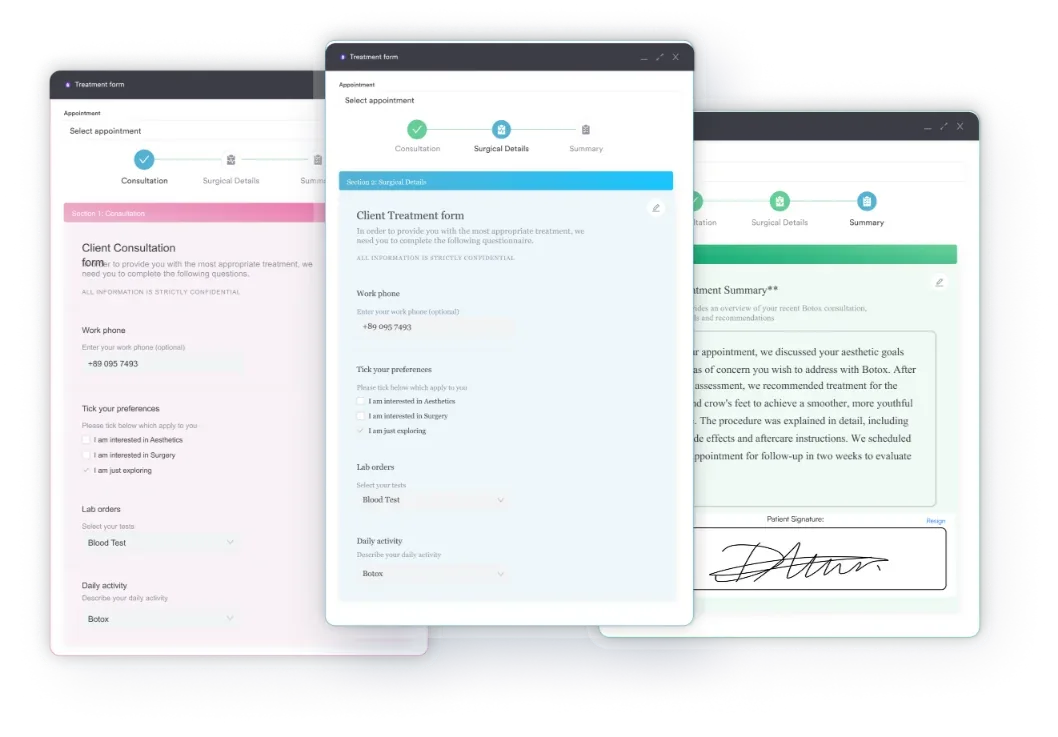
Practice management software like Pabau lets you rebuild this note as a digital consultation form. Conditional logic hides the fertility and HCG questions unless they apply, so the patient only sees what is relevant to them.
The form goes out by email or SMS ahead of the appointment, and the answers land in the patient’s record before they arrive. Because the score fields are structured, you can pull last visit’s AMS or IIEF-15 total onto the screen next to today’s.
Consent forms sit alongside the note in the same patient record, so the paper version’s split filing disappears.
Every completion and edit is timestamped and attributed. That gives you an audit trail for a sensitive record. A clinician covering the case can see exactly what was asked, and when.

Pabau turns your sexology consultation note into a digital form that patients complete before arrival. Scores, history, and consent are filed in one patient record. Your team spends the appointment assessing instead of transcribing.

Download the note, read it against your own pathway, and decide what you need to bolt on. For most practices that means a registration record in front of it and a consent form beside it. In exchange you get a first appointment that ends with a number, a diagnosis, and a decision.
The scores are the part worth protecting. Record them at baseline and repeat them at review. The second visit then opens with evidence rather than recall, so you can see whether the treatment helped. Book a demo to see how Pabau collects consultation notes, scores, and consent in one patient record.

Need a scored measure of sexual orientation? The Kinsey scale template shows how the scale is scored and where it fits in a sexual history.
Training staff on hormone disorders? Our endocrinology quiz tests staff knowledge of hormone and thyroid disorders with a complete answer key.
Checking hormones alongside symptoms? The male estrogen levels template gives you reference ranges to read next to a testosterone result.
Need the examination detail? Our guide to the cremasteric reflex covers how to elicit it and what an absent response means.
Offering the O-Shot procedure? The O-Shot Consent Template documents informed consent for PRP treatment that supports intimate health in women.
It is a sexology initial consultation note. It records presenting sexual symptoms, medical and drug history, testosterone deficiency medications, allergies, and surgical and family history. It then covers mental health, sex and relationships, fertility, AMS, ESS and IIEF-15 scores, measurements, and blood results. It closes with impression, diagnosis, and next actions.
No. The note has no consent declaration, no privacy notice, and no signature block, and it has no patient demographics header either. Pair it with your own registration record and a separate consent form, and keep both filed against the same patient.
They are three validated questionnaires the patient completes. The Aging Males’ Symptoms scale measures symptoms linked to low testosterone. The Epworth Sleepiness Scale measures daytime sleepiness. The International Index of Erectile Function measures erectile and sexual function. The form asks you to record each total.
Plan for 45 to 60 minutes. A first sexual health assessment covers hormonal, psychological, and relationship history alongside examination and scoring, so it runs longer than a routine appointment. Sending the history and questionnaires out beforehand is the most reliable way to keep it inside the hour.
Not without heavy editing. The prompts are hormonal and sexual, and the form has no demographics, consent, or contraindication screening. For aesthetic intake, start from our med spa consultation form template instead and keep this note for sexual health assessments.
Yes, when the platform keeps an audit trail, encrypts the data, and controls who can open the record. Digital notes and e-signatures are accepted under GDPR and HIPAA. A timestamped entry is usually easier to defend than a scanned paper page.