Journal prompts for mental health
Journal prompts for mental health are guided questions that help people process ...

2
Last Updated: Oct 13, 2026

Body dysmorphia questionnaire (BDDQ) is a validated 8-item screening tool developed by Dr Katharine Phillips that identifies suspected BDD in clinical settings within minutes.
A positive BDDQ screen requires follow-up diagnostic assessment; the questionnaire is a screening instrument, not a diagnostic tool, and should not be used alone to diagnose BDD.
Mental health clinicians and aesthetic practitioners should screen pre-procedure or pre-treatment to identify patients who may benefit from mental health support before pursuing appearance-focused interventions.
Pabau’s digital intake forms and automated workflows help embed BDD screening into consultation workflows, ensuring systematic assessment and documented screening records.
A comprehensive psychological assessment tool designed to evaluate symptoms and behaviors associated with body dysmorphic disorder (BDD). This questionnaire helps healthcare professionals systematically assess patients’ perceptions of their physical appearance, related distress levels, and impact on daily functioning to guide appropriate treatment planning.
Download templateThe body dysmorphia questionnaire (BDDQ) is a brief, evidence-based screening tool for identifying patients who may have body dysmorphic disorder. Developed by Dr Katharine Phillips at Brown University, the BDDQ has become the gold standard for rapid assessment in mental health, dermatology, and aesthetic practice settings across the US and UK. Injectors screening with the BDDQ will find charting and HIPAA compliance covered in our roundup of the top med spa software.
This guide explains how to administer, score, and interpret the questionnaire, plus how to integrate it into your practice’s intake workflow.
Body dysmorphic disorder is a mental health condition characterized by a preoccupation with perceived or slight flaws in physical appearance that are not observable or appear slight to others. The preoccupation is accompanied by repetitive behaviors (mirror checking, excessive grooming, reassurance seeking) or mental acts (comparing appearance to others, rumination) that cause significant distress and interfere with daily functioning. A psychology practice running several assessments needs them scored and stored the same way each time.
BDD affects an estimated 1-2% of the general population, with higher prevalence among patients seeking cosmetic procedures. Individuals with untreated BDD experience high rates of social isolation, occupational impairment, depression, and suicidality-making early identification and appropriate referral a critical component of ethical aesthetic and mental health practice.
The disorder is classified in DSM-5 as an obsessive-compulsive and related disorder, meaning it shares features with OCD and other conditions characterized by intrusive thoughts and compulsive responses. Understanding BDD’s clinical presentation helps practitioners distinguish it from normal appearance concerns, low self-esteem. A structured mental health assessment framework is essential for accurate differentiation.
BDD manifests across cognitive, behavioral, and functional domains. Clinicians should watch for the following cardinal symptoms when screening new patients:
In aesthetic surgery contexts, BDD symptoms are a red flag indicating the patient may not benefit from the procedure and may experience worse distress post-procedure. Early identification prevents harm and enables appropriate mental health referral.
Multiple validated instruments exist for BDD assessment, each serving a distinct clinical purpose. The table below summarizes the main tools used in research and practice:
The BDDQ is the starting point for most practitioners. It is brief, self-administered, and has demonstrated good sensitivity and specificity as a screening tool. Patients scoring positive on the BDDQ should be referred for a full diagnostic interview with a mental health clinician. That interview can surface other mental status findings, including thought blocking, a distinct disruption in the flow of speech.
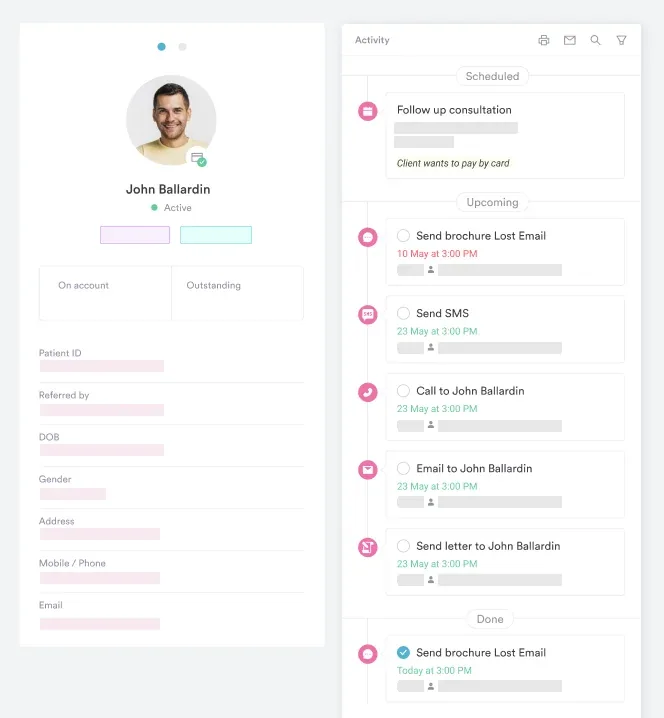
Teams using software to manage patient records can pull up prior scores before every reassessment.
Once BDD is diagnosed, the BDD-YBOCS (Yale-Brown Obsessive Compulsive Scale Modified for BDD) quantifies symptom severity and tracks treatment response. Unlike the BDDQ, the BDD-YBOCS is clinician-administered and measures the intensity and time spent on BDD obsessions and compulsions across 12 items.
The BDD-YBOCS is scored on a 0-48 scale with four severity bands: Mild (below 24), moderate (24-29), severe (30-36), and extreme (37-48). These are the empirically validated 2025 cutoffs from Mataix-Cols and colleagues — co-authored by Katharine Phillips, drawing on 804 patients across 11 datasets — replacing the long-established bands used previously.
Clinicians administer this tool at baseline and then periodically during treatment to monitor progress and adjust intervention intensity as needed.
Aesthetic and cosmetic practitioners should screen all new patients for BDD pre-procedure. Research indicates 7-15% of cosmetic surgery candidates screen positive for BDD, and literature consistently shows that untreated BDD patients have poor surgical outcomes and higher dissatisfaction rates.
The BDDQ-AS (Aesthetic Surgery version) is a distinct, separately validated 7-item instrument for this setting — not simply an adapted BDDQ. A positive screen warrants a compassionate conversation: Acknowledge the patient’s appearance concerns, explain that BDD is a treatable psychiatric condition unrelated to actual appearance, and recommend mental health referral before proceeding with elective procedures.
This protects both patient welfare and clinical liability.
A positive BDDQ result initiates a structured referral pathway. First, communicate results to the patient with sensitivity and psychoeducation-many patients feel shame or fear around the BDD label. Explain that BDD is a recognized mental health condition with evidence-based treatments (cognitive behavioral therapy, selective serotonin reuptake inhibitors, or both).
Second, document the screen, score, and referral recommendation in the patient’s chart. Third, provide warm handoff to a mental health clinician-either via direct referral letter, contact information for local therapists.
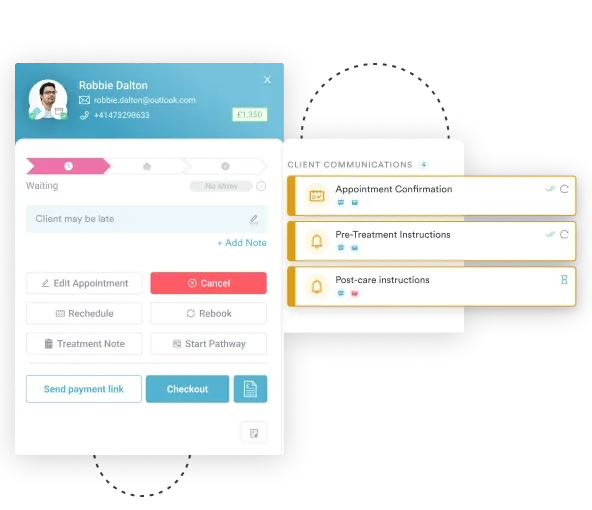
Pabau’s practice management platform lets you embed the body dysmorphia questionnaire directly into your practice’s intake workflow. Digital intake forms can be customized to embed the BDDQ, with auto-scoring that flags positive screens and generates summary notes for your clinician dashboard. Once administered, results are stored in structured patient records alongside clinical history, treatment plans, and referral notes.
For aesthetic practices. Post-positive-screen.
This systematic approach reduces clinician time, ensures consistency, and improves patient safety and satisfaction.
Administering the BDDQ and storing a patient’s responses means you’re handling protected health information (PHI). If your practice is HIPAA-covered in the US, or handles patient data under GDPR in the UK/EU, make sure your intake form, storage, and access controls meet the applicable standards.
Screening responses, severity ratings, and any referral notes become part of the patient’s medical record and are subject to your usual record-retention policy.
Because BDD screening touches directly on mental health status and, in aesthetic settings, procedure eligibility, treat positive screens with the same confidentiality safeguards as any other behavioral health finding.
Restrict access to the relevant clinical staff, and keep the open-text responses to question 3 (what specifically bothers the patient about their appearance) inside the secure record rather than in loose notes or intake paperwork that isn’t filed.
If a full diagnostic interview confirms the condition, code the diagnosis using ICD-10 F45.22 (body dysmorphic disorder) in the patient’s chart.
The BDDQ screen itself isn’t billed under a dedicated code, but documenting the screening date, the responses against each of the eight items, and any referral against the encounter supports continuity of care and protects your practice if a screening decision is ever reviewed.
Structured patient records keep the screen, the severity ratings, and the referral outcome in one auditable file, rather than scattered across paper forms.
The body dysmorphia questionnaire is a brief, validated tool that improves patient safety and care quality across mental health, dermatology, and aesthetic practice settings. Early identification of BDD enables timely referral to mental health specialists and prevents unnecessary procedures that may worsen symptoms for patients with this condition.
Remember that a positive screen is a compound result — concern, preoccupation, and either at least moderate severity or functional interference — not a simple count of “yes” answers.
By embedding the BDDQ into your practice’s intake workflow, scoring it correctly, and pairing it with a documented referral pathway, you create a systematic, compassionate approach to BDD screening that benefits every patient while reducing clinician workload.
A few related templates and resources worth pairing with BDD screening in your workflow:

Want a comprehensive mental health intake tool? Biopsychosocial assessment template provides a comprehensive framework for mental health intake that can be paired with the BDDQ for full BDD diagnostic workup.
Need to document consent for group sessions? Group therapy informed consent explains what to include, covering confidentiality limits, rules, and boundaries.
Curious about other personality assessments? Jungian personality test scores a 10-statement self-report using Carl Jung’s four personality dichotomies.
A screening tool (like the BDDQ) rapidly identifies patients who may have BDD based on a few key questions; a positive screen suggests BDD but does not confirm it. Diagnostic assessment involves a full clinical interview by a mental health professional using DSM-5 criteria to establish formal diagnosis. Screening is fast and suitable for primary care or intake settings; diagnosis is thorough and required before initiating treatment.
The BDDQ is not scored by counting “yes” answers — two of its eight items are numbered severity ratings (1-5), not yes/no responses. A positive screen requires yes to appearance concern (question 1), yes to preoccupation (question 2), and either at least moderate-or-worse distress or impairment on the severity rating in question 4 or 5, or yes to significant interference in question 6 or 7. All three conditions must be met together.
The BDDQ can be self-administered (e.g. via digital form) or clinician-read; both formats show similar sensitivity and specificity. Self-administered digital forms are common in routine care settings because they are efficient and reduce clinician burden. However, clinicians should follow up on positive screens with a face-to-face conversation to provide psychoeducation and referral coordination.
The BDDQ is designed as a screening tool, not a progress-tracking tool. For treatment monitoring, use the BDD-YBOCS severity scale instead. However, repeating the BDDQ at intervals can indicate whether BDD symptoms have improved enough that the patient no longer meets screening threshold-a useful indicator of treatment response to discuss with the patient’s mental health provider.
Do not proceed with the cosmetic procedure. Instead, explain respectfully that BDD is a recognized psychiatric condition, not a true cosmetic defect, and that elective procedures often worsen BDD symptoms. Provide the patient with a referral to a mental health clinician who specializes in BDD. Many patients respond well to CBT and medication; after treatment, some choose to revisit cosmetic goals with clearer perspective.
The International OCD Foundation’s BDD Center and Body Dysmorphic Disorder Foundation offer free professional resources, webinars, and assessment tool downloads. The PubMed database contains peer-reviewed literature on BDD screening and treatment outcomes that can guide your practice protocols.