Massage Gift Card Template
A massage gift card template is a fill-in-the-blank certificate you customize wi...

22
Last Updated: Sep 11, 2026

A client consultation happens before treatment, never after it, because that is when screening and consent still count.
Cover goals, motivations, medical history, previous treatments, skin assessment, documentation, treatment planning, and budget.
A review of 817 cosmetic surgery patients found that the nine missed cases of body dysmorphic disorder all had a bad surgical outcome.
Document as you go, with timestamped photos, the risks you discussed, and the client’s own words.
Talk about total cost and payment options during the consultation, not at the front desk afterwards.
A consultation in medi-aesthetics is where you establish whether the treatment, the practitioner, and the client are a genuine match. Once the answer is yes, the booking and charting tools compared in our guide to software for med spas take over.
The consultation always comes first, before any treatment. It is where you screen for contraindications, set expectations you can meet, and decide whether to say no.
Handled well, that conversation is also your best defense when a client is unhappy months later. Your notes, photos, and consent record are the evidence.
One appointment does seven jobs before any treatment begins. It is the one point in the journey where you can still change course, before anything irreversible happens.
Those jobs are:
False. The consultation happens before treatment, never after it.
The claim that a client consultation happens after a service is performed turns up in cosmetology and esthetics exam prep. It has the sequence backwards.
Everything a consultation does only works beforehand: screening for contraindications, taking informed consent, and confirming the client is suitable. Consent signed after a treatment is not consent. A contraindication found after a treatment is a complication.
What does belong after the service is the follow-up. That means aftercare, a check-in, and notes on how the client responded.
If your booking page lets a new client book a treatment directly, the sequence depends on goodwill. Practice management software like Pabau can enforce it instead, so a treatment slot stays locked until the consultation is done.
A consultation is a structured conversation with three jobs: build the relationship, gather the clinical picture, and decide whether to treat.
It is also the client’s opportunity to assess whether they trust you with the work. They are deciding whether to trust you with their face, so let them ask everything.
Get all three right and the treatment proceeds on a shared understanding — which is what most complaints reveal was missing.
The med spa consultation tips below run in the order the appointment itself takes, from the first question to the payment conversation.
Work through all nine and you finish with both the clinical picture and the paper trail.
During the consultation, ask what the client wants and record it in their own words.
Vague goals produce vague results. “I want to look less tired” needs turning into something you can treat, like tear-trough hollowing or brow descent.
A consultation that lands is what turns an inquiry into a booked treatment.
Ask why now. The answer tells you more about risk than the medical form does.
A client booking six weeks before a wedding needs a different plan from one chasing a filtered photo of themselves.
Social media, filters, and celebrity culture have shifted what people read as normal. Part of your job is noticing when the goal itself is the problem.
Ask what worries them, then answer it plainly, including the answers that might cost you the booking.
A client who leaves with an unspoken concern either cancels, or arrives anxious in a way that affects the treatment. Neither outcome serves them.
Write the concern into the record. If a complication appears later, you can show that it was discussed.
Take a full medical history before you discuss any treatment, not after they have chosen one.
Conditions, medications, supplements, allergies, and previous reactions all change what is safe to offer.
Certain metabolic and inflammatory conditions can affect healing and increase complication risk. All relevant history belongs in the notes before any treatment is discussed.
Autoimmune conditions, active skin infection, pregnancy, and anticoagulants all belong on the form, not in a corridor conversation.
Record what they have had done, when, where, and who did it.
Filler placed 18 months ago changes how you assess volume today, and clients rarely volunteer it unprompted.
Treatment abroad matters here too. If it did not go to plan, you are being asked to correct someone else’s work.
Assess the skin in person, in good light, and record what you see.
Medical history plus visible concerns, such as acne, rosacea, or dryness, decide which treatment is appropriate.
The Fitzpatrick scale for skin color and tanning response belongs in the notes. It guides laser and peel settings, and it protects you if pigmentation changes later.
Document as you go, not from memory at the end of the day.
Timestamped before photos, shot in consistent lighting and at consistent angles, are the most useful thing in the file.
They let you show progress at review, and they are typically the first thing that resolves a complaint before it escalates.
Pabau keeps the questionnaire, the consent form, and the photos on one client record. That way the evidence sits together when you need it.
Present the options, including the option of doing nothing.
Match each option to their medical suitability, the indications and contraindications, and their own preference.
Say what each choice can deliver and what it cannot, then let them choose. A client who chooses is a client who commits.
Put the money conversation inside the consultation, not at the front desk afterwards.
Give the full cost of the plan, including the number of sessions and any maintenance, before they agree to anything.
A client who discovers at checkout that the result needs three visits feels sold to rather than treated.
Where you offer payment plans or finance, say so here, and say what it costs. Where the full plan is out of reach, offer a staged version rather than a discount that undermines your pricing.
Quote prices with tax in mind — our guide des taxes pour les salons et spas explains US salon and spa tax rules in French.
Budget also decides what is realistic, so it belongs with expectation-setting rather than after it.
Here is what a defensible consultation record contains, and the mistake that usually undermines each entry.
Good questions are how you learn what a client wants and what they expect to see afterwards.
The first consultation runs in both directions. You are assessing them, and they are assessing you. It is also their chance to size up you, your practice, and the way you answer awkward questions.
Here are the questions worth asking every time:
Budget belongs in the same conversation. Covering it here prevents a plan collapsing at the payment stage.
After each consultation, the follow-through matters as much as the conversation itself.
Compliance in medical aesthetics rests on three things: full disclosure, client education, and duty of care.
The same screening discipline applies to wellness services — our clinical guide to holotropic breathwork shows contraindication screening in practice.
Shelly Hemmings is a cosmetic insurance handler at Hamilton Fraser, with 15 years in insurance and five of them in aesthetics.
She joined us for a webinar on consultations. These were her two points from a compliance perspective:
“It’s important to ensure that your potential patient is right for that treatment. If there are any indications during the consultation process that suggest that the patient isn’t suitable, that’s a simple conversation. You say you don’t feel that you are the right practitioner for them. Because you don’t feel that you can reach that desired expectation.”
Shelly Hemmings, cosmetic insurance handler, Hamilton Fraser
“We would recommend documenting the consultation so that there is evidence that a conversation like this has taken place, alongside time stamped photographs. You can do that using software, so you know they’re already embedded within the patient record.”
Shelly Hemmings, cosmetic insurance handler, Hamilton Fraser
The most useful measure is what the consultation prevents: unsuitable clients treated, complications, and revision work.
Robust data on consultation effectiveness in aesthetic settings is limited, but the screening evidence is strong.
A 2017 meta-analysis of 33 studies found body dysmorphic disorder in 15.04% of plastic surgery patients. Among dermatology patients the figure was 12.65%.
Epidemiological studies put general-population prevalence between 0.7% and 2.4%. The people sitting in your consultation room are a higher-risk group than the street outside.
A review of 817 cosmetic surgery patients found 63 with body dysmorphic disorder. Preoperative evaluation identified 54 of them.
The nine cases it missed all had a bad outcome after surgery. That is the consultation’s measurable contribution to patient safety, and screening is the mechanism.
Three figures are worth tracking in your own practice:
A high conversion rate alongside a zero decline rate means your consultation has quietly become a sales call.
Everything above is process. Whether that process holds under daily clinical pressure depends on where it lives.
Pabau is an all-in-one practice management system built around med spa workflows, and these are the pieces that carry a consultation.
Clients book their own consultation through online booking, at any hour, without a phone call.
That means fewer voicemails for your front desk and fewer inquiries lost overnight.
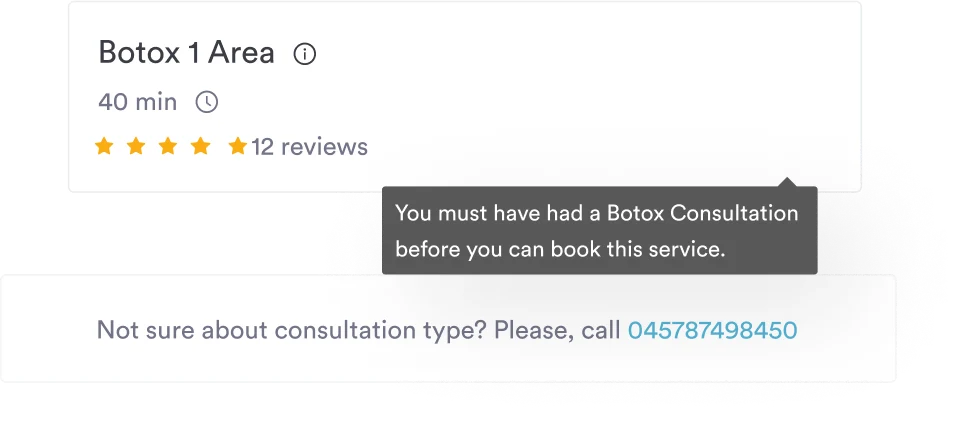
You can set your booking rules so that new clients can only book a consultation.
Treatment slots stay closed to them until that consultation has happened.
It is the difference between meeting someone for the first time at a consultation and meeting them with a needle in your hand.
Some consultations do not need the client in the room.
Pabau runs secure video consultations, with the client’s full history on screen during the call.
That suits triage, review appointments, and clients who live two hours away.
Consultations get forgotten like any other appointment.
Automated SMS and email reminders cut consultation no-shows without anyone chasing by phone.
Send a consultation form the client completes before they arrive.
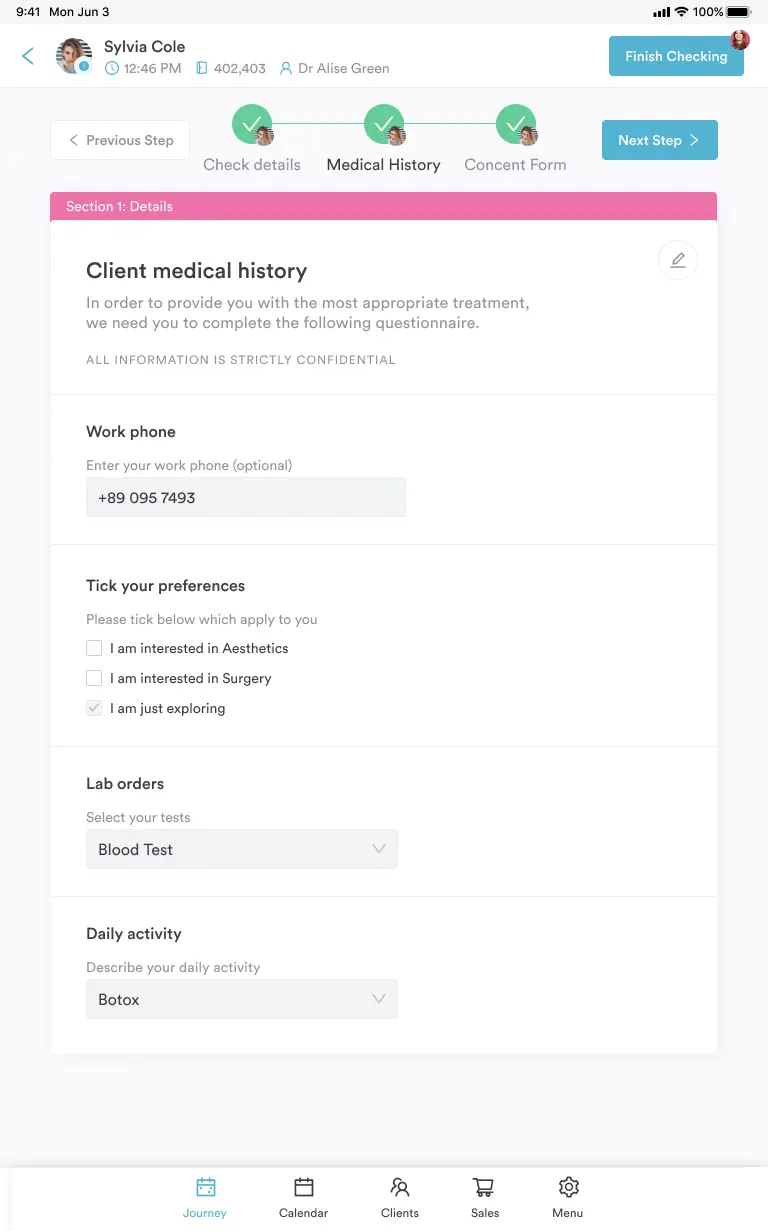
Medical questionnaires, consent forms, and pre- and aftercare instructions can all be tied to the specific service booked.
Everything they complete lands on their record, so nothing needs retyping.
Consultation notes belong in the client record, not in a notebook.
Keeping them in the client’s EMR means the next practitioner can see what was agreed and why.
Consultation records hold sensitive data, so HIPAA and GDPR both apply.
Pabau limits access to authorized staff and keeps a trail of who opened which record, which matters most in a multi-practitioner practice.
Cost questions come up in every consultation, so answer them in writing.
You can build a quote from the treatment plan, customize the template, and send it before the client leaves.
Pabau tracks when a quote was sent, opened, and accepted, so follow-up is targeted rather than hopeful.

Pabau keeps the medical history, consent, photos, notes, and quote for every consultation on one client record. So the evidence is there the day a client questions an outcome.

The consultation is the only part of the visit where you can still say no. That makes it the clinical gate, whatever it looks like on the schedule.
The trade-off is time. A consultation done properly costs you a slot you could have sold, and it will occasionally cost you the booking too.
That is still the cheapest insurance in aesthetics. The alternative is a complaint you cannot evidence.
Standardize the questions, document as you go, and let one system hold the record. Book a demo to see how Pabau runs consultations end to end for med spas and medi-aesthetics practices.

Want clients coming back after their consult? Med spa membership packages shares 3 ideas for turning first-time clients into recurring revenue.
Running injectable consultations? Botox consultation guide walks through assessment, the dosing conversation, and consent.
Consultations not turning into treatments? Converting consultations covers what to change in the conversation itself.
Need a structure for the notes? Aesthetic consultation notes shows what to record and how to lay it out.
Building a med spa intake pack? Med spa consultation form explains what to include and why each field earns its place.
Consultations let you assess suitability, review medical history, and identify contraindications before treatment. They are also where you set expectations the treatment can meet. And they build the rapport that makes a client tell you the truth, so both sides know it is a good match.
Assess four things: the client’s medical history and medications, their previous treatments, their goals and expectations, and their suitability for the treatment they want. Allergies and contraindications belong in the same pass. That combination is what lets you tailor the plan safely.
They give you time to compare what the client is imagining with what the treatment can deliver. Saying that out loud, before anything is booked, prevents disappointment at review. It also makes the client confident in the plan they agreed to.
Build a connection strong enough that the client is honest with you. Collect their medical history and previous treatments. Assess whether they are suitable, then explore the options with them, including the option of not treating. Done well, all four also demonstrate your standards of care.
Practices differ. Some offer a free consultation to remove a barrier to booking; others charge a fee, often credited toward treatment if the client goes ahead. A paid consultation filters for people who are serious, and it values the practitioner’s time on a service that already includes assessment, documentation, and consent. Whichever you choose, state the policy upfront so no one is surprised at the desk.