Despina Petrushevska
Nursing care plan for aggressive behavior
A nursing care plan for aggressive behavior is a structured clinical document fo...

2
Last Updated: Oct 26, 2026
Free PDF 2 pages, print-ready Clinician-reviewed
Screening for trauma history is a cornerstone of mental health practice management, yet many clinicians lack a structured template to guide patient interviews. A trauma questionnaire template standardizes how trauma exposure information is collected and ensures consistency across your practice. It also helps clinicians identify PTSD symptoms early, so they can plan appropriate treatment interventions.
This guide covers what a trauma questionnaire template is and how to use validated instruments like the Trauma History Questionnaire (THQ) and Brief Trauma Questionnaire (BTQ) in your clinical workflow. It also explains how digital trauma intake forms in practice management software like Pabau can streamline patient intake while maintaining confidentiality and compliance.
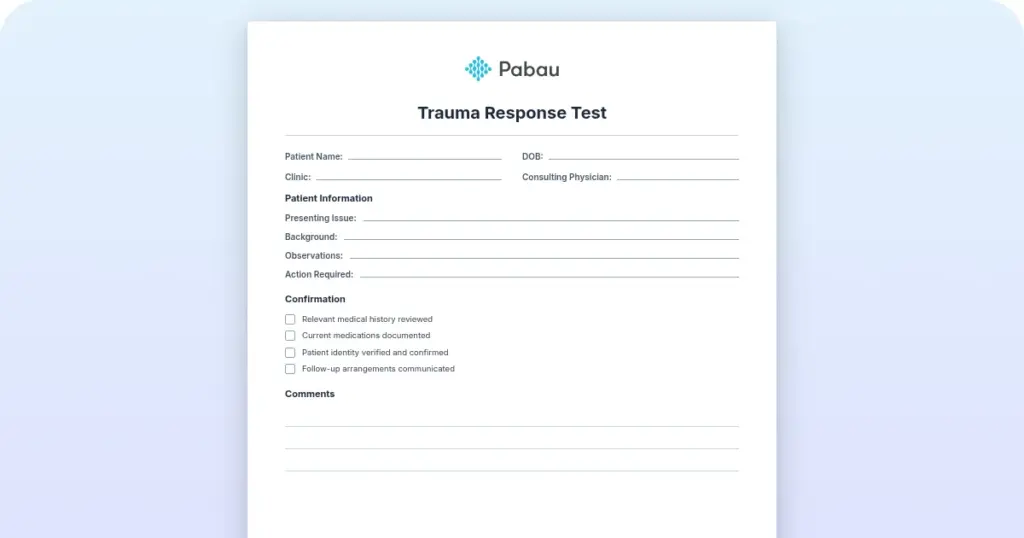
A free, printable trauma questionnaire template for systematically evaluating patient trauma history, PTSD symptoms, and adverse childhood experiences during intake and clinical assessment in mental health, therapy, and private practice settings.
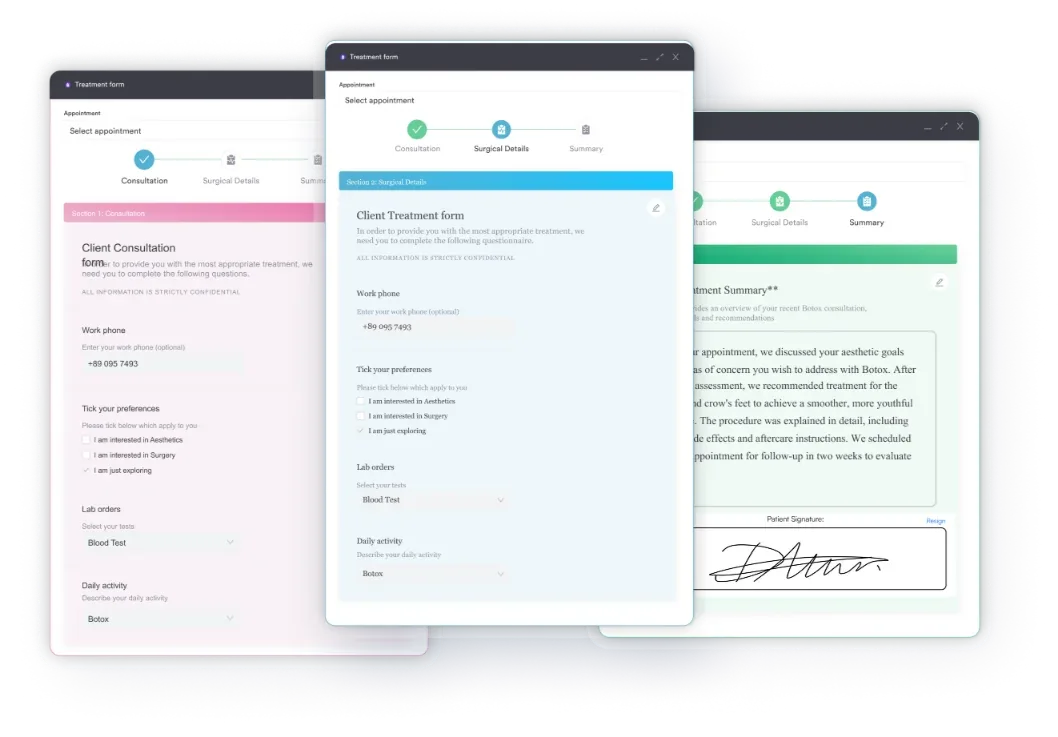
Upload this PDF, or any form you already use, and Pabau's AI Form rebuilds it with tick boxes, text fields and a signature. Attach it to the treatment once, and every patient gets it on time.
AI Form rebuilds the consent, history and aftercare forms you already use. You review each one, then publish.
Patients complete forms on their phone before they arrive, so the front desk stops retyping paper.
Every signed form is versioned and attached to the treatment record, ready when you need it.
Set how long a consent stays valid. Returning patients skip forms they have already signed.
Supports HIPAA and GDPR compliance AES-256 encryption 4.8 on G2 4.7 on Capterra Trusted by 4,000+ practices worldwide

A trauma questionnaire template is a screening tool, not a diagnostic instrument. It helps clinicians systematically collect and document patients’ trauma histories.
Validated instruments like the Trauma History Questionnaire (THQ), Brief Trauma Questionnaire (BTQ), and Trauma Screening Questionnaire (TSQ) are evidence-based tools for adult trauma assessment, with the BTQ built around Criterion A trauma exposure (life threat or serious injury).
Digital trauma questionnaire templates administered through patient portals reduce intake burden, improve data quality, and ensure trauma disclosures are securely stored with full HIPAA compliance.
Pabau, our practice management software, enables clinicians to deliver customized trauma questionnaires through the patient portal, automatically link responses to clinical records, and generate structured trauma histories in real time.
A trauma questionnaire template is a screening instrument designed to help clinicians systematically assess a patient’s exposure to potentially traumatic events and the resulting psychological symptoms. A trauma questionnaire template is a screening tool, not a diagnostic instrument.
Screening tools identify whether a client warrants a full diagnostic assessment for post-traumatic stress disorder (PTSD) or complex trauma. Diagnosis remains the clinician’s responsibility following comprehensive evaluation.
Trauma questionnaire templates serve several clinical purposes:
The most validated trauma questionnaire templates follow DSM-5 diagnostic criteria for PTSD and are grounded in decades of clinical research. The National Center for PTSD maintains a comprehensive library of evidence-based trauma screening instruments used by clinicians worldwide.
Administering a trauma questionnaire template in clinical practice follows these five operational steps:
Using secure patient care management workflows ensures trauma responses remain confidential and integrated with the rest of their clinical record.
A trauma questionnaire template is essential for any practice that serves adults or adolescents with mental health concerns. The template is most directly applicable to mental health therapists (psychologists, counselors, clinical social workers) and psychiatrists running independent practices.
However, broader applications include primary care physicians screening for trauma-related risk factors, occupational health clinicians assessing workplace injury trauma, and wellness practitioners integrating trauma-informed care into their intake process.
Psychology practice software users can embed trauma questionnaire templates directly into their intake workflow, automatically populating responses into the client record.
Standardized trauma screening improves patient outcomes and practice operations. Trauma questionnaire templates reduce missed diagnoses because they prompt clinicians to ask about specific traumatic events rather than relying on patients to disclose spontaneously. They also speed up intake by collecting written responses before the appointment, freeing clinician time for deeper assessment and therapeutic work during the session.
Documentation clarity is another major benefit. A completed trauma questionnaire template provides an audit trail of the patient’s reported trauma history, protecting both patient and clinician legally.
Responses demonstrate informed consent and a trauma-informed approach to assessment. Additionally.
Effective trauma screening uses a trauma-informed lens that recognizes how trauma affects the nervous system and behavior. When administering a trauma questionnaire template, clinicians should:
Storing trauma disclosures with HIPAA-compliant software also demonstrates your commitment to safety and confidentiality, which builds trust with trauma-affected clients.
Digital delivery of trauma questionnaires has become standard in modern practices. Patient portal-based questionnaires offer several advantages:
Patients can complete them at home at their own pace, which often yields more honest and thoughtful responses than a waiting-room pen-and-paper version.
Additionally, responses integrate automatically into the clinical record, eliminating manual data entry and the errors that come with it.
For clinicians using patient portals for engagement, sending a trauma questionnaire template 48 hours before appointment reduces no-shows and ensures patients come prepared to discuss their trauma history with focus and intentionality.
Whether you deliver the trauma questionnaire template in paper or digital format, the clinical outcome is the same: structured information that informs diagnosis, treatment planning, and ongoing care of the patient’s trauma and recovery.
With Pabau, you can send trauma questionnaires through the patient portal and have responses populate patient records automatically, so your intake notes are ready before the first session. Book a demo to see how digital intake workflows save time and improve the quality of your trauma assessment documentation.
The downloadable template above is a general intake questionnaire. When a case warrants a validated measure, most trauma assessment tools map to DSM-5 or ICD-11 criteria and carry decades of research. The instruments clinicians reach for most often are:
No single measure fits every case. Match the instrument to your patient population and time constraints, then confirm the current version and scoring in its manual. The International Society for Traumatic Stress Studies (ISTSS) maintains guidance on selecting trauma assessment tools for your setting.

Want a companion resource for building patient coping skills? Resilience worksheet gives clients a structured way to build mental strength alongside trauma-informed care.
Working with clients navigating major life transitions? Divorce worksheet is a free clinical template therapists can use alongside trauma screening for a fuller picture of a client’s stressors.
Want to understand PTSD assessment standards better? SAMHSA’s National Helpline provides evidence-based guidance on trauma assessment and mental health treatment planning.
A trauma questionnaire template is a foundational tool for clinicians who want to provide trauma-informed care. Using a structured intake template creates a safer space for patients to disclose experiences, and following up with validated instruments like the THQ or BTQ when indicated supports appropriate treatment planning.
Delivering the template digitally before appointments reduces burden on both clinician and patient. Storing responses in secure digital records ensures confidentiality and clinical continuity.
Whether you use a paper or digital version, a well-designed trauma questionnaire template demonstrates your commitment to comprehensive assessment and patient safety.
A trauma questionnaire template is used to systematically screen for and document a patient’s exposure to potentially traumatic events, identify PTSD symptoms, and inform treatment planning. It is a screening tool, not a diagnostic instrument. Diagnosis remains the clinician’s responsibility following comprehensive evaluation.
No. A trauma questionnaire template is a screening instrument that identifies whether a patient warrants further evaluation for PTSD or complex trauma. Formal diagnosis requires a full diagnostic interview and clinical assessment by a qualified mental health professional.
Choose based on your patient population and time constraints. Use the Trauma History Questionnaire (THQ) for comprehensive 24-item assessment, the Brief Trauma Questionnaire (BTQ) for quick 10-item screening, or the International Trauma Questionnaire (ITQ) for cross-cultural and ICD-11-aligned assessment. Consult the ISTSS resource library for detailed instrument comparisons.
Most adult trauma questionnaires like the THQ and BTQ are designed for adults age 18+. For adolescents (12-17 years), the Childhood Trauma Questionnaire and Child and Adolescent Trauma Screen (CATS) are more developmentally appropriate. Always verify the age range specified in the instrument’s documentation before administering.
Store trauma questionnaire responses in HIPAA-compliant electronic health records (EHRs) with encryption, access controls, and audit trails. Never store trauma information in unencrypted email or shared documents. Digital patient portals with role-based access ensure only authorized clinicians can view sensitive trauma history.
If a patient reports severe trauma exposure or moderate-to-severe PTSD symptoms, follow up with a detailed diagnostic assessment (e.g., the PCL-5 PTSD Checklist) and refer to a trauma-specialized therapist or psychiatrist if your scope does not include trauma-focused treatment. Always establish a safety plan and provide crisis resources before the patient leaves the appointment.
The PCL-5 is the 20-item PTSD Checklist for DSM-5. Patients rate how much each of the four DSM-5 symptom clusters has bothered them in the past month, and a total around 33 or higher signals that a fuller PTSD assessment is warranted. It is a follow-up measure, not a standalone diagnosis.
The Adverse Childhood Experiences (ACE) questionnaire is a 10-item count of childhood adversity such as abuse, neglect, and household dysfunction. A higher ACE score flags greater long-term health and trauma risk and can prompt a more detailed trauma history.