Maja Popovska
Nursing care plan for aggressive behavior
A nursing care plan for aggressive behavior is a structured clinical document fo...

2
Last Updated: Oct 26, 2026
Free PDF 1 page, print-ready Clinician-reviewed
Download your free assertive communication techniques handout A ready-to-use patient education resource covering the four communication styles, seven key assertive techniques, practical exercises, and role-play scenarios to help clients build confidence in expressing their needs respectfully. Download template What is the assertive communication techniques handout? An assertive communication techniques handout is a clinician-friendly educational tool […]
A ready-to-use patient education resource covering the four communication styles, seven key assertive techniques, practical exercises, and role-play scenarios to help clients build confidence in expressing their needs respectfully.
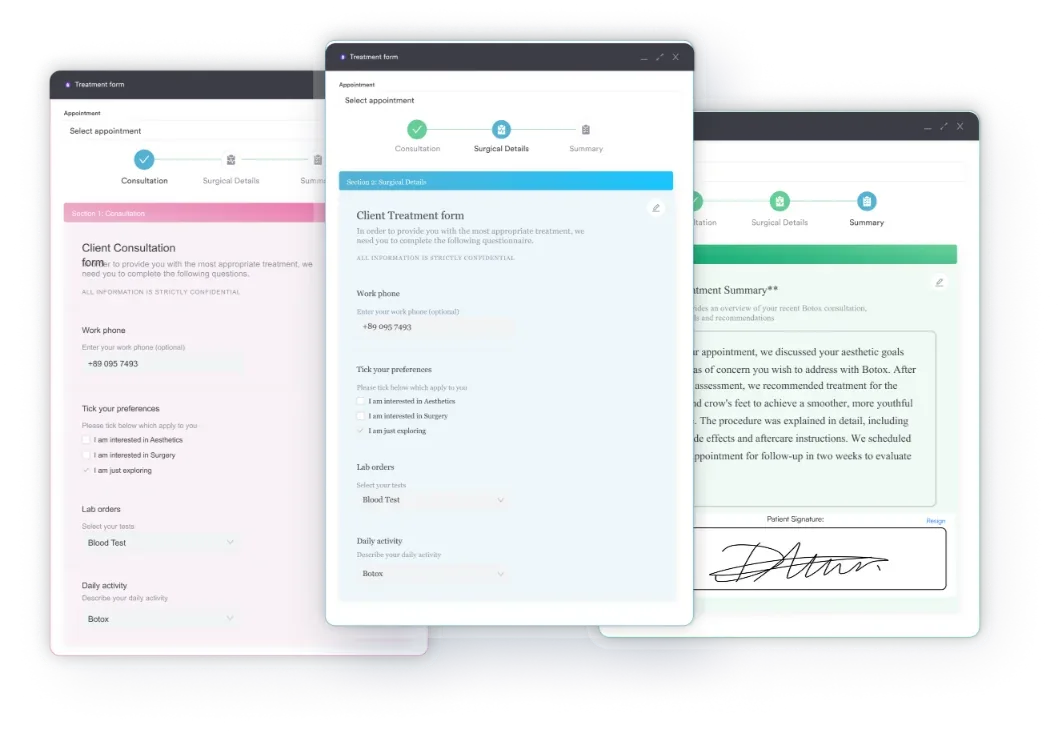
Upload this PDF, or any form you already use, and Pabau's AI Form rebuilds it with tick boxes, text fields and a signature. Attach it to the treatment once, and every patient gets it on time.
AI Form rebuilds the consent, history and aftercare forms you already use. You review each one, then publish.
Patients complete forms on their phone before they arrive, so the front desk stops retyping paper.
Every signed form is versioned and attached to the treatment record, ready when you need it.
Set how long a consent stays valid. Returning patients skip forms they have already signed.
Supports HIPAA and GDPR compliance AES-256 encryption 4.8 on G2 4.7 on Capterra Trusted by 4,000+ practices worldwide

Assertive communication involves expressing your needs, feelings, and boundaries respectfully while respecting others’ rights.
The four communication styles are assertive, passive, aggressive, and passive-aggressive — each with distinct thoughts, feelings, and outcomes.
Key techniques include ‘I’ statements, active listening, maintaining appropriate body language, and setting clear boundaries.
Practice management software like Pabau offers digital forms and a client portal that help therapists and clinicians deliver this handout and track patient engagement with assertiveness practice.
An assertive communication techniques handout is a clinician-friendly educational tool that teaches clients how to express themselves honestly and respectfully, without tipping into passivity or aggression. It doubles as an assertive communication worksheet clients complete between sessions. The core definition it teaches: assertiveness means respecting your own rights and the rights of others at the same time.
The handout combines psychoeducation — theory and explanation — with practical exercises. Therapists, counselors, psychologists, and coaching practitioners use it during sessions to help clients move away from passive patterns (where needs go unmet) or aggressive patterns (where others feel attacked) into the assertive middle ground built on mutual respect.
A printed or digital version gives clients something concrete to take home. Used as an assertiveness worksheet, it lets them review the techniques between sessions, practice them in real situations, and return with examples. That reinforcement builds accountability and speeds up learning.
The assertive communication techniques handout follows a five-step clinical workflow:
Understanding the spectrum is the foundation of assertiveness training. A social communication questionnaire can help identify which style a client defaults to before you introduce this framework. Clients often oscillate between two or three styles depending on the situation, relationship, and stress level. Here’s the breakdown:
Most people have a default style but shift depending on context.
Practices using software for managing patients retrieve past forms in seconds during consultations.
The handout covers seven foundational techniques that make assertiveness concrete and teachable:
Replace blame (“You never listen”) with ownership (“I feel unheard when…”). The structure: I feel [emotion] when [situation], because [impact], and I need [request].
Pause, reflect back what you’ve heard, and ask clarifying questions. This shows respect and prevents misunderstandings. Practicing with an active listening skills worksheet helps clients build the habit before applying it in session.
Maintain eye contact, uncrossed arms, upright posture, and a calm facial expression. These non-verbal cues reinforce your words and signal confidence without aggression.
Be specific. “I need more support” is vague. “I need 15 minutes after each shift to debrief with the team” is clear and actionable.
When someone offers criticism or disagreement, say “I appreciate that feedback” or “Let me think about that.” Defensive reactions shut down dialogue. The same principle applies in reverse .
Clearly define what you will and won’t accept. Example: “I’m happy to help, but I need 24 hours’ notice.” A healthy boundaries worksheet or emotional boundaries list gives clients extra practice defining limits before they need to hold one in a live conversation. Boundaries protect both parties.
Speak up for yourself without waiting for others to notice your needs. This is especially important for healthcare professionals who often deprioritize their own wellbeing.
In clinical settings, assertiveness directly affects patient safety and clinician wellbeing. Nurses and allied health professionals who speak up about potential errors improve outcomes.
Therapists who set boundaries with clients prevent burnout. Practice managers who communicate clearly reduce staff turnover.
This resource works across mental health, therapy, counseling, coaching, and primary care settings. Specific use cases include:
Structured handouts reinforce what happens in the room. The benefits are concrete:
The handout includes real-world scenarios — a client asking for a raise, a family member setting a boundary, a healthcare provider standing up in a team meeting. Each scenario walks through a passive response (what usually happens), an aggressive response (what damages relationships), and an assertive response (what works).
Role-play during the session cements the learning.
Deliver the handout digitally via therapy practice management systems so clients can download, print, or return to it on any device. Assign specific scenarios to clients based on their presenting issues. Track completion and progress in session notes. The handout becomes part of the treatment record, supporting clinical rigor.
Practice management software like Pabau keeps the handout, the assigned scenarios, and the client’s progress notes on one patient record, so nothing lives in a separate forms tool or a filing cabinet. Want to see how the digital forms and client portal handle handout distribution and practice tracking? Book a demo with our team.
An assertive communication techniques handout gives clients a structured way to move from passive or aggressive patterns into confident, respectful communication. The seven techniques covered here — from “I” statements to self-advocacy — give practitioners a consistent framework to teach, practice, and reinforce across sessions.
Use the downloadable template above to standardize how your practice delivers assertiveness training, track client progress in session notes, and support the safety and wellbeing outcomes that come with clearer communication.
Assertive communication involves expressing your needs and feelings directly and respectfully while honoring others’ rights. Aggressive communication prioritizes your needs at others’ expense, often through raised voice, insults, or threats. Assertiveness is balanced; aggression is not.
Yes. The handout works well for group settings. Distribute it to all participants, walk through the four styles together, then break into small groups for role-play scenarios. Groups benefit from seeing multiple responses to the same situation.
Some clients notice immediate shifts in confidence (even in a single session practice). Deeper habit change typically takes several weeks of consistent practice, depending on how entrenched the old patterns are.
Assertiveness norms vary across cultures. Some emphasize harmony over directness; others prioritize individual voice. Adapt the framework to your client’s cultural context and values. The core principle — mutual respect — remains universal.
Many practitioners add their logo, practice name, and specialized examples (healthcare scenarios, industry-specific communication challenges). A tailored handout feels more relevant and increases engagement.