GLP-1 diet plan
A GLP-1 diet plan is a structured eating framework for patients taking semagluti...

1
Last Updated: Oct 13, 2026
Crisis intervention techniques are the specific words and actions a clinician uses to keep a person in acute crisis safe, calmer and connected to help. StatPearls gives the standard crisis intervention definition: “a short-term management technique designed to reduce potential permanent damage to an individual affected by a crisis.”
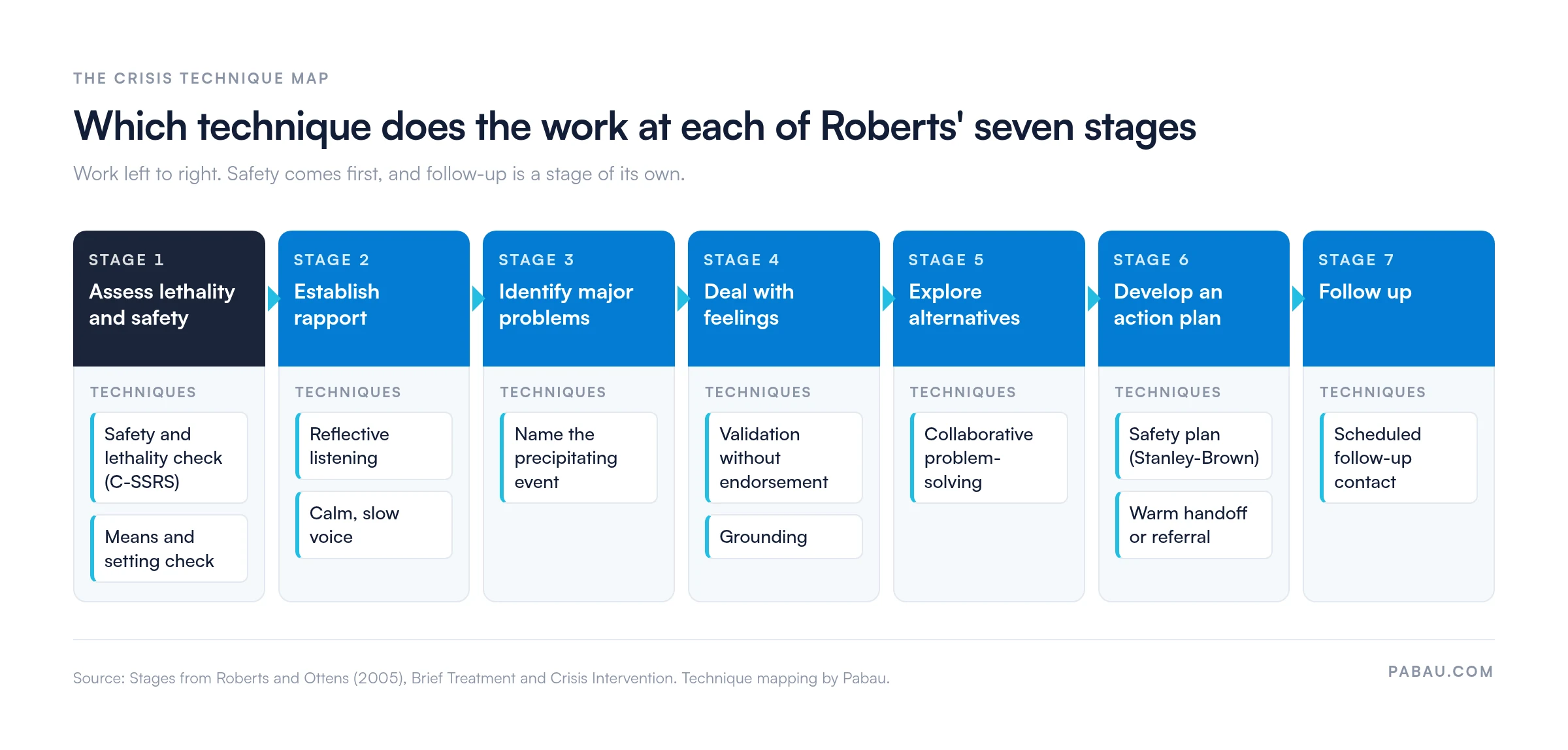
In immediate crisis intervention, the order of the techniques matters as much as the techniques themselves. Check safety and lethality first, then listen and build rapport, then name what triggered the crisis. After that, validate feelings, explore coping options, agree on a written plan and book the follow-up.
This guide lays those steps out as the crisis technique map. Each technique sits on its stage of Roberts’ seven-stage model, with example wording and the note you should write afterward.

Crisis intervention techniques work in sequence, starting with safety and lethality, then rapport, the problem, feelings, options, a plan and follow-up.
Roberts’ seven-stage model is the fullest map for outpatient sessions, while SAFER-R suits brief, one-off contacts.
Per SAMHSA, a plan to act now with access to means calls for 911. Suicidal thoughts without a plan call for support and a 988 referral.
De-escalation starts with your own voice and body, so slow down, lower your tone, give space and offer choices.
The crisis note should record the screening answers verbatim, the precipitant, the safety plan, any referral and the next contact date.
One crisis follow-up program described in 988 best-practice guidance calls within 24 hours, then again on days 7, 14 and 30.
The Roberts seven-stage crisis intervention model moves from assessing lethality to building rapport, identifying problems, exploring feelings, generating alternatives, action planning and follow-up.
Albert Roberts and Kenneth Ottens set out the 7 stages of crisis intervention in a 2005 paper in Brief Treatment and Crisis Intervention. In a live session the stages overlap. The order still holds, because you can’t problem-solve with someone who isn’t yet safe.
The diagram below shows the crisis technique map at a glance, with the techniques that do the work at each stage.
Roberts’ seven-stage model suits sessions long enough to reach a booked follow-up, SAFER-R suits brief one-off contacts, and the six-step model suits counseling work.
Most types of crisis intervention taught in training are variations on these three. The James and Gilliland crisis intervention model comes from their textbook Crisis Intervention Strategies. It splits six steps into three listening steps and three acting steps. StatPearls describes the SAFER-R model of crisis intervention as a common choice that helps patients return to their mental baseline after a crisis.
The six-step crisis intervention model lists safety second, after defining the problem. In practice, James and Gilliland treat assessment as continuous across all six steps, so the safety check never really stops.
The core crisis intervention techniques are a safety check, reflective listening, naming the precipitant, validation, grounding, problem-solving, safety planning, a warm handoff and scheduled follow-up.
Training courses call them techniques of crisis intervention, crisis intervention methods or crisis counseling techniques, but the core moves are the same. The table below is the crisis technique map in full. Use the middle column as a starting script rather than a line to recite.
The crisis intervention skills that matter most are the ones you can still use when your own heart rate is up. Unlike longer crisis therapy interventions, each technique on the map is built to work within a single contact. In social work, crisis intervention techniques follow the same stages, with more weight on linking the person to housing, benefits or family support.
Ask about suicide directly, in plain words. A structured crisis assessment tool keeps the check fast and consistent between clinicians. The Columbia Suicide Severity Rating Scale (C-SSRS) screener covers a wish to be dead, suicidal thoughts, method, intent, a worked-out plan and preparatory behavior.
Record the answers on intent and plan in the patient’s own words. Those two answers carry the most weight when you decide whether to escalate. Before you start, confirm you’re dealing with an acute crisis, because separating existential dread from crisis changes the response.
Reflect the feeling as well as the facts. “You’ve been holding this together for weeks, and today it gave way” tells the patient you followed both. Summarize every few minutes, and ask open questions that start with “what” or “how” rather than “why,” which can sound like blame.
A trauma-informed approach adds one habit. Ask permission before you move closer, change the room or bring in a colleague, so the patient keeps some control.
Someone in a panic can’t weigh options. SAMHSA’s guidance for an overwhelmed patient mid-appointment suggests deep breathing, counting backward or focusing on the senses. Ask for a 0 to 10 distress rating before and after, so the note shows whether grounding worked. A grounding techniques worksheet gives the patient the same exercises to take home.
Call 911 when someone plans to act now and has the means, and connect to 988 when suicidal thinking comes without that immediate danger.
That’s the line SAMHSA draws in its 2024 guide, Advising People on Using 988 Versus 911. The table condenses its in-person scenarios into a decision rule you can keep beside the phone.
Mobile crisis teams sit between the two numbers. According to the same SAMHSA guide, 988 counselors can send mobile crisis services to a caller’s location when it’s necessary. The 988 Lifeline takes calls, texts and chats.

De-escalation techniques in crisis intervention lower arousal first by modeling calm, offering choices, spotting triggers early, adjusting the room and validating feelings without endorsing behavior.
Crisis intervention and verbal de-escalation go together, because an agitated person hears your tone before your words. Use these five moves with an agitated patient, in roughly this order.
Keep your sentences short while someone is escalating. One request at a time is easier to hear than a list of instructions. If verbal de-escalation stalls and someone faces immediate physical harm, move to the 911 row of the escalation table.
These three crisis intervention examples are composites of situations practice teams commonly face. Each one shows which stages and techniques did the work, and what went in the note.
Twenty minutes into a routine therapy session, a patient says it would be easier not to wake up. The therapist pauses the agenda and runs the C-SSRS screener (stage 1). The patient reports suicidal thoughts but no intent and no plan.
Reflective listening surfaces the precipitant, a layoff the week before (stages 2 and 3). The therapist validates the shame, then builds a safety plan with the patient and saves 988 in their phone (stages 4 to 6). A follow-up call is booked for the next morning (stage 7).
A patient raises their voice at the front desk after an appointment was moved. One clinician steps in, speaks slowly and offers a choice of a quiet room or a seat by the window. The receptionist steps back so only one person is talking.
Once the patient sits, the clinician names the precipitant and validates the frustration without promising the slot back. The incident note records the triggers seen, who was present and how the patient settled. If the patient had threatened staff physically, the plan was 911.
A patient arrives the day after a car crash, numb and unable to sleep. With one short contact available, the clinician uses SAFER-R. Grounding stabilizes the patient, and they tell the story at their own pace.
The clinician explains that these reactions are common after a shock, which helps the patient understand them. They agree on two coping steps for tonight, and the clinician refers the patient to trauma-focused care. The note records the referral and the date of the next contact.
A crisis intervention plan is a written list of warning signs, coping steps, people and services to contact, and ways to make the environment safer.
The most widely used format is the Stanley-Brown Safety Planning Intervention. Its safety plan has seven steps.
Write the plan in the patient’s words, and give them a copy before they leave. Our mental health safety plan template follows the same structure if you’d rather not start from a blank page.
Follow-up is the stage that slips when the schedule fills. The 988 network’s best-practice guide on crisis follow-up describes one program that calls within 24 hours of referral, then on days 7, 14 and 30. In 988 follow-up, the first call reviews risk with the C-SSRS and the safety plan with the Stanley-Brown format.
SAMHSA’s 2025 National Guidelines for a Behavioral Health Coordinated System of Crisis Care say everyone with current suicidal ideation should be offered follow-up services. In clinical crisis management, each follow-up call needs a named owner and a date in the calendar.
Crisis intervention management doesn’t end with the plan. Once the acute phase passes, crisis management therapy shifts to the problems underneath, usually over several sessions.
Then look after the team. A short crisis intervention debriefing after a hard session lets staff review what happened and what they’d change. After a critical incident, such as a patient death or an assault on staff, some organizations run group sessions using critical incident stress management (CISM). Protect supervision time too, because crisis work adds up.
A crisis intervention note records the risk screen verbatim, the precipitant, techniques used, the safety plan, any referral and the next contact date.
The checklist below is the “What to chart” column of the crisis technique map, organized by stage. We often see crisis notes split across a paper risk form, a supervisor email and a one-line entry in the EHR. That leaves a covering clinician three places to search at 2 AM.
Write the note the same day, while the patient’s words are fresh. If your team uses a set format, a template for psychotherapy progress notes can hold these fields as structured sections.

Pabau, the practice management system we build, keeps the crisis record and its follow-up steps on one patient file. The next contact is booked with a reminder attached, so it still happens after a hard day.
Pabau’s intake forms can ask about prior crises, past attempts and current supports before the first appointment. That way, risk history is already in the record when a crisis starts.
In Client records, the crisis note, the safety plan and the screening answers sit on one patient timeline the next clinician can open. Build the checklist above into a note template, and every clinician charts the same fields.
Pabau’s automated reminders confirm the follow-up appointment so the day-7 check-in doesn’t drop off the calendar. A patient portal gives patients one secure place to find their safety plan between sessions.
For counseling and psychology teams, the same record sits alongside scheduling and billing in our software for therapy practices. Every subscription includes every feature, and structured onboarding sets your note templates up with you.

Pabau keeps the crisis note, safety plan and screening answers on one patient timeline. Automated reminders keep each follow-up contact on schedule.

The order you use crisis intervention techniques in matters more than any single technique. A perfect validation statement won’t protect someone you haven’t screened for a plan.
If you change one habit after reading this, build the crisis technique map into your note template. Each stage then gets a field, and the covering clinician inherits a full picture instead of a fragment.
The trade-off is a few extra minutes per crisis note. Those minutes pay off the next time that patient calls in crisis. Book a demo to see how Pabau keeps crisis notes, safety plans and follow-up reminders together for your practice.

Not sure it’s an acute crisis? Existential dread vs existential crisis explains how duration and functional impairment separate the two.
Working with adolescents? Safety plan for teenagers template adapts the safety plan steps for younger patients.
Teaching coping skills after the crisis? DBT distress tolerance skills covers the skills patients can use when the next wave of distress hits.
Documenting crisis work in social work? SOAP notes for social work shows how to structure clinical notes that hold up to review.
Crisis intervention is short-term, immediate support that helps a person in acute distress get safe, regain control and connect to ongoing care. It’s time-limited by design. Immediate crisis intervention covers the next hours and days, and longer-term therapy picks up the underlying problems afterward.
No single official five-step model exists. Most five-step versions assess safety, build rapport, define the problem, explore coping options, and agree on a plan with follow-up. These crisis intervention steps condense Roberts’ seven-stage model, which separates feelings from problems and makes follow-up its own stage.
The six stages come from James and Gilliland’s six-step model. They are defining the problem, ensuring safety, providing support, examining alternatives, making plans and obtaining commitment. The first three are listening steps and the last three are acting steps, with assessment running throughout.
Check for immediate danger first, then stay calm, listen, and help the person name what happened before you plan next steps together. If they plan to act now and have the means, call 911. For suicidal thoughts without that danger, SAMHSA recommends support plus a 988 referral. These crisis intervention skills work the same in a therapy room, a waiting room or on the phone.
Crisis intervention nursing involves rapid risk assessment, de-escalation, keeping the patient and environment safe, and coordinating referral and follow-up with the wider care team. Nurses often make the first contact, so the lethality check and clear documentation usually start with them.