GLP-1 diet plan
A GLP-1 diet plan is a structured eating framework for patients taking semagluti...

1
Last Updated: Oct 13, 2026
Therapist burnout is a work-related syndrome of emotional exhaustion, detachment from patients, and a fading sense that your sessions still help. It rarely arrives as a crisis. Instead, it builds from heavy caseloads, late-night notes and job stress that never gets resolved.
What matters most is the stage, because the right fix depends on it. Early burnout usually eases with schedule and admin changes. Severe burnout calls for a lighter caseload, time off and your own therapist.
Misjudge the stage and you lose months, and your patients feel the strain too. The sections below walk through the signs, the causes, verified statistics and the Burnout Stage Ladder, which matches each stage to its next move.

Therapist burnout has three parts: emotional exhaustion, depersonalization toward patients, and a reduced sense of personal accomplishment.
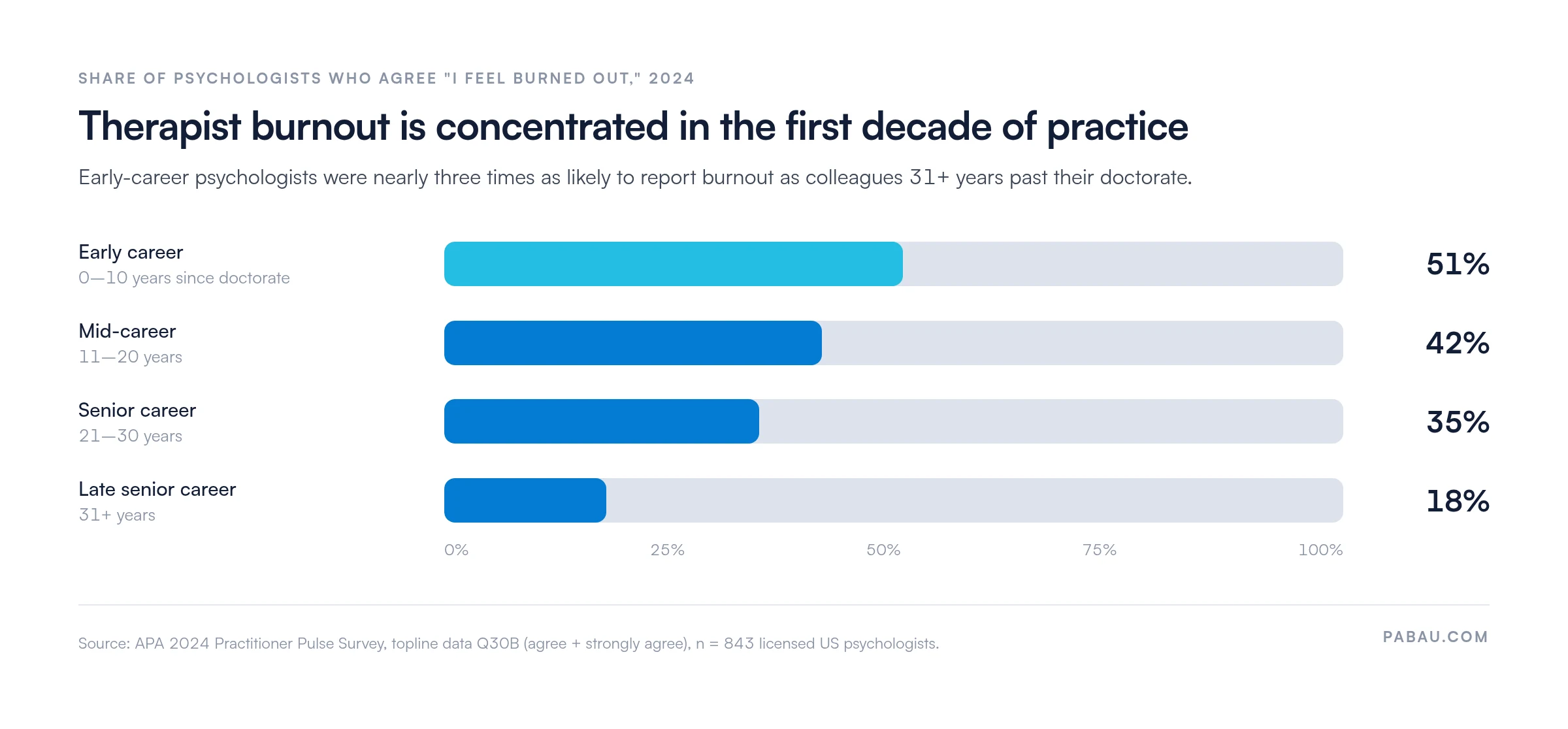
About a third of US psychologists said they felt burned out in 2024, rising to roughly half of those in their first decade of practice.
Burnout differs from compassion fatigue and vicarious trauma because it grows from workload and conditions rather than from exposure to patients’ trauma.
The Burnout Stage Ladder matches each stage to a move, from adjusting your own schedule to cutting caseload and seeing your own therapist.
Practice-level fixes such as note templates, session buffers, caseload caps and automated reminders stop documentation spilling into evenings.
Therapist burnout is a state of emotional, mental and physical exhaustion caused by prolonged work stress in clinical practice. It shows up as drained empathy, growing distance from patients, and doubt that your sessions still help.
The World Health Organization lists burnout as an occupational phenomenon in ICD-11 rather than as a medical condition. Its definition ties burnout to chronic workplace stress “that has not been successfully managed,” which places the cause in the job itself.
Researchers measure burnout across three dimensions, first described by psychologist Christina Maslach:
Burnout can also affect counselors, social workers, psychiatrists and other mental health professionals. The same three dimensions apply to all of them, and each one surfaces as symptoms you can spot in an ordinary week.
Therapist burnout symptoms usually include persistent fatigue, dread before sessions, reduced empathy, irritability with patients, and physical complaints such as poor sleep and headaches.
They tend to cluster into four groups. Spotting which group shows up first tells you where the strain is landing:

Answer these five questions about the last month. Two or more “yes” answers are worth taking to supervision. That threshold is a prompt for reflection and has not been validated as a cutoff. The checklist is not a diagnosis either.
For a scored result, use a validated therapist burnout questionnaire. The Maslach Burnout Inventory measures all three dimensions, and our Maslach Burnout Inventory template lets you run it in a few minutes.
The Professional Quality of Life Scale, known as ProQOL, is a second option. ProQOL scores burnout alongside compassion satisfaction and secondary traumatic stress.
Burnout is common among therapists: about a third of licensed US psychologists said they felt burned out in 2024, down from 45% in 2022.
Those figures come from the American Psychological Association’s yearly practitioner surveys. The earlier years are summarized in the APA Monitor, and the latest figures come from the 2024 Practitioner Pulse Survey.
The table pairs each figure with its source and year, so you can check it against the original survey:
All the APA figures come from surveys of psychologists. Comparable data for counselors, social workers and marriage and family therapists is limited. Treat year-to-year comparisons as indicative, because the survey’s sample and platform changed between years.
Career stage makes the sharpest difference. In 2024, 51% of psychologists in their first 10 years agreed they felt burned out. That fell to 42% at 11 to 20 years, 35% at 21 to 30 years and 18% after that.
A wider view comes from a 2018 meta-analysis of 33 studies and 9,409 mental health professionals. The review found high emotional exhaustion in 40%, depersonalization in 22%, and low personal accomplishment in 19%.
For comparison, the AMA’s national survey found 45.2% of US physicians reported at least one burnout symptom in 2023. Rates that high across professions point back to how clinical work is organized.
Therapist burnout is caused mainly by workload: heavy caseloads, documentation, and emotionally intense sessions, made worse by low control, unclear roles, and isolation.
The 2018 meta-analysis above backs this up. The authors named workload and relationships at work as key drivers, with role clarity, autonomy, fair treatment and regular supervision acting as protection.
Heavy caseloads, back-to-back scheduling, and documentation are the leading causes. Progress notes, treatment plans, insurance forms and intake paperwork all compete with recovery time between sessions.
In practices we onboard, the evening backlog is usually unsigned notes, intake forms and reminder calls that a full day of patients pushed aside.
Early-career therapists carry the highest risk, as the APA data shows. They often take the caseloads senior colleagues turn down, while still building the boundaries and shortcuts that protect experienced clinicians.
In community or multidisciplinary settings, unclear expectations create stress. Therapists may be asked to act as clinician, case manager and administrator at once, often with little supervision.
Autonomy protects against burnout. When therapists have little say over their schedules, case mix or therapeutic approach, motivation drops.
Isolation, especially in solo private practice, amplifies stress. There are fewer chances to debrief a hard session with a colleague before the next patient arrives.
High trauma exposure, crisis work and emotionally intense caseloads demand constant emotional regulation. Recognizing and managing countertransference is part of that work, since unexamined reactions to patients can quietly erode attunement.
Without enough recovery time, vicarious trauma and compassion fatigue can layer on top of burnout and deepen it.
Burnout builds gradually from workload and working conditions, while compassion fatigue and vicarious trauma come from empathic exposure to patients’ trauma. Depression, by contrast, affects your whole life.
Telling them apart matters because the first move differs. Workload changes help burnout, but they will not resolve secondary trauma or clinical depression on their own:
If you suspect compassion fatigue rather than burnout, our compassion fatigue test helps separate the two before you plan changes.
Therapist burnout moves through three stages, early, moderate and severe. Each one calls for a different response, from small schedule changes to time away from practice.
The Burnout Stage Ladder below is a practical framework we use. It has not been validated as a clinical scale. Each row pairs a stage with a decision rule. Find the row that matches the last month, not your worst day:
Stage two is easy to dismiss as a busy month. Checking the ladder once a month helps you catch the shift before it reaches stage three.
See a therapist for burnout once symptoms reach stage three, or sooner if low mood, hopelessness or heavy drinking start showing up outside work.
Clinicians often delay this because they know the process from the other chair. Booking your own sessions models the care you recommend to patients. If you ever have thoughts of self-harm, contact a crisis line such as 988 in the US.
Therapist burnout recovery usually takes weeks to months. It works best when you reduce workload first, then rebuild rest, support and boundaries before returning to a full caseload.
There is no fixed timeline, because recovery depends on the stage and on what changes at work. A practical sequence looks like this:
Recovery stalls for predictable reasons. Before you plan your next month, check that you are not repeating one of these:
Burnout becomes an ethics issue when it starts to impair your work with patients. Both major US ethics codes address this directly.
The ACA Code of Ethics (standard C.2.g) asks counselors to monitor themselves for impairment. If needed, they limit, suspend or end professional duties until they can safely resume.
The APA Ethics Code (standard 2.06) asks psychologists facing personal problems to seek consultation. They then decide whether to limit, suspend or terminate their work-related duties.
Therapist burnout does affect patient care. Research links therapists’ disengagement to measurably poorer outcomes in depression and anxiety treatment.
A 2018 study in the journal Depression and Anxiety followed 2,223 patients treated by 49 therapists. Therapists’ disengagement and job satisfaction scores explained between 31% and 39% of the difference in outcomes between therapists.
Patients may pick up on subtle detachment or impatience. That weakens trust and the therapeutic alliance, which much of the treatment depends on.
You prevent therapist burnout by controlling workload and recovery. That means firm boundaries, regular supervision, daily rest, clear roles, and practice systems that keep admin inside working hours.
Set firm limits on working hours, session volume and case types. Route patient messages through a patient portal rather than personal email or text, so they wait until working hours.
Sleep, nutrition, exercise and time outdoors give your body the recovery that sessions use up. Short breaks of five to 10 minutes between sessions help reset attention and emotional regulation.
In the 2024 APA survey, 78% of psychologists said they had been able to practice self-care over the past year. Self-care helps, but it cannot offset a caseload that is too large.
Regular supervision and consultation groups offer emotional release, ethical clarity and professional validation. Nearly half (47%) of psychologists in the 2024 APA survey had sought peer support to manage burnout.
Continuing professional development helps too. A new skill or modality can restore the sense of accomplishment that burnout erodes.
Agree on expectations with team leads or colleagues in writing. Clear delegation of intake, billing and scheduling tasks stops therapists absorbing admin by default.
If you own or run a practice, the strongest prevention sits in how the week is built. These changes target the documentation load that pushes notes into evenings:
Most of the fixes above depend on admin getting done without a therapist touching it. Today that often means a calendar, a forms tool, a notes app and a phone for reminders, with someone copying details between them.
Pabau, the all-in-one practice management platform we build, puts scheduling, online booking, intake forms, reminders and notes into one patient record. As software built for therapists, Pabau sends intake forms at booking and reminders automatically, so the front desk stops chasing either.
Pabau Scribe, our AI scribe, drafts session notes for the therapist to review and sign. That keeps documentation inside the working day instead of in the evening.
Every Pabau subscription includes every feature, and Pabau Scribe usage runs on credits that you top up as needed. Structured onboarding sets up session buffers, reminder timing and note templates with your team.
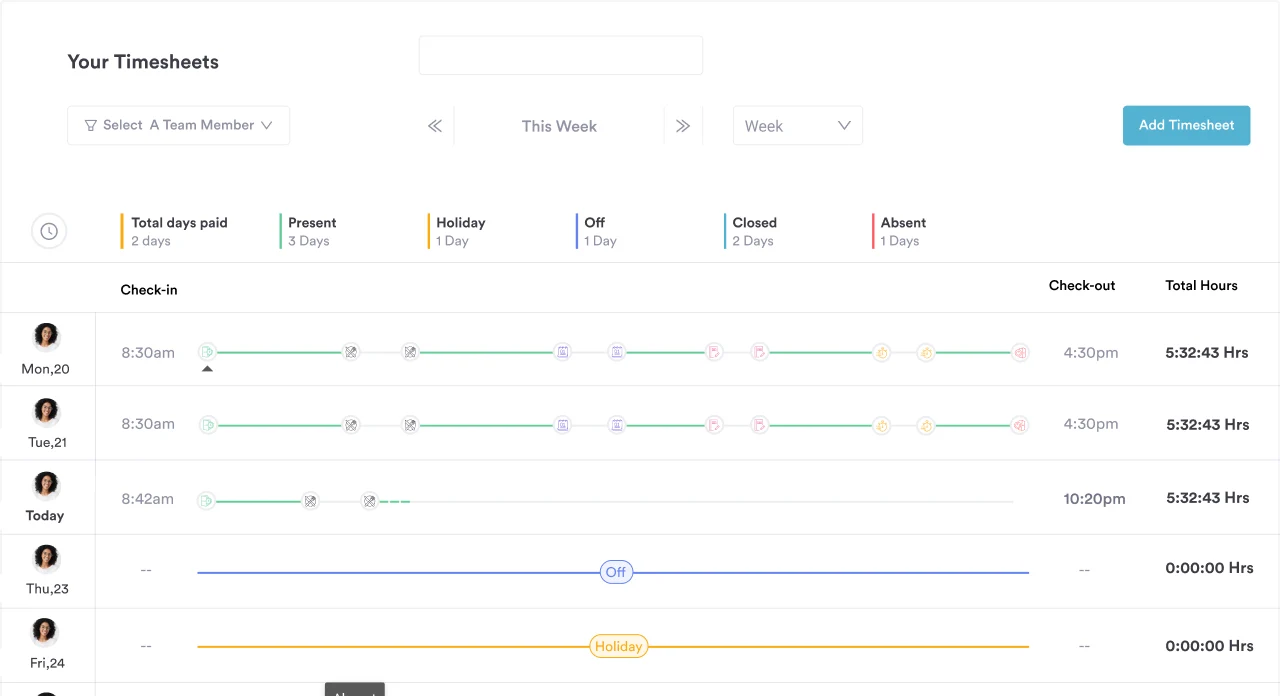

Pabau brings scheduling, intake forms, automated reminders and AI-drafted session notes into one patient record, so therapists finish documentation before they go home.

Burnout is an occupational signal that the workload and the support around it are out of balance. Treating it as a personal failing delays the change that helps.
Check where you sit on the Burnout Stage Ladder this month, and act on the matching move. If you run a practice, fix the admin load first, because it shapes every therapist’s week.
Book a demo to see how Pabau keeps notes, forms and reminders off your therapists’ evenings.

Choosing a system for your therapy practice? Best EHR for therapists compares the platforms that handle notes, scheduling and billing for mental health practices.
Want a structured way to set limits? Emotional boundaries worksheet helps you map where your work boundaries are slipping and what to change.
Spending evenings on documentation? Progress notes for psychotherapy gives you a structured template for writing concise therapy notes faster.
Is insurance admin adding to the load? Insurance billing for therapists explains the billing workflow and where it can be simplified.
Need a structure for daily recovery? Self-care worksheet helps you plan rest, movement and support around a full caseload.
No. The DSM-5-TR does not list burnout as a mental disorder. ICD-11 includes it as an occupational phenomenon under code QD85, in the chapter on factors influencing health status. If symptoms meet the criteria for depression, anxiety or an adjustment disorder, that condition is diagnosed instead.
The 42% rule comes from the 2019 book Burnout by Emily and Amelia Nagoski. The rule suggests spending about 42% of your time, roughly 10 hours a day, on rest, sleep and connection. It is a self-help guideline rather than a clinical standard.
No professional body sets a weekly cap. A sustainable number depends on session length, case complexity and how much admin each session creates. Your notes are a practical test: if they regularly spill past working hours, the caseload is too high for your current setup.