HCPCS code V2300: Sphere trifocal lens billing guide
HCPCS code V2300 covers one sphere trifocal lens up to 4.00D HCPCS code V2300 is...

Last Updated: Oct 19, 2026
V2212 is the HCPCS code for one spherocylinder bifocal lens with a sphere of ±7.25 to ±12.00D and a cylinder of 2.25 to 4.00D. It is billed per lens, and Original Medicare pays for it only after cataract surgery or for aphakia.
Billers can confuse it with V2211 and V2213, because all three codes share the same sphere band and differ only by cylinder power. A lens coded to the wrong cylinder band can be denied or recouped by the DME MAC. Reading both powers from the lab order settles which code applies.
Let Pabau's smart automation suggest the right codes, reduce claim denials, and keep your practice compliant—effortlessly.
Automate repetitive tasks and focus on what matters most—your patients.
Reduce coding errors and ensure compliance with the latest regulations.
Clean claims, fewer denials, and faster reimbursements.
Powerful insights and reporting to help your practice thrive.
HIPAA compliant SOC 2 certified GDPR-compliant Trusted by 4,000+ clinics worldwide

V2212 bills one spherocylinder bifocal lens with a sphere of ±7.25 to ±12.00D and a cylinder of 2.25 to 4.00D.
V2211, V2212 and V2213 share the same sphere band, so the cylinder on the dispensed lens decides the code.
Original Medicare pays for V2212 only as a prosthetic lens after cataract surgery or for aphakia, through the DME MAC.
Payment comes from the DMEPOS fee schedule, not the Physician Fee Schedule, and each lens goes on its own RT or LT line.
Reading the sphere and cylinder from the lab order before you code prevents the most costly V2212 error.
HCPCS code V2212 describes one spherocylinder bifocal spectacle lens for a high-power prescription. The sphere runs from plus or minus 7.25 to plus or minus 12.00 diopters (D), and the cylinder from 2.25 to 4.00D. It is an active vision supply code in the HCPCS Level II code set, which the Centers for Medicare and Medicaid Services (CMS) maintains. You bill it per lens, so a pair takes two claim lines.
The official long descriptor reads “Spherocylinder, bifocal, plus or minus 7.25 to plus or minus 12.00d sphere, 2.25 to 4.00d cylinder, per lens.” The short descriptor is “Lens sphcyl bifo 7.25-12/2.2”.
Three elements must all match the dispensed lens for V2212 to be correct:
If any one of the three falls outside the descriptor, a different code applies.
A spherocylinder lens corrects astigmatism as well as nearsightedness or farsightedness. The sphere value carries the main focusing power, and the cylinder value adds the astigmatism correction along a set axis.
The bifocal part is a near-vision segment set into the lens, usually a flat-top or round segment. The sphere and cylinder in the V2212 descriptor describe the distance prescription, not the add power. A bifocal add over 3.25D is reported separately with V2220, and progressive lenses use V2781 instead.
Sphere and cylinder are the two specifications that decide whether V2212 is the right code. Read both from the dispensed lens, not only from the original prescription.
The code covers the lens itself. Frames, tints, coatings and other add-ons are billed as separate line items under their own V-codes.
The bifocal lens codes are sorted by sphere band first and cylinder band second. V2211, V2212 and V2213 share the ±7.25 to ±12.00D sphere band, so cylinder power is what separates them.
Two worked examples show how the bands interact. A lens of -8.50D sphere with 3.00D cylinder is V2212. Change the cylinder to 1.50D and the same lens becomes V2211, while 4.75D makes it V2213.
The sphere boundary matters too. A -7.00D sphere with 3.00D cylinder falls in V2208, and a sphere beyond ±12.00D moves the lens to V2214 at any cylinder.
The diagram below follows the order a biller should use: sphere first, then cylinder.
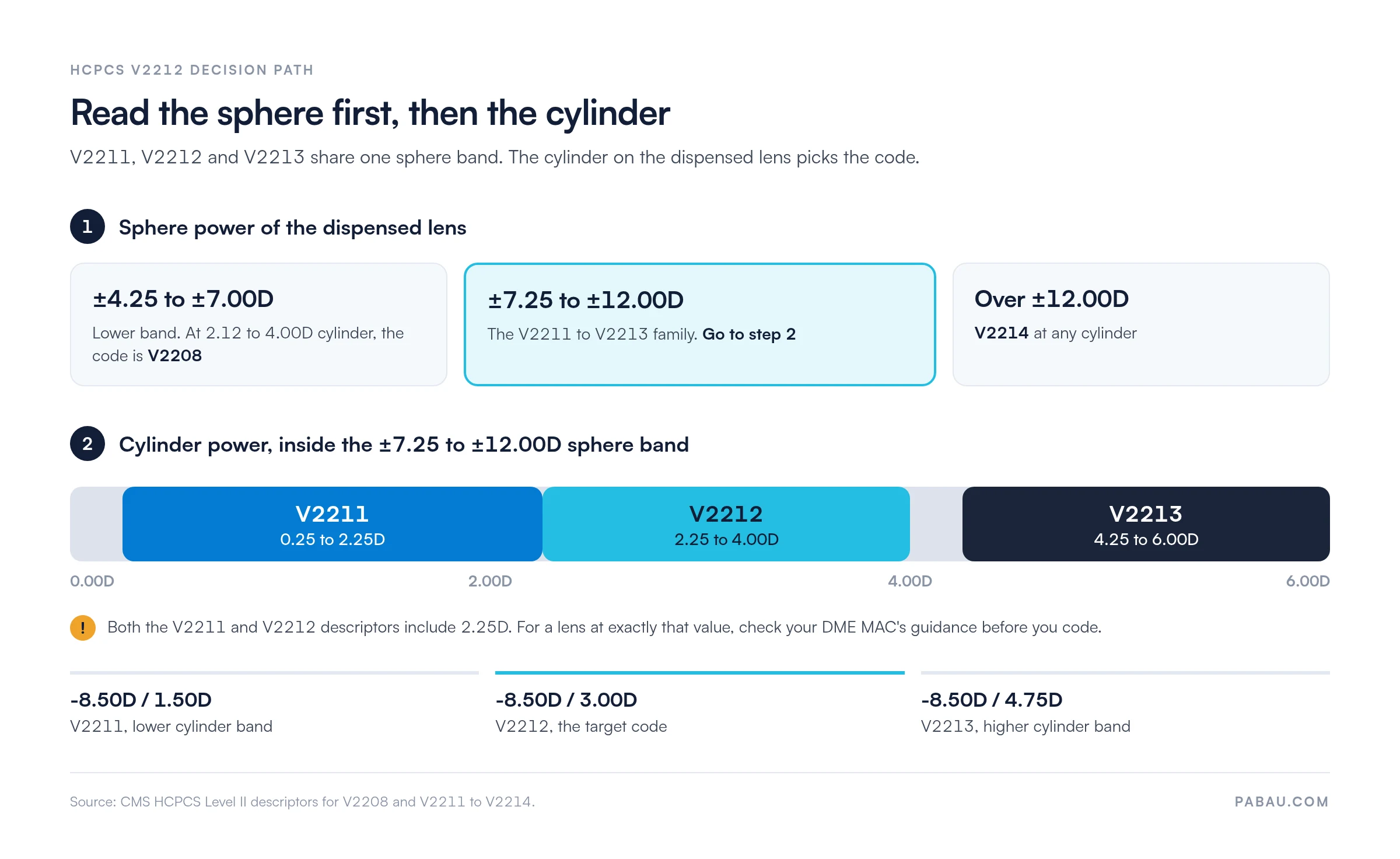
The published descriptors for V2211 and V2212 both include a 2.25D cylinder. If a lens sits exactly on that value, check your DME MAC’s guidance before you choose the code.
Slab-off prism is not part of this family. It is billed with V2710 as an extra line on the lens it applies to.
Original Medicare does not cover routine eyeglasses. V2212 is payable only under the prosthetic device benefit, which replaces the focusing power of the eye’s natural lens.
Part B covers one pair of conventional eyeglasses or contact lenses after each cataract surgery that implants an intraocular lens (IOL). The rule comes from the CMS Medicare Benefit Policy Manual. Lenses for aphakia, where the natural lens is absent, are covered as well. A V2212 lens may be covered when all of the following apply:
Commercial and Medicaid payers have their own coverage rules. Some cover routine bifocal lenses through a vision benefit, and others cover only post-surgical lenses. Verify eligibility and benefits before dispensing, because coverage for V2212 varies by payer and plan.
Medicare claims for V2212 go to the DME MAC for the patient’s state. The Refractive Lenses LCD (L33793) and its policy article (A52499) set the coverage and coding rules. Check both before you submit.
A V2212 claim is only as strong as the paper behind it. Gather these records before the claim leaves the practice:
Retain documentation for at least seven years for Medicare claims. Medical billing compliance requirements at the federal level set this floor, and some state Medicaid programs require longer retention.
Pull the lab order alongside the clinical prescription before you select the V-code. The sphere and cylinder on the lab order are the billable specification, especially if the lab adjusted the power during fabrication. A mismatch between the prescription on file and the lab order is an audit risk even when the claim pays.
A clean V2212 claim needs the right code on the right line, with the right supporting details. Follow these steps in order.
Run through your clean claim checklist before you send any V2212 claim. It catches the structural slips, such as a missing NPI, a wrong POS or an absent modifier.
Most V2212 rework traces back to a detail nobody checked at the coding desk. Hold the claim until each of these is true:
The lab order check matters most, because a wrong cylinder band can pass the payer’s edits and only surface at audit.
Medicare pays V2212 under the DMEPOS fee schedule, not the Physician Fee Schedule. CMS publishes a fee schedule amount for each state and updates the file every quarter.
V2212 carries pricing indicator 38, so its state amounts are subject to national floors and ceilings. Look up the current figure for the patient’s state in the CMS file rather than relying on a quoted dollar amount.
Several factors determine what the practice is finally paid for a V2212 lens:
For Medicaid, rates are set at the state level and often fall below Medicare amounts. For commercial payers, check the contracted rate in your fee schedule agreement rather than assuming parity with Medicare.
Medicare requires a laterality modifier on every V2212 line. Leave it off, or use the wrong side, and the line comes back denied.
Confirm modifier rules in the DME MAC policy article for the patient’s jurisdiction. Some commercial payers handle laterality differently, so check each payer’s editing rules before submission.
V2212 denials cluster around a handful of preventable errors. Match the claim adjustment reason code (CARC) to its root cause, and the correction or appeal gets much quicker.
Wrong-band coding and missing laterality modifiers are the two V2212 denials you can stop at the coding desk. Building a denial dashboard by CARC is covered in more depth in the denial management guide.
Medicare does not require prior authorization for lenses provided under the post-cataract benefit, but certain Medicare Advantage plans do. The requirement is plan-specific, not a uniform Medicare rule.
For commercial payers, prior authorization requirements vary widely. Some plans require authorization before dispensing any optical supply above a cost threshold, and others pay without pre-approval. Check the payer’s provider portal or call the benefits line before dispensing.
If a plan requires prior authorization and the practice dispenses without it, the claim is typically denied with CARC 197 or a plan equivalent. These denials are rarely overturned on appeal, because the contract requires pre-service approval. Log each payer’s rule in the patient’s record before the fitting appointment.
When a Medicare Advantage plan denies a V2212 claim for missing prior authorization, check the requirement in the plan’s provider manual before appealing. Some plans waive it when the service was urgent, or when a request was submitted but not answered in time. The timestamp of your authorization request is the key evidence.
Many optical and ophthalmology practices keep the prescription, the lab order and the claim in three places. When a DME MAC asks which sphere and cylinder were dispensed, someone has to dig through all three.
Pabau, the practice management platform we build, keeps prescriptions, dispensing notes and claims in the same patient record. Its claims management software pre-fills the claim from that record and sends it through Claim.MD.
The Claim.MD connection also runs eligibility checks and posts electronic remittances back to the record. A V2212 payment or denial shows up without re-keying. Choosing between V2211, V2212 and V2213 stays with your biller, with the lab order one click away.

Pabau pre-fills claims from the patient record and sends them through Claim.MD, with eligibility checks and remittance posting built in. See how optical and ophthalmology practices use it to cut claim rework.

Coding V2212 correctly comes down to two numbers on the lab order. The sphere must sit between ±7.25 and ±12.00D, and the cylinder between 2.25 and 4.00D. Get both right, put each lens on its own RT or LT line, and the claim has a clean path through the DME MAC.
The costliest V2212 error is a lens coded one cylinder band too high or too low, because it often surfaces only at audit. A lab-order check in your dispensing routine removes that risk before a payer sees the claim. To see how Pabau keeps prescriptions, lab orders and claims in one record, book a demo.

Want to understand how HCPCS V-codes fit into the broader billing framework? What is medical billing covers the end-to-end process from code selection through payment posting.
Need to build a denial prevention workflow for optical claims? Denial management in healthcare explains how to track CARC codes and reduce resubmission cycles.
Looking for a clean claim checklist for vision supply submissions? Clean claim guide outlines the fields and documentation that payers validate before adjudicating a claim.
Original Medicare covers V2212 only as a prosthetic lens. That means one pair after each cataract surgery with an IOL, or lenses for aphakia. Routine eyeglasses are excluded, and claims go to the DME MAC.
All three cover spherocylinder bifocal lenses with a ±7.25 to ±12.00D sphere. The cylinder decides the code: V2211 is 0.25 to 2.25D, V2212 is 2.25 to 4.00D and V2213 is 4.25 to 6.00D.
Per lens. A pair goes on two claim lines, one with RT and one with LT, each with one unit. The two eyes can carry different codes if their powers differ.
No. Progressive lenses are reported with V2781 instead. V2212 covers a bifocal with a near-vision segment, and an add over 3.25D is billed separately with V2220.
Yes. A V2212 lens is often billed with a frame code such as V2020. Tints and coatings go on their own lines under their own V-codes.
The usual causes are a wrong cylinder or sphere band, a missing RT or LT modifier, and a missing or expired prescription. Medicare also denies the lens when the post-cataract benefit does not apply.