HCPCS code J7178: Hyaluronidase injection billing guide (2026)
HCPCS code J7178: Official descriptor and 2026 updates HCPCS code J7178 carries ...

Last Updated: Nov 20, 2026
V2211 is the HCPCS code for spherocylinder, bifocal, plus or minus 7.25 to plus or minus 12.00d sphere, .25 to 2.25d cylinder, per lens.
It bills one bifocal lens that corrects a strong sphere and mild astigmatism, so a pair goes on two lines with RT and LT. Most denials come from three sources. The cylinder belongs to a neighboring code, the Medicare claim lacks a post-cataract diagnosis, or a Medicaid managed care plan needed prior authorization.
Let Pabau's smart automation suggest the right codes, reduce claim denials, and keep your practice compliant—effortlessly.
Automate repetitive tasks and focus on what matters most—your patients.
Reduce coding errors and ensure compliance with the latest regulations.
Clean claims, fewer denials, and faster reimbursements.
Powerful insights and reporting to help your practice thrive.
HIPAA compliant SOC 2 certified GDPR-compliant Trusted by 4,000+ clinics worldwide

HCPCS code V2211 bills one bifocal spherocylinder lens with a sphere of ±7.25 to ±12.00D and a cylinder of .25 to 2.25D.
Cylinder power picks the neighbor code at this sphere range: 2.25 to 4.00D is V2212, and 4.25 to 6.00D is V2213.
Medicare Part B excludes routine eyeglasses, so V2211 pays only under the prosthetic lens benefit after cataract surgery.
Bill each lens on its own line with RT or LT, and report a wide segment or strong add with V2219 or V2220.
Pabau, a practice management platform, checks eligibility, submits claims through Claim.MD and brings back ERA remittances.
HCPCS code V2211 is the Level II code for one bifocal spherocylinder spectacle lens in a high sphere range. CMS publishes its official descriptor in the quarterly HCPCS code files. It reads “Spherocylinder, bifocal, plus or minus 7.25 to plus or minus 12.00d sphere, .25 to 2.25d cylinder, per lens.” Its AAPC Codify entry shows the code valid since January 1985, with the current descriptor effective October 1, 2003.
Three facts on the prescription must all line up before V2211 is the right code:
The code is billed per lens. Lens material and coatings do not change the base code, although some payers allow separate V-codes for tints, coatings or oversize lenses. What makes the claim defensible is a signed prescription that states the sphere, the cylinder, the axis and the add for each eye.
Documentation that makes the code defensible on audit:
Several lens types fall outside V2211’s scope. Knowing these boundaries prevents coding errors that attract Recovery Audit Contractor (RAC) scrutiny.
NCCI (National Correct Coding Initiative) edits can also restrict certain modifier pairings with V2211. Because the NCCI tables are updated quarterly, verify current edit pairs against the CMS NCCI edits page rather than from memory. Citing an NCCI rule that has since changed is a common error in audit responses.
The V2200–V2299 bifocal series works as a grid. Sphere power sets the row, and cylinder power sets the column. V2211 sits in the high-sphere row, V2211–V2213, in its lowest cylinder band. Picking the wrong cell is a frequent V-code error, and it often surfaces as a medical necessity denial rather than a plain coding denial.
How to read the prescription: Check that the lens is a bifocal, then read the sphere (Sph) column, then the cylinder (Cyl) column. A sphere of −9.50D with a cylinder of −1.25D on a bifocal is V2211. The same sphere with a −3.00D cylinder is V2212. Code each eye on its own, because the two lenses often fall in different cells. The decision path below runs those checks in order and names the code each miss routes to.
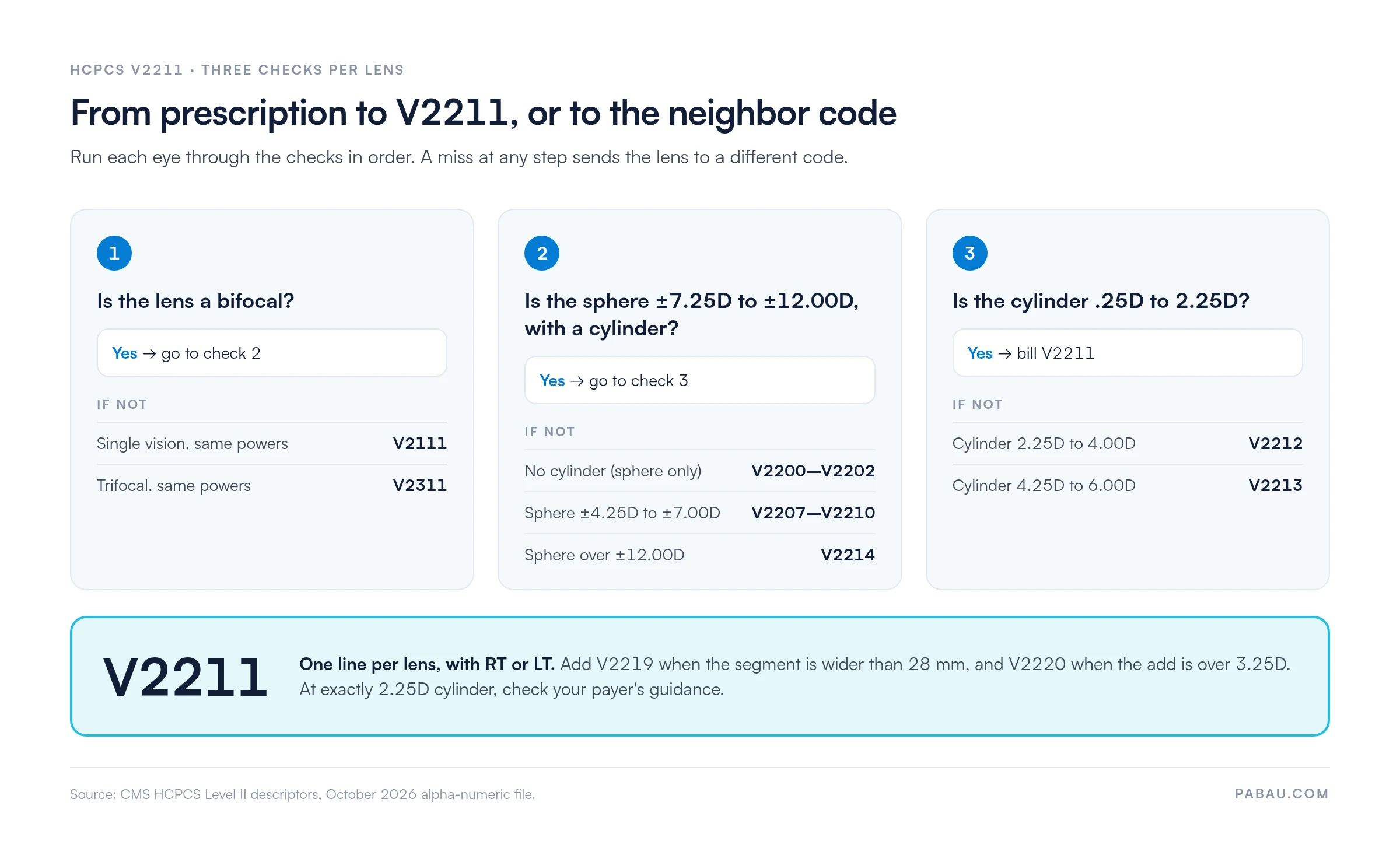
Watch the 2.25D seam. The official descriptors list 2.25D as the top of V2211’s cylinder band and the bottom of V2212’s. When a prescription lands exactly on 2.25D, check your payer’s or MAC’s guidance before picking a code, and keep that guidance with your coding notes.
Coverage for V2211 differs sharply by payer, and the Medicare rule is the one most likely to generate a denial if misunderstood.
Medicare Part B excludes routine vision care under Social Security Act Section 1862(a)(7), so standard eyeglasses are not covered. The exception is the prosthetic lens benefit for patients who have had cataract surgery. After surgery with an intraocular lens (IOL) implant, Medicare covers one pair of eyeglasses or contact lenses. Patients left aphakic, with no IOL, can also qualify for prosthetic lenses. The qualifying diagnosis must appear on the claim, or it fails on the routine vision exclusion.
Medicaid optical coverage is set at the state level. Some states cover routine vision for adults, others cover it only for children, and others exclude it almost entirely. Before billing V2211 to a state Medicaid program, check that program’s current optical coverage policy. Medicaid managed care plans add another layer. Even where the state covers the service, the managed care organization (MCO) may set its own prior authorization rules and fees.
Commercial health plans vary widely. Vision-specific riders commonly cover routine ophthalmic lenses, while medical plans without a vision rider typically follow the Medicare exclusion logic. Verify eligibility and benefits before dispensing. Also confirm whether the plan routes vision claims to a vision benefit manager, such as EyeMed or VSP, rather than the medical carrier.
Run a benefits verification call that asks three questions. Does the plan have a vision rider, who processes ophthalmic supply claims, and does an annual benefit maximum apply? A medical eligibility check alone can miss vision-rider coverage.
Medicare fee-for-service does not require prior authorization (PA) for the prosthetic lens benefit after cataract surgery. The qualifying diagnosis on the claim serves as the coverage trigger. Medicaid managed care plans are where PA is most common for V2211. Many MCOs require a PA request before the lens is dispensed, and a claim billed without it is hard to appeal after the fact.
When a PA is required, the typical submission package includes:
Some commercial plans also require PA for ophthalmic supplies above a defined cost threshold. Check the plan’s PA list each year, because optical supply requirements change with annual contract renewals.
The diagnosis codes paired with HCPCS code V2211 determine whether the claim clears medical necessity review. Because the lens corrects astigmatism and a near add, the refractive diagnoses usually include astigmatism and presbyopia. The Medicare prosthetic lens benefit needs a post-cataract diagnosis instead.
Always use the most specific laterality code available (right eye, left eye, bilateral). For the Medicare prosthetic lens benefit, some Medicare Administrative Contractors (MACs) want the cataract history paired with Z96.1 or an aphakia code. Check your MAC’s Local Coverage Determination (LCD) for the ophthalmic supply policy in your region.
Modifier selection determines laterality, equipment status, and in some cases triggers NCCI review. Using the wrong modifier is a clean, preventable denial.
Bilateral billing: Bill two separate line items, one with LT and one with RT, rather than a single line with a quantity of two. Most payers, including Medicare, expect lenses billed this way. Each eye is an independent supply item, and the two lenses may not even share a code.
A clean V2211 claim follows a consistent pre-submission checklist. Optical supply claims carry more documentation than visit codes, so most of the work happens before the claim leaves the practice.
V2211 denials cluster around a handful of root causes. Each one can be caught before submission, and the table pairs every cause with its fix.
Appealing a Medicare routine vision denial: Sometimes a claim is denied as routine vision even though the patient had cataract surgery. Appeal with the operative report and the aphakia or Z96.1 diagnosis code. Many of these denials are automated, and the appeal succeeds when the clinical documentation goes with it. Track these denials by payer, so a recurring pattern gets fixed at intake. For the CARC/RARC codes you’ll see on remittance advices, see this list of denial codes in medical billing.
RAC and MAC audits on ophthalmic supply claims focus almost entirely on documentation completeness. Auditors look for missing prescriptions, undocumented delivery or absent provider credentials.
The chart note and billing record for a V2211 claim must collectively contain:
Keep claims-supporting records for generally at least 6 years to cover Medicare’s audit windows, and note that state law may require longer. Keep these records searchable in your practice management system. That way, an Additional Documentation Request (ADR) does not turn into a hunt through paper files.
Scan and attach the written prescription to the encounter in your practice management system on the day of dispensing. Waiting until an audit request arrives to locate a prescription is how practices lose appeals they should have won.
Most optical practices still check coverage on one portal, code the lens on paper and send the claim from another system. Each handoff is a chance to drop the cylinder value, the laterality modifier or the post-cataract diagnosis that V2211 depends on.
Pabau’s claims management software keeps those steps in one place. It runs eligibility checks before the appointment, submits claims through the Claim.MD clearinghouse and brings back ERA remittances. Your team sees which lens lines were paid or denied, and why, without logging into separate portals.
The outcome is fewer surprises after dispensing. Coverage questions surface before the lens is ordered, and denial patterns show up early enough to fix at intake.

Pabau checks eligibility, submits claims through Claim.MD and returns ERA remittances, so your team catches V-code denials before they age.

V2211 is a narrow code: one bifocal lens, a high sphere and a light cylinder. Most errors come from treating it as a sphere-only or single vision code, or from ignoring the cylinder column. Code both numbers for each eye, every time, and the neighbor codes stop being a trap.
The payer rules matter as much as the lens. A correct V2211 still fails at Medicare without a post-cataract diagnosis, or at a Medicaid MCO without prior authorization. Build those checks into intake rather than the appeal. Book a demo to see how Pabau keeps eligibility, claim submission and remittances in one place for your optical billing.

Need a clean claim framework for optical supply billing? Medical claims clearinghouse explains how clearinghouse validation catches code errors before they reach the payer.
Seeing recurring CARC codes on your remittance advices? Electronic remittance advice covers how to read ERA files and map denial reasons back to billing workflow gaps.
Building a denial prevention workflow? Insurance eligibility verification shows how to catch coverage problems before the lens is dispensed.
Is the add stronger than +3.25D? HCPCS code V2220 explains how to report the strong-add feature alongside the base lens code.
Billing the same powers in a single vision lens? HCPCS code V2111 covers the single vision spherocylinder lens in this sphere and cylinder range.
HCPCS code V2211 covers one bifocal spherocylinder spectacle lens. The sphere must be between ±7.25D and ±12.00D, and the cylinder between .25D and 2.25D. It is billed per lens, so a pair goes on two lines with RT and LT.
Both are bifocal lens codes, but they cover different prescriptions. V2200 is a sphere-only bifocal from plano to ±4.00D, with no cylinder. V2211 is a spherocylinder bifocal with a much stronger sphere of ±7.25 to ±12.00D plus a .25 to 2.25D cylinder.
All three cover a bifocal spherocylinder lens with a sphere of ±7.25 to ±12.00D. The cylinder decides the code: .25 to 2.25D is V2211, 2.25 to 4.00D is V2212, and 4.25 to 6.00D is V2213. For a cylinder of exactly 2.25D, check your payer’s guidance.
Medicare covers V2211 only under the prosthetic lens benefit after cataract surgery. Medicare Part B excludes routine eyeglasses, so V2211 is not paid for a standard refractive correction. The claim needs a qualifying post-cataract diagnosis, such as aphakia or presence of an intraocular lens. Some MACs also ask for the operative note.
Bill two separate line items: one unit of V2211 with the LT modifier for the left lens, and one with RT for the right lens. Do not bill one line with a quantity of two. Code each eye on its own, because the two prescriptions may fall under different codes.
Medicare fee-for-service does not require prior authorization for the prosthetic lens benefit. Many Medicaid managed care plans do require it before the lens is dispensed, as do some commercial plans. Check the plan’s PA list at eligibility verification, because a missing PA is hard to fix after dispensing.
Keep the prescription, proof of delivery and other claims-supporting records for generally at least 6 years. State law may require longer, so follow whichever period is stricter. Store them where your team can find them fast when a MAC or RAC sends an Additional Documentation Request.