CPT code 95808: Attended polysomnography billing guide
CPT code 95808 covers attended PSG with 1 to 3 extra channels CPT code 95808 is ...

Last Updated: Nov 11, 2026
92341 is the CPT code for fitting of spectacles, except for aphakia; bifocal. It pays for the professional work of measuring, adjusting and verifying bifocal glasses when they're dispensed.
The bifocal lenses are billed separately with V2200-V2299 HCPCS codes, one per lens. Single-vision fittings use 92340, while trifocals and progressives use 92342. Mixing up those siblings, or folding the lens cost into the fitting fee, are common causes of denials.
Let Pabau's smart automation suggest the right codes, reduce claim denials, and keep your practice compliant—effortlessly.
Automate repetitive tasks and focus on what matters most—your patients.
Reduce coding errors and ensure compliance with the latest regulations.
Clean claims, fewer denials, and faster reimbursements.
Powerful insights and reporting to help your practice thrive.
HIPAA compliant SOC 2 certified GDPR-compliant Trusted by 4,000+ clinics worldwide

CPT code 92341 covers the professional fitting of bifocal spectacles, and it excludes both aphakia and the lens materials.
The bifocal lenses go on the same claim as separate V2200-V2299 lines, one line per lens.
The date of service is the day the finished glasses are verified on the patient, not the day of the eye exam.
Medicare lists 92341 as non-covered, and after IOL cataract surgery Part B covers one pair of conventional glasses billed with supplier V-codes.
Pabau, our practice management platform, sends US claims through Claim.MD, runs eligibility checks and receives ERA remittances for your optical claims.
CPT code 92341 is the code for “Fitting of spectacles, except for aphakia; bifocal.” It pays for the professional work of measuring, adjusting and verifying a pair of bifocal glasses. The lenses themselves are billed separately with HCPCS V-codes.
The code sits in the Medicine section of the CPT code library, in a three-code family that splits by lens type. The AMA maintains and updates the code set annually.
All three codes exclude aphakia, so none of them applies when the patient’s crystalline lens was removed without an IOL. Aphakic spectacle fitting has its own codes, 92352 and 92353.
Think of 92341 as the chair time around a pair of bifocals. These tasks are included in the fitting fee:
The lens blanks, coatings, photochromic treatments and frame are supplies, so they go on their own V-code lines. Contact lens fitting uses 92310-92326, and aphakic fitting uses 92352 or 92353. Folding the lens cost into a higher 92341 charge is an overcoding risk. Payers expect separate lines for the service and the supplies.
Here’s how the work usually unfolds, and why the claim waits for the second visit.
The chart needs steps 1, 3 and 5 at minimum. A missing near add or a missing dispensing check is the documentation problem auditors find most often.
Record the bifocal segment height in millimeters at dispensing. Without it, nothing in the chart shows that a fitting took place. Lensometer readings for each lens (sphere, cylinder, axis and add) give you extra audit protection.
Code choice depends on one thing, the number of focal zones in the finished lens. The patient’s diagnosis, plan and age don’t change it. Bill 92340 for a single-vision lens, 92341 for a bifocal and 92342 for anything with more zones.
Progressives cause the most trouble. A practice bills 92341 because the patient “wears bifocals,” but the lab made a progressive addition lens.
The claim then carries V2781 for the lens beside a bifocal fitting code, and the mismatch draws an edit. The fitting code and the lens V-codes have to describe the same lens, as the pairing below shows.
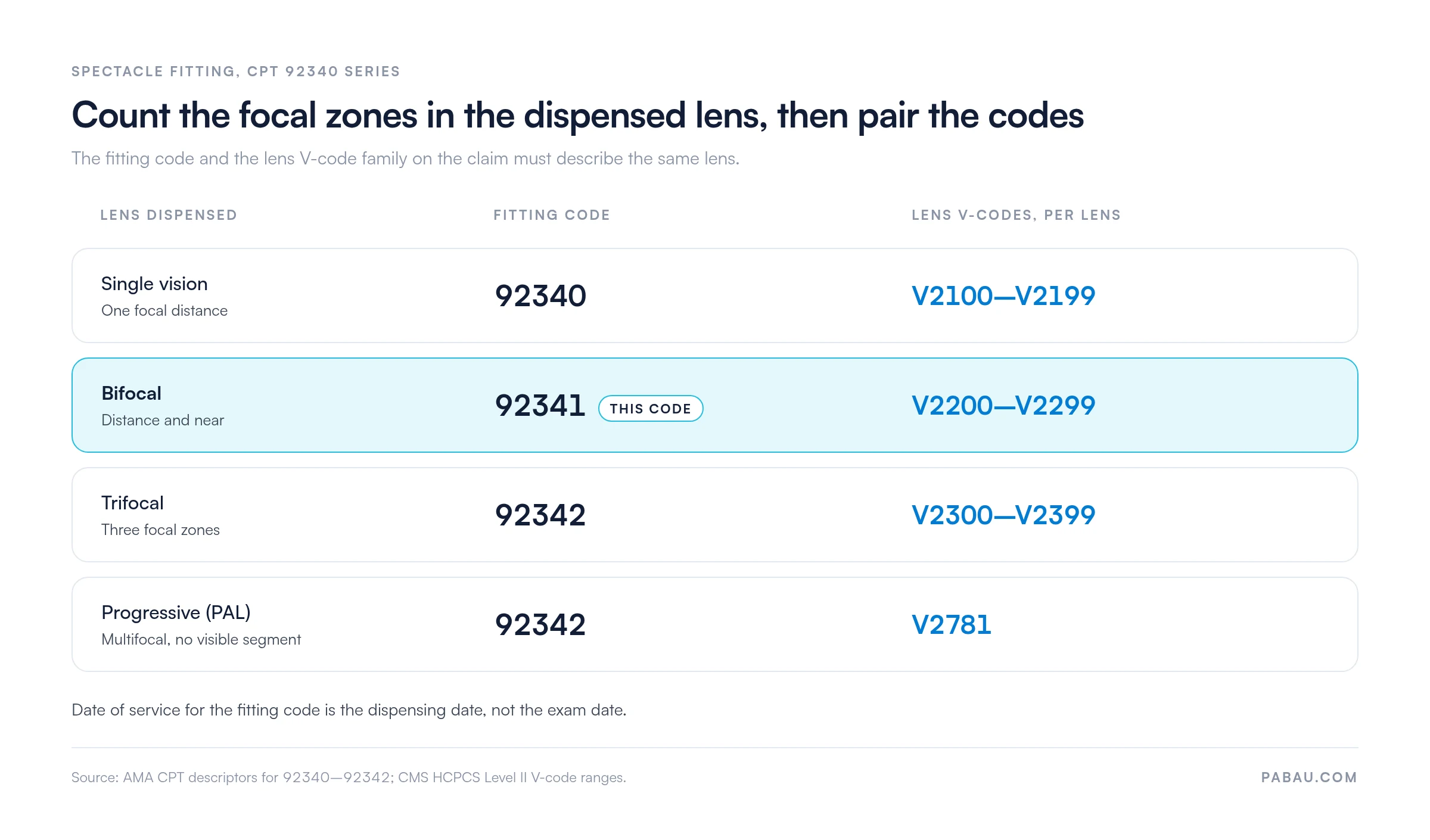
Every 92341 claim should carry at least one bifocal V-code for the lens supply. The V-code names the lens power range dispensed, starting at V2200 for low sphere powers.
A full pair means two lens lines. Add-ons such as a coating or a photochromic treatment get their own lines on top. HCPCS codes and payer allowances change from year to year, so check the CMS fee schedule and your plan contracts each January.
Most denials on this code start before anyone opens the claim form. This is the path a clean bifocal claim takes.
Add a modifier only when the circumstances change the service or the payer’s coverage decision.
Leave off the LT and RT laterality modifiers. A spectacle fitting covers both eyes by nature, so they don’t apply to 92341.
Medicare Part B excludes routine vision care, and spectacle fitting falls inside that exclusion. Coverage then depends on who the patient’s glasses are billed to.
The Medicare Physician Fee Schedule carries 92341 as a non-covered service, so there’s no Medicare payment rate to work from. Look up the status yourself in the CMS fee schedule search tool each year.
What you collect comes from your commercial and vision-plan contracts, and in some states from the Medicaid fee schedule. Vision plans often process fitting under the vision benefit rather than the medical benefit. Check which fee schedule applies before you set the patient’s share.
Run through this list at charge entry. Each item maps to one of the denial patterns or audit findings covered below.
A missing segment height is the item reviewers notice first. Without it, the fitting looks no different from a patient collecting ready-made readers, which isn’t billable.
The fitting can’t be finished until the patient has the finished glasses on. Measurements taken at the exam are part of ordering, while the verification and adjustment happen at dispensing. That’s why the exam date is the wrong date of service, and it’s a common audit finding in optometry billing.
Most 92341 denials fall into six patterns, and each one has a clear fix. A steady denial management routine tracks them across your whole 92340-series volume.
Read each explanation of benefits (EOB) or electronic remittance at the CARC level, so you can see which of the six patterns keeps coming back. Then note the fix you made, so the same error doesn’t return in the next billing cycle.
Run a monthly report of 92340-series claims grouped by denial reason code. When the same CARC keeps showing up, such as CO-97 for bundling or CO-4 for a modifier problem, fix the charge entry step. Chasing each remittance one at a time won’t stop the next one.
In many eye care practices, the exam and the dispensing visit live in different places. The claim is typed into a clearinghouse portal, and remittances are matched to it by hand.
Pabau’s practice claims management software keeps that work on the patient record. In the US, CMS-1500 and 837P claims go out through the Claim.MD clearinghouse. You can run eligibility checks before the lab order, send secondary claims, and receive ERA remittances back.
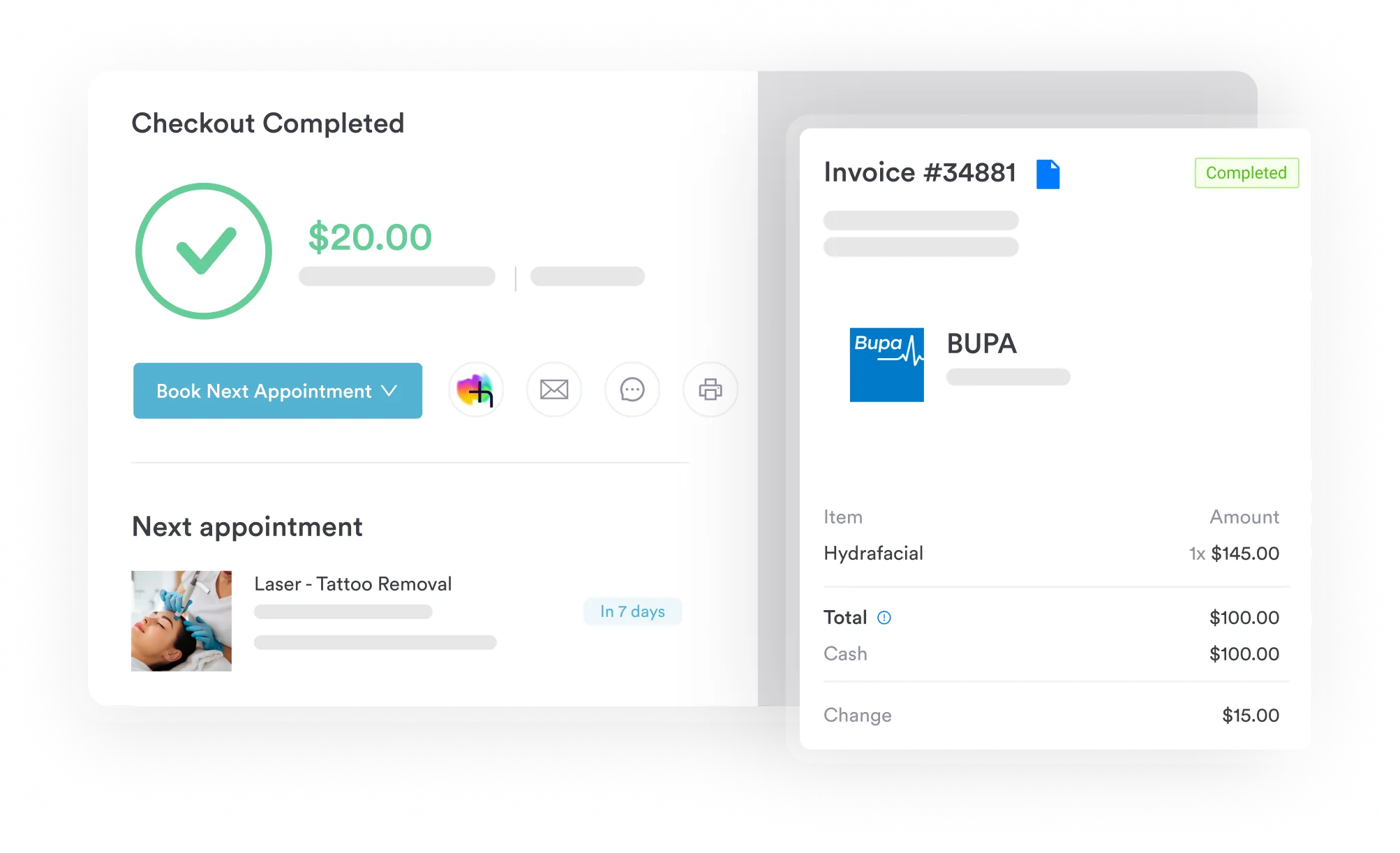
The outcome is fewer surprises after dispensing. Coverage is known before the glasses are ordered, and denials come back as electronic remittances instead of paper EOBs.

Pabau sends US claims through Claim.MD, runs eligibility checks before you order the glasses and brings ERA remittances back. Your team tracks each 92341 claim from submission to payment.

92341 is a small fee, but a denied one costs more staff time than it ever pays. If you change one habit, make it a lens check at charge entry. Look at the lab order, count the focal zones, and confirm the V-codes match before the claim goes out.
For Medicare patients, settle coverage before the lab order rather than after the denial. A quick IOL question at the exam saves an awkward conversation at pickup.
Book a demo to see how Pabau handles eligibility, claims and remittances for your optical dispensing.

Need a clearinghouse for your optical claims? Our Claim.MD clearinghouse guide explains how claims travel from your practice software to the payer.
Confused by the 837 claim format for vision billing? The 837 EDI transaction guide walks through how optical practices structure electronic claims for submission.
Billing the refraction from the same exam? CPT code 92015 covers the refraction that produces the bifocal prescription.
Want claims accepted on the first pass? Our clean claim guide lists the checks that stop a rejection before submission.
Want to reduce denials across your full billing operation? Our revenue cycle management overview covers the end-to-end process from eligibility verification through payment posting.
No. Reading glasses have one focal distance, so their fitting is 92340, with single-vision V-codes for the lenses. 92341 applies only when the lens carries both distance and near zones.
Repair and refitting of spectacles has its own code, 92370, and 92371 covers the same work on an aphakia prosthesis. Bill 92341 again only when you fit a new pair of bifocals.
Yes, when the glasses are dispensed and verified that day, which usually means stock lenses. The exam and refraction are billed with their own codes, and the fitting notes must be complete.
Use the refractive diagnosis behind the prescription. Presbyopia, H52.4, is the most common reason for bifocals, often alongside a myopia, hyperopia or astigmatism code.
Optometrists and ophthalmologists bill it most often, and some payers and states also allow dispensing opticians. Vision plans keep their own provider lists, so check credentialing before you bill.