HCPCS Code V5095: Semi-implantable middle ear hearing prosthesis
HCPCS Code V5095: Definition and clinical descriptor HCPCS Code V5095 is the Lev...

Last Updated: Nov 25, 2026
V2214 is the HCPCS Level II code for one spherocylinder bifocal lens with a sphere power over plus or minus 12.00 diopters, billed per lens. It covers any cylinder value at that sphere power, so the sphere on the prescription alone decides the code.
Medicare Part B covers V2214 only for pseudophakia, aphakia or congenital aphakia, with one pair after each cataract surgery with an intraocular lens. Routine vision correction is excluded, and Medicaid and commercial coverage varies by plan.
Let Pabau's smart automation suggest the right codes, reduce claim denials, and keep your practice compliant—effortlessly.
Automate repetitive tasks and focus on what matters most—your patients.
Reduce coding errors and ensure compliance with the latest regulations.
Clean claims, fewer denials, and faster reimbursements.
Powerful insights and reporting to help your practice thrive.
HIPAA compliant SOC 2 certified GDPR-compliant Trusted by 4,000+ clinics worldwide

HCPCS Code V2214 covers one spherocylinder bifocal lens with a sphere power over ±12.00D, at any cylinder value.
V2214 is billed per lens, so a pair goes on two claim lines, one with RT and one with LT.
Medicare covers V2214 only for pseudophakia, aphakia or congenital aphakia, with one pair after each cataract surgery with an IOL.
V2215, V2218, V2219 and V2220 are add-ons billed on top of V2214, never in its place.
Pabau’s claims management software keeps the prescription, diagnosis and claim on one patient record, so lens claims go out complete.
HCPCS Code V2214 is the billing code for one spherocylinder bifocal eyeglass lens with a sphere power over plus or minus 12.00 diopters. The descriptor in CMS’s January 2027 HCPCS file reads “Spherocylinder, bifocal, sphere over plus or minus 12.00d, per lens.”
The code sits in the HCPCS Level II V2200-V2299 range of bifocal lenses, glass or plastic. The Centers for Medicare and Medicaid Services (CMS) maintains the code set.
“Spherocylindrical” means the lens corrects a spherical refractive error (nearsightedness or farsightedness) and a cylindrical one (astigmatism). “Bifocal” means it adds a reading segment for near vision.
Unlike the codes below it, V2214 sets no cylinder band, so any cylinder value bills to V2214 once the sphere passes ±12.00D. It is billed per lens, one line for each eye, not per pair.
The spherocylinder bifocal codes run from V2203 to V2214, and two values on the prescription pick the code. The sphere power picks the row, and the cylinder power picks the code within it. V2214 is the top row, and the only one with no cylinder bands, as the grid below shows.
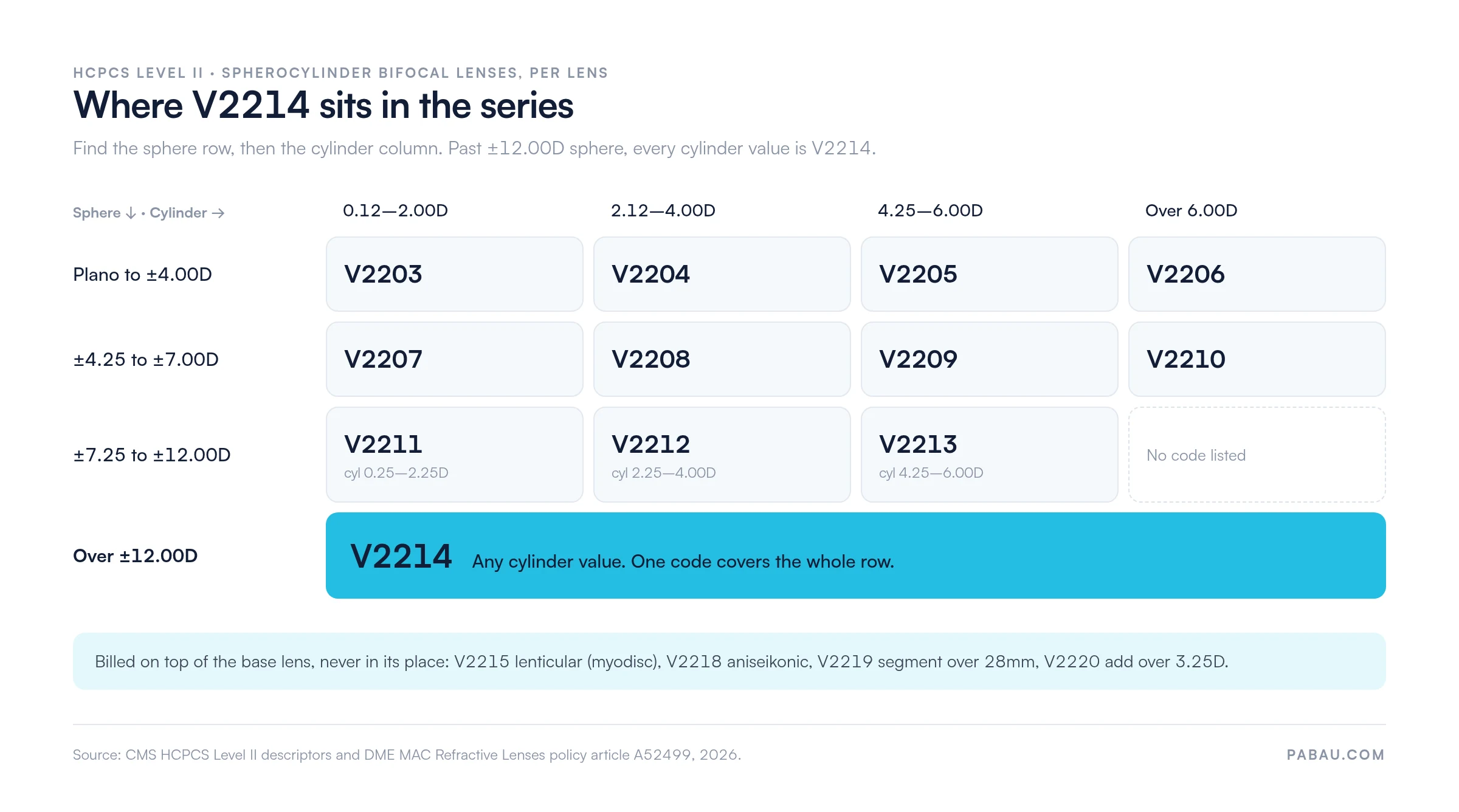
Add power does not change the base code. A bifocal add over 3.25D is reported with V2220 on top of V2214, and a lenticular or aniseikonic design adds V2215 or V2218. Medicare’s Refractive Lenses policy article lists all four as add-on features, billed in addition to the basic lens.
Practical rule: Read the sphere value first. At exactly ±12.00D the lens is V2213 or one of its two neighbors, depending on the cylinder. At ±12.25D or more it is V2214. Keep the dated prescription on file, since it is the record that proves which band the lens falls in.
Medicare Part B covers HCPCS Code V2214 under the prosthetic devices benefit, and only for a patient who lacks the natural lens of the eye. Covered diagnoses are limited to pseudophakia, aphakia and congenital aphakia. Under Social Security Act Section 1862(a)(7), eyeglasses for routine vision correction are excluded.
For a patient with pseudophakia, coverage is limited to one pair of eyeglasses after each cataract surgery with an intraocular lens (IOL). Replacement lenses are noncovered. A patient who has both eyes operated on, with no glasses dispensed in between, gets one pair after the second surgery.
Claims go to the Durable Medical Equipment Medicare Administrative Contractor (DME MAC) for the beneficiary’s state. Noridian runs Jurisdictions A and D, and CGS Administrators runs Jurisdictions B and C for the rest of the country. All four apply the same Refractive Lenses LCD (L33793) and its policy article, so check both before you bill.
Run insurance eligibility verification for every beneficiary before you dispense a V2214 lens under Medicare. A patient with no cataract surgery or aphakia in the billed eye has no covered benefit for this code.
Every V2214 line carries RT or LT. When both lenses use V2214, bill two lines with one unit each, RT on one and LT on the other. A single line with RTLT and two units is rejected as incorrect coding.
The KX modifier does not go on V2214 itself. Under the policy article, KX belongs on add-ons such as anti-reflective coating (V2750), tints (V2744, V2745) and oversize lenses (V2780). It applies only when the treating practitioner documents medical necessity for that feature.
Medicaid coverage of HCPCS Code V2214 varies by state. Medicaid is state-administered, and each state sets its own optical benefit for adults. Some states cover bifocal spectacle lenses for adults, while others limit optical benefits to children under EPSDT, cap frequency, or exclude bifocal designs. Check the state Medicaid agency or provider portal before billing.
Commercial health plans set their own optical benefits, independent of Medicare and Medicaid rules. A plan may cover V2214 for routine vision correction, pay a fixed allowance, require prior authorization, or exclude spectacle lenses. Get a benefits verification for the member’s plan and benefit year.
Every V2214 claim needs a diagnosis code that supports it. For Medicare, the policy article lists six: Z96.1, H27.00 to H27.03, and Q12.3. Medicare denies any other diagnosis on a V2214 line as noncovered. Commercial and Medicaid plans usually accept refractive error codes instead.
Use the most specific code the record supports, and match the eye on the diagnosis to the RT or LT on the line. An unsupported diagnosis is one of the most frequent denial triggers on V2214 claims.
Before submitting, check the sphere value against the V2214 band and pair the line with the most specific diagnosis. Z96.1 covers the Medicare post-cataract case. H52.221 and H52.4 together cover a commercial bifocal-with-astigmatism claim. Keep the prescription and the diagnosis in the patient record.
Documentation decides whether a V2214 claim survives an audit or a post-payment review. Billing compliance documentation has to support every element of the claim before it goes out.
Keep the documentation in the patient’s record for the payer’s retention period, which is seven years from the date of service for Medicare. One missing document can lead to a full recoupment on audit.
V2214 claims get denied for a small set of repeating reasons. Finding the denial reason and fixing the root cause is faster than resubmitting blind. Effective denial management strategies start with tracking denial patterns by code, not by individual claim.
Our guide to common denial codes explains how to read remittance advice remark codes on a returned claim.
Medicare pays HCPCS Code V2214 from the DMEPOS fee schedule, which CMS updates each year and prices by state. The allowable in a Jurisdiction A state (Noridian) may differ from one in a Jurisdiction C state (CGS Administrators). A dollar figure printed here would go out of date at the next annual update.
Download the current DMEPOS fee schedule from CMS.gov and look up V2214 for the beneficiary’s state. The figure is the Medicare allowed amount, the most the program pays before the 20% coinsurance the beneficiary or a secondary payer owes.
For Medicaid rates, check the state Medicaid fee schedule directly, because each state publishes its own optical rates. For commercial plans, the contracted rate in the provider agreement governs.
Use the AAPC Codify HCPCS lookup or the PGM Billing HCPCS lookup tool to confirm the descriptor. Both pull from CMS data and show whether the code is active in the billing year.
Pull the DMEPOS fee schedule for V2214 each January, when CMS publishes the annual update, and recheck it at each quarterly release. Store the current allowable in your fee schedule reference file, so your billing team quotes accurate patient responsibility amounts.
A clean HCPCS Code V2214 claim takes seven checks before it reaches the payer. Build them into the pre-submission routine, so they do not wait for rework after a denial.
Running a structured clean claim checklist before each submission cycle catches these errors before they turn into denials.
V2214 covers the base lens itself, in glass or plastic. It applies to new prescriptions, prescription changes and post-cataract initial dispensing, plus replacements where a commercial plan covers them.
What the code does not include:
An optical billing team checks the same facts on every V2214 claim: the sphere value, the eye, the diagnosis and the surgery date. Those facts often sit in three places, the prescription, the clinical note and a separate billing screen.
Pabau, a practice management platform with built-in billing, keeps the clinical record and the claim in one system. With its optical practice claims software, the team submits claims, checks eligibility, tracks claim status and posts remittances from the patient record.
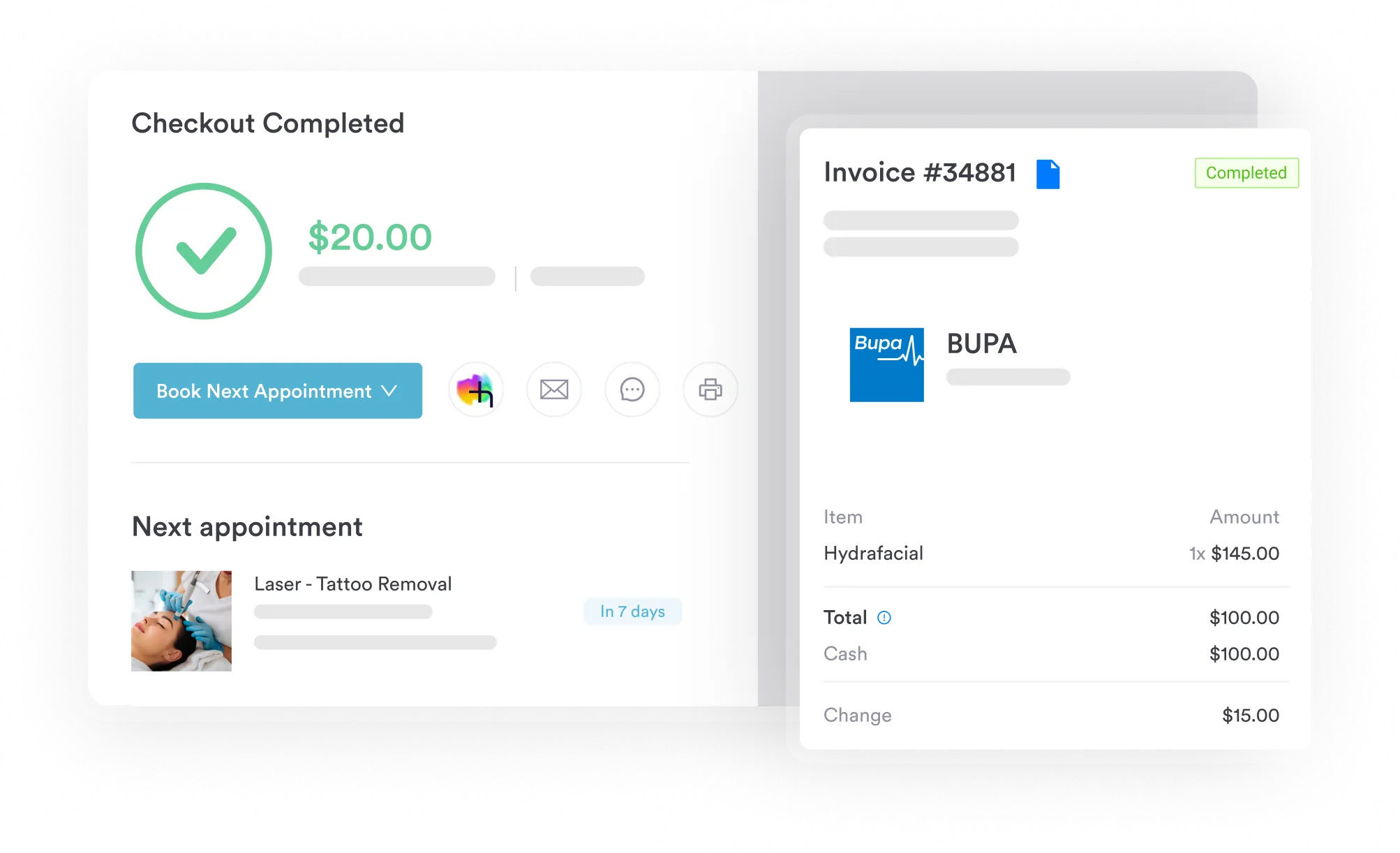
With the prescription and diagnosis beside the claim, a biller can confirm the sphere band and the eye before submission. That keeps high-power lens claims out of the rework queue.

Pabau’s claims management software submits claims, checks eligibility and posts remittances against the patient record. Your optical billing team sends complete lens claims the first time.

V2214 is one of the easier codes in the bifocal series to assign, because the cylinder value stops mattering once the sphere passes ±12.00D. The risk sits around the code: the eye modifier on each line, a diagnosis Medicare accepts, and add-ons kept on their own lines.
Settle those at the point of dispensing and the claim rarely comes back. Book a demo to see how Pabau keeps prescriptions, diagnoses and lens claims in one record for your optical billing team.

Need a broader medical billing foundation? Medical billing fundamentals covers the revenue cycle from charge capture through payment posting.
Billing a lower sphere power? HCPCS code V2211 covers the ±7.25 to ±12.00D bifocal band with the lowest cylinder range.
Dispensing a progressive design? HCPCS code V2781 explains how the progressive add-on line is billed alongside the base lens.
HCPCS Code V2214 covers one spherocylinder bifocal eyeglass lens with a sphere power over plus or minus 12.00D, at any cylinder value. It covers the base lens in glass or plastic. Frames, coatings, tints, progressive upgrades and lenticular designs are billed on separate lines.
Only when the patient was born without a natural lens (congenital aphakia). Medicare covers V2214 under the prosthetic devices benefit for pseudophakia, aphakia and congenital aphakia. Routine vision correction is excluded under Social Security Act Section 1862(a)(7), so a lens for any other diagnosis is denied as noncovered.
V2213 covers a sphere of ±7.25 to ±12.00D with 4.25 to 6.00D of cylinder. V2214 covers any sphere over ±12.00D, whatever the cylinder value. The sphere on the prescription decides between them, so a lens at exactly ±12.00D is never V2214.
No. Medicare’s Refractive Lenses policy article puts KX on add-ons such as V2750, V2744, V2745 and V2780 when medical necessity is documented. The V2214 line itself needs RT or LT, with one unit per line and a separate line for each eye.
Medicaid reimbursement for V2214 varies by state, because each state runs its own program. Some states cover adult bifocal lenses, while others limit optical benefits to children under EPSDT or cap frequency. Check the state’s Medicaid provider manual or optical fee schedule before billing.
For Medicare, only six codes support V2214: Z96.1, H27.00, H27.01, H27.02, H27.03 and Q12.3. Commercial and Medicaid plans usually accept refractive codes such as H52.221, H52.222, H52.4, H52.11, H52.12 and H52.31. Check the payer’s policy before submitting.