CPT code 59618: Cesarean after attempted VBAC billing guide
CPT code 59618 bills a cesarean after a VBAC attempt CPT code 59618 is the globa...

Last Updated: Nov 4, 2026
V2213 is the HCPCS Level II code for one spherocylinder bifocal spectacle lens. Its sphere runs ±7.25 to ±12.00D and its cylinder 4.25 to 6.00D.
Billers confuse it most often with V2211 and V2212, which share its sphere band and split only on cylinder. Medicare pays it under the DMEPOS fee schedule. Part B covers it only after cataract surgery, never as routine vision care.
Let Pabau's smart automation suggest the right codes, reduce claim denials, and keep your practice compliant—effortlessly.
Automate repetitive tasks and focus on what matters most—your patients.
Reduce coding errors and ensure compliance with the latest regulations.
Clean claims, fewer denials, and faster reimbursements.
Powerful insights and reporting to help your practice thrive.
HIPAA compliant SOC 2 certified GDPR-compliant Trusted by 4,000+ clinics worldwide

V2213 reports one spherocylinder bifocal lens with a sphere of plus or minus 7.25 to 12.00D and a cylinder of 4.25 to 6.00D.
The same sphere band splits by cylinder: V2211 covers 0.25 to 2.25D and V2212 covers 2.25 to 4.00D. A sphere over plus or minus 12.00D moves to V2214.
Medicare Part B covers spectacle lenses only after cataract surgery that results in aphakia or pseudophakia. Routine eyeglasses are excluded under Section 1862(a)(7) of the Social Security Act.
Every V2213 claim line carries an RT or LT modifier, one lens per line. A missing side modifier is a leading denial trigger.
Pabau’s claims management software helps practices check HCPCS codes, track modifiers, and monitor claim status before submission.
HCPCS code V2213 is the Level II code for one spherocylinder bifocal spectacle lens. The official descriptor reads: “Spherocylinder, bifocal, plus or minus 7.25 to plus or minus 12.00d sphere, 4.25 to 6.00d cylinder, per lens.”
CMS publishes and maintains the full HCPCS Level II code set. Our HCPCS codes library indexes the neighboring V-series lens codes alongside V2213.
The descriptor matters because the V-series groups spectacle lenses by lens type first, then by power range. Single-vision lenses sit in V2100 to V2199, bifocals in V2200 to V2299, and trifocals in V2300 to V2399.
V2213 sits in the bifocal range, in the high sphere band and the upper cylinder band. Bill a different code and the claim describes a lens that does not match the patient’s prescription. That is both a compliance issue and a claim problem.
Verify the current descriptor at the CMS HCPCS Release and Code Sets page, which publishes annual updates every January. The descriptor language above reflects the standard CMS specification. Your DME MAC’s Local Coverage Determination adds the documentation rules for each claim.
V2213 belongs to the bifocal spherocylinder series, which CMS splits first by sphere power and then by cylinder power. A wrong code is a frequent technical denial in spectacle lens billing. The thresholds look alike until you read them to the quarter diopter.
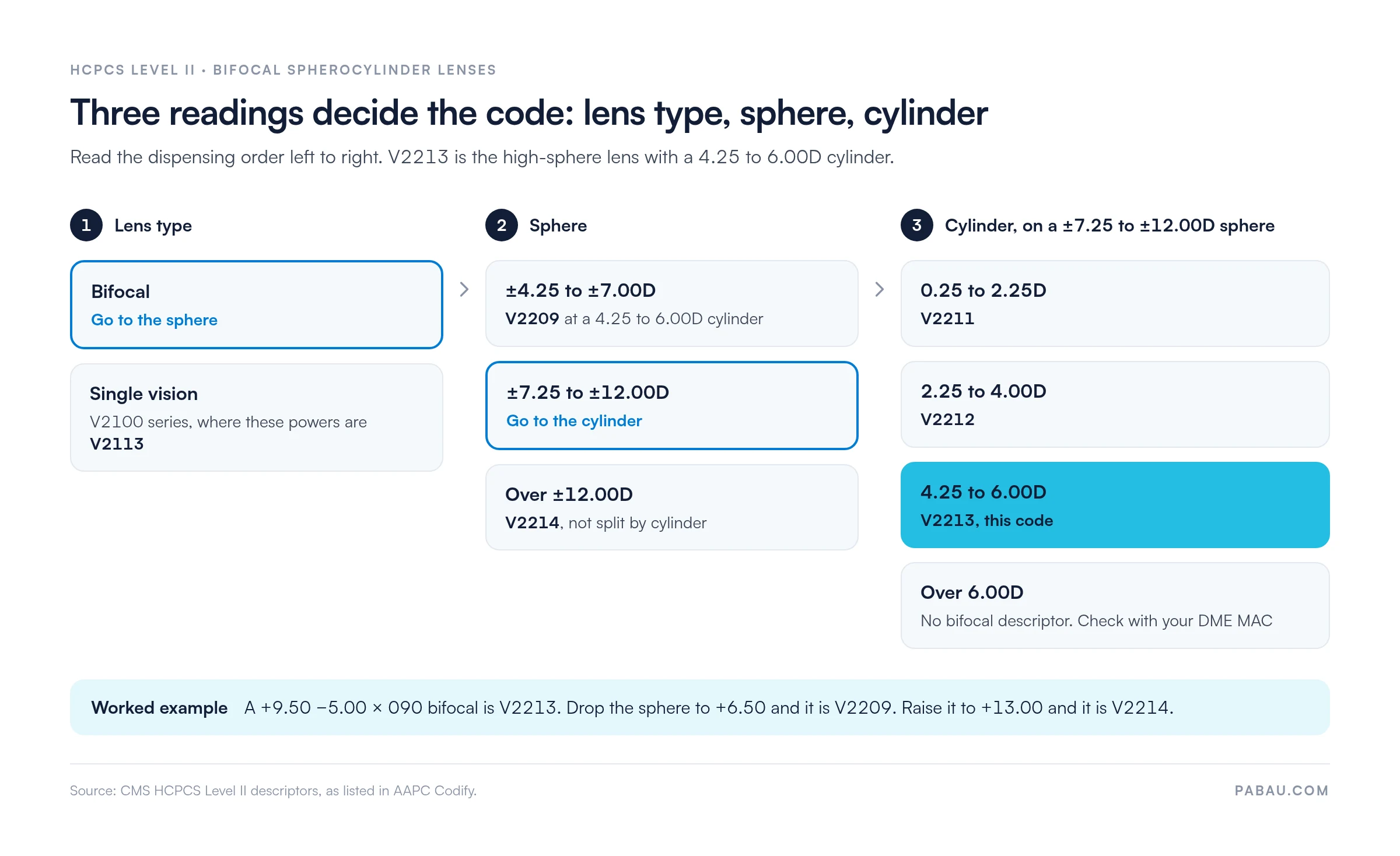
The practical decision rule runs in three steps. First, confirm the lens is a bifocal. A single-vision spherocylinder lens codes in the V2100 series instead, and the single-vision twin of V2213 is V2113.
Second, read the sphere: plus or minus 7.25 to 12.00D keeps you in V2211 to V2213, and anything over 12.00D is V2214. Third, read the cylinder, where 4.25 to 6.00D lands in V2213 and 2.25 to 4.00D lands in V2212.
A bifocal lens of +9.50 −5.00 × 090 is V2213. The same cylinder on a +6.50 sphere drops to V2209, and on a +13.00 sphere it moves to V2214. No bifocal descriptor covers a cylinder over 6.00D on a sphere of 7.25 to 12.00D. Check that case with your DME MAC before you bill. Descriptor ranges are as published by CMS and listed in AAPC Codify.
Taken together, the three readings form a short decision path, and the chart below follows it from lens type to code.
V2213 applies to one spherocylinder bifocal ophthalmic lens, dispensed as part of medically necessary spectacles. The code is per lens, so a pair is billed as two lenses. It does not cover lens coatings (anti-reflective, photochromic, UV), frames, or fitting services. Each of those carries its own code or sits in the dispenser’s pricing outside the claim.
Lens types that fall outside V2213:
Material type (glass, standard plastic, polycarbonate, high-index) is not part of the V2213 descriptor itself. Some MACs and private payers ask billers to document the material in the claim record. The code selection still follows the power range, not the material.
CMS and MAC Local Coverage Determinations require specific documentation before a V2213 claim is processed. Missing any of these is the fastest route to a denial. Pabau’s claims management software lets optical practices track documentation checklists per claim so nothing is submitted incomplete.
Required documentation typically includes:
Keep all supporting documentation for at least seven years. DME MAC audits for optical supplies are routine. A common finding is a proof-of-delivery record that does not match the dispensing date on the claim.
Medicare Part B excludes routine vision care, including standard eyeglasses for refractive error, under Section 1862(a)(7) of the Social Security Act.
V2213 claims are therefore denied for most Medicare beneficiaries, with one narrow exception. The patient had cataract surgery that resulted in aphakia (lens removed, no replacement) or pseudophakia (intraocular lens implanted).
In those cases, the lenses fall under the prosthetic devices benefit in Section 1861(s)(8) of the Social Security Act. After cataract surgery with an intraocular lens, coverage is limited to one pair of eyeglasses or contact lenses per surgery. The DME MAC Refractive Lenses LCD (L33793) and its Refractive Lenses policy article (A52499) set the claim rules.
Key Medicare coverage conditions for V2213:
Private payer rules vary widely. Some commercial plans cover spectacle lenses as a vision benefit regardless of surgical history. Others mirror Medicare’s post-surgical requirement.
Always verify coverage and any prior authorization requirements with the specific plan before dispensing. Private payer contracts can add their own rules on top of what Medicare requires.
Medicare reimburses HCPCS code V2213 under the Durable Medical Equipment, Prosthetics, Orthotics and Supplies (DMEPOS) fee schedule. CMS updates this schedule annually, typically effective January 1. Fee schedule amounts differ by state. For current figures, download the CMS DMEPOS fee schedule files and look up V2213 for your state.
A few practical points about reimbursement:
The DMEPOS fee schedule changes every year and varies by state, so a dollar figure copied into a patient price list goes stale fast. Confirm the allowed amount against the current CMS rate file before you quote a patient or submit the claim.
V2213 denials cluster around four root causes: wrong payer type, missing or invalid documentation, incorrect code selection, and modifier errors. Knowing the exact cause lets billing staff fix and resubmit the same day rather than spending a week investigating.
For systemic denial patterns across multiple claims, review your denial management workflow. The root cause is usually missing documentation, a coder training issue, or a payer-specific policy change. Most DME MAC denials are reversible on first appeal when the documentation is clean.
Confirm modifier requirements against your DME MAC’s current LCD and policy article before submission. Both change with annual updates, and a modifier that was optional in a prior year may become required the following January.
Before submitting any V2213 claim to Medicare, confirm that the patient’s DME MAC is the correct filing destination. Optical practices sometimes route spectacle lens claims to the professional MAC out of habit. DMEPOS claims go to the DME MAC assigned to the patient’s state of residence, not the state where the practice is located. Routing to the wrong MAC results in an automatic rejection that requires a full resubmission.
Manual HCPCS code selection invites errors because the V-series power thresholds sit close together. Coders often work from prescription printouts, with the surgical record and the delivery receipt filed somewhere else.
Billing software that keeps those documents with the claim catches problems at the point of entry, before a denial arrives.
Pabau’s claims management tools help optical practices in four ways:
Understanding how medical billing workflows connect prescription documentation to claim submission is especially useful for optical practices that are new to DMEPOS billing.
The cleaner the front-end process, the less rework lands on the billing team’s desk. Clean claims submitted with complete documentation are far less likely to generate the denial patterns detailed in the section above.

Pabau’s claims management software helps optical and specialty practices submit clean HCPCS claims, monitor denial patterns, and resolve outstanding balances. Your billing team spends less time chasing payments.

V2213 is one cell in a grid, and the dispensing order decides which cell, not the frame or the material. Code from the sphere and cylinder on that order, and the claim matches the lens the patient received.
For Medicare patients, the bigger risk sits upstream of the code. Without the cataract surgery record, a correctly coded V2213 lens is still a non-covered pair of glasses. Build the operative note, the RT and LT lines, and the DME MAC routing into the dispensing step. Then medical billing compliance stops depending on memory.
To see how Pabau keeps prescriptions, surgical notes, and claim status on one patient record, book a demo.

Need a primer on how HCPCS codes are structured and maintained? Medical billing fundamentals explains how HCPCS Level I and Level II codes differ and how payers process each claim type.
Getting repeated denials across multiple claim types? Clean claim requirements walks through the pre-submission checks that reduce denials before they start.
Billing a high-minus bifocal instead? HCPCS code V2215 covers the lenticular myodisc bifocal lens and how it is documented.
HCPCS code V2213 covers one spherocylinder bifocal spectacle lens. The sphere power is plus or minus 7.25 to 12.00 diopters, and the cylinder power is 4.25 to 6.00 diopters. It is billed per lens and does not include frames, coatings, contact lenses, single-vision lenses, or progressive lenses.
Yes, but only in a narrow circumstance. Medicare Part B covers one pair of spectacle lenses or contact lenses after each cataract surgery that results in aphakia or pseudophakia. Routine vision care, including eyeglasses for refractive error, is excluded under Section 1862(a)(7) of the Social Security Act. Outside that post-surgical benefit, Medicare denies V2213 claims.
Both are spherocylinder bifocal codes, but they split on sphere power. V2213 covers a sphere of plus or minus 7.25 to 12.00 diopters with a cylinder of 4.25 to 6.00 diopters. V2214 covers any sphere over plus or minus 12.00 diopters, and its descriptor sets no cylinder band. Read the sphere on the dispensing order first, then the cylinder.
The most common reasons are a missing or incomplete written order and a claim routed to the wrong MAC. Spectacle lens claims belong with the DME MAC, not the professional MAC. Medicare claims also fail without documentation of the underlying cataract surgery. Other causes are a missing RT or LT modifier and lens powers outside the V2213 bands. Most of these denials are correctable on resubmission when the documentation is complete.
Every V2213 line needs RT (right side) or LT (left side), with 1 unit per line, as the DME MAC Refractive Lenses policy article requires. Modifier GA is appended when the patient has signed an Advance Beneficiary Notice because coverage is uncertain. Some payers also expect NU (new equipment). Confirm the full requirement with your DME MAC’s Local Coverage Determination and the payer’s own rules.
Yes. When the two eyes need lenses in different power bands, bill each lens on its own line. Give it its own code and an RT or LT modifier. For example, one eye might need V2213 and the other V2212. When both lenses fall in the V2213 bands, bill V2213 on two lines, one with RT and one with LT.