HCPCS Code V5095: Semi-implantable middle ear hearing prosthesis
HCPCS Code V5095: Definition and clinical descriptor HCPCS Code V5095 is the Lev...

Last Updated: Nov 25, 2026
V2204 is the HCPCS Level II code for spherocylinder, bifocal, plano to plus or minus 4.00d sphere, 2.12 to 4.00d cylinder, per lens.
Most denials for HCPCS Code V2204 trace back to two errors. Billers pick the wrong cylinder band from the V2200 series, or submit without RT or LT modifiers.
Let Pabau's smart automation suggest the right codes, reduce claim denials, and keep your practice compliant—effortlessly.
Automate repetitive tasks and focus on what matters most—your patients.
Reduce coding errors and ensure compliance with the latest regulations.
Clean claims, fewer denials, and faster reimbursements.
Powerful insights and reporting to help your practice thrive.
HIPAA compliant SOC 2 certified GDPR-compliant Trusted by 4,000+ clinics worldwide

HCPCS code V2204 bills one bifocal spherocylinder (toric) lens. Its sphere runs from plano to plus or minus 4.00D, and its cylinder from 2.12D to 4.00D.
The cylinder picks the code. A cylinder of 2.00D or less is V2203, 4.25D to 6.00D is V2205, and over 6.00D is V2206.
Medicare Part B covers V2204 only after cataract surgery, as a prosthetic device exception under SSA Section 1861(s)(8).
Claims require an RT or LT modifier, a valid written prescription, and an ICD-10-CM diagnosis code confirming medical necessity.
Pabau’s claims management tools help optical and ophthalmology practices track HCPCS code submissions and flag denial patterns before they recur.
HCPCS code V2204 describes one spherocylinder bifocal lens, also called a toric bifocal lens. The official descriptor in CMS’s October 2026 HCPCS file reads “Spherocylinder, bifocal, plano to plus or minus 4.00d sphere, 2.12 to 4.00d cylinder, per lens.”
It sits in the V2200 to V2299 bifocal range of the HCPCS Level II code set. That set is maintained by the Centers for Medicare and Medicaid Services (CMS).
Two numbers on the prescription decide the code. The sphere has to sit between plano and plus or minus 4.00D, and the cylinder between 2.12D and 4.00D. A lens that misses either band belongs under a different code. Rounding a value to fit V2204 is a common cause of denial on edit review.
V2204 covers the base bifocal lens, in glass or plastic, for a prescription that carries both a sphere and a cylinder inside the bands above. The cylinder corrects astigmatism, so V2204 is a toric lens rather than a pure sphere. The segment style, such as a flat-top 28 or a round segment, does not change the code.
Coating and frame codes are billed on separate claim lines, not bundled into V2204. Submitting a single V2204 line and expecting frame reimbursement is a common first-year biller error. The add power for the reading segment plays no part in choosing the code.
The bifocal codes work like a grid. V2200 to V2202 are sphere-only lenses, split by sphere power. V2203 to V2210 add a cylinder, where the sphere picks the row and the cylinder picks the band inside it. V2204 sits in the low-sphere row, in the second cylinder band, as the grid below shows.
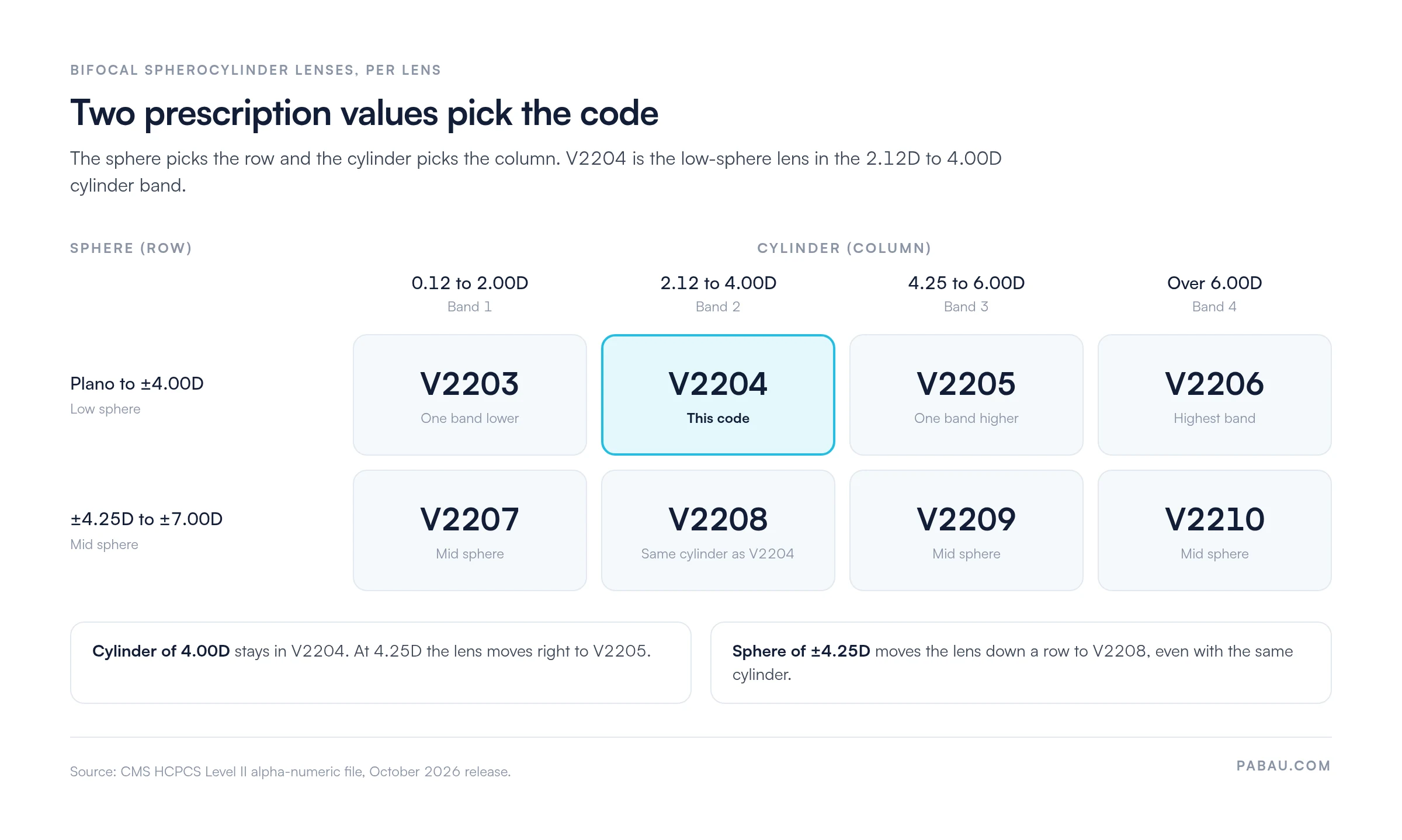
Most common mix-up: V2203, V2204, V2205, and V2206 all share the plano to plus or minus 4.00D sphere range, so only the cylinder separates them. A cylinder of exactly 4.00D stays in V2204, while 4.25D moves to V2205. A cylinder of 2.00D or less drops to V2203.
Second mix-up: V2204 and V2208 share the 2.12D to 4.00D cylinder band, so the sphere decides between them. A sphere of plus or minus 4.25D or more moves the lens to V2208. Read the sphere first, then the cylinder, ignoring its sign, and code from the written prescription rather than a previous claim.
Transposition trap: Converting a prescription between plus-cylinder and minus-cylinder form keeps the cylinder size but changes the sphere. For example, -1.00 -3.00 x 180 transposes to -4.00 +3.00 x 090, and both forms stay in V2204. But -1.50 -3.00 x 180 transposes to -4.50 +3.00 x 090, which reads as V2208 instead. Code from the form on the lab order, and keep the prescription on file in that same form.
Medicare Part B covers V2204 only under the prosthetic device exception in Social Security Act Section 1861(s)(8). The CMS Medicare Benefit Policy Manual describes it in Chapter 15, Section 120. Coverage is restricted to patients who have had cataract surgery and require spectacle lenses as a prosthetic replacement for the natural lens.
Routine vision correction is explicitly excluded. A patient who has never had cataract surgery cannot receive Medicare reimbursement for V2204, regardless of prescription strength.
Z96.1 is the workhorse diagnosis code for post-cataract V2204 claims. If the patient had a standard phacoemulsification with IOL insertion, Z96.1 paired with V2204 and the correct RT or LT modifier covers the documentation basis. Aphakia codes (H27.0x) apply when no intraocular lens was placed, which is less common today but still occurs in certain pediatric and high-risk surgical cases.
A V2204 claim is only as strong as the paperwork behind it, because the DMEPOS MAC can ask for the file in a post-payment review. Keep these documents on file before the claim goes out.
DMEPOS items also carry record-retention expectations. Optical supply records generally should be kept for seven years from the date of service, consistent with Medicare’s audit lookback window.
Run a weekly pre-submission audit. For every pending V2204 claim, confirm the written prescription, delivery receipt, and diagnosis code documentation are on file before the claim leaves the practice. A three-field pre-flight check takes under two minutes per claim, and it stops a missing document from turning into a denial.
V2204 is billed on a CMS-1500 form or its 837P electronic equivalent, routed to the DMEPOS MAC for the patient’s geographic region. Billing software such as Pabau, a practice management platform with built-in claims, checks the required claim fields before a claim is sent.
RT and LT modifier requirements vary by MAC jurisdiction. Confirm with the active local coverage determination for eyeglasses issued by your DMEPOS MAC before finalizing your modifier policy.
Some MACs treat missing RT/LT as a technical denial you can correct on resubmission. Others treat it as a coverage denial that needs a formal redetermination.
The Medicare reimbursement rate for V2204 is set through the CMS DMEPOS fee schedule, which updates annually and varies by MAC locality. No single national allowable applies to all regions. The rate depends on the supplier’s location and the fee schedule year.
Under Medicare Part B cost-sharing rules, Medicare pays 80 percent of the approved amount after the annual Part B deductible is met. The patient (or supplemental coverage) is responsible for the remaining 20 percent co-insurance. Use the CMS DMEPOS fee schedule files to find the current V2204 allowable for your DMEPOS MAC region.
Important: Do not rely on reimbursement figures from prior-year remittance advices for annual budget planning. CMS publishes the DMEPOS fee schedule each calendar year and updates it quarterly. Rates for high-index lenses and certain specialty bifocal configurations may differ from standard material rates under DMEPOS pricing rules.
Most V2204 rejections fall into one of the seven categories below. Check the remittance advice remark code after each denial to see which one applies. The reason codes themselves are explained in our guide to medical billing denial codes.
When a V2204 claim is denied and the denial appears incorrect, the first appeal level is a redetermination request to the DMEPOS MAC. Submit the redetermination within 120 days of the initial denial notice.
Track every V2204 denial by denial code in a simple log. When three or more claims share the same denial reason in a month, the cause sits in a step before the claim is built. Fix that step first, then appeal the claims it already affected.
Many commercial health plans and vision benefit plans also reference HCPCS V-codes directly. They use the same descriptors to define covered lens categories, but their rules differ from Medicare’s in four places.
Practices that bill both Medicare and commercial vision plans should keep separate billing rules for each plan type. That keeps Medicare documentation logic off a commercial claim with different requirements.
Use the AAPC HCPCS Level II code lookup and PGM Billing’s HCPCS lookup tool to verify current V2204 descriptors. Check for annual updates to the V2200 series before each benefit year starts.
Many optical practices still key each lens line by hand, copying the code, modifier, and diagnosis from the chart into a separate billing tool. Every copy is a chance to pick the wrong cylinder band, drop an RT or LT modifier, or link the wrong diagnosis.
Pabau’s claims management software pre-fills each claim from the patient record. HCPCS and ICD-10-CM lookups sit inside the claim form, and the form checks required fields before it can be sent. In the US, claims go out through Claim.MD from the same screen.
Your team then tracks each claim’s status in one place. A stalled V2204 lens claim gets traced before the filing window closes, and repeated denial reasons show up as a pattern instead of a surprise.

Pabau checks each lens claim’s required fields, including the RT or LT modifier, before it reaches the payer. Claim status sits in the same place, so repeated denial reasons show up early.

V2204 is a toric bifocal lens, and two prescription values decide it. A cylinder of 2.12D to 4.00D on a sphere no stronger than plus or minus 4.00D is V2204. A quarter diopter past either edge changes the code. Most V2204 denials come from that band slip or a missing RT or LT modifier.
Both errors are preventable when the billing template reads the written prescription directly. To see how Pabau keeps prescriptions, lens lines, and claim status in one optical billing workflow, book a demo.

Is the sphere stronger than plus or minus 4.00D? HCPCS code V2209 covers the mid-sphere bifocal with a 4.25D to 6.00D cylinder.
Looking for software that handles optical billing? Pabau claims management is built for multi-specialty practices managing HCPCS and CPT submissions in one workflow.
HCPCS Code V2204 covers one bifocal spherocylinder (toric) spectacle lens. The sphere runs from plano to plus or minus 4.00 diopters, and the cylinder from 2.12 to 4.00 diopters. It is billed as one unit per lens. It does not cover frames, coatings, progressive upgrades, trifocals, or routine vision correction.
V2204 covers a sphere from plano to plus or minus 4.00 diopters combined with a cylinder from 2.12 to 4.00 diopters. A cylinder of exactly 4.00 diopters still falls in V2204, while 4.25 diopters moves the lens to V2205. Always confirm both values from the written prescription before selecting the code.
Each lens is billed as a separate claim line with quantity 1. For both eyes, submit two V2204 lines, one with the RT modifier and one with the LT modifier. Never enter quantity 2 on a single line to cover both lenses.
Yes, but only under a narrow exception. Medicare Part B covers V2204 as a prosthetic device under Social Security Act Section 1861(s)(8) for patients who have had cataract surgery. Routine vision correction is excluded. The claim must be routed to the DMEPOS MAC, and the billing supplier must hold active DMEPOS enrollment.
All three are spherocylinder bifocal codes with a sphere from plano to plus or minus 4.00 diopters, so the cylinder separates them. V2203 covers a cylinder of 0.12 to 2.00 diopters, V2204 covers 2.12 to 4.00 diopters, and V2205 covers 4.25 to 6.00 diopters. A bifocal with no cylinder belongs in V2200 to V2202 instead.
The most common reasons are a cylinder or sphere outside the V2204 bands, a missing RT or LT modifier, and no documented cataract surgery. Others include an absent or non-compliant written prescription, a duplicate claim, and a supplier without DMEPOS enrollment. Each denial’s remittance remark code identifies the specific cause.
Yes, when both lenses fall in the V2204 bands. Bill two separate V2204 lines, one with RT and one with LT, both pointing to the supporting ICD-10-CM diagnosis code. If the other eye has a different cylinder, it gets its own code, such as V2203 or V2205.