CPT code 59618: Cesarean after attempted VBAC billing guide
CPT code 59618 bills a cesarean after a VBAC attempt CPT code 59618 is the globa...

Last Updated: Nov 4, 2026
V2220 is the HCPCS Level II code for bifocal add over 3.25d. It reports the reading segment of a bifocal lens when the add power exceeds +3.25D, billed per lens. It is an add-on, so it always sits on its own line beside the base bifocal lens code, V2200-V2214, V2215, V2218 or V2221.
A V2220 line billed without that base lens line, or for an add of +3.25D or less, gets denied. Original Medicare pays only when the lenses are a prosthetic device under SSA §1861(s)(8), after cataract surgery with an IOL or for aphakia.
Let Pabau's smart automation suggest the right codes, reduce claim denials, and keep your practice compliant—effortlessly.
Automate repetitive tasks and focus on what matters most—your patients.
Reduce coding errors and ensure compliance with the latest regulations.
Clean claims, fewer denials, and faster reimbursements.
Powerful insights and reporting to help your practice thrive.
HIPAA compliant SOC 2 certified GDPR-compliant Trusted by 4,000+ clinics worldwide

HCPCS Code V2220 reports a bifocal reading add over +3.25D, billed per lens
V2220 never stands alone: It goes on its own line beside the base bifocal code (V2200-V2214) that describes the lens power
V2221 is a different item, a lenticular bifocal lens, so the add power alone never decides between the two codes
Original Medicare pays for the lens only after cataract surgery or for aphakia, under the prosthetic device benefit in SSA §1861(s)(8)
Bill each eye on its own line with RT or LT and one unit, for both the base lens and the V2220 add
HCPCS Code V2220 is the Healthcare Common Procedure Coding System Level II code for a bifocal add over 3.25D, reported per lens. It describes a feature of the lens, the reading segment’s add power, rather than a complete lens. The base bifocal lens is billed with its own code, and V2220 is added beside it when the add exceeds +3.25D.
The code sits in the V2200-V2299 bifocal lens range maintained by the Centers for Medicare and Medicaid Services (CMS). Most presbyopic prescriptions carry an add between +1.00D and +3.00D, so V2220 shows up mainly on low-vision and high-reading-demand orders.
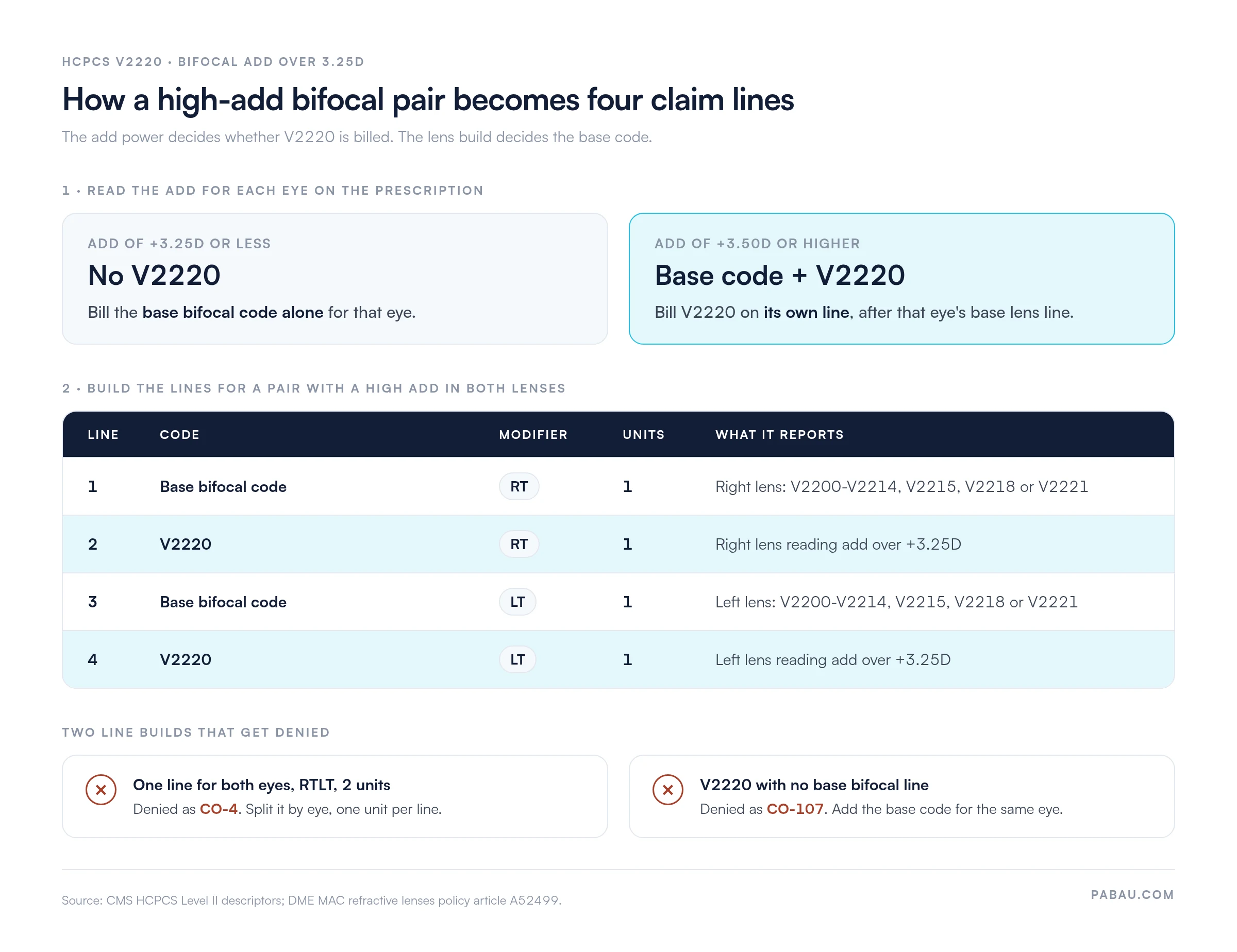
Because the code is billed per lens, a pair with a high add on both lenses produces four claim lines. Each eye gets a base bifocal line and a V2220 line, each carrying RT or LT and one unit, as the diagram below lays out.
V2220 covers the extra work of grinding a bifocal reading segment with an add power above +3.25D. It applies to each lens that carries that add. It does not describe the distance power, the cylinder, the frame or any coating.
Included under V2220:
Not included (use a different code):
The add power is the deciding field. An add of exactly +3.25D does not qualify, because the descriptor reads “Bifocal add over 3.25d”.
V2220 and V2221 sit next to each other in the code set but describe different items. V2220 is an add-on for a high reading add. V2221 is a complete lenticular bifocal lens, used mainly for very high plus prescriptions in aphakia.
The codes can even appear together. A lenticular bifocal with a +3.50D add is billed as V2221 plus V2220 for each eye. The lens build picks the base code, and the add power decides whether V2220 is added.
Confirm descriptors in the current CMS HCPCS Level II file at the start of each claim year. The AAPC HCPCS code lookup provides a searchable reference updated to the current year.
Billing V2220 correctly takes six steps in sequence. A missing base lens line and a missing RT or LT modifier are the two most common failure points.
The medical billing workflow for optical dispensing differs from physician billing mainly in the documentation chain. The prescriber and the dispenser are often different entities, and payers want both NPIs on the claim.
Auditors reviewing V2220 claims look first for proof that the add exceeds +3.25D. A record that can’t show it invites a take-back, even on a claim that was paid.
A superbill that captures the prescriber’s NPI, the base lens line, the V2220 line, the modifiers and the diagnosis code makes audit responses much faster.
RT and LT are required on every V2220 line. The GA, GZ and GY modifiers apply when a Medicare claim falls outside the coverage criteria.
Build the claim lines in pairs: the base bifocal code, then V2220, for the right eye, and the same two lines for the left. Each line carries one unit and its own RT or LT. Never combine both eyes on one line with RTLT and two units.
Original Medicare excludes routine eyeglasses under Section 1862(a)(7) of the Social Security Act. V2220 is payable only when the lenses act as a prosthetic device, under SSA §1861(s)(8). That covers patients who have had cataract surgery with an intraocular lens (IOL) and patients with aphakia.
The rule is set out in the Medicare Benefit Policy Manual, Chapter 15, §120. The DME MAC refractive lenses policy article A52499 applies it to claims. A V2220 claim is covered when these conditions are met:
For pseudophakia, Medicare covers one pair of eyeglasses or contact lenses after each cataract surgery with IOL insertion. A patient who has both eyes done but gets no glasses in between receives one pair, after the second surgery. Replacement pairs for a later prescription change are not covered under this benefit.
Commercial vision plans (VSP, EyeMed, Spectera, Davis Vision) work under their own contracts. Their fee schedules and frequency limits apply to commercially insured patients. Medicare rules do not override them, so medical billing compliance for these patients follows the plan contract.
Original Medicare does not require prior authorization for V2220 when the patient meets the post-cataract or aphakia criteria. Medicare Advantage, Medicaid and commercial vision plans often do, and the rules vary by plan and state.
Four denial reason codes account for most V2220 rejections. Each one points to a specific coding or documentation fault with a clear fix.
Systematic denial management strategies for optical billing start by tracking which denial codes recur on lens claims. Repeated CO-4 or CO-107 denials point to the line-building step, which is fixed before the next claim goes out. A list of common medical billing denial codes helps billing staff spot those patterns faster.
CMS sets Medicare allowable amounts for V2220 through the DMEPOS fee schedule, which updates each January. The allowable for V2220 pays for the high add only, on top of the base lens line. Rates vary by state, so check the current file rather than a figure from an older claim.
Commercial vision plans negotiate their lens add-on rates in provider contracts, and those rates are not published by CMS. Medicaid fee schedules for eyeglass lens codes are set by each state and change from year to year.
Every V2220 claim needs an ICD-10-CM code that tells the payer which benefit applies. For Medicare, that code must show pseudophakia or aphakia.
A diagnosis code alone does not prove coverage. A Medicare V2220 claim coded Z96.1 still needs the surgery record in the chart, or an audit will reverse the payment.
Check the add power on the lab order against the Rx before the claim goes out. If the lab order shows a lower add than the Rx, a V2220 line billed for that lens has no support in the record.
Many optical practices still keep the prescription, the lab order and the claim in separate places. That’s how a V2220 line goes out without its base lens, or with an add the record can’t support.
Pabau, the practice platform we build for clinical teams, includes claims management software that keeps the prescription, lab order and diagnosis in one patient record. The claim is pre-filled from that record, and required fields are checked before it is sent.
In the US, claims go through Claim.MD, with status tracking and remittance posting built in. So when a payer asks for the add power and the surgery record, the file is already together.

Pabau keeps the prescription, lab order and diagnosis in one patient record, then pre-fills each lens claim from it. Required fields are checked before the claim goes out.

V2220 is easy to code once it is treated as an add-on. Read the add from the prescription, code the base bifocal lens first, and add V2220 only for an eye whose add is over +3.25D.
For Medicare, the deciding fact is the prosthetic benefit. Without pseudophakia or aphakia in the record, the lens is routine eyewear, and an ABN is the only protection for the practice.
Book a demo to see how Pabau keeps prescriptions, lab orders and lens claims together for your optical practice.

Want to understand the full billing process from claim to payment? Revenue cycle management explains how each step from eligibility check through remittance posting connects.
Billing a wide reading segment too? HCPCS code V2219 covers a bifocal segment wider than 28mm, which can sit on the same lens as V2220.
HCPCS Code V2220 covers a bifocal reading add over +3.25D, billed per lens. It is an add-on to the base bifocal lens code, so it always appears on its own line beside that code. Frames, coatings and the lens power itself are billed with other codes.
V2220 reports a high bifocal add over +3.25D, while V2221 reports a complete lenticular bifocal lens. V2221 is a base lens code, used mostly for aphakia. A lenticular bifocal with an add over +3.25D is billed as V2221 plus V2220.
No, V2220 is never billed on its own. Each V2220 line needs a base bifocal lens line for the same eye, such as V2200-V2214, V2215, V2218 or V2221. A V2220 line with no base lens is typically denied as a missing related service.
Yes, but only when the lenses are a prosthetic device under SSA §1861(s)(8). That means after cataract surgery with an IOL, or for aphakia. Routine eyeglasses are excluded under Section 1862(a)(7), and Medicare Advantage plans set their own rules.
For Medicare, use Z96.1 for pseudophakia, H27.01-H27.03 for aphakia, or Q12.3 for congenital aphakia. Commercial vision plans covering routine presbyopia usually accept H52.4. The diagnosis must match the benefit the claim relies on.
Original Medicare does not require prior authorization for V2220 when the post-cataract or aphakia criteria are met. Medicare Advantage, Medicaid and commercial vision plans often do. Check the patient’s plan before ordering the lens.