HCPCS Code V2113: Spherocylinder single vision lens billing reference
HCPCS Code V2113: Official descriptor and code attributes HCPCS Code V2113 is th...

Last Updated: Oct 7, 2026
V2208 is the HCPCS code for spherocylinder, bifocal, plus or minus 4.25 to plus or minus 7.00d sphere, 2.12 to 4.00d cylinder, per lens.
Most denials on this code trace to two problems. The first is confusing its cylinder boundaries with adjacent codes V2207 and V2209. The second is submitting without a valid prescription that states the sphere and cylinder values.
Let Pabau's smart automation suggest the right codes, reduce claim denials, and keep your practice compliant—effortlessly.
Automate repetitive tasks and focus on what matters most—your patients.
Reduce coding errors and ensure compliance with the latest regulations.
Clean claims, fewer denials, and faster reimbursements.
Powerful insights and reporting to help your practice thrive.
HIPAA compliant SOC 2 certified GDPR-compliant Trusted by 4,000+ clinics worldwide

V2208 covers a spherocylinder bifocal lens and is billed per lens, so a pair needs two separate claim lines.
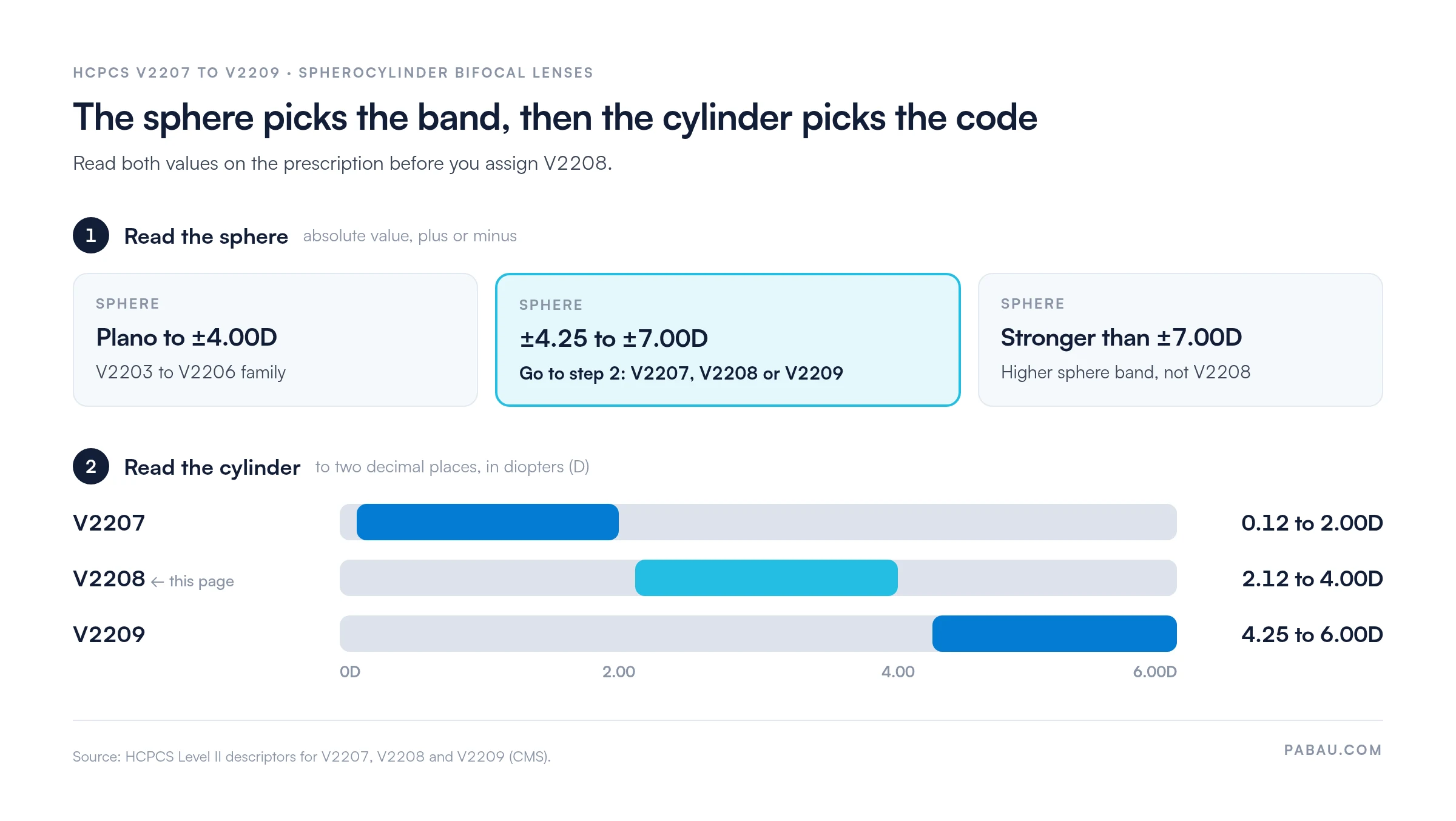
V2208 applies when the sphere is ±4.25 to ±7.00D and the cylinder is 2.12 to 4.00D. V2207 and V2209 share that sphere range, so the cylinder decides the code.
Medicare Part B covers V2208 only as a prosthetic device after cataract surgery, and routine eyeglasses are not covered.
Pabau’s claims management software keeps the prescription, the lens code, the LT and RT modifiers and the claim status in one patient file.
HCPCS Code V2208 is a Level II alphanumeric code for a spherocylinder bifocal spectacle lens, maintained by the Centers for Medicare and Medicaid Services (CMS).
It covers a sphere of ±4.25 to ±7.00 diopters with a cylinder of 2.12 to 4.00 diopters. The code sits in the V2200-V2299 bifocal lens range of the HCPCS Level II codes. That range sorts lenses by sphere power first, then splits each sphere band by cylinder power.
The billing unit is the single lens. One dispensed pair of lenses means two line items on the claim, one for each eye.
The V2200 series codes sort spherocylinder bifocal lenses by two values on the prescription: sphere power and cylinder power. V2208 needs both to fall inside its ranges. Checking only one of them is how most V2208 coding errors start.
V2208 covers a sphere of ±4.25 to ±7.00 diopters combined with a cylinder of 2.12 to 4.00 diopters. The sphere sets the band, and the cylinder picks the code within it. V2207 and V2209 use the same sphere band, so they differ from V2208 only by cylinder power. The diagram below runs the two checks in order.
The bifocal add power (the near-vision addition) does not affect code selection. It still belongs on the prescription, but the sphere and cylinder values decide which code applies.
The “plus or minus” in the descriptor means myopic (minus) and hyperopic (plus) sphere powers are treated alike. A -5.50D sphere and a +5.50D sphere both fall inside the V2208 sphere band. Read the absolute value of each figure against the range.
Prescribers write cylinder in either plus-cylinder or minus-cylinder form. The cylinder magnitude stays the same in both forms, but transposing between them changes the sphere figure. When a sphere sits near the ±4.25D or ±7.00D edge, check which form the prescription and your payer use before you assign the code.
V2207, V2208 and V2209 cover the same lens type and the same ±4.25 to ±7.00D sphere band. Cylinder power is the only value that separates them. A wrong pick here bills a different lens from the one dispensed, which is a compliance risk on audit.
None of these three codes is a plano code. Plano and low sphere powers up to ±4.00D belong to V2203-V2206, which repeat the same cylinder splits at a lower sphere band. A lens with a -3.75D sphere and a 3.00D cylinder is therefore not V2208, even though its cylinder fits.
The costliest mix-ups happen at the cylinder edges. A 2.00D cylinder is still V2207, and a 4.25D cylinder has already moved to V2209. Read the cylinder to two decimal places before you choose between the three codes.
Eligible providers for HCPCS Code V2208 include optometrists, ophthalmologists, and licensed optical dispensers. The dispensing event must be supported by a valid, dated optical prescription from a qualified prescriber. The prescription must originate from the treating provider, not the dispensing optician, for Medicare claims.
Three clinical scenarios justify V2208 billing:
V2208 is never appropriate when the dispenser wrote the optical prescription without a separate qualified prescriber. CMS guidance on the eyeglass prosthetic benefit flags this as a billing compliance risk.
Missing or incomplete documentation is the second-most common V2208 denial reason after code-boundary errors. The coder must confirm each of the following before claim submission:
Keep the optical prescription in the patient file for the payer’s full audit period. Medicare requires seven years for prosthetic device claims.
Audit a sample of V2208 claims each quarter by pulling the optical prescription and checking both the sphere and the cylinder against the billed code. A 4.25D cylinder on a V2208 claim belongs under V2209, and a 2.00D cylinder belongs under V2207. Catching boundary errors internally costs far less than a payer audit.
Medicare Part B covers V2208 lenses only under the prosthetic device benefit for patients who have had cataract surgery with removal of the crystalline lens. Routine vision care, including eyeglasses for refractive error alone, falls outside standard Medicare Part B coverage. The rule sits in Chapter 15, Section 120 of the Medicare Benefit Policy Manual.
Medicaid coverage varies by state. Commercial plan coverage depends on the enrollee’s specific optical benefit. Neither category should be assumed covered without a prior eligibility check. Run that check before the lenses go to the lab.
Because V2208 is billed per lens, modifiers LT (left side) and RT (right side) identify which eye each line item covers. Bilateral dispensing produces two claim lines, one with modifier LT and one with modifier RT. Each line carries a unit count of one. Submitting a single line item with two units instead of two separate lines is a common formatting error that triggers claim rejection.
Verify modifier requirements with your specific Medicare Administrative Contractor (MAC). Some MACs publish Local Coverage Determinations (LCDs) for vision services that may include additional modifier instructions beyond LT/RT.
V2208 denials cluster around four root causes. Each has a clear resolution once the coder knows what the remittance advice is signaling. A denial management routine catches most of these before they reach secondary billing.
For payer-specific denial codes, cross-reference the remittance advice CARC (Claim Adjustment Reason Code) with the applicable MAC’s LCD for vision services. A clean claim check before submission catches the unit-count and missing-prescription errors in the table above.
CMS publishes allowable amounts for HCPCS Level II vision codes through the DMEPOS fee schedule, not the Physician Fee Schedule. DMEPOS stands for Durable Medical Equipment, Prosthetics, Orthotics, and Supplies. V2208, as a spectacle lens code, falls under the DMEPOS schedule when billed to Medicare.
CMS updates the DMEPOS fee schedule every year and releases revised files each quarter. A fixed dollar figure in a reference article goes stale within months. For the current rate, download the latest quarterly file from the CMS DMEPOS fee schedule page. Find V2208 in that file and read the fee listed for your state.
Commercial payer rates for V2208 are individually negotiated by contract and typically run above Medicare allowable amounts. Medicaid rates are state-set and may fall below Medicare.
Neither can be generalized, so verify contracted rates in your payer agreements. Before billing, use the AAPC HCPCS code lookup or the PGM Billing HCPCS tool to check current code status and any active coverage policies.
Set a calendar reminder for each quarterly DMEPOS fee schedule release. Download the updated file, pull the V2200-V2299 rates and compare them to your current fee schedule. Even a small per-lens allowable change adds up quickly across a high-volume optical practice.
Most optical practices check lens codes by hand. A biller reads the prescription, picks between V2207, V2208 and V2209, then keys two lines with LT and RT. Every step depends on someone reading two decimal places correctly under time pressure.
Pabau, the practice management and billing platform we build, keeps the signed prescription, the dispensing record and the claim in the same patient file. The biller can check the sphere and cylinder against the billed code without hunting through paper or a separate lab system. Pabau’s claims management software then tracks each line from submission to payment.
The result is fewer boundary errors reaching the payer and faster fixes when one does. A rejected V2208 line points straight back to the prescription that should have decided the code.

Pabau keeps the signed prescription, the dispensing record and the claim in one patient file. Check sphere and cylinder against the billed code before every submission.

V2208 is a two-value code, and treating it as a one-value code is what gets it denied. A cylinder check alone cannot tell V2208 from its lower-sphere twin in the V2203-V2206 family. A sphere check alone cannot tell it from V2207 or V2209.
Make the prescription the gate. No V2208 line should leave the practice until someone has matched a ±4.25 to ±7.00D sphere and a 2.12 to 4.00D cylinder. That one habit removes the most common denial on this code. It also leaves the remaining work to routine items such as per-lens lines and post-cataract records.
Book a demo to see how Pabau keeps prescriptions and lens claims together, so optical billing errors are caught before submission.

Unsure how optical billing fits into the wider revenue cycle? What is revenue cycle management explains how claims flow from dispensing through payment posting.
HCPCS Code V2208 is the Level II code for a spherocylinder bifocal spectacle lens, billed per lens. It covers a sphere of ±4.25 to ±7.00 diopters with a cylinder of 2.12 to 4.00 diopters. Optometrists, ophthalmologists and optical dispensers use it to report these lenses to Medicare, Medicaid and commercial payers.
V2208 is billed per lens. A pair of bifocal lenses needs two separate claim lines, each with a unit count of one. One line carries modifier LT for the left eye, and the other carries RT for the right eye. Billing a single line with two units is a formatting error that causes rejection.
Yes, but only as a prosthetic device following cataract surgery that removed the natural lens. Medicare Part B does not cover routine eyeglasses or contact lenses for refractive error. The patient’s record must document the prior cataract procedure to support the Medicare claim.
All three codes cover spherocylinder bifocal lenses with a sphere of ±4.25 to ±7.00 diopters. They differ only by cylinder: V2207 covers 0.12 to 2.00D, V2208 covers 2.12 to 4.00D, and V2209 covers 4.25 to 6.00D. None of them is a plano code, since plano and lower spheres belong to V2203-V2206.
You need a valid, dated optical prescription showing sphere (±4.25 to ±7.00D), cylinder (2.12 to 4.00D), axis and bifocal add power. Add the prescriber’s credentials and NPI, the dispensing date and the lab record. Medicare claims also need proof of the prior cataract surgery, such as an operative report.
Modifiers LT (left side) and RT (right side) identify which eye each V2208 line item covers when billing bilaterally. Verify specific modifier requirements with your Medicare Administrative Contractor, as some MACs publish Local Coverage Determinations for vision services with additional instructions.