

CCSD Code D1010: Radical mastoidectomy including meatoplasty
CCSD Code D1010: Definition and clinical scope CCSD Code D1010 is the UK private...

Last Updated: Nov 25, 2026
V2312 is the HCPCS Level II code for one trifocal spherocylinder spectacle lens. It covers a sphere of plus or minus 7.25 to 12.00D with 2.25 to 4.00D of cylinder, billed per lens.
V2311 and V2313 use the same sphere band and differ only in cylinder power, so read the cylinder for each eye before you code. Medicare pays for the lens only after cataract surgery or for aphakia, never for routine glasses.
Let Pabau's smart automation suggest the right codes, reduce claim denials, and keep your practice compliant—effortlessly.
Automate repetitive tasks and focus on what matters most—your patients.
Reduce coding errors and ensure compliance with the latest regulations.
Clean claims, fewer denials, and faster reimbursements.
Powerful insights and reporting to help your practice thrive.
HIPAA compliant SOC 2 certified GDPR-compliant Trusted by 4,000+ clinics worldwide

HCPCS code V2312 bills one trifocal spherocylinder lens with a sphere of ±7.25 to ±12.00D and 2.25 to 4.00D of cylinder, per lens.
V2311, V2312 and V2313 share the same sphere band, so cylinder power alone decides between them. A 2.25D cylinder fits both the V2311 and V2312 descriptors.
Medicare covers the lens only after cataract surgery with an intraocular lens, or for aphakia. Routine eyeglasses are excluded by statute.
Bill each eye on its own claim line with one unit and an RT or LT modifier. A single RTLT line is rejected.
Pabau’s claims management software keeps the prescription, diagnosis and claim on one patient record, so lens powers are never re-keyed.
HCPCS code V2312 is the Healthcare Common Procedure Coding System (HCPCS) Level II code for one trifocal spherocylinder spectacle lens. CMS publishes it in the HCPCS Level II quarterly update files, in the V2300-V2399 trifocal lens group. That group sits inside the V2020-V2799 vision services range.
The official CMS descriptor reads: Spherocylinder, trifocal, plus or minus 7.25 to plus or minus 12.00d sphere, 2.25 to 4.00d cylinder, per lens. A trifocal gives three zones of correction in one lens: distance, intermediate and near. Spherocylinder means the lens also corrects astigmatism, through its cylinder power.
The code describes the lens only. The frame, the dispensing fee and the eye exam are billed separately, under their own codes.
Inside the trifocal group, two numbers from the prescription decide the code: the sphere power and the cylinder power. V2311, V2312 and V2313 share one sphere band of ±7.25 to ±12.00D. Within that band, the cylinder tier alone separates them.
So a cylinder of 0.25 to 2.25D takes V2311, 2.25 to 4.00D takes V2312, and 4.25 to 6.00D takes V2313. A sphere over ±12.00D moves the lens to V2314, whatever its cylinder.
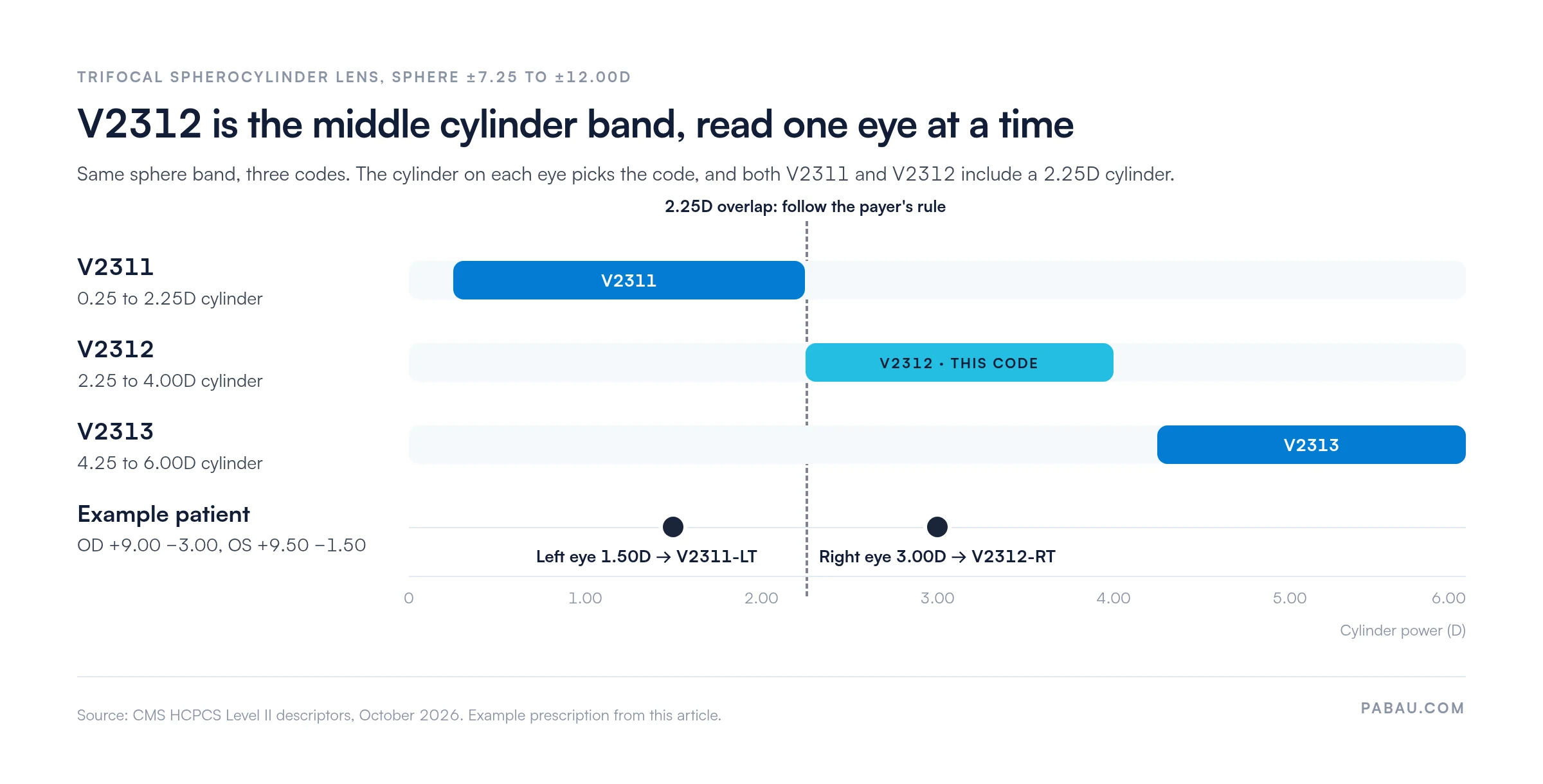
Both boundaries of V2312 need care. The V2311 and V2312 descriptors both include a 2.25D cylinder, so a 2.25D prescription fits either text. Ask the payer which code it expects at that value, then apply its answer on every claim.
The upper boundary is cleaner. V2312 stops at 4.00D and V2313 starts at 4.25D, so cylinder steps of 0.25D never fall between them.
Transposition can also move a lens out of the band. A +8.00 −3.00 × 090 prescription becomes +5.00 +3.00 × 180 in plus-cylinder form. The sphere drops below ±7.25D, so the lens no longer qualifies for V2312. Keep the prescription, the lab order and the claim in one notation.
Knowing what falls outside V2312 prevents the most common selection errors in trifocal dispensing.
Code selection runs one eye at a time, and the cylinder is the deciding value. Work through these steps for each lens on the order.
Take a patient with OD +9.00 −3.00 × 180 and OS +9.50 −1.50 × 170. Both spheres sit in the ±7.25 to ±12.00D band. The right lens has 3.00D of cylinder and takes V2312-RT. The left lens has 1.50D and takes V2311-LT, on a second claim line.
Medicare does not cover routine eyeglasses. Section 1862(a)(7) of the Social Security Act excludes them, so a V2312 lens for a routine prescription change is a non-covered service.
The exception sits in Section 1861(s)(8) of the Social Security Act, which treats post-cataract lenses as prosthetic devices. 42 CFR 410.36 covers one pair of eyeglasses or contact lenses after each cataract surgery with an intraocular lens.
Durable medical equipment Medicare administrative contractors (DME MACs) process these claims. Their Refractive Lenses LCD (L33793), a local coverage determination, also covers lenses for aphakia and congenital aphakia.
Outside traditional Medicare, coverage depends on the plan. Medicare Advantage plans often add a routine eyewear benefit, with their own rules. State Medicaid programs set their own vision benefits, including which adults qualify for eyeglasses.
Commercial vision plans usually cover one pair of lenses per benefit period, often every 12 or 24 months. Medicare Part B does not require prior authorization for refractive lenses. Some Medicare Advantage, Medicaid and commercial plans do, so check the plan before you order the lenses.
The right diagnosis depends on who pays. Medicare covers V2312 only when the natural lens is missing, while vision plans pay on H52 refraction codes such as H52.4.
A Medicare claim that carries only H52 refractive codes is denied, because those codes describe routine vision. Confirm each code is valid for the date of service before you submit.
Medicare DME MACs require RT or LT on V2312. Each lens goes on its own claim line with one unit, and a single RTLT line is rejected as incorrect coding.
KX is not required on V2312. Policy article A52499 limits KX to lens-option codes such as V2744, V2745, V2750, V2780 and V2784. Commercial plans set their own modifier rules, so check each plan.
Payers expect the following records behind every V2312 line. A missing item is the usual reason a post-payment review recoups the claim.
V2312 denials follow a predictable pattern. The table below maps each one to its cause and fix.
A structured denial management process that tracks these by lens code shows recurring errors early. Our guide to denial codes in medical billing explains the adjustment codes on each remittance.
Add a pre-submission rule for trifocal lens claims: when the cylinder is 2.25D, the code must match the payer’s stated rule. When it is 4.25D or above, V2312 should never appear. Two checks at billing entry stop the most common band errors.
Most V2312 errors start before the claim exists. The prescription lives in the exam notes, the lens order goes to the lab, and the biller re-keys the cylinder by hand.
Pabau’s practice management system keeps the prescription, the diagnosis and the dispensing record on one patient file. Its claims management software pulls the patient, treatment and insurer details from that record into a pre-filled submission. Validation checks run each time you send a claim, so missing details surface before the payer sees them.

For US practices, Pabau submits claims through Claim.MD, runs real-time eligibility checks and posts electronic remittance advice (ERA). Fewer re-keyed values mean fewer avoidable denials and more clean claims on the first pass.

Pabau’s claims management software keeps the prescription, diagnosis and claim on one record. Validation checks run before each submission, so missing details surface before the payer sees them.

V2312 is a cylinder code. Once the sphere sits in the ±7.25 to ±12.00D band, the cylinder for each eye decides between V2311, V2312 and V2313. Settle the 2.25D boundary with each payer once, in writing, rather than claim by claim.
For Medicare, the diagnosis decides payment before the lens does, so confirm pseudophakia or aphakia before you bill a DME MAC. Book a demo to see how Pabau keeps prescription, diagnosis and claim details together so trifocal lens claims go out clean.

Need a foundation in medical billing workflows? What is medical billing explains the end-to-end process from service delivery through payment posting.
Want to understand the broader billing compliance picture? Medical billing compliance outlines the key regulatory requirements affecting DMEPOS and other supply billing.
Ordering a bifocal instead? HCPCS code V2212 covers the bifocal lens with the same sphere and cylinder bands as V2312.
Is the sphere under ±4.00D? HCPCS code V2303 explains the lowest-power trifocal spherocylinder band and how to bill it.
HCPCS code V2312 is the Level II code for one trifocal spherocylinder spectacle lens. It covers a sphere of plus or minus 7.25 to 12.00D with 2.25 to 4.00D of cylinder, billed per lens. It sits in the V2300-V2399 trifocal group of the V2020-V2799 vision services range.
All three share the same sphere band of plus or minus 7.25 to 12.00D. Cylinder power separates them: 0.25 to 2.25D is V2311, 2.25 to 4.00D is V2312, and 4.25 to 6.00D is V2313.
Both the V2311 and V2312 descriptors include 2.25D, so either text fits. Ask the payer which code it expects at that value, and apply its answer on every claim.
Only in specific cases. Medicare covers one pair of eyeglasses after each cataract surgery with an intraocular lens, under Social Security Act section 1861(s)(8) and 42 CFR 410.36. The DME MAC LCD L33793 also covers lenses for aphakia. Routine eyeglasses are excluded.
Medicare DME MACs require RT or LT on each lens. GY applies to a routine pair billed only to obtain a denial, and EY to a lens supplied without a valid order. KX is not required on V2312.
Yes. Bill two separate lines on the same claim, one with RT and one with LT, each with one unit. If the other eye falls in a different cylinder tier, that line takes V2311 or V2313 instead.




