HCPCS Code E0272: Foam rubber mattress billing guide
HCPCS Code E0272: official descriptor and code overview HCPCS Code E0272 is the ...

Last Updated: Nov 6, 2026
V2112 is the HCPCS Level II code for a single vision spherocylinder lens, billed per lens. It covers sphere power from ±7.25 to ±12.00 D with cylinder power from 2.25 to 4.00 diopters.
The lens corrects high nearsightedness or farsightedness together with moderate astigmatism. Common V2112 denials come from a cylinder value that belongs to V2111 or V2113. Others come from a lens line sent without its RT or LT modifier.
Let Pabau's smart automation suggest the right codes, reduce claim denials, and keep your practice compliant—effortlessly.
Automate repetitive tasks and focus on what matters most—your patients.
Reduce coding errors and ensure compliance with the latest regulations.
Clean claims, fewer denials, and faster reimbursements.
Powerful insights and reporting to help your practice thrive.
HIPAA compliant SOC 2 certified GDPR-compliant Trusted by 4,000+ clinics worldwide

HCPCS Code V2112 covers one single vision spherocylinder lens with sphere ±7.25 to ±12.00 D and cylinder 2.25 to 4.00 D, billed per lens.
V2111 and V2113 share the same sphere band and differ from V2112 only by cylinder power, so the cylinder value decides the code.
A pair of glasses bills as two V2112 lines at one unit each, one with modifier RT and one with modifier LT.
Medicare Part B excludes routine eyeglasses and pays for V2112 only after cataract surgery with an intraocular lens.
Medicare prices V2112 on the DMEPOS fee schedule through DME MACs, not on the Physician Fee Schedule.
HCPCS Code V2112 is the Level II code for a single vision spherocylinder lens, billed per lens. The official CMS descriptor reads: Spherocylinder, single vision, plus or minus 7.25 to plus or minus 12.00d sphere, 2.25d to 4.00d cylinder, per lens. The lens corrects high nearsightedness or farsightedness together with moderate astigmatism.
Both halves of the descriptor have to match the dispensed lens. A prescription of -9.50 D sphere with -3.00 D cylinder meets both conditions and bills as V2112. The same sphere with -1.50 D cylinder bills as V2111. A -13.00 D sphere moves the lens to V2114, whatever its cylinder.
According to the CMS HCPCS Level II coding system, V-series codes for vision services are updated in the annual HCPCS release. Check the current year’s descriptor file before submitting claims.
V2111 and V2113 are V2112’s closest siblings. All three share the sphere band of ±7.25 to ±12.00 D, and only the cylinder power separates them. V2112 is the middle cylinder tier, and V2114 takes over once the sphere passes ±12.00 diopters.
The cylinder value is where most V2112 coding errors start. Read it from the signed prescription rather than the lab order, then match it to the tier. A cylinder of exactly 2.25 D appears in both the V2111 and V2112 descriptors.
Check the payer’s policy for that value and apply one house rule to every claim. The grid below maps both values to the right code.
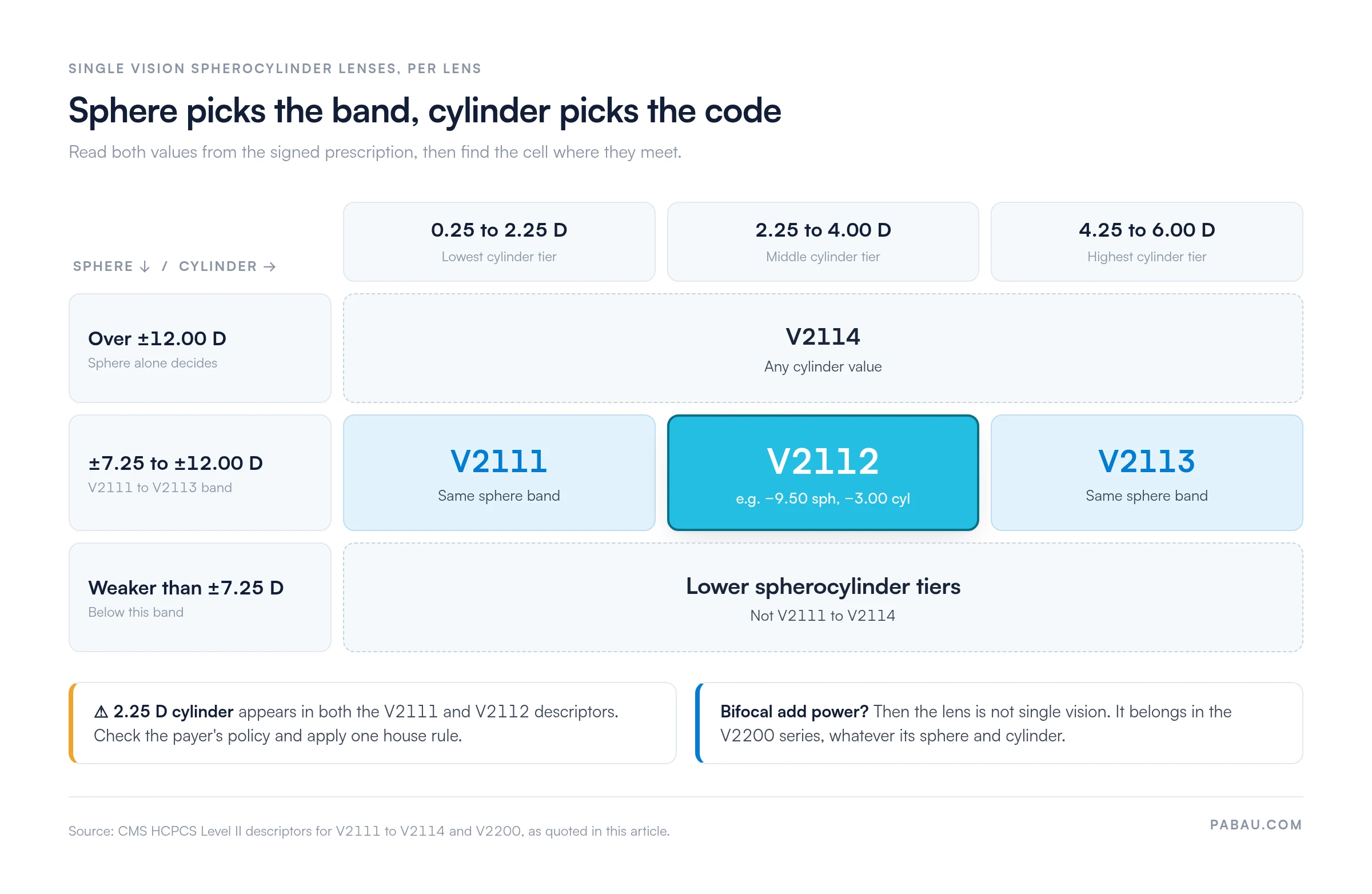
Do not confuse V2112 with V2200, which covers a bifocal sphere lens from plano to ±4.00 diopters. If the prescription carries an add power for a near segment, the lens is a bifocal and belongs in the V2200 series. You can verify current code descriptors using the AAPC Codify HCPCS lookup.
V2112 covers one single vision prescription lens whose sphere and cylinder both fall inside the descriptor’s ranges. The descriptor names no material, so glass, plastic, polycarbonate, and high-index lenses all qualify.
What V2112 does not cover:
Standard Medicare Part B does not cover routine eyeglasses or contact lenses. That rules out most V2112 dispensing, with one exception for patients who have had cataract surgery.
The post-cataract IOL exception: Medicare Part B covers one pair of eyeglasses or contact lenses after each cataract surgery with an intraocular lens (IOL). The coverage rests on 42 CFR 410.36 and the Medicare Benefit Policy Manual. The manual sets it out in Chapter 15, §120 (Prosthetic Devices), subsection B.3, Limitation on Coverage of Conventional Lenses.
A V2112 claim under this exception must link to a diagnosis code documenting post-cataract status. The date of dispensing must also follow the cataract surgery. Without a covered diagnosis code, the claim is denied.
Medicare prices V2112 on the CMS DMEPOS fee schedule, and DME MACs process the claims. That schedule sets the allowable by state, so never apply one flat national rate to reimbursement projections.
After modifier errors, incomplete documentation causes many of the V2112 denials that reach a biller’s desk. Every element below must be present in the patient record before the claim is submitted. Solid medical billing compliance practices start with getting the documentation right before the lens is dispensed.
Audit your dispensing workflow. The date of service on a V2112 claim is the date the lens was dispensed, not the date of the eye exam or refraction. Submitting the exam date instead of the dispensing date is a frequent technical error that triggers claim edits at many MACs. Document the dispensing date in the patient record at the moment of handoff.
Because V2112 is a per-lens code, both lenses in a pair generate separate claim lines. Each line requires a modifier identifying which eye is being billed. A line sent without a side modifier is one of the most common denial triggers for vision HCPCS codes.
A pair of single vision glasses with both lenses in the V2112 range generates two claim lines. Those are V2112 LT (quantity 1) and V2112 RT (quantity 1). When only one eye falls in the V2112 range, bill the other lens under the code its own powers support.
Do not bill V2112 with a quantity of 2 on a single line to represent both lenses. Most payers deny that format, because it breaks the per-lens unit in the descriptor. Modifier rules can vary by MAC, so confirm them against the Local Coverage Article for spectacle lenses in your region.
Correct claim form completion prevents technical denials that have nothing to do with coverage. These are the steps for submitting V2112 on a CMS-1500 or 837P electronic claim. For practices managing medical billing workflows across multiple providers, a consistent claim preparation checklist removes the most common technical errors before submission.
Medical billing software can fill modifiers and diagnosis pointers from the patient record, which cuts manual entry errors on busy dispensing days. For submitting a clean claim on V2112, build the checklist above into the handoff from dispensing to billing.
Most V2112 denials fall into a small number of repeating patterns. Identifying these early, before resubmission windows close, is where effective denial management in healthcare pays off most for optometry practices.
Run a monthly denial report filtered to V2112 claim lines. If missing-modifier denials show up more than twice a month, look at the workflow before you look at the staff. Check whether your billing software fills LT and RT from the dispensing record or needs manual entry. Fixing that handoff stops this denial at the source.
Every V2112 claim requires a supporting ICD-10 code that explains why the lens is medically necessary or documents a covered condition. The diagnosis code decides whether the claim fits the applicable benefit and whether payer edits flag it for review. Each code below has its full descriptor in our ICD-10-CM codes library.
Routine refractive error codes (H52.0, H52.1, H52.22) support commercial vision benefit claims but do not meet Medicare medical necessity criteria for the eyeglass benefit. The post-cataract coverage exception requires Z96.1 on the claim.
Using a refractive error code alone on a Medicare claim for V2112 will result in a non-covered-benefit denial. Cross-reference diagnosis code selection against the PGM Billing HCPCS lookup tool to confirm current payer coverage edits for each code combination.
Most optical dispensaries split V2112 billing across the chart, the lab order, and the claim. The cylinder value that decides the code sits in one system, and the modifier rule sits in a biller’s memory. Each handoff is a chance to pick the wrong tier or drop RT or LT.
Pabau, the practice management and billing platform we build, keeps the prescription, the invoice, and the claim on one patient file. Each claim is raised from the patient’s invoice, so the lens lines arrive pre-filled. Claim validation flags missing or invalid details before Pabau sends the CMS-1500 through Claim.MD.
Eligibility checks run before the visit, which matters when Medicare only pays for post-cataract glasses. If a payer rejects a claim, Pabau shows the reason. Your biller can then fix the tier or modifier and resubmit well inside the filing window.

Pabau raises each claim from the patient’s invoice and validates it before submission. Your team catches missing or invalid details before a V2112 line reaches the payer.

V2112 is safe to bill once two numbers are checked against the descriptor. The sphere has to sit between ±7.25 and ±12.00 D, and the cylinder between 2.25 and 4.00 diopters. Add RT or LT to each line and link a covered diagnosis, and the claim rarely comes back.
The judgment calls sit at the edges: a cylinder of exactly 2.25 D, a Medicare patient without an IOL, and each payer’s prescription window. Settle them as written house rules rather than case by case. To see how Pabau supports revenue cycle management for vision practices, book a demo.

Want to understand how claim denials are managed systematically? Denial codes in medical billing explains how to read and act on common denial reason codes across HCPCS and CPT claims.
Curious how clearinghouse submission affects V-code claim success rates? Medical claims clearinghouse explains how electronic claim routing and payer edits interact with HCPCS codes at submission.
HCPCS Code V2112 covers one single vision spherocylinder lens, billed per lens. The sphere must fall between ±7.25 and ±12.00 diopters and the cylinder between 2.25 and 4.00 diopters. The lens corrects high nearsightedness or farsightedness together with astigmatism.
Cylinder power is the only difference. All three codes cover single vision spherocylinder lenses with sphere of ±7.25 to ±12.00 diopters. V2111 covers cylinder of 0.25 to 2.25 D, V2112 covers 2.25 to 4.00 D, and V2113 covers 4.25 to 6.00 diopters.
No. V2112 is a single vision code, and bifocal lenses bill under the V2200 series. V2200 is the bifocal sphere code for plano to ±4.00 D and is often confused with V2112. If the prescription carries an add power for a near segment, V2112 is the wrong code.
Medicare Part B covers V2112 only after cataract surgery with intraocular lens (IOL) insertion, under the post-cataract spectacle benefit (42 CFR 410.36). Routine eyeglasses without this surgical history are excluded from standard Medicare Part B coverage.
Most payers require modifier RT on the right lens line and modifier LT on a separate left lens line. V2112 is a per-lens code, so each line carries a quantity of 1. Never bill two units on one line to represent a pair. Modifier RA applies when a lost or stolen lens is being replaced.
The most common reasons are a missing RT or LT modifier and a cylinder outside the 2.25 to 4.00 D tier. Others are a Medicare claim without the post-cataract diagnosis Z96.1 and a prescription past the payer’s validity window. Each is correctable on resubmission once the documentation or claim data is fixed.