

HCPCS code E0198: Water pressure pad billing guide
HCPCS code E0198 is a water pad for a standard mattress HCPCS code E0198 is the ...

Last Updated: Oct 13, 2026
H2001 is the HCPCS Level II code for rehabilitation program, per 1/2 day.
Let Pabau's smart automation suggest the right codes, reduce claim denials, and keep your practice compliant—effortlessly.
Automate repetitive tasks and focus on what matters most—your patients.
Reduce coding errors and ensure compliance with the latest regulations.
Clean claims, fewer denials, and faster reimbursements.
Powerful insights and reporting to help your practice thrive.
HIPAA compliant SOC 2 certified GDPR-compliant Trusted by 4,000+ clinics worldwide

HCPCS code H2001 describes a rehabilitation program billed per half day in a non-residential setting.
H2001 is billed in half-day units, so a full program day typically requires two units on the same claim line.
Coverage is primarily through Medicaid; Medicare generally does not cover H2001, and state Medicaid rates vary significantly.
Practice management software like Pabau helps behavioral health practices keep treatment plans, session notes, and billing records organized in one system, so documentation is ready whenever a payer requests it.
Most claim denials for HCPCS code H2001 trace back to one of three things: billing the wrong unit, choosing the wrong place of service, or pairing the code with a diagnosis that the payer doesn’t consider medically necessary. Getting all three right starts with understanding exactly what H2001 covers.
HCPCS code H2001 is a Level II HCPCS code with the official descriptor: Rehabilitation program, per 1/2 day. It sits within the H-series of HCPCS Level II codes, which the Centers for Medicare and Medicaid Services (CMS) designates for mental health and substance use disorder services. The code is active for 2026 with no scheduled termination date.
The “non-residential” qualifier is the critical line between H2001 and residential treatment codes. Services must be delivered in a structured program setting outside an inpatient or residential facility. Intensive outpatient and partial hospitalization programs commonly use this code when billing Medicaid, though payers differ on exactly which program structures qualify.
H2001 applies when a provider delivers structured group or individual rehabilitation services in a non-residential, outpatient setting for a minimum qualifying session length, typically a half day. The behavioral health providers most likely to bill this code include:
The code is appropriate when the program runs a structured curriculum, includes clinical oversight, and sessions meet the payer’s definition of a half-day threshold (usually three to four hours). If the program runs a full day, bill two units of H2001 on the same claim line.
H2001 does not apply to individual psychotherapy sessions billed by the hour, to residential treatment where overnight accommodation is provided, or to case management services covered under separate H-series codes. When in doubt, the state Medicaid provider manual for your jurisdiction is the authoritative source on qualifying program criteria.
Reimbursement for H2001 is set by each state Medicaid agency, not by a single national fee schedule. Rates vary considerably by state, program type, and contract tier. The figures below reflect general industry ranges; verify current rates with your specific state Medicaid agency or managed care organization (MCO) before submitting claims.
Because state Medicaid rates change annually and MCO contracts are renegotiated on varying cycles, building a habit of pulling the current fee schedule before each billing cycle prevents underbilling or surprises during reconciliation. Cross-check code status against CMS’s quarterly HCPCS update file alongside your state Medicaid portal.
Submitting these codes through a claims management tool keeps the inevitable payer queries organized and answerable.
H-series HCPCS codes were designed primarily for Medicaid billing. Traditional Medicare does not typically cover H2001 because Medicare structures its mental health and substance use benefits through CPT codes rather than HCPCS H-series codes. This distinction catches many billers off guard.
For behavioral health programs that serve dual-eligible patients (those covered by both Medicaid and Medicare), the coding strategy depends on which payer is primary. If Medicaid is primary for a given service, H2001 is appropriate.
If Medicare is primary, work with your compliance team to identify the correct CPT equivalent and confirm whether the payer’s coverage policies extend to the service being rendered.
State Medicaid coverage conditions for H2001 commonly include:
Always verify coverage conditions against your state’s Medicaid provider manual. The HIPAA compliance framework also applies to how patient diagnosis information is transmitted on claims, regardless of payer.
Accurate HCPCS code H2001 claims require the right combination of place of service, diagnosis, unit count, and documentation. Follow these steps to build a clean claim.
Clean documentation is what separates a paid claim from a recoupment demand. For H2001, maintain the following records for each billing period:
Payers differ on retention periods, but maintaining records for a minimum of six years is consistent with federal Medicaid audit standards. Using digital documentation workflows reduces the risk of missing entries and supports faster retrieval during an audit.
Starting each case with a structured biopsychosocial assessment also gives programs a consistent record of the history and diagnosis that supports medical necessity.
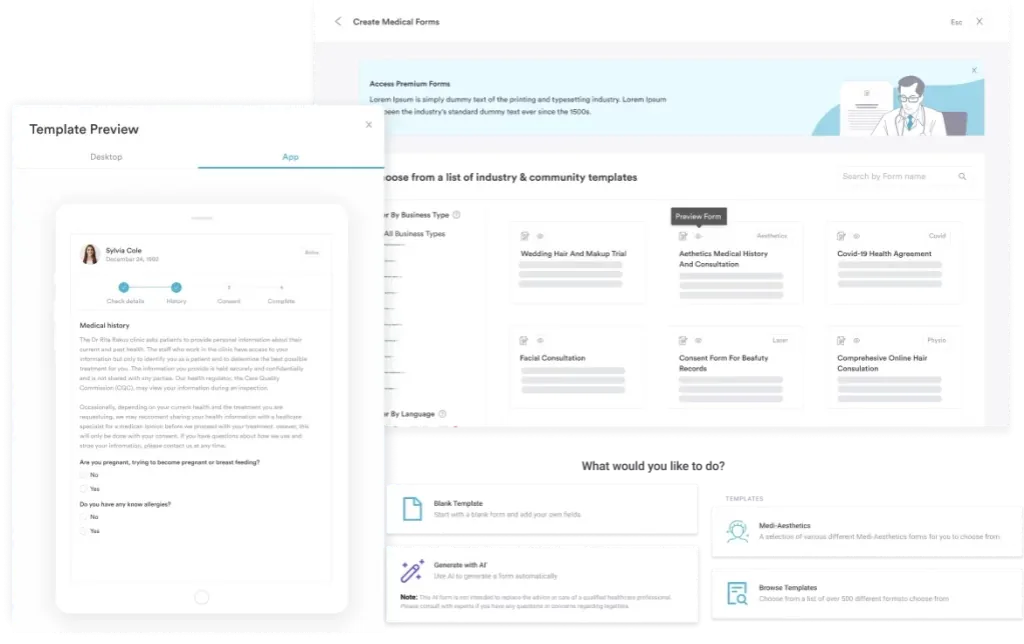

Pabau helps behavioral health practices store session documentation, attach it to patient records, and keep billing information organized as claim volume grows.

Modifiers refine the claim by describing the delivery context, provider qualifications, or funding source. Your state Medicaid plan specifies which modifiers are required; not all payers require all modifiers listed here. Using an inapplicable modifier can cause a denial just as easily as omitting a required one.
When stacking modifiers, place the most clinically significant modifier first. Some state Medicaid systems accept only two modifiers per claim line; exceeding that limit causes a technical denial. Verify your payer’s modifier stacking rules before submitting.
H2001 belongs to a cluster of H-series codes covering structured behavioral health programs. Understanding where H2001 sits relative to its neighbors helps avoid upcoding and undercoding. The AAPC HCPCS lookup tool provides full descriptor comparisons across the H-series.
The most common mix-up is between H2001 and H2012. Both cover behavioral health day treatment, but H2012 bills in hourly units while H2001 bills in half-day units. Choosing the wrong one results in either underbilling or a payer-level denial for the wrong billing increment. Check your state Medicaid plan for which code is accepted for your specific program type.
Claim denials for H2001 follow predictable patterns. Behavioral health billing teams that track their denial codes surface the same errors repeatedly, and nearly all are preventable at submission time.
Run a pre-submission audit on H2001 claims: confirm unit count against the attendance log, verify prior auth numbers are attached, and check that each ICD-10-CM code on the claim falls within your payer’s approved diagnosis list. Catching these before transmission saves the cost of resubmission and appeal cycles.
Manual H2001 billing is error-prone by design. Half-day unit counting, modifier stacking, and prior authorization tracking across a full caseload of behavioral health patients creates significant administrative load.
Practice management platforms built for behavioral health settings support H2001 billing in several ways:
Pabau supports this from the documentation side. Treatment plans, session notes, and provider credentials stay attached to each patient record and sync with your billing system, so nothing has to be tracked down separately when a payer asks for it.
For practices running high-volume H2001 programs, having that documentation centralized cuts down the time staff spend assembling records for billing or an audit. See how the platform organizes documentation and billing workflows by booking a demo.

Coding an unclear personality disorder? Adult personality disorder code explains when F69 keeps a claim moving if a more precise classification is not supported.
Coding a profound intellectual disability? Profound intellectual disability code explains when F73 applies for an IQ below 20 to 25 with documented deficits.
Coding intellectual disability without severity data? Unspecified intellectual disability code explains when F79 applies if severity cannot be determined from the assessment.
HCPCS code H2001 is straightforward in concept but demanding in execution. The per-half-day unit structure, state-by-state Medicaid variation, and documentation requirements create multiple points where a clean claim can go wrong. Getting it right consistently requires accurate unit counting, correct place of service, active prior authorization, and documentation that stands up to post-payment review. A payer audit samples claims and extrapolates, so one repeated error becomes a large repayment.
For behavioral health practices running high-volume rehabilitation programs, Pabau keeps treatment plans, session notes, and billing records in one system, so documentation is easy to retrieve whenever a payer asks for it. See how the platform organizes documentation and billing workflows by booking a demo.
HCPCS code H2001 is a Level II HCPCS code with the descriptor “Rehabilitation program, per 1/2 day.” It is used by behavioral health and substance use disorder providers to bill Medicaid for structured, non-residential rehabilitation program services delivered in half-day increments.
H2001 is primarily a Medicaid code. Traditional Medicare generally does not cover H-series HCPCS codes, and coverage conditions vary by state Medicaid plan.
One unit equals one half-day session, so a full program day requires two units. Unit counts must match the attendance log exactly to avoid audit triggers.
Common modifiers include HQ (group setting), HN (bachelor’s-level clinician), HO (master’s level), and HP (doctoral level). State Medicaid plans may also require U-series modifiers; verify requirements with your state’s provider manual.
H2001 bills per half day for a full rehabilitation program; H2014 bills per 15-minute unit for discrete skills training sessions. Using H2001 for a 15-minute skills session constitutes upcoding.
It depends on the state. Some Medicaid plans accept H2001 for non-residential PHPs; others require separate codes. Check your state’s Medicaid provider manual to confirm.



