

HCPCS Code E0272: Foam rubber mattress billing guide
HCPCS Code E0272: official descriptor and code overview HCPCS Code E0272 is the ...

Last Updated: Nov 6, 2026
33206 is the CPT code for insertion of new or replacement of permanent pacemaker with transvenous electrode(s); atrial.
Coders routinely confuse it with 33207 (ventricular lead) and 33208 (dual-chamber), and that confusion is a frequent source of denials on pacemaker claims. The operative note must explicitly confirm atrial lead placement, atrial chamber only, and a single-lead generator for the code to survive audit.
Let Pabau's smart automation suggest the right codes, reduce claim denials, and keep your practice compliant—effortlessly.
Automate repetitive tasks and focus on what matters most—your patients.
Reduce coding errors and ensure compliance with the latest regulations.
Clean claims, fewer denials, and faster reimbursements.
Powerful insights and reporting to help your practice thrive.
HIPAA compliant SOC 2 certified GDPR-compliant Trusted by 4,000+ clinics worldwide

CPT code 33206 reports a new or fully replaced permanent pacemaker system with one transvenous lead in the right atrium.
A generator-only replacement on a single-lead system is 33227, and lead-only work falls under 33215-33218.
No modifier is mandatory on a Medicare 33206 claim, though 24, 57, 59, 79 and AS apply in specific situations.
A diagnosis missing from your MAC’s pacemaker LCD is a common cause of medical-necessity denials for 33206.
Pabau, the practice management platform we build, pre-fills 33206 claims from the patient record and checks required claim fields before submission.
CPT code 33206 is the code you report when a surgeon implants a permanent pacemaker with one transvenous lead in the right atrium.
The AMA descriptor reads “Insertion of new or replacement of permanent pacemaker with transvenous electrode(s); atrial.” It covers a brand-new system or a replacement of the whole system, generator and lead together.
The lead’s position is the fact that matters most. Move that single lead to the ventricle and the code becomes 33207. A wrong pick means a denial, an appeal and weeks of delayed payment.
The sections below walk through the neighboring codes, the operative note, the modifiers and the denials that trip these claims up.
The AMA lists 33206 with 33207 and 33208 under pacemaker and implantable defibrillator procedures, in the cardiovascular surgery section. Each neighbor covers a different slice of device work. So check the scope of the work before you check the lead.
The table below sorts each kind of pacemaker work by what the operative note describes.
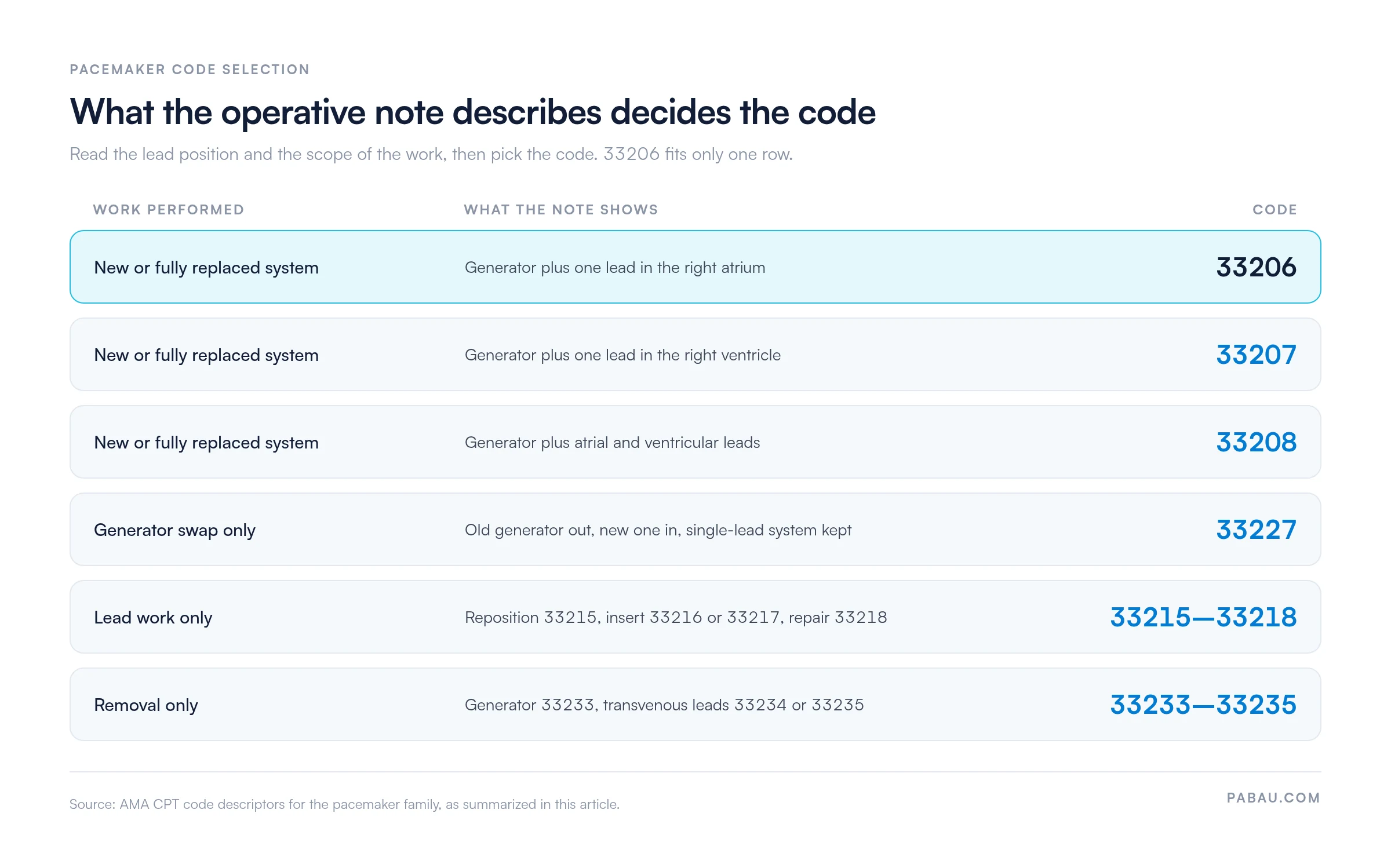
Watch for the add-a-lead case. If the surgeon only added an atrial lead to an existing system, report 33216 and leave 33206 off the claim.
Several parts of the implant are bundled into 33206. None of them goes on the claim as a separate line.
71090 used to report radiological supervision and interpretation for pacemaker insertion. CMS and the AMA deleted it on January 1, 2012, when fluoroscopic guidance moved into 33206-33208. A claim that still carries it rejects as an invalid code, so purge it from older charge sheets.
A chest X-ray taken after the implant is a different service. It goes on the claim as 71045 or 71046, depending on the number of views.
These three codes split on lead position, and that’s where many pacemaker coding errors start. All three describe a permanent system, either single- or dual-chamber.
Treat the operative note as the arbiter. Here is how a coder reads three typical notes:
When both leads go in during the same session, 33208 replaces 33206 entirely. Picking 33207 when the note documents an atrial lead is a common error. It usually happens when a coder defaults to the more familiar ventricular code.
Before a coder assigns 33206, the operative note should answer four questions.
A note that says only “permanent pacemaker implanted” gives a reviewer nothing to match against the code. Build a dictation template that prompts the surgeon for all four points before signing.
Build a pacemaker procedure checklist into your pre-operative workflow. Confirm the intended lead chamber before the patient enters the OR. A mismatched operative note and claim code is far harder to correct after the fact than a 60-second pre-case verification.
Each Medicare Administrative Contractor (MAC) publishes a Local Coverage Determination (LCD) listing the diagnoses that support pacemaker implantation. Pairing 33206 with a diagnosis the LCD doesn’t list is a common cause of medical-necessity denials.
Coverage rules vary by MAC jurisdiction, so check yours before billing. The CMS Medicare Coverage Database lists every active LCD along with its billing and coding article.
Medicare pays 33206 under the Physician Fee Schedule (PFS), which CMS updates every year. The figures below are the 2026 national values. Use the CMS Physician Fee Schedule lookup tool to find your locality-adjusted payment.
During those 90 days, routine post-op visits are part of the 33206 payment. An unrelated E/M visit needs modifier 24, and an unrelated procedure needs modifier 79. In both cases, the note has to show the service had nothing to do with pacemaker recovery.
Traditional Medicare fee-for-service doesn’t require prior authorization for pacemaker implantation. The procedure still has to meet your MAC’s LCD criteria before Medicare pays.
Medicare Advantage and commercial plans often do require it. Many also ask for specific diagnostic records before they approve the implant:
Check the plan’s prior authorization list at scheduling. If a plan requires approval and the implant goes ahead without it, the claim may be denied and the contract’s patient-liability rules apply. A Claim.MD clearinghouse eligibility check confirms active coverage before the patient reaches the operating room.
No modifier is mandatory on a Medicare claim for 33206. KX doesn’t apply here, because it attests coverage criteria for specific DME and therapy codes. The modifiers below come into play only in particular situations.
Use 59 sparingly, since payers audit it closely. Where one fits better, the X modifiers (XE, XS, XP, XU) describe the distinct service more precisely.
Most 33206 denials trace back to a short list of causes. Prevention starts with documentation, well before the remittance arrives. That is why a denial management process belongs at the front of the workflow.
When a denial does land, the remittance tells you why. Our guide to denial codes in billing decodes the CARC and RARC codes on your ERA.
Run a quarterly audit of your 33206 claims using your clearinghouse’s ERA data. Filter for CARC 29 (timely filing expired), 96 (non-covered charge), 50 (not medically necessary) and 97 (bundled). Each denial type maps to a specific prevention step in your workflow.
The National Correct Coding Initiative (NCCI), maintained by CMS, sets the code pairs that bundle with 33206. CMS updates the edit tables every quarter. Check the current CMS NCCI edits before billing any new code combination.
The upgrade case catches people out. If the electrophysiologist converts a pacemaker to a defibrillator in one session, 33249 reports the new device. Removal of the old pacemaker generator goes on the claim as 33233.
Work through these points before the claim leaves your system. Each one maps to a denial cause covered above.
Many pacemaker claims are still keyed by hand from the operative note. That’s where a wrong code or a missing authorization number slips through.
Pabau’s claims management software pre-fills the claim from the patient record. The procedure code and diagnoses land on the form, and built-in ICD-10-CM and CPT/HCPCS libraries let coders look up a code without leaving the claim.
Before you send, Pabau checks that required claim fields, such as member ID and authorization number, are complete. On the US route through Claim.MD, the clearinghouse submits the claim electronically, checks eligibility, posts ERAs and tracks claim status.
The code libraries are lookup tools, so choosing 33206 over 33207 stays with your coder. What changes is the rework. Your team stops retyping data and chasing status calls, and spends that time on the coding decisions this page covers.

Pabau pre-fills 33206 claims from the patient record, checks required claim fields, and tracks each claim through to payment. Your team spends less time on rework.

33206 rewards precision. One atrial lead on a new or fully replaced system is the whole test, and the operative note has to say so in plain words.
Settle the code before anyone builds the claim. Confirm the lead position, rule out a generator-only swap, and match the diagnosis to your MAC’s LCD. Do that every time, and prior authorization and timely filing become routine checks.
The trade-off is a little more discipline at dictation in exchange for far fewer appeals later. Book a demo to see how Pabau helps cardiology practices send pacemaker claims out complete and on time.

Need to understand denial codes on your ERA? Denial codes in medical billing explains the CARC and RARC codes on a rejected 33206 claim, so your team can act on remittance data faster.
Submitting claims electronically through a clearinghouse? How Claim.MD clearinghouse works covers the 837P claim format, real-time eligibility, and ERA delivery that support pacemaker procedure billing.
Want to verify eligibility before the procedure date? Insurance eligibility verification explains how to confirm coverage status for cardiac procedures before the patient reaches the OR.
Concerned about clean claim submission? What makes a clean claim outlines the diagnosis and documentation requirements that prevent first-pass denials on surgical procedures like 33206.
Planning the follow-up device check? CPT code 93288 covers the in-person pacemaker interrogation that typically follows a 33206 implant.
No. 33206 covers a new system or replacement of the whole system, generator plus lead. A generator swap on an existing single-lead system is 33227, with 33228 and 33229 for dual- and multiple-lead systems.
A transcatheter right ventricular leadless pacemaker is reported with 33274, not 33206. That code covers insertion or replacement and includes imaging guidance. Removal of a leadless device is 33275.
Temporary transvenous pacing uses 33210 for a single-chamber catheter and 33211 for a dual-chamber one. 33206 is for permanent systems only.
None. 33206 has no mandatory Medicare modifier, and KX does not apply. Situational modifiers are 24, 57, 59, 79 and AS, used only when the documentation supports them.
No. 71090 was deleted on January 1, 2012, and fluoroscopic guidance is now included in 33206. A claim carrying 71090 rejects as an invalid code. A separate chest X-ray uses 71045 or 71046.




